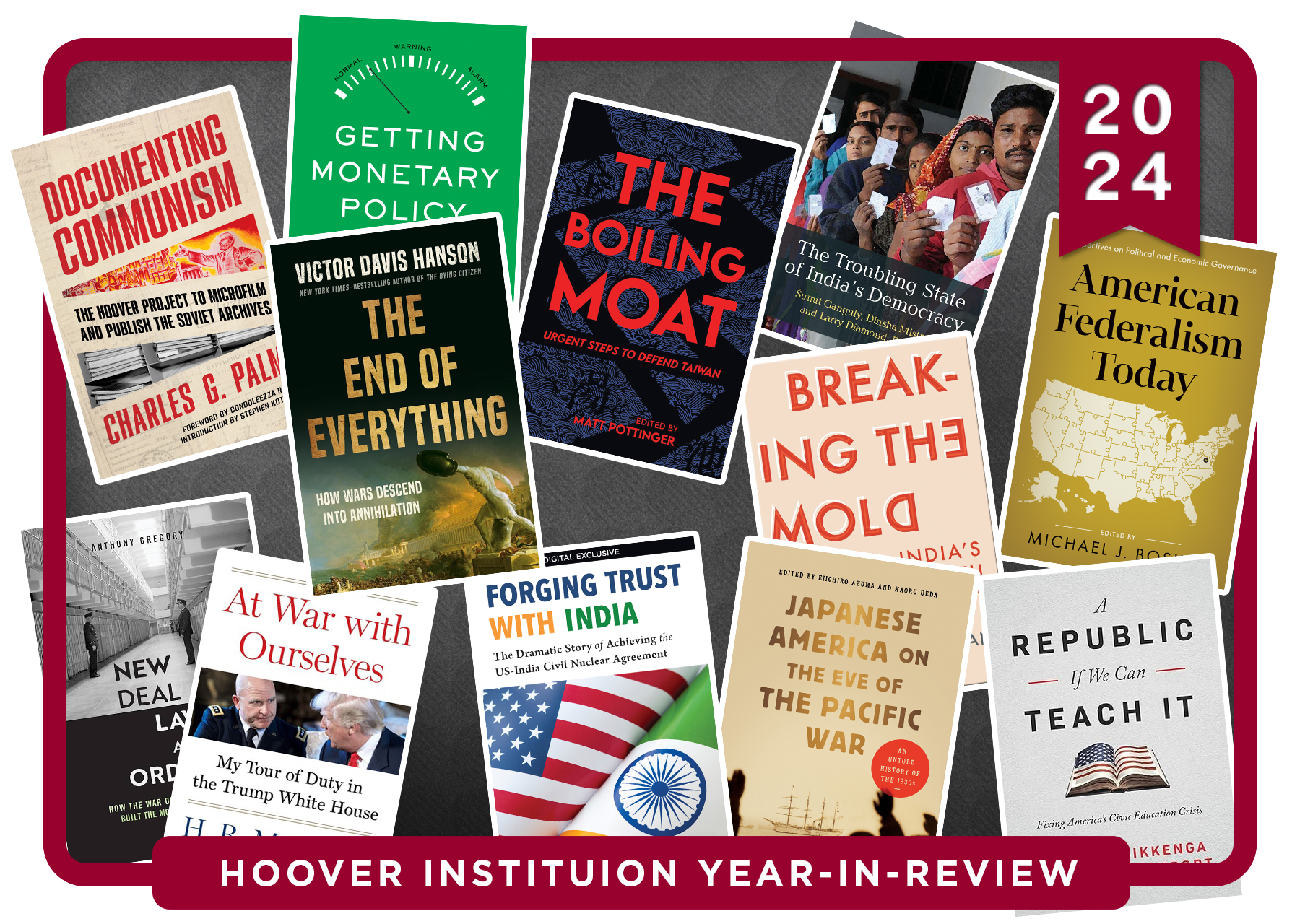
Hoover Institution (December 22, 2024): The depth of Hoover’s scholarship is reflected in the numerous books published by our fellows on a broad variety of topics and issues.
Edited by Matt Pottinger (Hoover Institution Press) Publication Date: July 1, 2024
Chinese leader Xi Jinping has openly expressed his intention to annex Taiwan to mainland China, even threatening the use of force. An invasion or blockade of Taiwan by Chinese forces would be catastrophic, with severe consequences for democracies worldwide. In The Boiling Moat, Matt Pottinger and a team of scholars and distinguished military and political leaders urgently outline practical steps for deterrence.
the full proceedings from this conference—the presentations, responses, and discussions. In it, participants debate the meaning of getting monetary policy “back on track,” the significance of recent bank failures, and how to improve forecasting and oversight.
In The End of Everything, military historian Victor Davis Hanson narrates a series of sieges and sackings that span centuries, from the age of antiquity to the conquest of the New World, to show how societies descend into barbarism and obliteration. In the stories of Thebes, Carthage, Constantinople, and Tenochtitlan, he depicts war’s drama, violence, and folly. Highlighting the naivete that plagued the vanquished and the wrath that justified mass slaughter, Hanson delivers a sobering call to contemporary readers to heed the lessons of obliteration lest we blunder into catastrophe once again.
By H.R. McMaster (HarperCollins Publishers) Publication Date: August 27, 2024
At War with Ourselves is the story of helping a disruptive president drive necessary shifts in US foreign policy at a critical moment in history. H.R. McMaster entered an administration beset by conflict and the hyperpartisanship of American politics. With the candor of a soldier and the perspective of a historian, McMaster rises above the fray to lay bare the good, the bad, and the ugly of Trump’s presidency and give readers insight into what a second Trump term might look like.
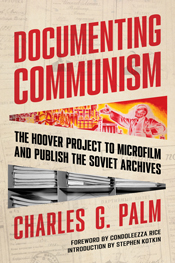
By Charles G. Palm (Hoover Institution Press) Foreword by Condoleezza Rice, Introduction by Stephen Kotkin Publication Date: June 1, 2024
In late 1991, the Soviet Union was officially dissolved. Over the next 12 years, the Hoover Institution microfilmed and published the newly opened records of the Soviet Communist Party and the Soviet State. Charles Palm, who led this mission, details how he and his colleagues secured a historic agreement with the Russian Federation, then launched and successfully carried out the joint project with the Russian State Archives and their partner, Chadwyck-Healey Ltd.
MONOCLE RADIO (December 22, 2024): Andrew Tuck, Sophie Grove and Emma Nelson join Monocle’s editorial director, Tyler Brûlé, for a festive edition filled with holiday spirit. It also features festive updates from Petri Burtsoff in Helsinki and Rob Bound in London.
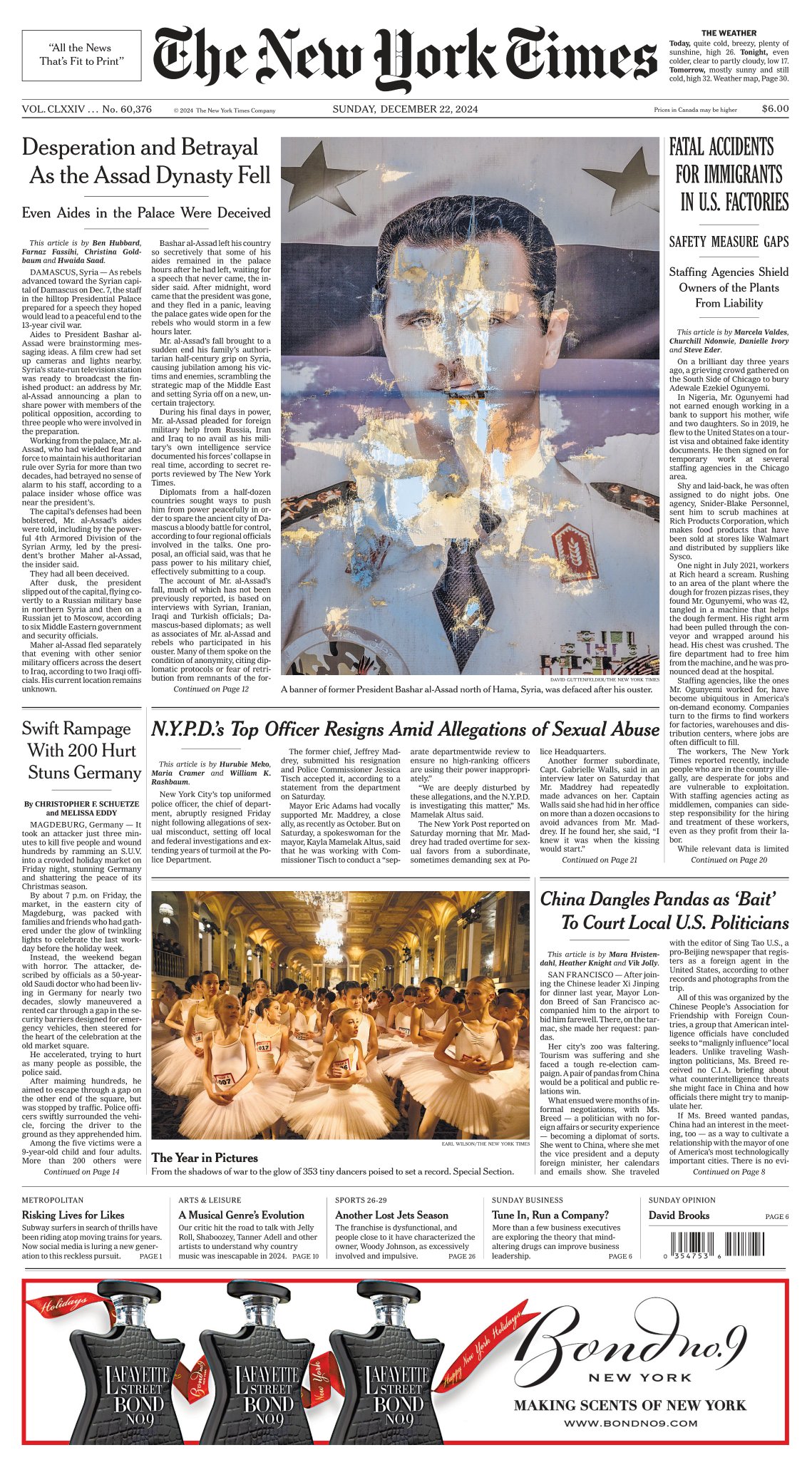
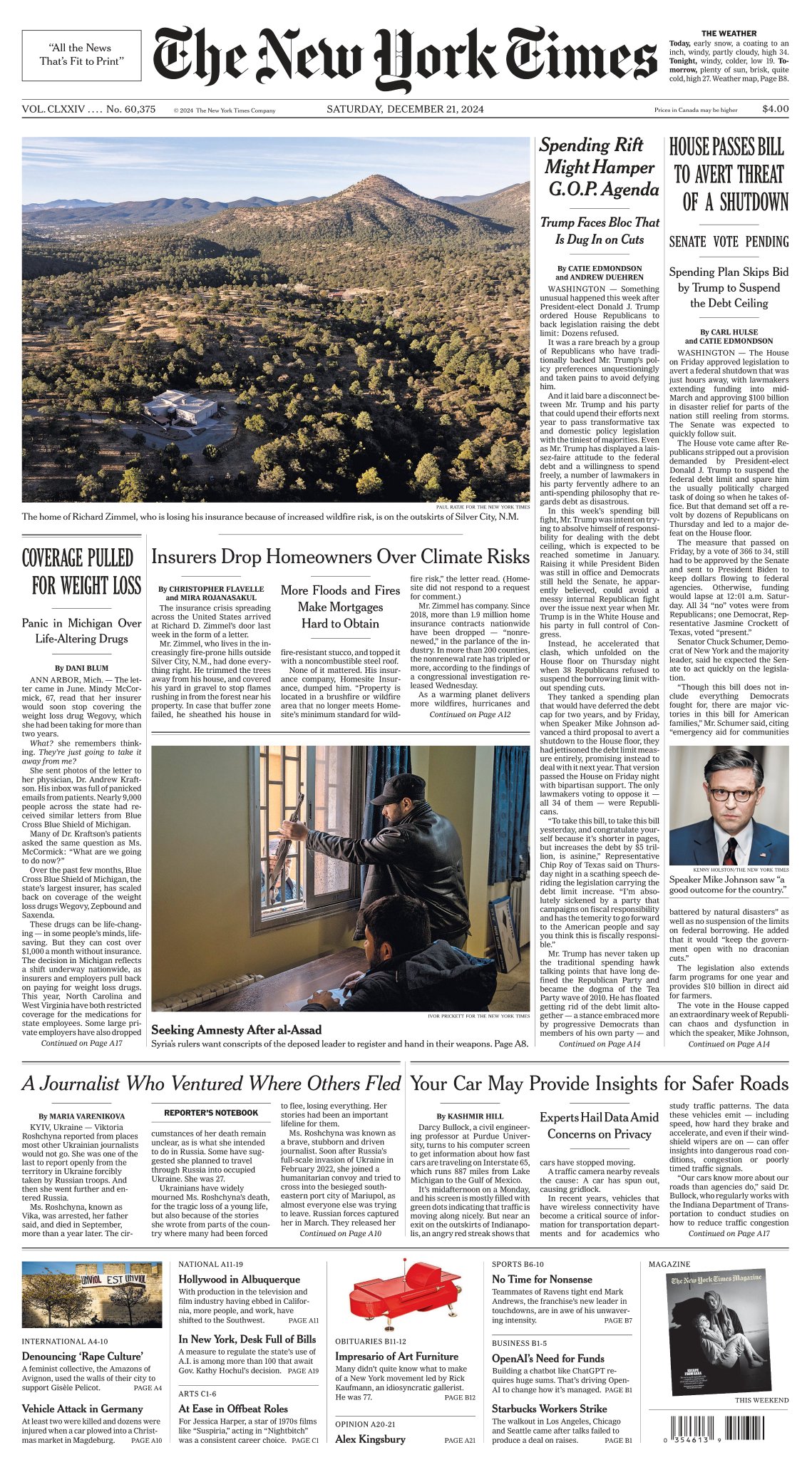
President Bashar al-Assad, who wielded fear and force over Syria for more than two decades, fled the country under the cover of night — and a fake political address.
The administration may extend protections for hundreds of thousands of immigrants whose legal status is set to expire near the start of the Trump administration.
At least five people, including a 9-year-old child, were killed in the attack, which took place in the eastern city of Magdeburg. The authorities are still seeking a motive.
Death on the Night Shift at Frozen Pizza Factories in Chicago
Undocumented workers help feed America’s hunger for prepared foods, but some take jobs with staffing agencies that expose them to hazardous conditions.
In Michigan, the state’s largest insurer has tightened restrictions around medications like Wegovy. Patients are panicking.
Al-Assad’s Soldiers Hope for Amnesty. First, They Have to Take a Number.
Syria’s new rulers say they will spare conscripts of Bashar al-Assad and pursue those who oversaw his regime’s abuses. Hundreds are lining up to learn which promise applies to them.
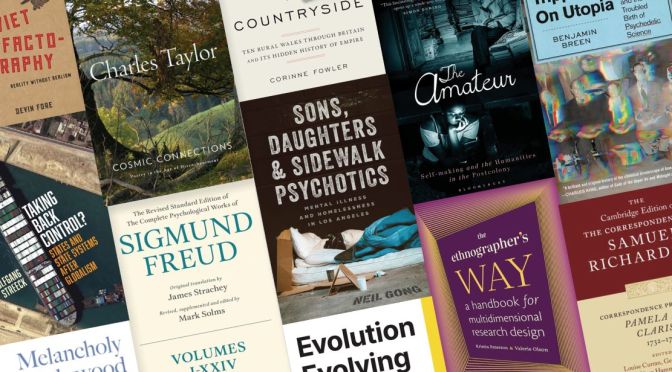
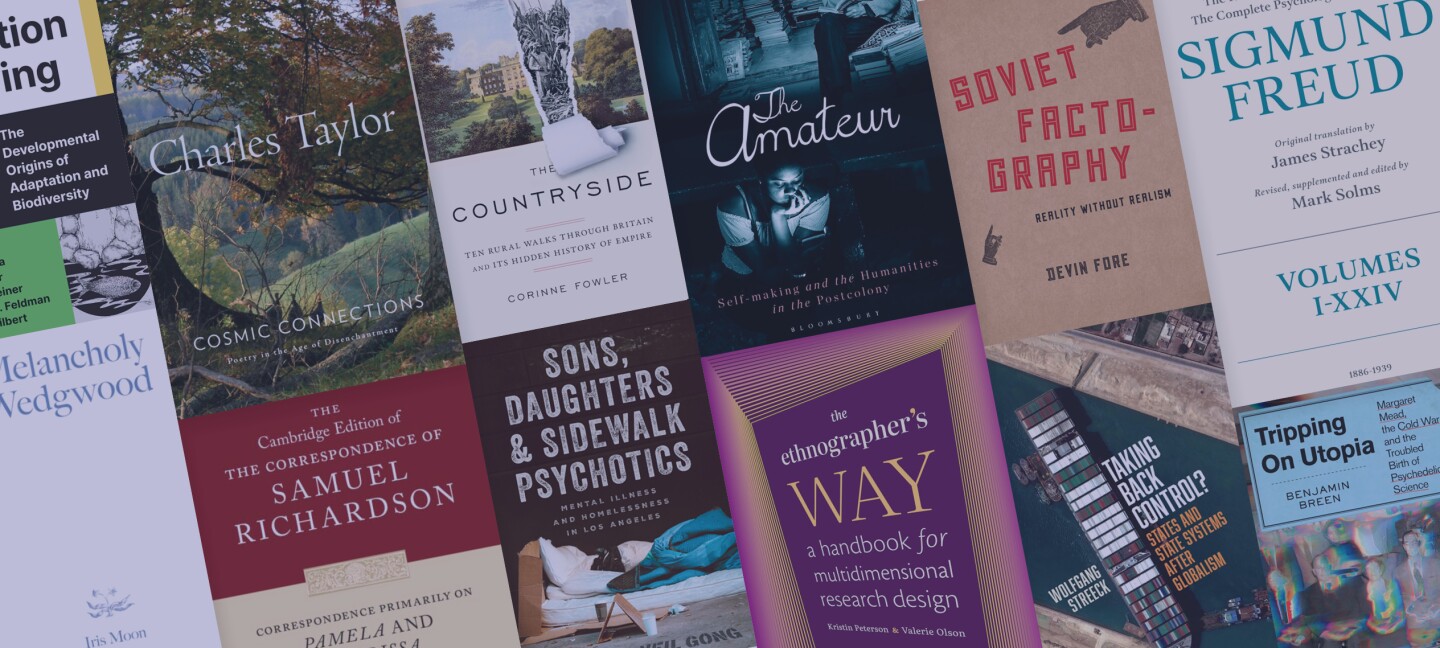
Charles Taylor’s revelatory Cosmic Connections: Poetry in the Age of Disenchantment (Harvard University Press, 2024) draws together different strands from Taylor’s storied philosophical career to present a new account of Romantic poetry. “Philosophy moves us because it convinces us; poetry convinces us because it moves us.” Taylor asks what it would mean to take seriously poetry’s ambition to reveal new dimensions of the world through the resources of image and symbol. Readers of Friedrich Hölderlin or William Wordsworth are familiar with the feeling that a poem is true or right in some deep sense, without being able to defend or even describe that rightness in philosophical terms. Consider the climax of Wordsworth’s “Lines Composed a Few Miles Above Tintern Abbey,” which serves as Taylor’s central example. The poet discerns
A motion and a spirit, that impels All thinking things, all objects of thought, And rolls through all things.
A New Theory of Evolution
By Jessica Riskin
Evolution Evolving: The Developmental Origins of Adaptation and Biodiversity (Princeton University Press, 2024) makes for an exhilarating reading. It is not just a book but an intellectual revolution. The authors show that the experiences and behaviors of living beings shape the course of evolution. You might find it strange that this would be a revolutionary idea. You might wonder how it could possibly be otherwise: How could the experiences and behaviors of living beings have no bearing whatsoever on the course of evolution?
Adventures With Books
By Priya Satia
Debate about the role of Western education in Britain’s colonies and former colonies (including the United States) is as old as the British empire itself. Those ever-evolving debates have, in turn, been studied for decades by historians, literary scholars, sociologists, and other scholars trained in the Western system that has become a global inheritance. Saikat Majumdar’s The Amateur: Self-Making and the Humanities in the Postcolony (Bloomsbury Academic, 2024) opens up a startlingly fresh perspective on these debates, attending to the unexpected and agonistic ways in which this education system shaped particular individuals whose work has had profound impact around the world.
Psychedelic Rabbit Holes
By Susan Stryker
I came for the acid, and stayed for the deep roots of gender theory that I found in Benjamin Breen’s Tripping on Utopia: Margaret Mead, the Cold War, and the Troubled Birth of Psychedelic Science (Grand Central Publishing, 2024). Admittedly, gender is not the main focus of Breen’s book. But in using the personal, professional, and intellectual partnership of Margaret Mead and Gregory Bateson to structure the narrative of this work of breathtaking originality, Breen reveals the kernel of a far-flung constellation of ideas and contexts that has rewired my brain’s understanding of the gender concept’s origins.
What does political revolution require of writers, artists, photographers, and filmmakers? How do they transform their ways of making in order to keep pace with such upheaval? In Soviet Factography: Reality Without Realism (University of Chicago Press, 2024), Devin Fore uncovers an entire archive of radical responses to these questions in the wake of the Russian Revolution of 1917, revealing a fascinating array of original strategies to record a world turned upside down. We follow all manner of “factographic” authors and artists (writer Sergei Tret’iakov and filmmaker Dziga Vertov are only the best known) as they scramble to register the revolution as immediately as possible. Their aim is not to arrest this transformation but, on the contrary, to dynamize it anew, to carry it forward into all areas of life, private and public, subjective and social. This riveting study of “reality in revolution” pressures our understanding of both terms; it also shows us how a reordering of any society involves a refashioning of its individuals.
Corinne Fowler’s enjoyable and thought-provoking The Countryside: Ten Rural Walks Through Britain and Its Hidden History of Empire (Scribner, 2024) achieves many things with an admirably light touch. Combining her lifelong passion for walking with her pathbreaking work linking England’s buildings and landscapes to the nation’s imperial past, she explores the many ways in which rural Britain was indelibly shaped by its overseas endeavors. She highlights how money, people, and rural industries closely connected the Cotswolds to Calcutta, the Scottish Highlands to Jamaica, Cornwall to West Africa and the Americas, and so on.
Ego, Redux
By Jonathan Lear
It surprised me to discover that The Revised Standard Edition of the Complete Psychological Works of Sigmund Freud (Rowman & Littlefield, 2024) is distinguished by its fidelity to two authors, not just one. Over 30 years in the making — though time was wasted with in-fighting among psychoanalysts — The Revised Standard Edition (RSE) aims to reanimate the distinctive translation into English of James Strachey. This is striking because so many of Strachey’s choices — for example, translating Ich as “Ego,” or Besetzung as “cathexis” — have been the subject of intense criticism. Why, the criticism goes, translate the wonderfully colloquial German that Freud used into a Latinized, “scientific” English? And why not use the occasion of a revised edition to make corrections?
Neil Gong’s Sons, Daughters, and Sidewalk Psychotics: Mental Illness and Homelessness in Los Angeles (University of Chicago Press, 2024) does what the best ethnographies do: provide the reader with an empathetic understanding of its subject. Gong’s comparative work provides a portrait of “sidewalk psychotics” in Los Angeles and compares their experiences to the children of elite families who have similar mental-health struggles.
For those on the street, the aim of most social programs begins with getting them housed. Gong follows people from homelessness into apartments and finds that our social programs of “tolerant containment” do little to tackle mental-health challenges. Policies and programs that focus on housing first are meant to provide a wider range of services, and through detailed observations Gong shows that this rarely happens. The mantra seems to be: get housed, and hopefully the rest will take care of itself. Once housed, people are quite free from intervention or monitoring, including free from programs that might help them address their mental health.
In 1660, the first national post was established in England. By the Victorian age, there were 12 mail deliveries a day in London; friends could dash off a letter in the morning and expect to continue an exchange until late at night. Today, the personal letter in its physical form is largely extinct. But in the era of WhatsApp chats and exchanges on X, its legacy has never been more obvious. Far more than the novel, confession, or diary, the letter is the literary genre at the origins of the modern self: social rather than solitary, reactive rather than reflective, on the cusp of public and private life.
Wolfgang Streeck’s Taking Back Control?: States and State Systems After Globalism (Verso, 2024) may not make for particularly cheerful reading for the holidays. But it is essential for any scholar seeking to make sense of a range of current trends: the ongoing retreat from 1990s-style globalization, the crisis of liberal democracy, and the rapid return of hot wars, cold wars, and trade wars to a world that just yesterday claimed to have overcome them all. It was written before Donald Trump was re-elected as president of the United States, but it helps make sense not only of the recent U.S. election but the broad trend of elections over the last decade and a half, from roughly the start of the financial crisis of 2007-8 down to the present, and not only in the United States but around the world.
It is a bold move to write a biography in 2024 of an artist like Josiah Wedgwood, a British man of the 18th century. Iris Moon knows as much. She describes her book Melancholy Wedgwood (The MIT Press, 2024) as an “experimental biography,” by which she implies something more than defiance of the genre’s conventions. Wedgwood is most familiar today as the name attached to your grandmother’s prized vase. To a narrower audience, he is known as the ceramics entrepreneur whose successful factory embodies the emergence of modern capitalism in England. Neither of those stories is at the heart of Melancholy Wedgwood.
The circumstances that you bring to read — that bring you to read — shape how you receive a text. It just so happens that I was reviewing a stack of grant applications and planning an ethnographic writing course for next term when I stumbled upon The Ethnographer’s Way: A Handbook for Multidimensional Research Design (Duke University Press, 2024), by the anthropologists Kristin Peterson and Valerie Olson. This research-design manual, whose title is a play on Julia Cameron’s The Artist’s Way, is unconventional in many ways: It eschews a linear, hierarchically constructed style of formulating “scientific” research proposals and encourages a collective, creative, and conceptual approach to research design that pushes back against the demands of the neoliberal university and the idea of the “lone, isolated anthropologist.” It’s even a little woo-woo. (The authors admit as much). Peterson and Olson’s model for building and working in community from the inception of a research project aims to “mitigate disheartening experiences of disconnection that occur throughout institutionalized landscapes, such as those between professors and students, people working inside and outside of bounded organizations, and those with expertise versus those with experience.”
THE ART NEWSPAPER (December 20, 2024): It is the final episode of 2024 and so, as always, we review the year, looking at the top stories, the big issues and the best art.
Host Ben Luke is joined by The Art Newspaper’s contemporary art correspondent, Louisa Buck, our art market editor, Kabir Jhala, and Ben Sutton, our editor in the Americas.
Under discussion, among much else: the growing faultlines between institutions and artists in relation to Gaza; the big museum stories, from Saudi Arabian funding to attacks on artworks and restitution; a market roundup; culture and the climate emergency; and the panel’s exhibitions and biennials of the year.
Monocle Radio (December 20, 2024): Is the time finally ripe for a ceasefire between Israel and Hamas? Plus: Ukraine’s Ark Project with Czech help, why the US government could shut down on Saturday and the world’s first luxury theme park.
News, Views and Reviews For The Intellectually Curious









 Boomers Daily