
Times Literary Supplement (December 1, 2023): The new issue features Godzilla returns! – Japan’s nuclear nightmare; Fear of flying at 50; Woolf and the Monuments woman; The lure of Vesuvius, Christmas Books and more…

Times Literary Supplement (December 1, 2023): The new issue features Godzilla returns! – Japan’s nuclear nightmare; Fear of flying at 50; Woolf and the Monuments woman; The lure of Vesuvius, Christmas Books and more…
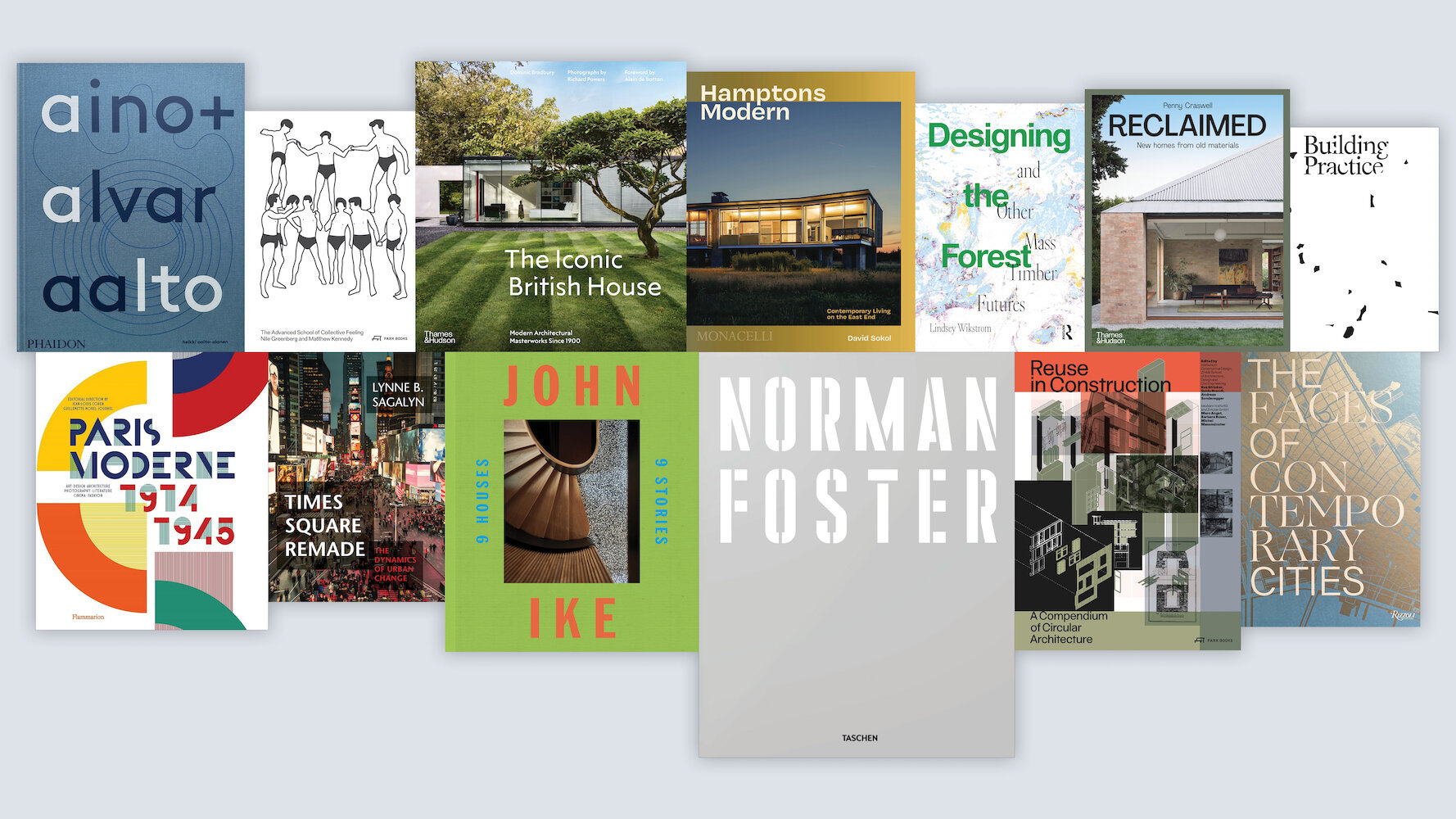

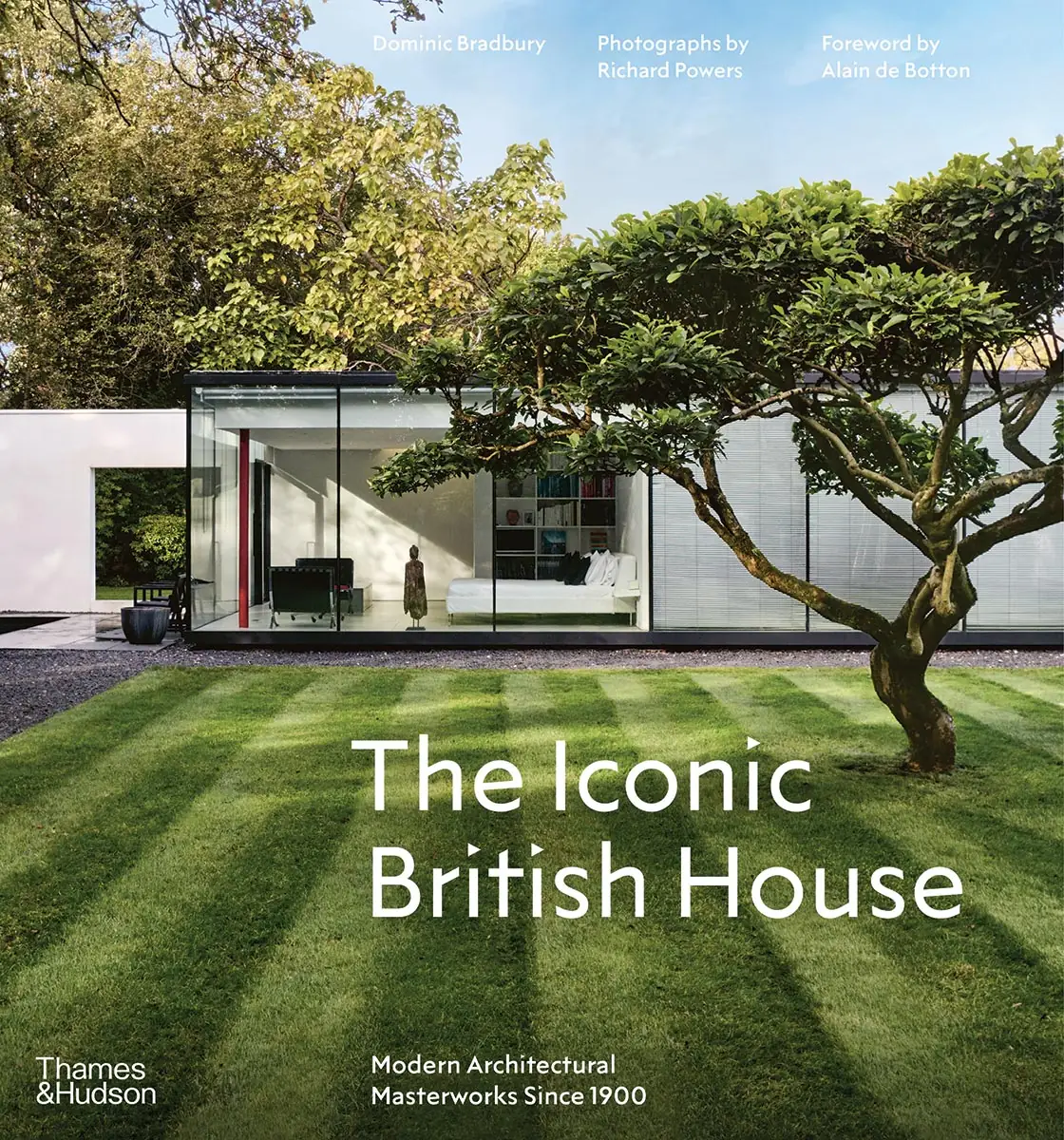
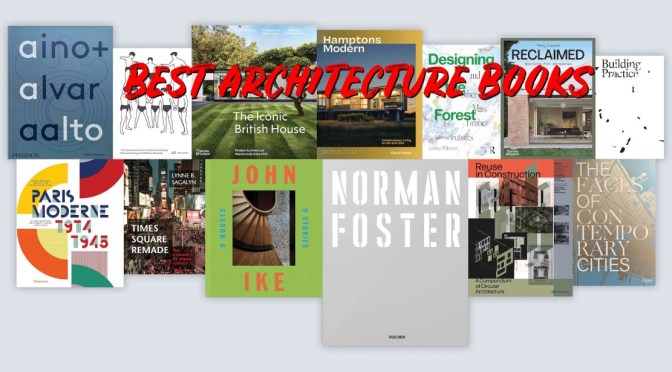
“This book should leave us inspired, and a little angry, in a fruitful way,” writes Alain de Botton in his foreword to this hefty, decade-hopping survey of modern domestic architecture in Britain. Kicking off with an Arts and Crafts treasure in Surrey designed by Edwin Lutyens as a rural retreat for “ladies of small means,” the book’s 50 featured domiciles—lushly photographed by Richard Powers—are pointedly diverse in style and context but unified by their creative flair, ingenuity, and ability to induce acute house envy. Don’t say you weren’t warned. Matt Hickman
Molly Hunker and Kyle Miller assemble a veritable who’s who of up-and-coming architects, designers, educators, and fabricators in Building Practice. Short, thematic essays, followed by interviews with 32 contributors explore what it means to build a practice, as well as how to practice the skill of building. Far from a run-of-the-mill compilation of flashy projects, this reader on the profession’s next generation offers up valuable insight that many young practitioners would be wise to heed. Leopoldo Villardi
Even though Alvar Aalto remains one of the most studied subjects in architectural history, his grandson Heikki Aalto-Alanen brings readers something new and unexpected—a love story. This deeply personal account of Aino and Alvar’s life together, replete with sketches and photographs, is told through never-before-published letters that reveal Aino’s often overlooked role in the creative partnership. As Sigfried Giedion wrote in 1949, after her unexpected death: “Their true secret is perhaps that, as people, while they are the complete opposites, they are also equals.” LV
Mass timber is often seen as an ecologically responsible alternative to concrete and steel. But this is not a given, since building at scale with wood introduces a whole set of new challenges. This is why Lindsey Wikstrom’s book is so welcome. While advocating use of mass timber for its carbon-storing capabilities and potential to be nonextractive, she debunks misguided assumptions and probes ethical and environmental considerations. Designing the Forest provides a deep dive into the material’s complexities and its opportunities. Joann Gonchar, FAIA
When Jean-Louis Cohen unexpectedly died in August, Gwendolyn Wright wrote in record that the profession had lost “the most insightful, wide-ranging, lyrical, and prolific historian of modern architecture.” Published posthumously, Paris Moderne, 1914–1945 surveys French design culture, from the overlooked to the widely known. Bookended with photo-essays by Antonio Martinelli, this encyclopedic volume would feel at home in the library of any historian or Francophile. LV
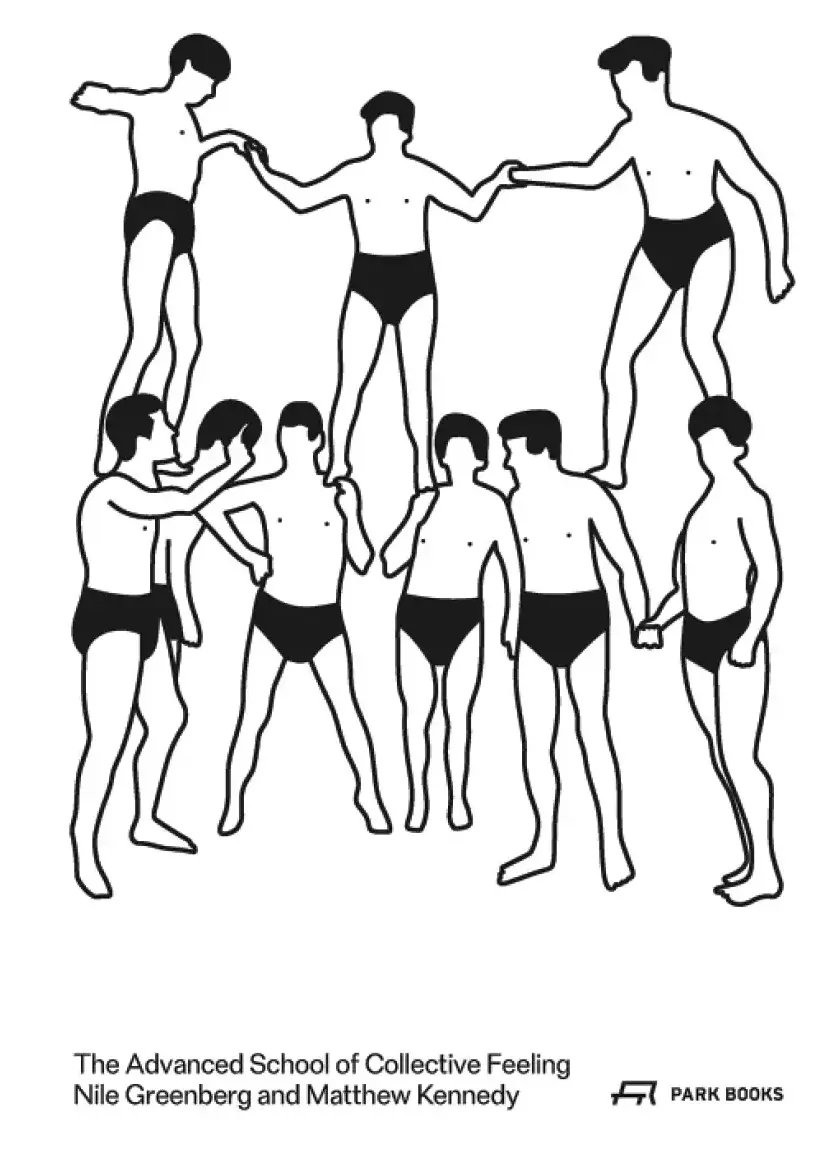
From the scantily clad figures on its cover to a ribbon bookmark that doubles as an architectural scale, The Advanced School of Collective Feeling is every bit as playful as it is a book about play. This jog through the history of physical culture vis-à-vis modern architecture features a series of drawings (beautifully rendered in metallic ink over black paper) and an impressive assortment of archival imagery. Taking the book over the finish line: a collection of somersaulting, weight-lifting, and jeté-ing silhouettes that are bound to elicit more than a few smiles. LV
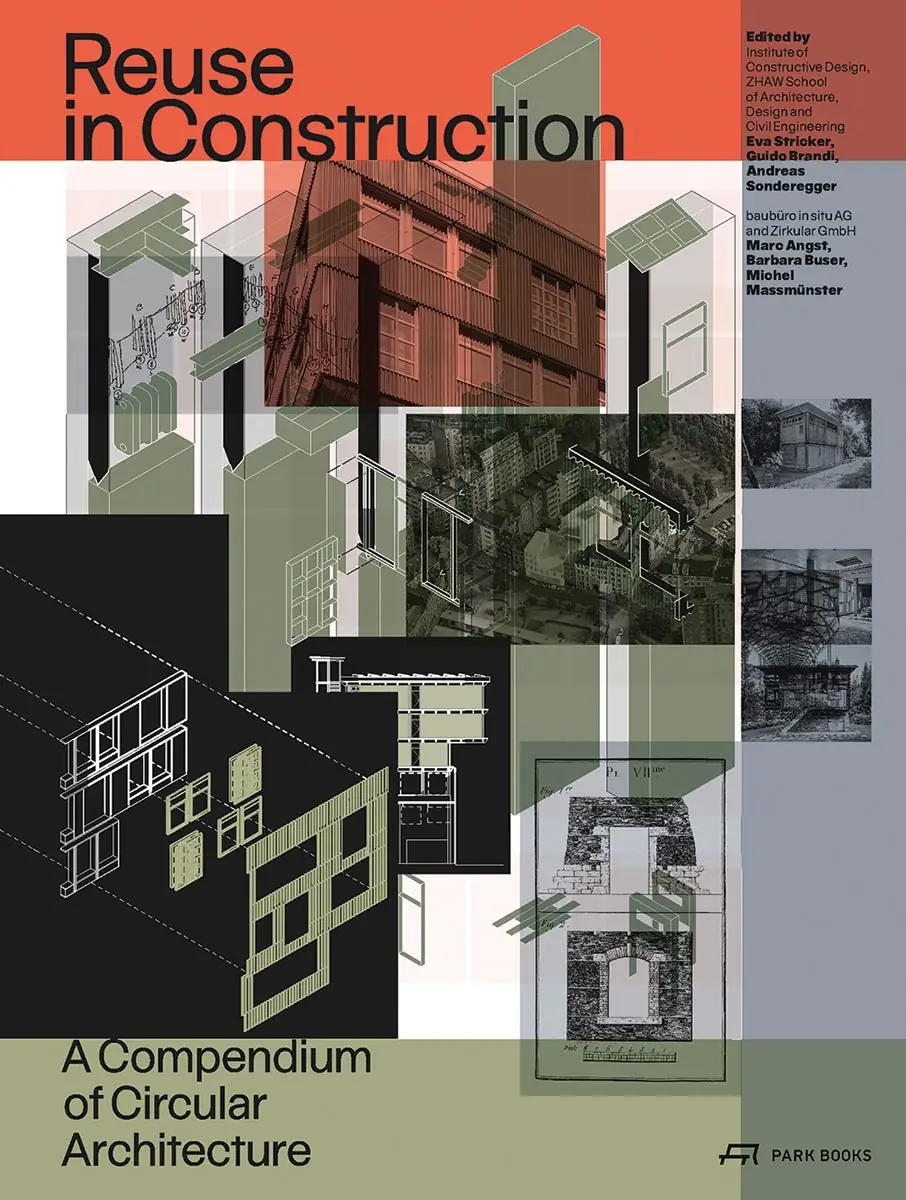
Green-building advocates agree that the construction industry is in dire need of an alternative to its typical “take-make-waste” model. But, so far, circular processes are extremely difficult for most architects to implement. Reuse in Construction is intended to help address this problem with an in-depth documentation of K.188, a building-expansion project in Winterthur, Switzerland, that relied almost exclusively on reused components. In addition to this case study, the book discusses the long history of circularity in architecture, as well as a range of practical concerns, including legal, economic, and energy-related issues. JG
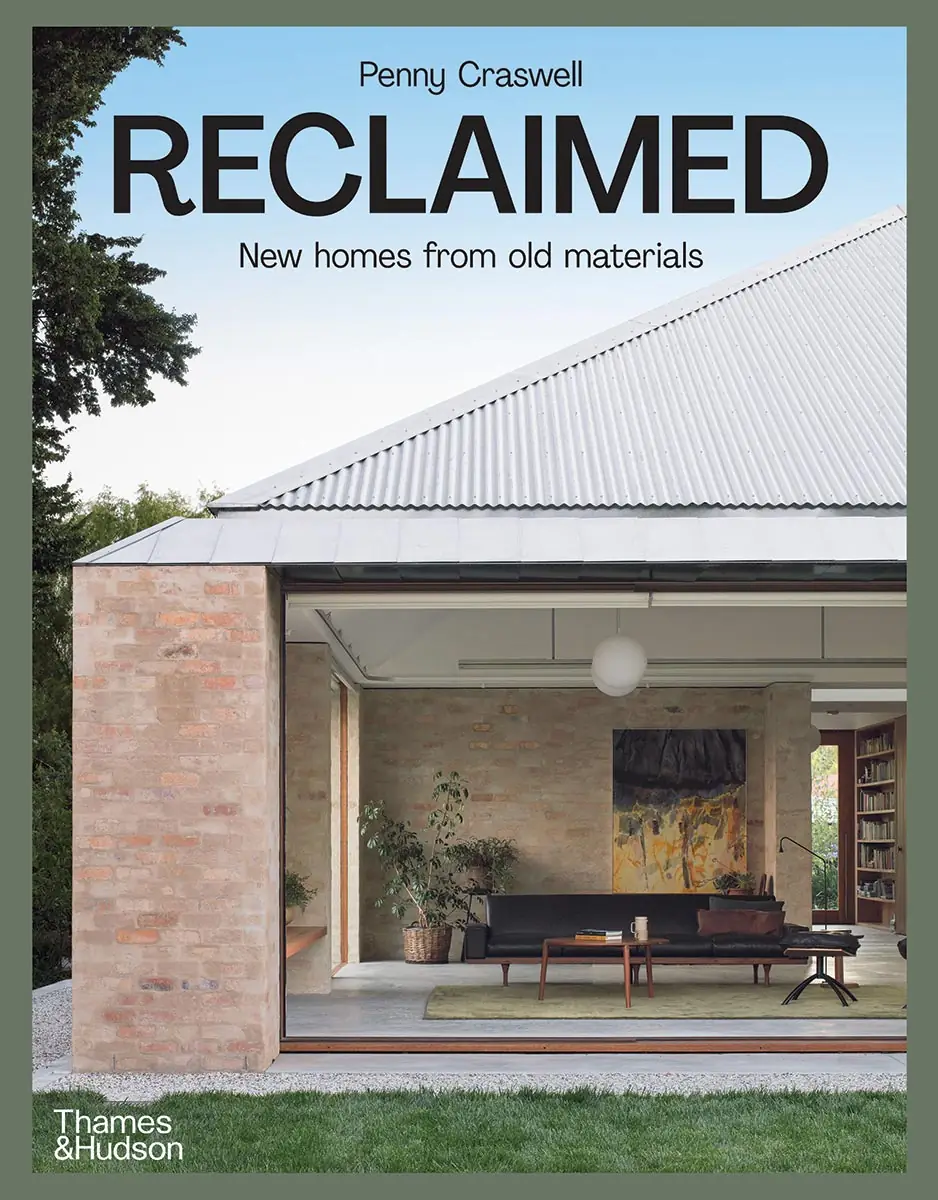
The World Green Building Council estimates that the built environment is responsible for 40 percent of global carbon emissions—10 percent stemming directly from embodied carbon from new materials and construction. Reclaimed offers an alternative to the status quo, demonstrating how to reuse materials for contemporary residential design. Divided into four material categories—brick, timber, metal, and postconsumer waste (denim repurposed as insulation, or recycled-plastic countertops, for example)—this thoughtful guide catalogues 24 houses and apartments across the world. Matthew Marani
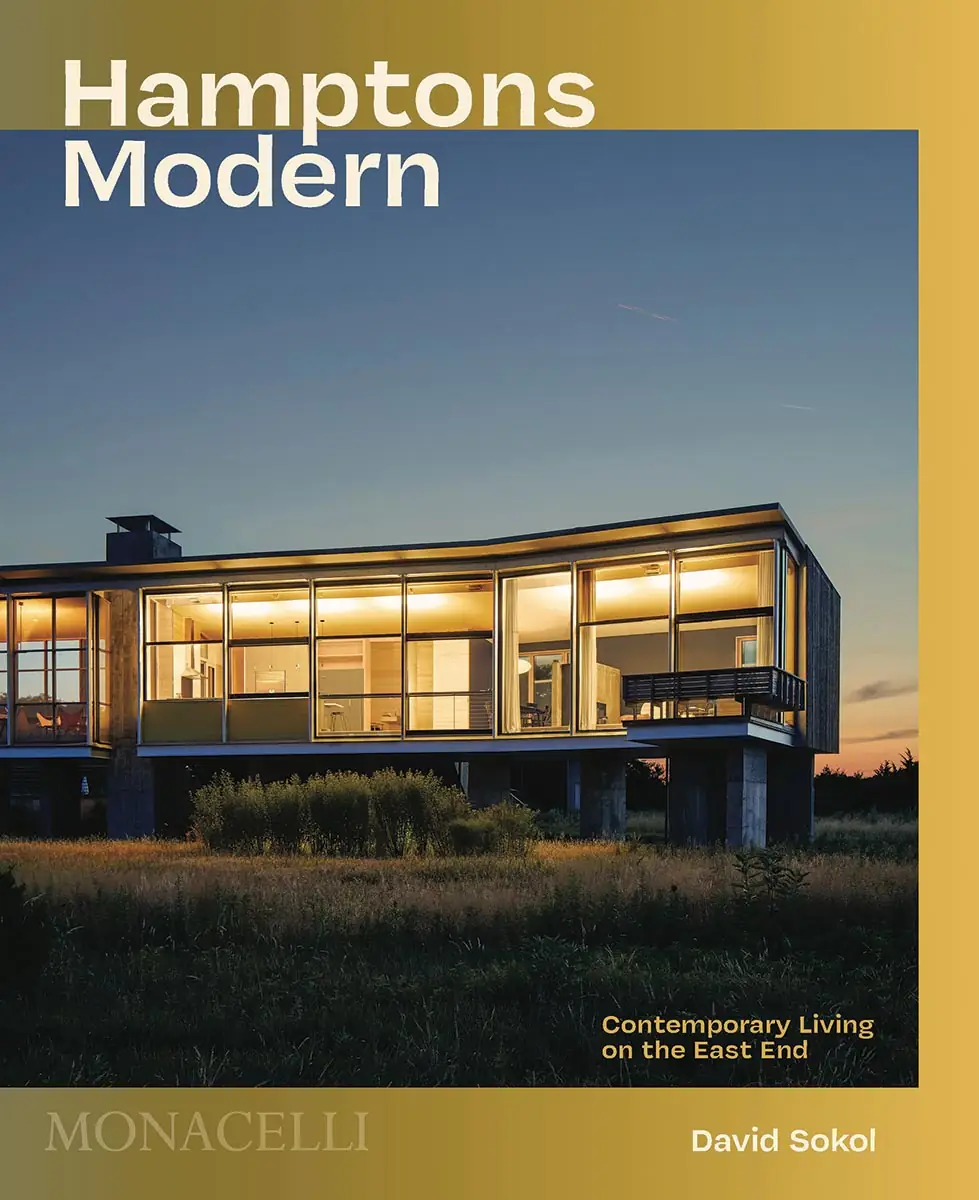
Intrepid New Yorker and record contributing editor David Sokol travels the East End of Long Island, exploring how the area’s roots in Modernism are shaping its contemporary residential architecture (apart from the manses for the rich and famous). Highlighting 18 houses, on both the South and North Forks, Sokol organizes this richly illustrated work into three sections: Stewarding the Past, Extending the Legacy, and Setting New Precedents. Infused with history, anecdotes, and interviews, this engaging ode to a design movement’s influence in time and place would be an asset to many libraries—and it’s a pleasure to read. Linda C. Lentz
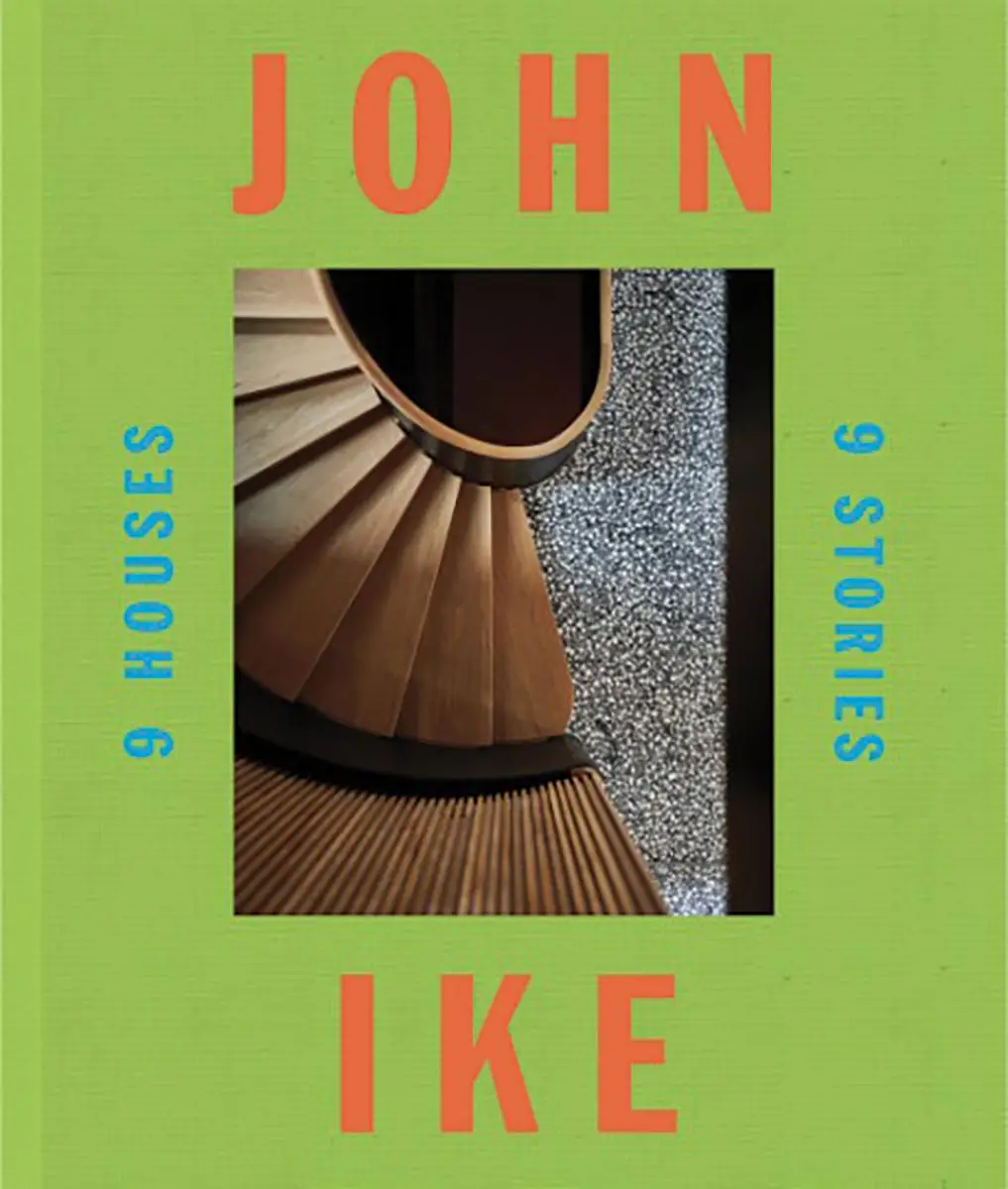
A chartreuse cloth cover with blue and tangerine lettering make this eye-catching showcase of residential work difficult to miss on a bookstore shelf. Nine dwellings—deeply contemporary yet full of historical references—slowly unfold over 304 pages, accompanied by the personal stories behind their making. But, reflecting on the collaborative nature of practice, the storytellers are just as varied as the houses. Among them are clients and contractors, as well as former firm partners Tom Kligerman and Joel Barkley. “9 Houses, 9 Stories is intended as a salute to our work,” Ike writes in the introduction. “It also marks the official end to the 34-year run of Ike Kligerman Barkley.” Each of the three architects has now gone out on his own, and readers will need to patiently wait to see what’s next in store. LV
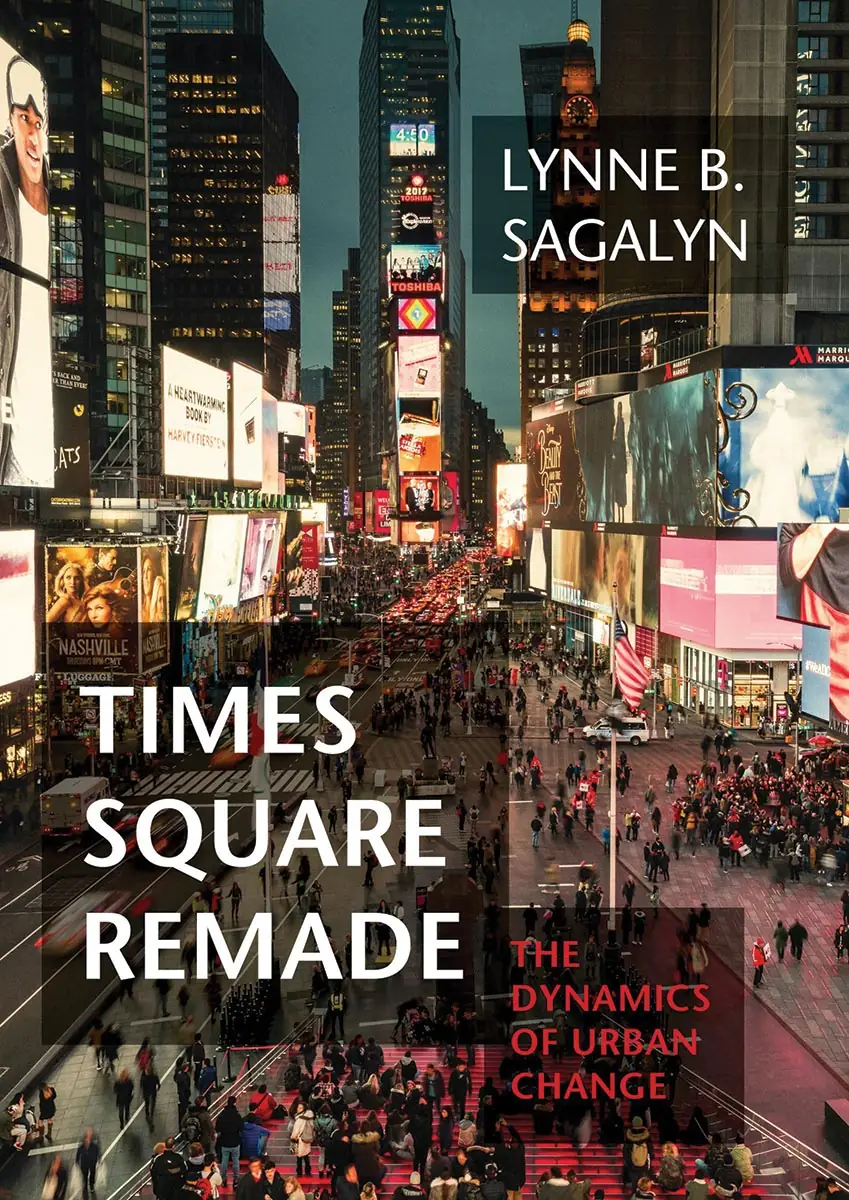
Take a front-row seat to the detailed chronicle of the making, remaking, “ruin,” and revival of New York’s “symbolic soul.” From Times Square’s Gilded Age inception as a highbrow arts destination to its working-class takeover as a carnivalesque playground, then its decline into a destination for pornography and prostitution and the 20-year sanitization campaign that followed, Columbia University professor emerita Lynne Sagalyn doesn’t confine herself to the broad strokes of financial deals or political machinations. She emphasizes the street-level humanity that has persisted at the “crossroads of the world,” throughout the fluctuations in its identity. Pansy Schulman
Accompanying the Norman Forster retrospective held at Paris’s Centre Pompidou earlier this year, this monograph is undoubtedly the heavyweight—literally, at 26 pounds—of architecture-book offerings in 2023. Neatly packaged in a 19″ by 15¼” by 5½” cardboard carton, this two-volume edition (one is titled “works” and the other “networks”) presents the Pritzker Prize–winning architect’s life, work, and personal interests in XXL format, with writings by Taschen regular Philip Jodidio and Foster himself. Not suitable for those who prefer to travel light! LV
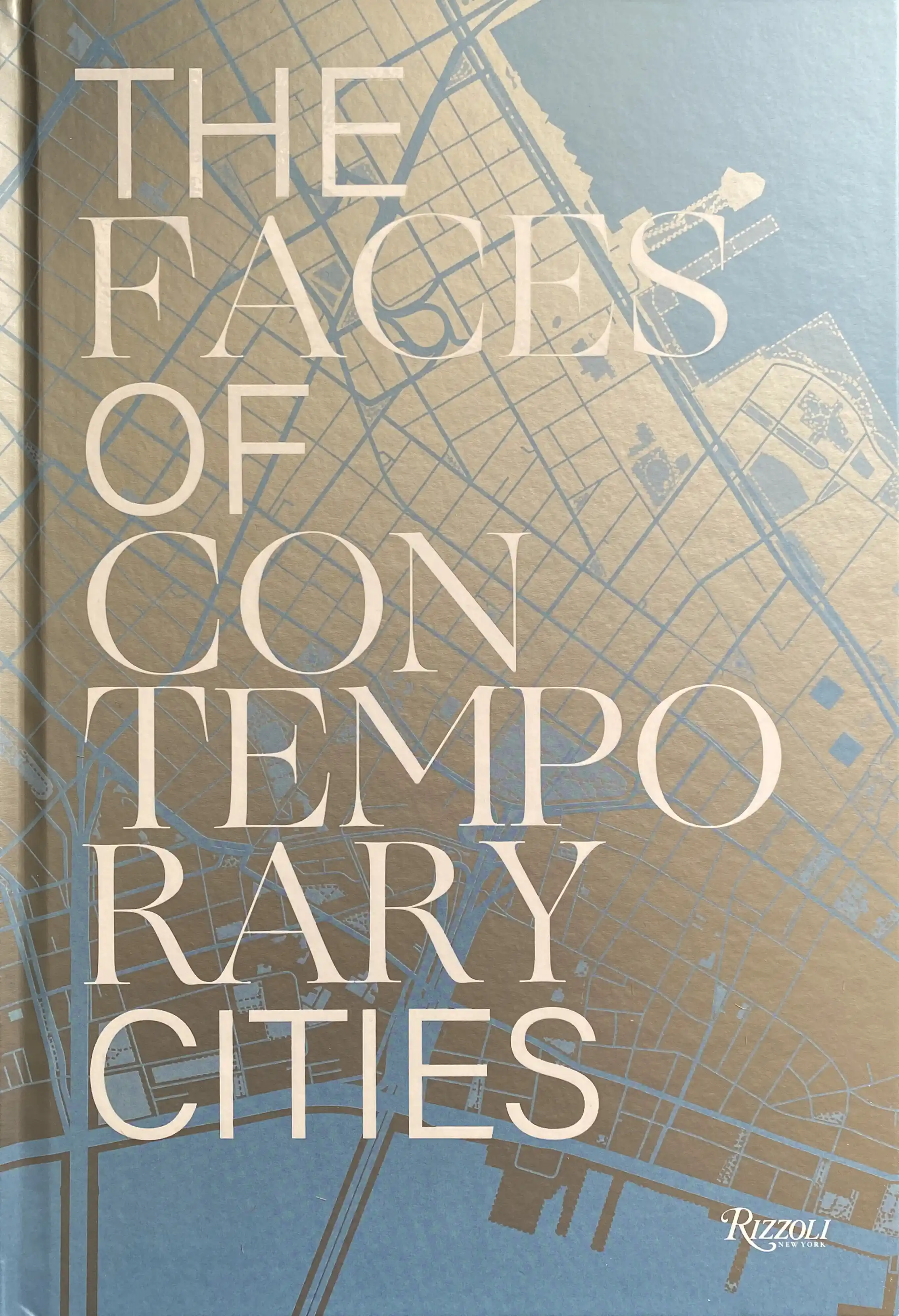
The story of Permasteelisa began in Italy 50 years ago. That small window manufacturer grew to become the company behind the facades of some of the world’s most famous buildings, including Renzo Piano’s Shard in London and Frank Gehry’s Guggenheim in Bilbao. This book reveals how the work of these architectural giants is made possible in part by companies such as Permasteelisa, which draws on its constant research into technology and materials to offer solutions for constructing the most futuristic buildings. With texts by international urban planning scholars and data analysis and georeferencing methodologies developed at the Transnational Architecture and Urbanism Lab (TAU-Lab) of the Politecnico di Milano, the book shows how Permasteelisa’s know-how has allowed it to shape the faces of many contemporary cities such as New York, Paris, London, Berlin, Frankfurt, Milan, Hong Kong, and Sydney.


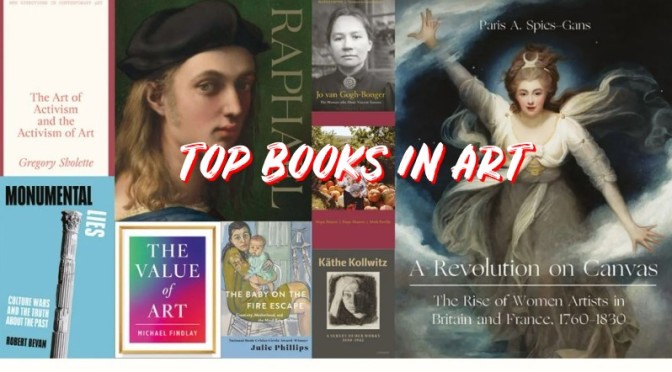
In his eighties, Claude Monet was spotted by a younger artist, “old but still very handsome”, wrapped in a sumptuous fur, sitting on top of a dyke “in a bitter west wind which ruffled his long white beard, mingling it with the foam of the waves”. This transporting biography by the Financial Times’s art critic Jackie Wullschläger paints the impressionist as a man for all seasons, out in the dawn and the dusk and the snow, obsessed, possessed, with capturing the fleeting effects of light, shade and water, calm as millpond or whipped up by a storm. Chocolate box? Jamais! Monet mounted the barricades of modern art, revolutionising the way the world could be seen and painted. A book for art-lovers — and for gardeners too. Art and literature, Monet proclaimed, were all humbug. “There’s nothing but the earth.” Laura Freeman

Who would have thought that the outstanding art book of the year would be written not by a curator or an art historian or even an artist — but by a museum guard? For ten years Patrick Bringley worked at the Metropolitan Museum in New York, directing visitors to the Islamic collections and watching out for angry protestors. It turned out to be a remarkably fruitful experience. Bringley weaves the story of a personal tragedy involving his sick brother with startling insights into museum life and — most impressively — into the great art in the Met’s collection. Waldemar Januszczak

If you have been living under a rock in 2023, you will not have noticed that this year was the 50th anniversary of the death of Picasso. The rest of us couldn’t avoid it. Countless exhibitions, events and books commemorated the occasion, but this was the most useful. Focusing on the art rather than the biography of the man, it’s a generous and sensitive text with brilliant illustrations. WJ

Pauline Boty was “the Wimbledon Bardot”, “an ice-cream of a girl” and by her own mocking, ironic reckoning, “a happy, dumb blonde”. She was so much more than that, as this fizzing biography shows. Meet Boty the Sixties It girl, pop artist, voice-of-a-generation broadcaster and “anti-ugly” campaigner against hideous postwar development. Marc Kristal gives you the crumbling studios of the Royal College of Art, the creative squalor of Notting Hill bedsitters and the thrill of finding your feet (in knee-high boots) in swinging London. Boty died appallingly young, but her life was no tragedy. It was full of mischief, provocation and promise. This book brings Boty to life, painting, protesting and dancing the miniskirted twist. LF

Venice isn’t just the most painted city in the world, it is probably the most written about too. Finding a fresh angle from which to view it is a challenge. Gayford’s answer is to understand the city and its history through the splendid and varied art it has inspired. Packed with potted histories and informed anecdotes, this is a tome to pack on a visit to La Serenissima. WJ

Alberto Giacometti used to claim that really he would have liked to carve and cast voluptuous women such as Marilyn Monroe. “The more I tried to make them broader, the narrower they got.” Giacometti’s beanpole people became icons of 20th-century art and Michael Peppiatt’s compelling portrait cuts to the core of the sculptor’s “strange life and his stranger fame”. Giacometti’s Paris studio is a character in its own right: a filthy lair filled with the most extraordinary figures and fragments, with a leaking roof, a tree growing up through the floor and a local fox given the run of the place. Appalling and fascinating. You’ll never look at a Giacometti the same way. LF
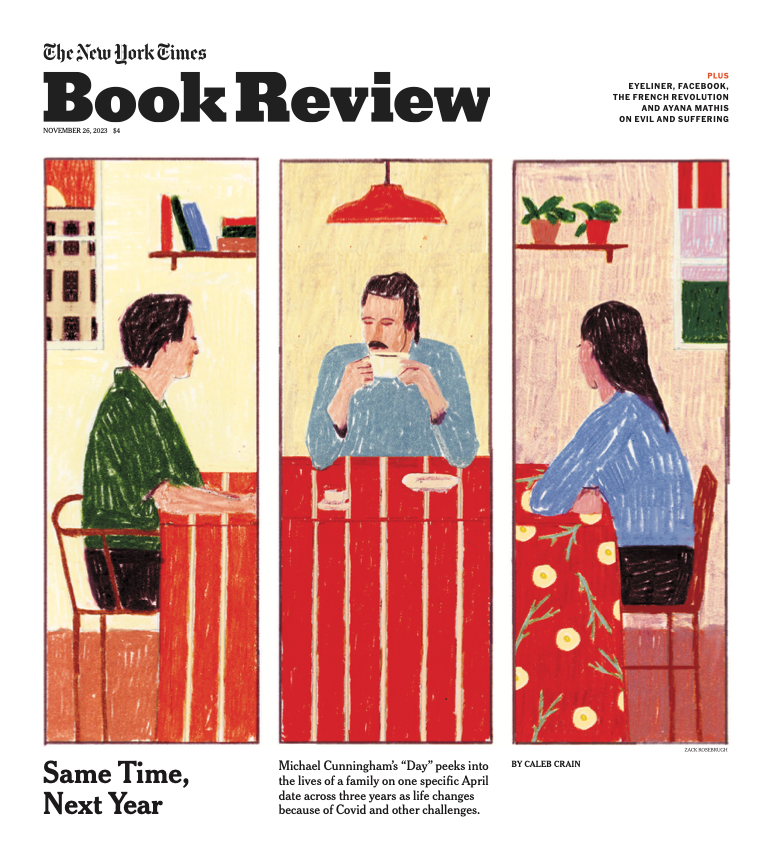

THE NEW YORK TIMES BOOK REVIEW (November 26, 2023): This week’s issue features Michael Cunningham’s “Day.”; the 2023 Notables list, “Kantika”, “The Nursery.” and “Western Lane” , because it’s a finalist for the Booker Prize, which will be announced on Sunday.

Michael Cunningham’s “Day” peeks into the lives of a family on one specific April date across three years as life changes because of Covid and other challenges.
By Caleb Crain
DAY, by Michael Cunningham
Michael Cunningham’s new novel, “Day,” visits a family on April 5 in 2019, 2020 and 2021 — before, during and after the onset of the Covid-19 pandemic, which shadows the book although the words “Covid” and “pandemic” never appear.

In Chetna Maroo’s debut novel, an adolescent girl mourns the death of her mother in the empty reverberations between points.
By Ivy Pochoda
WESTERN LANE, by Chetna Maroo
At the start of Chetna Maroo’s polished and disciplined debut, Gopi, an 11-year-old Jain girl who has just lost her mother, stands on a squash court outside London. She isn’t playing. Instead, she’s listening to the sound of the ball hitting the wall on the adjacent court, “a quick, low pistol-shot of a sound, with a close echo.” It is not so much the shot itself that Gopi is hearing, but that echo, the empty reverb, the lonely response as the ball’s impact gives the striker a split second to retreat to the T, the center of the court, and prepare to counteract her opponent’s responding shot.


Gillray was, shows Clayton, as much an artist as a caricaturist – his fertile wit and invention were equalled by his facility with an etching needle. His images reveal a man of learning, liberal with allusions in his prints to Shakespeare, Milton and the classics, who developed a style that combined the literary and the visual. His seven years at the Royal Academy, meanwhile, helped shape him into one of the most accomplished draughtsmen of the early 19th century.
Although Clayton takes Gillray from his early training as a letter engraver through his time as a travelling player and into his pomp and then the madness that blighted his later years, this is not a biography in the traditional sense. There are few documentary sources relating directly to Gillray, so Clayton skilfully reveals his man through examining the ‘business of satire’. He looks at Gillray’s often overlapping professional and personal relationships, at the intricacies of Georgian print culture, and the ebbs and flows of politics.
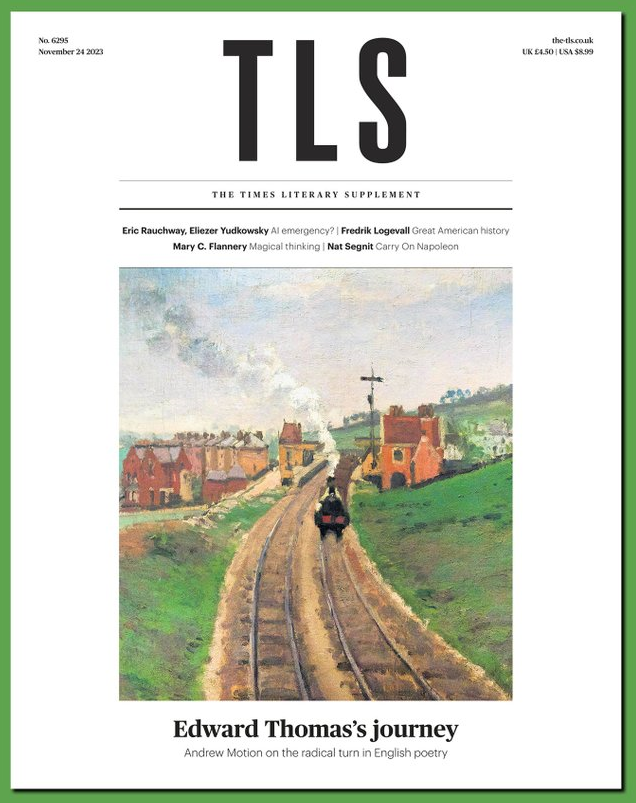
Times Literary Supplement (November 22, 2023): The new issue features Edward Thomas’s journey – The radical turn in English poetry; An AI emergency; Great American history; Magical thinking; Carry On Napoleon, and more…

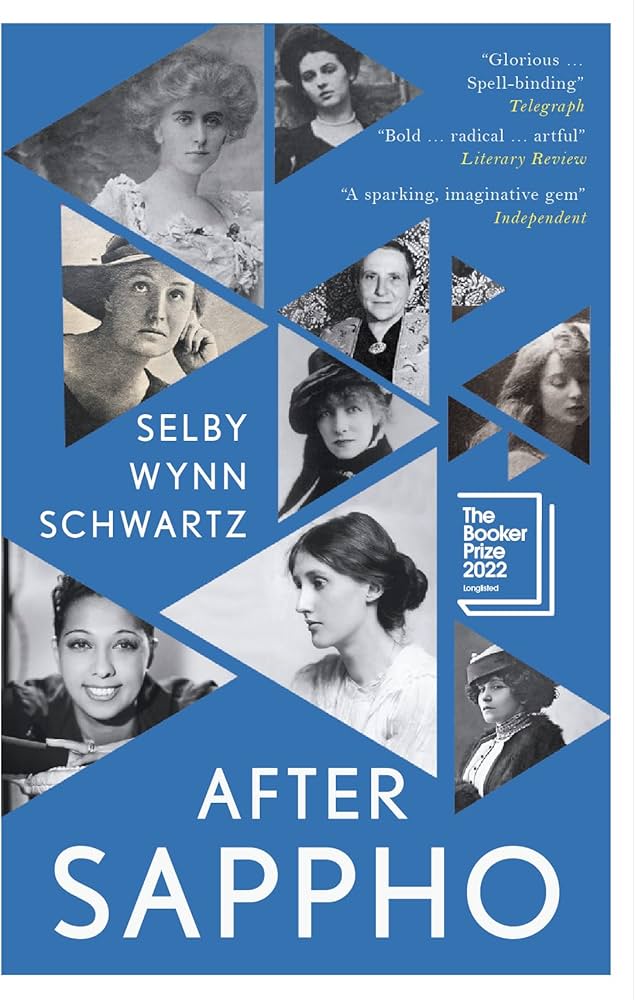
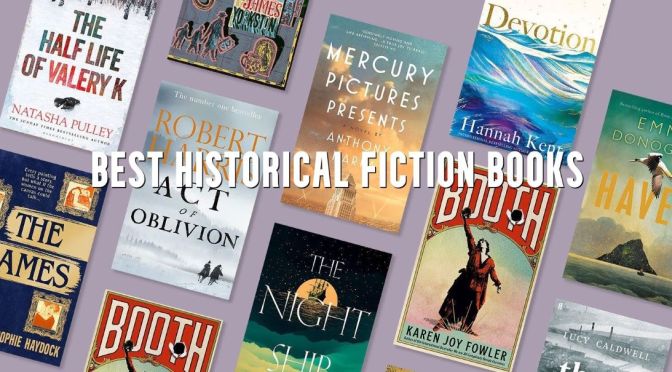
Inspired by Sappho’s work, Schwartz’s debut novel offers an alternate history of creativity at the turn of the 20th century, one that centers queer women artists, writers and intellectuals who refused to accept society’s boundaries.

Verghese’s first novel since “Cutting for Stone” follows generations of a family across 77 years in southwestern India as they contend with political strife and other troubles — capped by a shocking discovery made by the matriarch’s granddaughter, a doctor.
A best-selling novelist and prominent anti-Fascist in her native Italy, de Céspedes has lately fallen into unjust obscurity. Translated by Ann Goldstein, this elegant novel from the 1950s tells the story of a married mother, Valeria, whose life is transformed when she begins keeping a secret diary.
Based on a celebrated 19th-century trial in which the defendant was accused of impersonating a nobleman, Smith’s novel offers a vast panoply of London and the English countryside, and successfully locates the social controversies of an era in a handful of characters.
This remarkable debut novel tells the story of an extended Indo-Ugandan family that is displaced, settled and displaced again.
This tale of a torrid, yearslong relationship between a young woman and a much older married man — translated from the German by Michael Hofmann — is both profound and moving.
Inspired by the life of Graver’s maternal grandmother, this exquisitely imagined family saga spans cultures and continents as it traces the migrations of a Sephardic Jewish girl from turn-of-the-20th-century Constantinople to Barcelona, Havana and, finally, Queens, N.Y.
The year is 1915, and the narrator of LaValle’s horror-tinged western has arrived in Montana to cultivate an unforgiving homestead. She’s looking for a fresh start as a single Black woman in a sparsely populated state, but the locked trunk she has in stow holds a terrifying secret.
Mason’s novel looks at the occupants of a single house in Massachusetts over several centuries, from colonial times to present day. An apple farmer, an abolitionist, a wealthy manufacturer: The book follows these lives and many others, with detours into natural history and crime reportage.
An ex-conquistador in Spanish-ruled, 16th-century Mexico is asked to hunt down an Indigenous prophet in this novel by a leading writer in Spain, splendidly translated by Katie Whittemore. The epic search stretches across much of the continent and, as the author bends time and history, lasts centuries.
In his latest novel, inspired by the true story of a devastating 1912 eviction in Maine that displaced an entire mixed-race fishing community, Harding turns that history into a lyrical tale about the fictional Apple Island on the cusp of destruction.
This novel follows three generations across time and place: a young mother trying to create a home for herself and her son in 1980s Philadelphia, and her mother, who is trying to save their Alabama hometown from white supremacists seeking to displace her from her land.
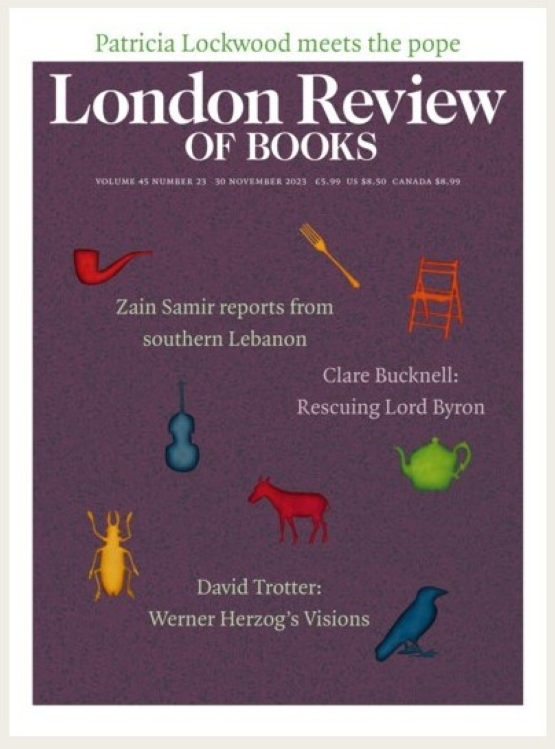
Jacqueline Rose on violence and its origins
In response to the destruction of Gaza, it seems to be becoming almost impossible to lament more than one people at a time. When I signed Artists for Palestine’s statement last month, I looked for mention of the atrocities committed by Hamas against Israeli Jews on 7 October, and then decided to settle for the unambiguous condemnation of ‘every act of violence against civilians and every infringement of international law whoever perpetrates them’.
‘Little Boy’ exploded over Hiroshima at 8.15 a.m. on 6 August 1945, wiping most of the city off the face of the earth and killing eighty thousand people instantly. But the ‘shock’ to the leadership in Tokyo envisaged by the former US secretary of war Henry Stimson failed to materialise.


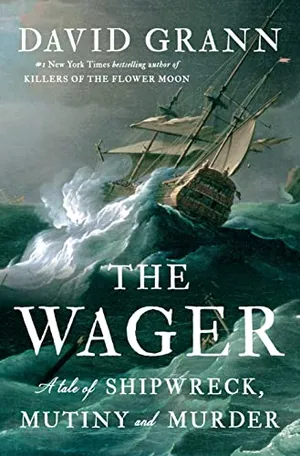
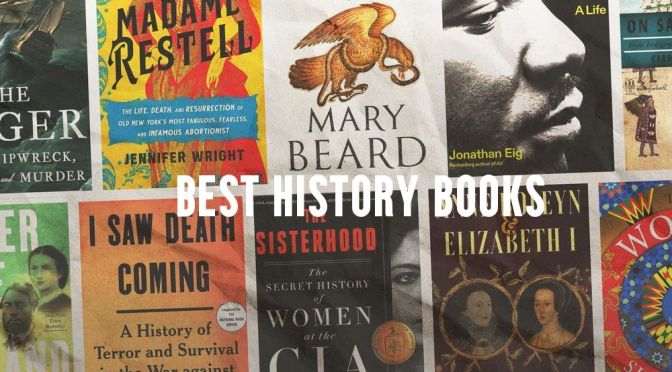
David Grann’s newest page-turner, The Wager, has much in common with his 2017 book, Killers of the Flower Moon, which was recently adapted for the screen by Martin Scorsese. Both tell the tale of a once-infamous, now more obscure chapter in history, resurrected through meticulous research and a gift for immensely readable prose. Just as the Reign of Terror, a string of murders that struck the Osage Nation in the early 20th century, was more widespread than an FBI investigation suggested, the circumstances surrounding the 1741 wreck of the HMS Wager were more mysterious than survivors initially claimed.
A Royal Navy ship that set sail from England in 1740, its crew tasked with pursuing an enemy galleon during a war with Spain, the Wager ran aground off the coast of Patagonia in 1741.A few years after the shipwreck, two sets of sailors returned home, each with their own competing version of events—one a story of survival under horrific conditions and the other a harrowing account of mutiny, a crime then punishable by death.
To untangle this web of contradictions, Grann, a longtime staff writer at the New Yorker, “spent years combing through the archival debris: the washed-out logbooks, the moldering correspondence, the half-truthful journals, the surviving records from the troubling court-martial,” as he explains in an author’s note. Grann frames his tale as a mystery, though he leaves readers to draw conclusions for themselves; the result is a tour-de-force book that will leave readers satisfied while prompting them to consider larger questions of imperialism and the notion of truth itself.
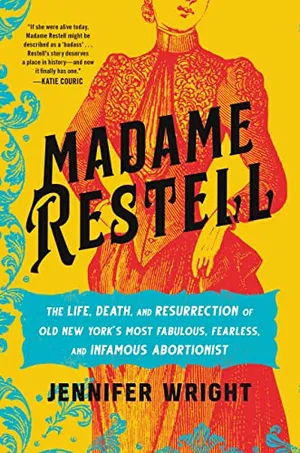
When the Supreme Court overturned Roe v. Wade in June 2022, Jennifer Wright was putting the finishing touches on her latest book, Madame Restell, a biography of the woman she deems “a businesswoman, a scofflaw, an immigrant and an abortionist [who] made men really, really mad.” The timing of the decision wasn’t lost on Wright, a journalist and author of pop-culture history books. It “disabuses us of the notion that we’ve come as long a way in our treatment of women as we liked to imagine we did,” she says in a statement. “A lot of people have talked about how we went back 50 years with the Dobbs ruling. I would say we went back 150,” to the 1870s.
By that decade, Restell had been offering abortions for more than 30 years. Born Ann Trow in England in 1811, she immigrated to the U.S. with her husband and daughter in 1831, only to find herself a widowed single mother just two years later. By a stroke of luck, she formed a connection with a neighbor who taught her how to compound pills and likely showed her how to provide surgical abortions when the abortifacient drugs she gave patients failed. With the help of her brother and her second husband, Trow developed a new persona, Restell, and started advertising her “celebrated preventative powders for married ladies whose health prevents too rapid an increase of family.” This straightforward acknowledgement of the nature of Restell’s services—risky at a time when abortion was a criminal offense in New York—attracted both satisfied customers and powerful enemies, among them the anti-vice activist Anthony Comstock, who would eventually bring about the abortionist’s downfall.
This biography presents a searing portrait of an indomitable woman, examining the experiences that shaped Restell’s career choice and the challenges she overcame, including multiple arrests and a stint in prison. Wright juxtaposes her subject’s story with those of Restell’s patients and an overview of the broader conversation surrounding abortion in the late 19th century.
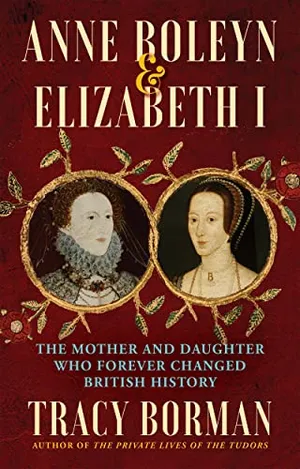
Tracy Borman is a prolific chronicler of Tudor England, with each of her books offering a novel take on the world’s most-discussed dynasty. In recent years, she’s examined the male influences in Henry VIII’s life and the private lives of the Tudors, from their romps in the bedroom to their bathroom habits. Now, Borman—an author who serves as joint chief curator of England’s Historic Royal Palaces—has turned her attention to the relationship between Anne Boleyn and Elizabeth I, a mother and daughter who she says “changed the course of British history.”
Anne was Henry’s second wife, a strong-willed, worldly woman whose refusal to become the king’s mistress pushed him to break with Rome and launch the English Reformation. Her time on the throne was brief, ending with her execution in 1536, but she left behind a daughter, the future Elizabeth I. Popular lore suggests Elizabeth, who was just 2 years old when her mother was beheaded, rarely acknowledged Anne, whose existence was all but erased by Henry after her death. When Elizabeth took the throne in 1558, she didn’t actively attempt to restore Anne’s reputation by overturning the annulment of her marriage or moving her body from a chapel at the Tower of London.
“The obvious conclusion is that Elizabeth was at best indifferent toward, and at worst ashamed of, Anne,” writes Borman. “But the truth is both more complex and more fascinating. Exploring Elizabeth’s actions both before and after she became queen reveals so much more than her words.” Evidence laid out in the book points to Elizabeth’s enduring love for Anne, whose push for religious reform reached new heights during her daughter’s reign. Borman suggests Elizabeth fulfilled a request made by Anne on the scaffold: “If any person will meddle of my cause, I require them to judge the best.”
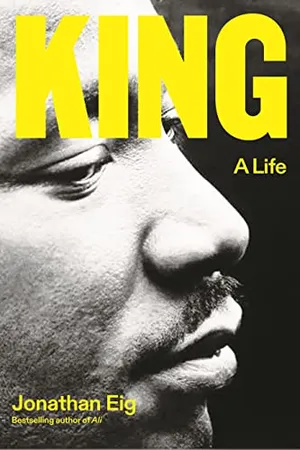
In his biography of civil rights icon Martin Luther King Jr., Jonathan Eig follows the winning formula laid out in his 2017 book, Ali: A Life, using an impressively researched deep dive to present a more nuanced portrait. “In the process of canonizing King,” Eig writes, “we’ve defanged him, replacing his complicated politics and philosophy with catchphrases that suit one ideology or another.”
Eig argues that contemporary observers have “mistaken King’s nonviolence for passivity” and “failed to recall that [he] was one of the most brutally divisive figures in American history.” Though he’s lionized today, King was widely disliked at the time of his assassination in 1968, attracting the disapproval of Southern segregationists, the government, militant Black activists and white liberals alike. Some thought he’d gone too far in his calls for equality; others said he hadn’t gone far enough. By reframing King’s life in a more realistic light, Eig seeks to “recover the real man from the gray mist of hagiography,” showing his strengths, like the power of his speeches, and his weaknesses, from his numerous affairs to his penchant for committing plagiarism.
A magisterial addition to the literature on King, Eig’s book is a clear-eyed, sympathetic tribute to a man who reshaped America in just 13 years, bringing “the nation closer than it had ever been to reckoning with the reality of having treated people as property and secondary citizens,” as the author writes. Based on newly declassified FBI papers, more than 200 interviewsand a trove of previously unpublished archival materials, King: A Life is poised to replace David J. Garrow’s Pulitzer Prize-winning 1986 book, Bearing the Cross, as the standard biography of the activist. Garrow acknowledges as much in a review for the Spectator, praising Eig’s work as “the best-informed account of this deeply courageous, yet also deeply flawed, life.”
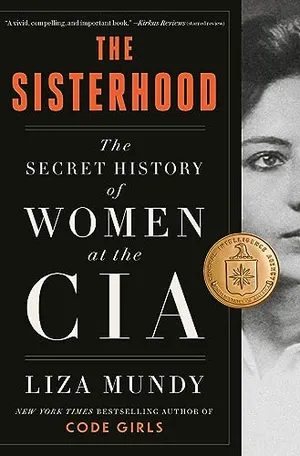
Liza Mundy’s newest is a worthy successor to her 2017 best seller, Code Girls, which explored the stories of the unheralded American women who served as code breakers during World War II. The Sisterhood offers a comprehensive exploration of a similarly understudied topic: women at the CIA. Though women have worked at the agency since its founding in 1947, Mundy, a journalist and former Washington Post staffer, argues that their contributions have long been overlooked, in part due to the secretive nature of the job but also because of sexism.
From Jeanne Vertefeuille, a typist-turned-investigator who exposed the most damaging mole in CIA history, to Heidi August, who witnessed the 1969 coup in Libya and the Cambodian Civil War firsthand, The Sisterhood shows how “women made contributions not despite their gender but because of it, using their sex to move around the world unremarked,” as Mundy writes in an author’s note. Beyond the women who worked at the CIA, the book profiles individuals on the periphery of the organization, like Shirley Sulick, the Black wife of a white agent, who enjoyed surveilling KGB operatives during trips to the store and making dead drops by pretending to pick up items that had fallen out of her purse.
Based on more than 100 interviews, published histories, academic articles, declassified documents and personal writings, The Sisterhood is a deeply researched, exhaustive read spanning seven decades of CIA history. “Women were behind numerous intelligence ‘wins’ that have never seen the light of day, and [they] made points, papers and predictions that more attention should have been paid to,” Mundy writes. At the same time, the journalist acknowledges the harm women have done as participants “in some of the agency’s darkest, most controversial chapters.”
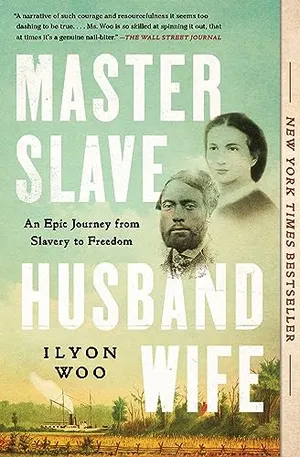
The story of Ellen and William Craft, a couple who escaped slavery in 1848 by disguising themselves as an ailing white planter and his enslaved attendant, has received renewed attention in recent years, inspiring a short film, a children’s book and several academic studies. But it’s Ilyon Woo’s biography of the Crafts, Master Slave Husband Wife, that’s poised to become the authoritative account of their journey to freedom.
Born to a white planter and an enslaved woman, Ellen fell in love with William, an enslaved cabinetmaker, while working in the Georgia home of her white half-sister. The couple hatched an escape plan, taking advantage of Ellen’s white-passing appearance to transform themselves into an unassuming duo: a master and his servant. Ellen dressed as a man, wore a sling on her arm to avoid being asked to write, applied poultices to her neck to indicate she had trouble speaking and wore hand-sewn clothing that spoke to her supposed high status. Traveling via train and steamship, the Crafts reached the free state of Pennsylvania on Christmas Day, after several close calls. They briefly found fame on the abolitionist speaking circuit, but following the passage of the Fugitive Slave Act of 1850, they fled to the United Kingdom. While living abroad, they wrote a book about their escape, though Woo points out that William downplayed Ellen’s role, claiming sole authorship of the text and referring to her only as his wife.
Master Slave Husband Wife is meticulously sourced, with “every description, quotation and line of dialogue” coming from historical materials, according to Woo. Yet the author’s prose is novelistic, immersing readers in the escape through descriptions of the “gentleman’s drawers” Ellen wore as part of her disguise and the tools of torture that awaited enslaved people at the Sugar House in Charleston, South Carolina, where the couple stopped on their way to Philadelphia. The dangerous voyage was “very cinematic,” Woo tells NPR. “Whenever I got stuck in trying to figure out how to tell this story, I sort of tried to picture: where would the camera move, and which camerapeople am I going to use in terms of the angles that I’ll get into the story?”
Reconstruction, the government-sanctioned push to reunite the nation in the aftermath of the Civil War, is often deemed a failure by historians. The federal government gave Southerners significant freedom to choose how they wanted to rebuild; rebellious states responded by passing laws that limited the rights of Black Americans and establishing white supremacist groups like the Ku Klux Klan. Given the systematic nature of this campaign against Black Americans, historian Kidada E. Williams believes that classifying Reconstruction as a failure is an oversimplification. “Black Reconstruction didn’t ‘fail,’ as so many are taught,” she writes in I Saw Death Coming. “White Southerners overthrew it, and the rest of the nation let them.”
Williams’ painstakingly researched book centers firsthand testimony from Black Americans, as recorded in transcripts from a congressional investigation into the KKK; affidavits provided to the Freedmen’s Bureau; interviews given to the Works Progress Administration in the 1930s; newspaper articles; and personal papers. Though these sources have long been available to historians, Williams approached them from a new perspective, focusing on “African Americans’ efforts to articulate what their families had gained with Reconstruction (what they had achieved with freedom and the expansion of democracy) and what they had lost and were losing to racist violence,” as she tells the Detroit Free Press.
I Saw Death Coming is a timely, incisive read at a time when white nationalism is on the rise, even as many Americans take steps to confront systemic racism in the U.S. Instead of attributing Reconstruction-era violence to “pockets of white resistance,” Williams suggests that “a kind of crypto-Confederacy emerged from the collective rage of a fallen white South that refused to cede an inch to those they had subjugated,” notes the Los Angeles Timesin a review. “White Southerners did not seek to completely exterminate all African Americans,” Williams argues, “but the successive violence they used, rejecting newly freed people’s right to any rights, was genocidal-like in nature.”
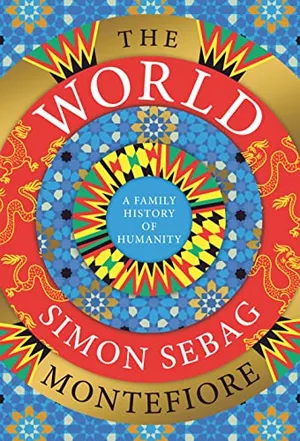
“The family,” writes Simon Sebag Montefiore in The World, “remains the essential unit of human existence.” From the Egyptian king Khufu and his mother to the “conquering family” of Genghis Khan, the Habsburg and Romanov dynasties, and the Roosevelts, Montefiore’s sweeping history traces the trajectory of the world through the relatives who ruled over it. Some of his subjects are household names, but many others are lesser known to many readers in the U.S., among them Jacques I of Haiti, the Mughal Emperor Babur and Chinese Empress Wu.
The historian’s sweeping exploration captures the complicated nature of family dynamics, particularly when politics is involved. He details acts of violence against relatives, including Ptolemy IV’s dismemberment of his son and Kim Jong-un’s likely murder of his brother; battles over succession rights among heirs; political marriages in which parents sent their daughters “to marry strangers in faraway lands where they then die[d] in childbirth”; and (comparatively rare) heartwarming moments between loved ones. The portrait that emerges is one of dysfunction, with the pitfalls of hereditary power, whether formalized or embodied by political dynasties like the Kennedys, readily apparent.
Packed with memorable anecdotes and lurid details, The World focuses less on how family units have evolved over time than on the stories of families throughout history. This approach succeeds in large part because of the encyclopedic depth of Montefiore’s research evident throughout the book’s 23 chapters and 1,344 pages. “In every family drama, there are many acts,” the historian writes. “That is what Samuel Johnson meant when he said every kingdom is a family and every family a little kingdom.”
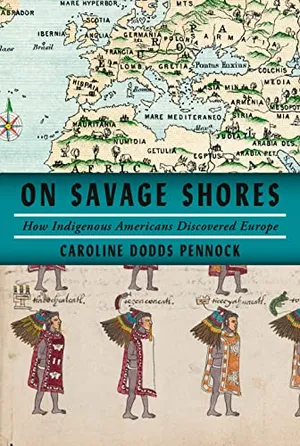
Books about the Age of Exploration tend to focus on the Europeans who journeyed to the Americas in the 15th and 16th centuries. Historian Caroline Dodds Pennock opted for a different approach, reversing focus to discuss the tens of thousands of Indigenous Americans who traveled to Europe between 1492, when Christopher Columbus supposedly “discovered” the New World, and 1607, when the colony of Jamestown was founded.
“These overlooked multitudes of Indigenous travelers—nobles, diplomats, servants, translators, families, entertainers, enslaved people—overturn our understandings of early modern exploration and empire,” writes Pennock in On Savage Shores. “And the vast network of global connections they inhabited … sowed the seeds of our cosmopolitan modern world more than a century before” the Mayflower landed in Massachusettsin 1620.
Pennock’s book draws on archival records to tell the stories of a diverse group of Indigenous people, including Martín Cortés, the mixed-race son of conquistador Hernán Cortés, who “lived the life of a young Spanish nobleman, essentially,” as Pennock told Smithsonianearlier this year; Guaibimpará (Catherine du Brasil), a Brazilian woman who settled in France with her husband, a shipwrecked Portuguese sailor, in 1528; and Diego de Torres y Moyachoque, a cacique, or tribal chief, who traveled to Spain on a diplomatic mission in 1575.
Many of Pennock’s subjects are anonymous, their names unrecorded in European sources that offer limited glimpses of their lives. But the historian deftly navigates these gaps in the archives, interrogating the colonialist bias of the records available to present a fuller portrait of cultural exchange at a pivotal moment in world history. As historian David Olusoga puts it in a review for the Guardian, On Savage Shores is a “work of historical recovery.”
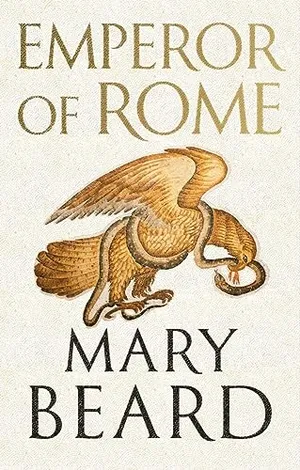
ClassicistMary Beard follows up her epic 2015 history of ancient Rome, SPQR, with a more intimate discussion of the empire’s rulers. As Beard writes in the book’s introduction, Emperor of Rome“explores the fact and fiction, … asking what [rulers] did, why they did it and why their stories have been told in the extravagant, sometimes lurid, ways that they have.” In addition to addressing “power, corruption and conspiracy,” the book asks what these individuals’ everyday lives were like, from what and where they ate to whom they slept with and how they traveled.
Beard begins her narrative with Elagabalus, a Syrian teenager who took the throne at age 14 and was murdered just four years later, in 222 C.E. The emperor is better known for his banquets than his achievements as a ruler: Ancient chronicles claim he forced guests to sit on whoopee cushions; served fake food crafted from wax or glass; and released tame animals in rooms occupied by hungover attendees, who died of fright upon waking up face to face with a lion, leopard or bear.
As entertaining as these anecdotes are, historians generally agree that they’re grossly exaggerated, concocted by those eager to win the favor of Elagabalus’ successor. Though these stories are unreliable, Beard argues that they open a window into “the anxieties that surrounded imperial rule,” chief among them “the terror of power without limits.” The scholar also uses archaeological evidence to examine the veracity of ancient accounts; as she points out, the limited nature of cooking facilities at Hadrian’s Tivoli villa contradicts the suggestion that feasts featuring peacock brains and flamingo tongues were regular occurrences there.Report this ad
The biggest question posed by Emperor of Rome is why some rulers are considered good and others bad. The answer, according to Beard, comes down to succession. Roman emperors didn’t simply pass on the throne to their eldest son, as generations of European rulers would later do. Instead, they designated a successor, who could be a relative but was often not. Whether this individual ultimately claimed the title—and what happened when emperors failed to name an heir—was an entirely different issue, and “the transition of power was almost always debated, fraught and sometimes killed for,” writes Beard. “Once the old ruler was dead, it was others who could turn, or refuse to turn, the implied promises of succession into reality.”
The emperors deemed successful, the classicist concludes, were the ones succeeded by their chosen successor, who was “almost bound to invest heavily in honoring the man who had put him there, and on whom his right to rule depended.”
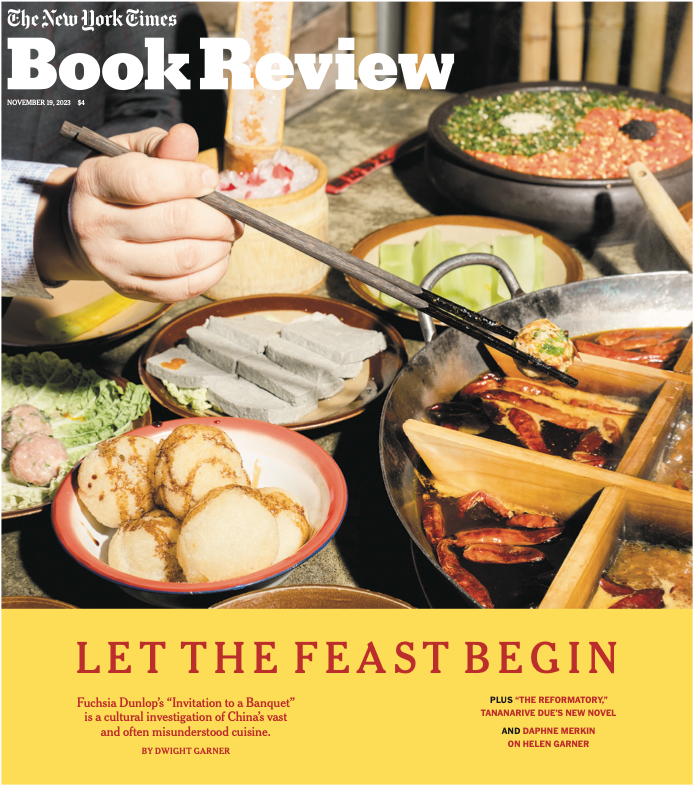
THE NEW YORK TIMES BOOK REVIEW (November 19, 2023): This week’s issue features Fuchsia Dunlop’s seductive new exploration of Chinese cuisine, “Invitation to a Banquet”; Michael Lewis Tells His Own Story of Sam Bankman-Fried; He Carried the Bags (and the Secrets) for the Beatles – A new biography resuscitates the colorful, tragic life of Mal Evans: roadie, confidant, procurer, cowbell player…

Fuchsia Dunlop’s “Invitation to a Banquet” is a cultural investigation of an impossibly broad and often misunderstood cuisine.
INVITATION TO A BANQUET: The Story of Chinese Food, by Fuchsia Dunlop
“A really good cookbook,” Jan Morris wrote, “is intellectually more adventurous than the Kama Sutra.” Fuchsia Dunlop’s masterly new book, “Invitation to a Banquet: The Story of Chinese Food,” is not a cookbook per se. But it has an earthiness that calls to mind Morris’s comment.
AUDIOBOOKS
In Jessie Gaynor’s debut novel, “The Glow,” read by Gabra Zackman, a P.R. rep immerses herself in the woo-woo world of a cultlike “spiritual retreat,” and its enigmatic leader.

 Boomers Daily