


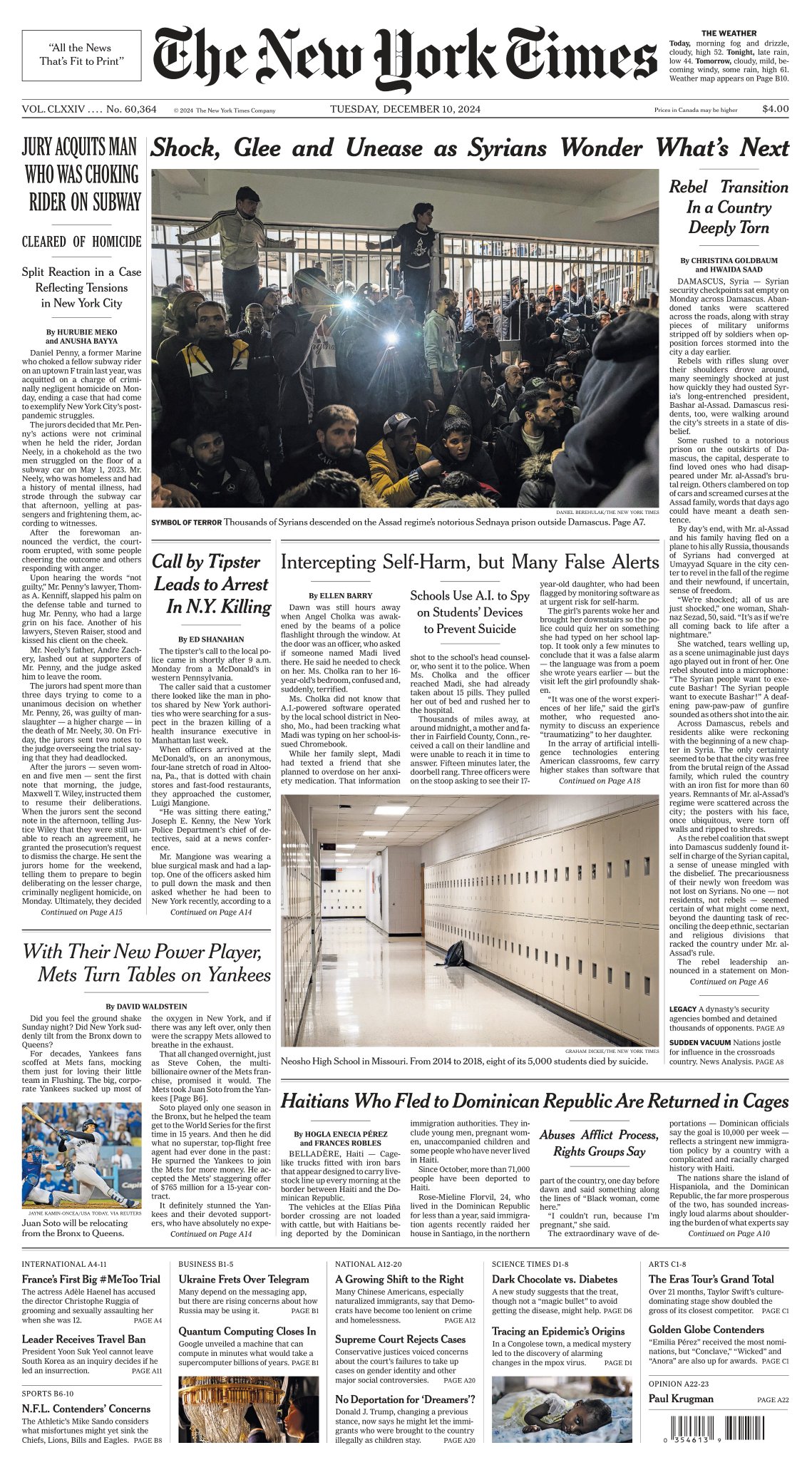
A day after the regime of President Bashar al-Assad fell, civilians poured into the streets of Damascus, weeping in disbelief. Many sought word of relatives held in a notorious prison on the outskirts of the city.
Mr. Penny choked Mr. Neely in a minutes-long struggle on the floor of an F train. The case reflected the pathologies of post-pandemic New York.
Luigi Mangione was arrested after a tip from a McDonald’s in Altoona. On Monday night, Manhattan prosecutors charged him with murder.
New technology alerts schools when students type words related to suicide. But do the timely interventions balance out the false alarms?

President Bashar al-Assad had kept opposition forces at bay for a decade with help from Russia and Iran. But rebels struck at a moment of weakness for those countries.
Thoughts of loved ones dead or missing complicate joyous relief at the prospect of Bashar al-Assad’s losing power.
With the fall of President Bashar al-Assad of Syria, Vladimir V. Putin has suffered one of the biggest geopolitical setbacks of his quarter-century in power.
Applicants for government posts, including inside the Pentagon and the intelligence agencies, say they have been asked about their thoughts on Jan. 6 and who they believe won the 2020 election.



by Henry Farrell and Abraham Newman
In a revelatory book, Farrell and Newman describe how the United States has turned its control over information networks into a hidden tool of economic domination—and warn of the risks of Washington’s weaponization of data power for ordinary people, as well as for the global financial system.read the review


by Sergey Radchenko
In a major reconsideration of Cold War history, Radchenko examines the Soviet Union’s competing ambitions for revolution, security, and legitimacy—and how Soviet leadership, blinded by its own hubris and aggression, set the stage for the downfall of the USSR. read the review

by Alan S. Kahan
Kahan argues that what unifies liberals across the centuries, including those involved in building and defending liberal democracy today, are their efforts to build societies free from the fear of arbitrary power. He sculpts a masterful and beautifully written history of liberalism’s long intellectual journey. read the review

by Steven Levitsky and Daniel Ziblatt
In this sobering study, Levitsky and Ziblatt demonstrate how the United States’ enduring constitutional order—one forged in a pre-democratic age—increasingly thwarts the will of an expanding multicultural majority in favor of a shrinking rural white minority.read the review


by Anne Applebaum
Focused on the sophisticated and networked world of autocracy, dictatorship, and tyranny, Applebaum argues that what separates hardcore autocratic states, such as China and Russia, from softer illiberal and authoritarian regimes, such as those in Hungary, India, and Turkey, is the ruthlessness and reach of their dictatorial power and their deep hostility to the Western-led democratic world.read the review


Assad Has Resigned and Left Syria, Russia Says
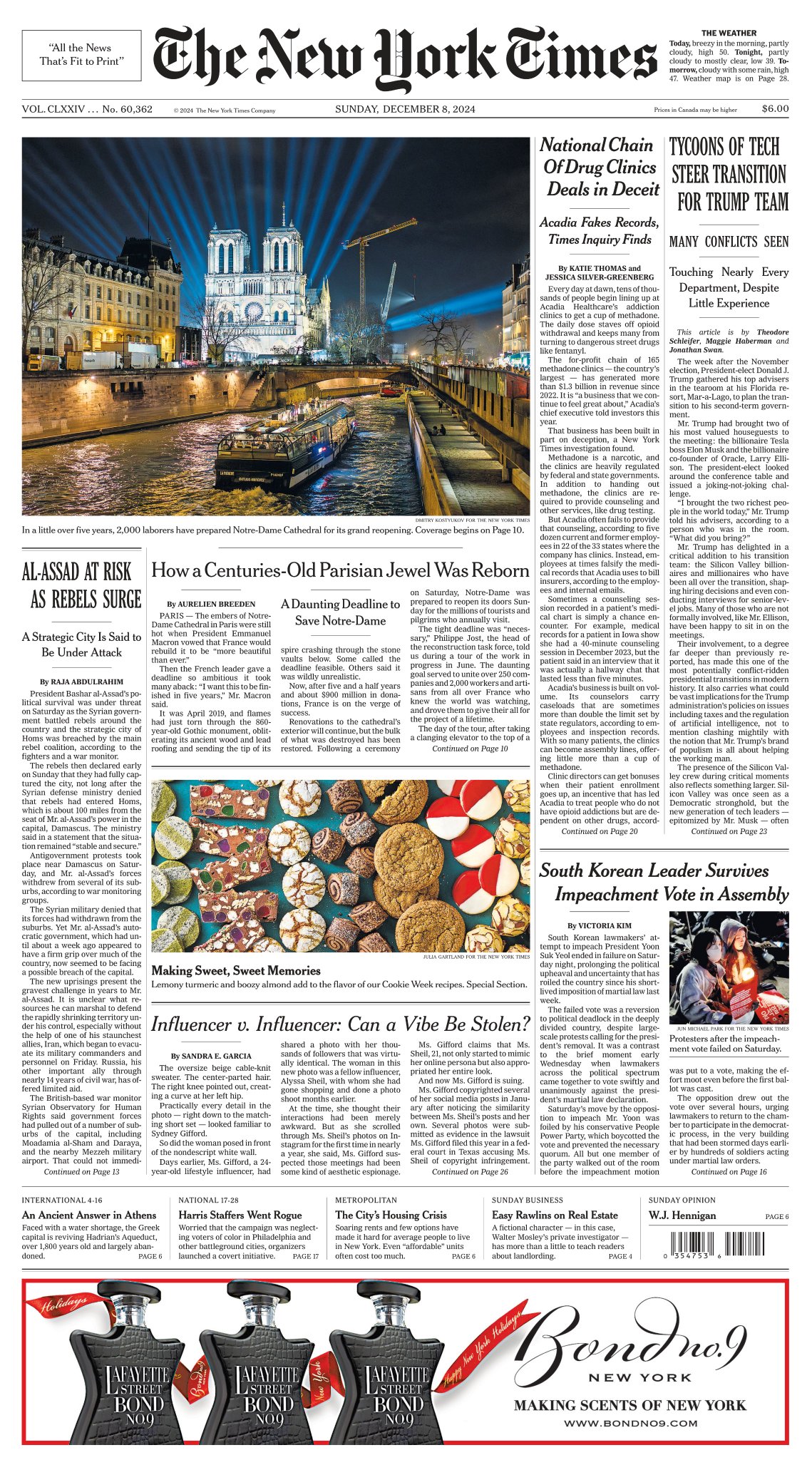
It took about 250 companies, 2,000 workers, about $900 million, a tight deadline and a lot of national pride.
The involvement of wealthy investors has made this presidential transition one of the most potentially conflict-ridden in modern history.
Acadia Healthcare falsifies records at its methadone clinics and enrolls patients who aren’t addicted to opioids, a Times investigation found.
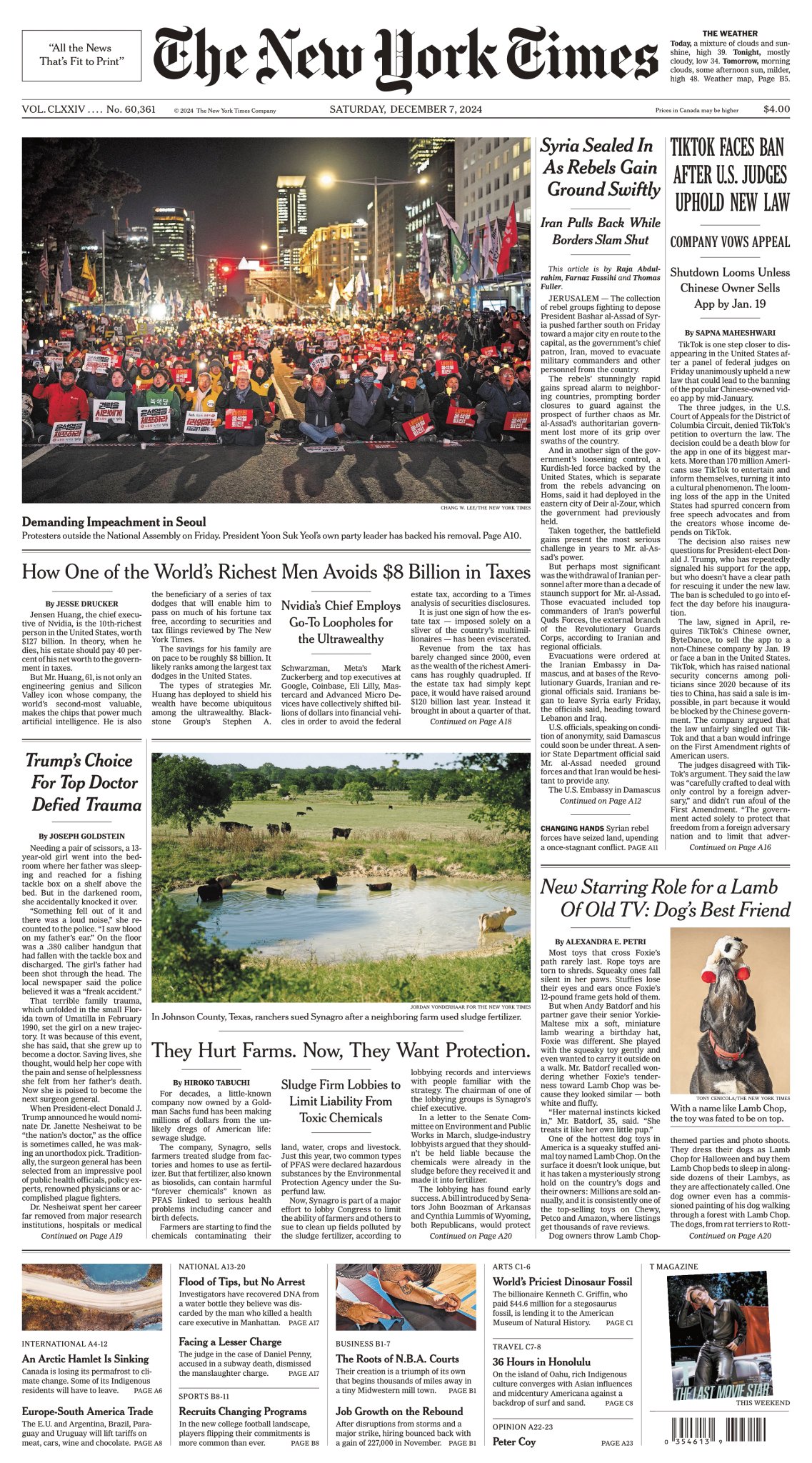
The law will ban the video app in the United States by Jan. 19 if its owner, ByteDance, does not sell it to a non-Chinese company.
The rebels’ gains prompted Lebanon and Jordan to close border crossings and Iran to begin withdrawing personnel from Syria.
The chief executive of Nvidia, Jensen Huang, has taken advantage of popular loopholes in the federal estate and gift taxes, which have quietly been eviscerated.
At the age of 13, Dr. Janette Nesheiwat said she accidentally knocked over a box in a darkened room. A handgun went off, leaving her father dead.
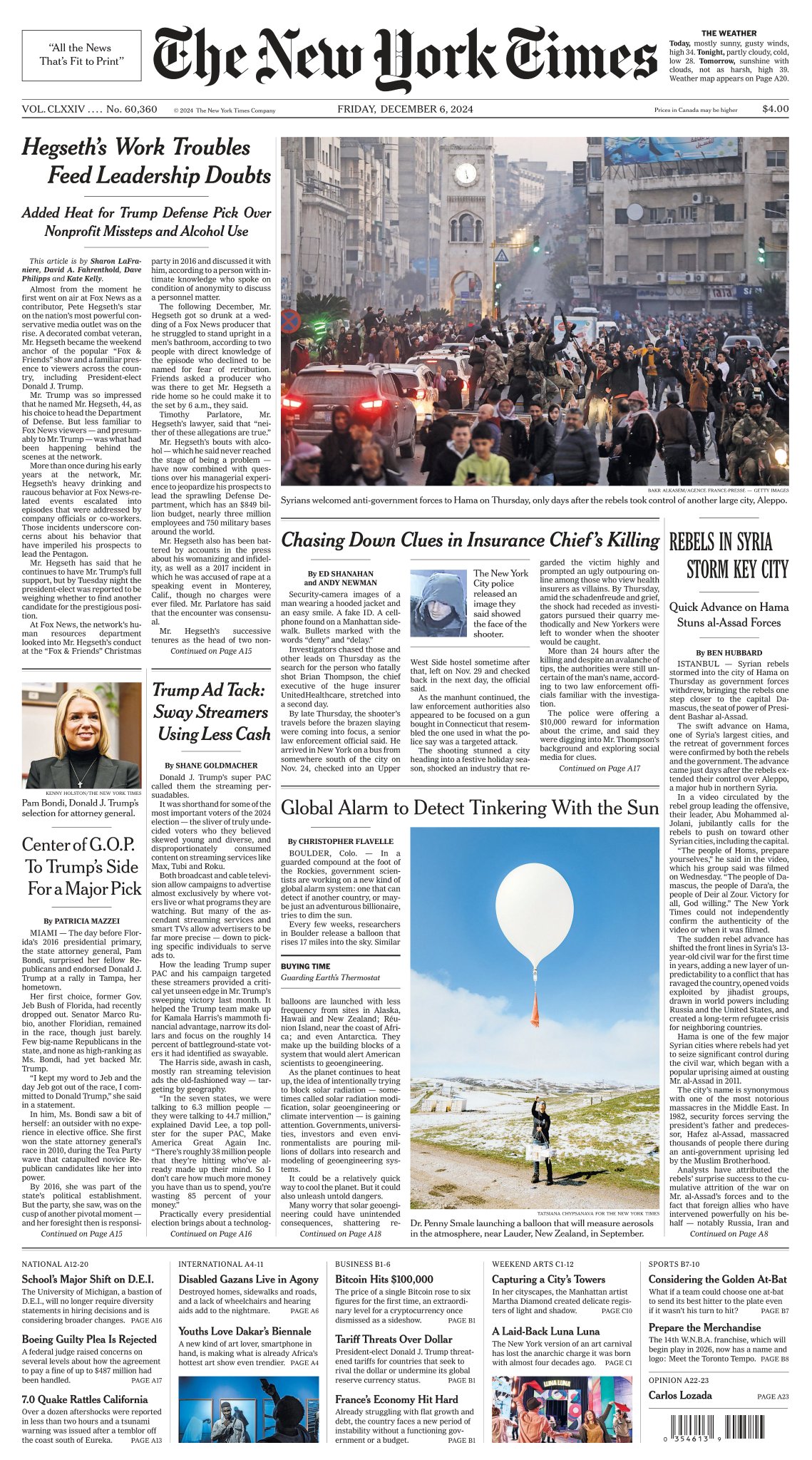
Opposition forces advanced on the city of Hama as their startling offensive moved quickly in the direction of the capital, Damascus.
President-elect Donald J. Trump’s choice for defense secretary led two nonprofits into debt, and episodes of drinking continued into his days as a Fox News personality.
The man sought in the killing of Brian Thompson wore a hood and a smile in surveillance photos. Investigators visited a hostel on the Upper West Side as they mapped his movements.
The president-elect’s choice for attorney general is known for her charm and fealty to him.
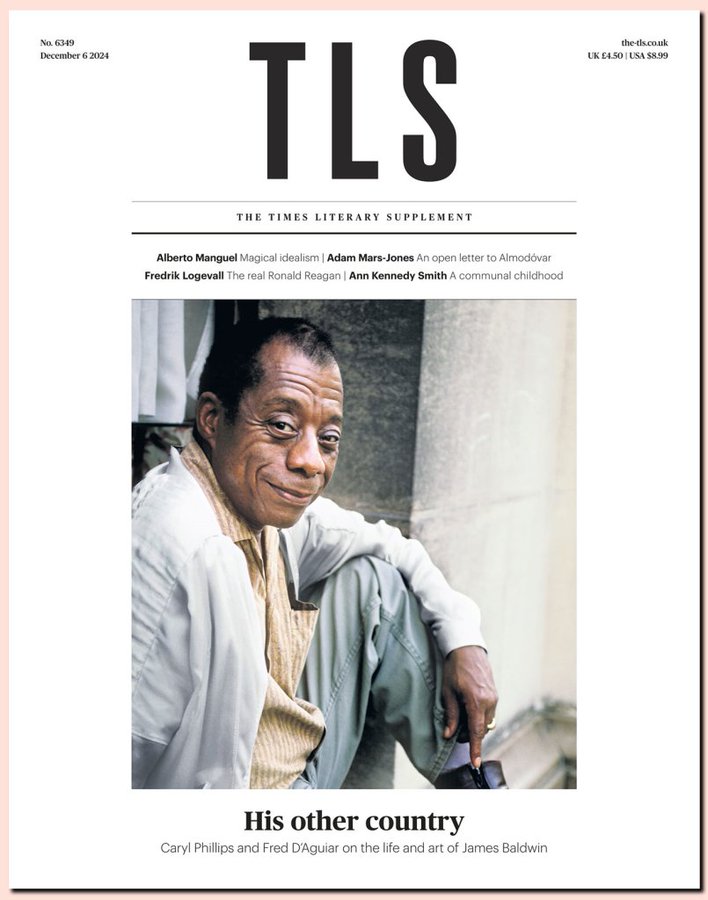
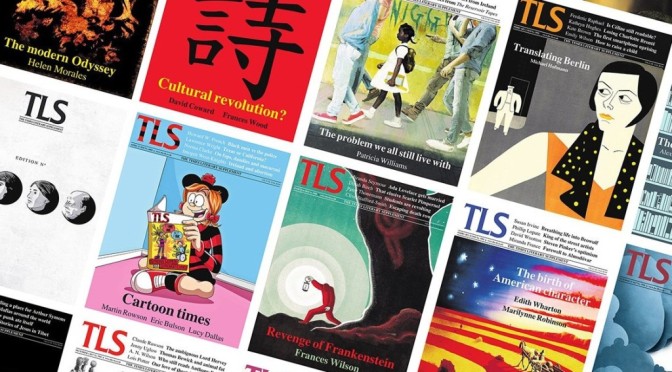
Times Literary Supplement (December 4, 2024): The latest issue features ‘HIs Other Country’ – The James Baldwin revival continues in the 100th anniversary year of his birth. A trickle of biographies has become a flood, and the causes for which he stood, racial equality and gay rights, speak to the times.

Record-label scouts chase ‘strange compositions’

A video game challenges the history of Argentina
By Mia Levitin


The gambling frenzy is mostly about people being free to enjoy themselves
It has no government and no budget, and is politically gridlocked
His coup attempt was foiled. But grave tests still remain for the country
The president’s reversal is understandable, hum

 Boomers Daily