Tag Archives: Automobiles

Classic Cars: The ‘1955 Chevrolet Bel Air’ (Video)

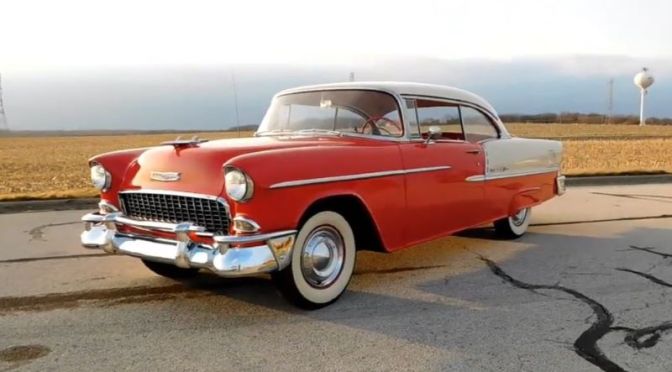
The 1955 Chevrolet (sometimes referred to as ‘55 Chevy) is an automobile which was introduced by Chevrolet in Autumn 1954 for the 1955 model year. It is considered a huge turning point for the manufacturer and a major success. It was available in three models: the 150, 210, and Bel Air.

The ’55’s top trim offering was the Bel-Air, which had more chrome than the 150 or 210. The Bel-Air, 210 and 150 model could be bought as a four-door, or could be bought as a two door with a post between the front and rear passenger windows, known as the two-door sedan.

The Bel-Air or 210 model could also be had as a two door with no post between the side windows. This was known as the sport coupe, or better known by collectors as “the two door hardtop”. Since this model had no post between the two side windows, it had a shorter roof and longer rear deck than the two door sedan had. Chevy also offered a convertible, with the same shorter roof and longer rear deck as the sport coupe, and it was offered in Bel-Air trim only.

1955 also saw the introduction of the Bel Air Nomad, a sporty two-door station wagon which featured frameless door glass and elongated side windows. The unique roof design of the Nomad came directly from the 1954 Corvette Nomad, a “dream car” designed to be shown at auto shows as a concept sport wagon. Although regarded as one of the most beautiful station wagon designs of Fifties, the Nomad sold poorly, partly due to its price tag (one of the most expensive models in the Bel Air lineup) as well as its lack of four doors. Also the Nomad’s two-piece tailgate design was prone to let excess rainwater leak through to the interior.

The ’55 offered a wide array of colors. One solid color, which was standard for the 150, could be had for the 210 or Bel Air…or nineteen different two-tone color combinations were also available.

Top Short Film: ‘Gullwing’ – Story Of ‘Most Iconic Car Of All-Time’ (Video)

Animated and Directed by:  João Elias

Have you ever seen a car spreading its wings? Now you do.

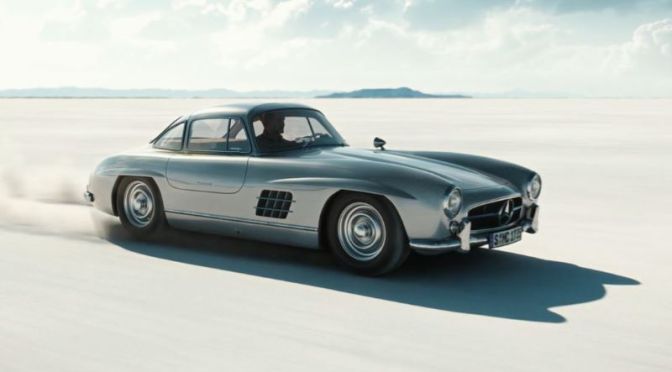
This is a full cgi shortfilm featuring the most iconic car of all time, the Mercedes-Benz 300SL Gullwing, at least in my opinion…
I always loved this car, and when I first started this project, I didn’t just wanna make a car rolling by in the desert, I knew there was a bigger story to make, it had to fly. Following its name legacy, I dived deep in this crazy rollercoaster of assembling car parts, raging though the desert of Bonneville salt flats, in order to build a full chassis so the flying body kit could land. After this, the rest is music. A symphony of a few animated shots of this beauty gloriously riding through the desert, creating clouds of smoke through the landscape while hearing that amazing engine roaring.

This is “Gullwing”.

Music: Evan Macdonald.
Sound design: João Elias

The Mercedes-Benz 300 SL (chassis code W 198) is a two-seat sports car that was produced by Mercedes-Benz as a gullwinged coupe (1954–1957) and roadster (1957–1963). It was based on the company’s 1952 racer, the W194, with mechanical direct fuel-injection which boosted power almost 50% on its 3-litre overhead camshaft straight-6 engine. Capable of reaching a top speed of up to 263 km/h (163 mph), it was both a sports car racing champion[4] and the fastest production car of its time.

Max Hoffman, Mercedes-Benz’s authorized United States importer at the time, inspired the 300 SL and correctly perceived an American market for such a car. The company introduced the 300 SL in February 1954 at the International Motor Sports Show in New York City instead of in Europe to get it into U.S. buyers’ hands sooner.

SL is the short form for “super-light” in German, Mercedes’ first use of the designation, referring to the car’s racing-bred light tubular frame construction.

The 300 SL was voted the “sports car of the century” in 1999.

Transportation: Why Cheap New Cars Are Disappearing (Video)

There are about 40 different car brands in the United States, but one kind of car that appears to be disappearing is the cheap car. Historically, about 20 percent of vehicle sales would have transacted below $20,000; however, they have completely dried up in the last few years. New cars are becoming more expensive, and it is unlikely those cheap cars will ever be back.

Classic Car Racing: ‘Inside The 2020 Mille Miglia’, Italy

Gentleman’s Journal

This year, the race had its own challenges, as the pandemic ripped across the world. The Mille Miglia usually takes place in May, but was postponed until October this time round — and many had feared it might be cancelled altogether. But the show must go on — and the sight of more than 400 stunning classic cars glinting in the autumn sun is one I will remember for a very long time.

The first Miglia Mille took place in 1927, founded by a group of car enthusiasts in the town of Brescia, Northern Italy — the race was their response to the region’s loss of the Italian Grand Prix to Monza, seven years earlier. A 1,000 mile loop around Northern Italy (hence the name), the race took place every year for three decades, save for a break during the Second World War. But the perilous, do-or-die nature of the contest led to many crashes and more than ten fatalities, and the final chequered flag fell in 1957. In the 1970s, the Mille Miglia was reborn as we know it today — more of a grand tour than a hotly-contested, breakneck race (although some drivers, even now, forget this from
time to time.)

Read more

Technology: Dutch ‘PAL-V’ Is World’s First Certified Flying Car (Video)

The world’s first-ever commercial flying car was recently unveiled by Dutch vehicle manufacturer PAL-V. Here’s what that means for our roads (and our skies).

Starting with the undercarriage, which PAL-V credits as their main breakthrough. The company was looking for a three-wheeled design that could still be stable when turning at normal road-going speeds.

In 2005, they discovered the work of another Dutch company, Carver, which made 3-wheeled cars that tilted like motorcycles. A hydraulic tilting system like that could eliminate the need for a 4th wheel and also be useful to raise the whole vehicle up, giving it ground clearance for a rear-facing propeller. Then there was the matter of generating lift.

Fixed wing aircraft need air to move over their wings fast enough to stay aloft, otherwise they’ll stall. A fixed wing flying car has to compromise the size and shape of its wings in the name of practicality, meaning its risk of stalling is higher. So PAL-V chose a rotary wing design instead, but rather than make their flying car a helicopter, they decided it should be an autogyro.

This Flying Car Costs $599K—and It’s Now Street Legal in Holland https://singularityhub.com/2020/10/29…

“In driving mode the Liberty can go up to 99 miles per hour, and in flight mode its max speed is 112 miles per hour. For comparison’s sake, the average helicopter can go up to about 160 miles per hour.”

Classic Cars: The ‘1929 Bentley Blower’ (Video)

One of the most iconic cars from Bentley’s history – Sir Tim Birkin’s 1929 supercharged 4½-litre “Blower” – is to be reborn with a new build of 12 matching cars, each individually handcrafted by a team of specialists from Bentley’s bespoking and coachwork division, Mulliner. Together, the new cars will form the world’s first pre-war race car continuation series.

Only four original ‘Team Blowers’ were built for racing by Birkin, in the late 1920s. All were campaigned on the racetracks of Europe, with the most famous car – Birkin’s own Team Car No. 2, registration UU 5872 – racing at Le Mans and playing a pivotal role in the factory Bentley Speed Six victory in 1930.

Now, using a combination of generations of handcraftsmanship skills and the very latest digital technology, the 1929 Team Blower will be the master example for 12 continuations – one for each race that the original fleet of four Team Blowers competed in.

Website

Automotive: ‘Aptera’ Launches First Solar Electric Vehicle (sEV)


Aptera Motors has introduced the first solar electric vehicle (sEV) that requires no charging for most daily use and boasts a range of up to 1,000 miles per full charge, shattering industry performance achievements to date. Aptera leverages breakthroughs in lightweight structures, low-drag aerodynamics and cooling, material science, and manufacturing processes to deliver the most efficient vehicle ever made available to consumers. Aptera’s Never Charge is built into every vehicle and is designed to harvest enough sunlight to travel over 11,000 miles per year in most regions.

Learn more about Aptera: https://www.aptera.us

Tech: ‘2021 Toyota Mirai’ – Enhanced Hydrogen Fuel Cell Electric Car (Video)

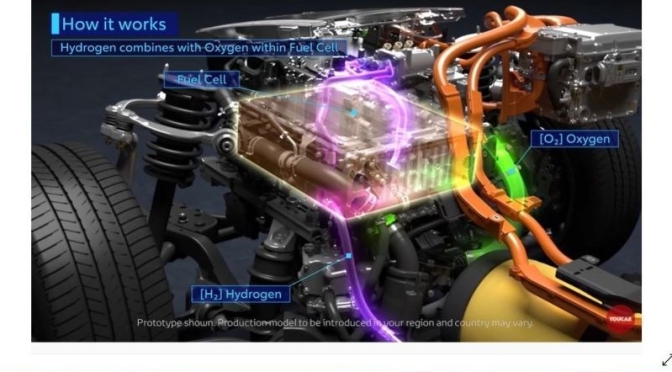
The 2021 Toyota Mirai is the second generation of zero emission hydrogen fuel cell electric sedan.

One of the principal aims for the new 2021 Mirai has been to give the car a stronger emotional appeal, making it a car that people will be attracted to by its looks and the way it drives, as well its eco-performance. The new GA-L platform and Toyota’s advances in FCEV technologies have made this possible. Toyota’s new fuel cell stack and fuel cell power converter (FCPC) have been developed specifically for use with the GA-L platform.

The designers have been able to bring all the elements together in the stack frame (including the water pumps, intercooler, air conditioning and air compressors and the hydrogen recirculation pump) with each part made smaller and lighter, while at the same time improving performance. The stack case itself has been made smaller by using Friction Stir Welding, reducing the gap between the fuel cell and casing.

The new Mirai is equipped with lithium-ion high-voltage battery in place of the current model’s nickel-metal hydride unit. Although smaller in size, it is more energy-dense, giving higher output and superior environmental performance. Containing 84 cells, it has a 310.8 rated voltage compared to 244.8, and a 4.0 Ah capacity, versus 6.5 Ah. Overall weight has been reduced from 46.9 to 44.6 kg. The output has improved from 25.5 kW x 10 seconds to 31.5 kW x 10 seconds.

The battery’s smaller dimensions have allowed it to be positioned behind the rear seats, avoiding intrusion in the load compartment. An optimised air-cooling path has been designed, with discreet inlets either side of the rear seats. The environmental benefit of driving the Toyota Mirai go beyond zero emissions to “negative emissions” – the car effectively cleans the air as it moves. A Toyota innovation, a catalyst-type filter is incorporated in the air intake.

As air is drawn into the vehicle to supply the fuel cell, an electric charge on the non-woven fabric filter element captures microscopic particles of pollutants, including sulphur dioxide (SO2), nitrous oxides (NOx) and PM 2.5 particulates. The system is effective in removing 90 to 100% of particles between 0 and 2.5 microns in diameter from the air as it passes into the fuel cell system.

Tech: ‘Why Electric Cars Took So Long To Develop’

Electric cars have been around since the mid 19th century… So why didn’t they catch on sooner? Telegraph motoring journalist Paul Hudson explains the long journey EVs have gone through, from almost extinction in postwar Britain, up to present day and their pivotal role in the future of driving. https://www.telegraph.co.uk/cars/advi..