The Globalist Podcast, Thursday, August 17: How will Hawaii get back on its feet following treacherous wildfires?
Plus: the significance of South Africa’s meeting on the ‘moonshot pact’, why China’s economy is struggling and swimmers plunge into the Seine for the first time since 1923.
State officials who rejected Donald Trump’s calls to subvert the election results say the party must move on from 2020 in order to defeat President Biden in 2024.
An indictment in the Georgia election conspiracy case marked perhaps the lowest point in the career of Rudolph W. Giuliani, who had staked his legacy on blind allegiance to the Trump administration.
After Maui’s Wildfire Horror, Residents Search for a Way Forward
As the search effort continues more than a week after the disaster, Maui’s residents try to balance helping friends and families with the tourism work needed to support themselves.
Scathing Letter Reveals Tension Among New York Democrats Over Migrant Crisis
The letter, responding to New York City’s list of demands for state help, said the city had already rebuffed some of the state’s offers and had been slow to aid migrants.
nature Magazine – August 17, 2023 issue: The cover shows an artist’s impression of Venetoraptor gassenae, a species of ancient reptile that lived some 230 million years ago. Dinosaurs and pterosaurs dominated land and air, respectively, around 70 million to 200 million years ago, but their evolutionary precursors are not that well known.
The Guardian Weekly (August 18, 2023) – This issue features ‘Back to the office: Is the work from home revolution over?’; Bangladesh’s ‘lost children’; AI does architecture; Pathfinders – In Ukraine minefields and more…
With even the big internet firms warning staff they need to show up more often, is working from home over? Or have the attitudes and expectations of employees changed for ever?
For years, Bibi Hasenaar felt rejected because she was adopted aged four. Then she saw a photo that described her as missing – and began to uncover an astonishing dark history
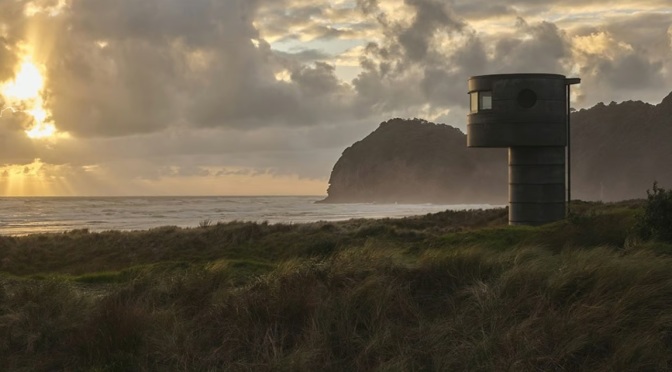
ArchiPro Films (August 16, 2023) – The lifeguard tower is an essential facility that enables observation, patrolling and protection at North Piha – one of New Zealand’s most beautiful but dangerous surf beaches. The tower is to serve the club and the community providing a functional and durable building to replace the existing dated structure.
The brief was for a robust, low-maintenance building that would withstand the severe North Piha coastal environment. It needed to provide accommodation for four lifeguards with excellent visibility along the beach – a building that was functional and responded to its context.
Piha is a part of the rohe (territory) of Te Kawerau ā Maki (the indigenous Māori tribe) who gifted the name Te Pae, meaning ‘to perch’ – a place to sit, look, and observe. It was a privilege to be able to incorporate this narrative into the concept for the tower.
The form offers a softness and quiet presence in this powerful coastal location. The site is remote, and so prefabricated concrete sections were factory-made and assembled on site. This minimised dune and planting disturbance on this fragile beach. North Piha is unusual in that the sand is black. The black oxidised concrete references this and the curved form reflects the undulating dunes that the building sits amongst. The tower is modest in scale and recessive, respecting its setting. At the same time, as a beacon for visitors to the beach, it requires easy recognition, and the distinctive form sits in contrast to the beautiful, rugged backdrop. This is a piece of coastal sculpture with a nod to traditional maritime observation structures around the New Zealand coast.
The tower is sustainable, utilising operable windows for ventilation, with high levels of insulation, sun protection, thermal mass, and natural light. It provides shelter and protection for the lifeguards. The placement of the windows was carefully determined with the club to provide optimum beach surveillance and a connection back to the clubhouse.
The new tower is a vital addition to safety at North Piha. It delivers a facility that supports the extraordinary volunteers who run it and meets the needs of its community now and into the future.
Times Literary Supplement (August 18 & 25, 2023): Theatre of war – How Susan Sontag brought Beckett to Sarajevo; Mina Loy; Madmen in the White House; Grieving for a child; Through the looking-glass again; Women artists unleashed and more…
Prosecutors have found racketeering laws to be powerful tools in targeting not only foot soldiers in a criminal enterprise, but also high-level decision makers.
Some lawyers have said that if the former president were an ordinary citizen issuing these attacks, he would be in jail by now. The question is whether he will face similar consequences.
Who Has Been Charged in the Election Inquiry in Georgia
The indictment Georgia prosecutors filed Monday in an election interference case targeting former President Donald J. Trump and his associates includes 41 criminal charges against 19 people who are accused of helping him seek to overturn his 2020 election loss.
How Fire Turned Lahaina Into a Death Trap
When a historic coastal town in Hawaii was overrun by fire, many residents fled for their lives — but there was nowhere to go.
Wall Street Journal (August 15, 2023) – For decades, Taiwan has looked to its east coast as a safe haven to survive a Chinese invasion until allies, particularly the U.S., can arrive to assist.
Video timeline: 0:00 Taiwan’s current strategy 1:38 The problem 4:15 Taiwan’s reliance on allies
In the east, Taiwan’s rugged mountain terrain also helps create a natural shield in the event of an attack. But China’s PLA activity on the island’s east has thrown that strategy into question. WSJ takes a look at how serious China’s threats to Taiwan’s east coast are and explores whether the island needs to change its defense strategy.
The Local Project (August 15, 2023) – Brad Swartz Architects has become an expert in blending small spaces with wabi-sabi aesthetics and Australian modernism.
Video timeline:00:00 – Intro to the Wabi-Sabi Tiny Apartment 00:52 – The Location of the Apartment 01:16 – A Walkthrough of the Wabi-Sabi Apartment 02:20 – Behind the Renovation 03:09 – The Clients Brief and the Japanese Inspiration 03:48 – Uncovering Unexpected Gems 04:14 – Playful Aspects of the Apartment 04:30 – The Paired Back Material Palette
This focus has been continued in Elizabeth Bay, with this tiny apartment taking inspiration from the client’s cultured past and the architecture of a historical Sydney building that resembles an ocean liner. ‘Kyabin’ is the Japanese spelling of ‘cabin’, a likeness which reveals itself when looking at the client’s brief to convert an 80-square-metre, two-bedroom, one-bathroom apartment into a one-bedroom, two-bathroom apartment with a single guest space.
The living space is also made to be more spacious and opens up to the view of Rushcutters Bay. Form over function was a defining principle of the modernist design philosophy that informed the interiors and overall style of the tiny apartment. Discovering the entire building was built with precast concrete beams – which had been concealed beneath ceiling sheeting for more than 60 years – also informed a refined materiality, deepening the interior design’s wabi-sabi undertones.
A pared-back material palette imbues the tiny apartment with a sense of calm, despite its small size, and a muted textural selection of stone and oak means the focus remains on the views beyond. The home’s design also has longevity in mind, allowing the next occupant to treat Kyabin Apartment as a blank canvas for personal expression.
News, Views and Reviews For The Intellectually Curious














 ArchiPro






 Wall Street Journal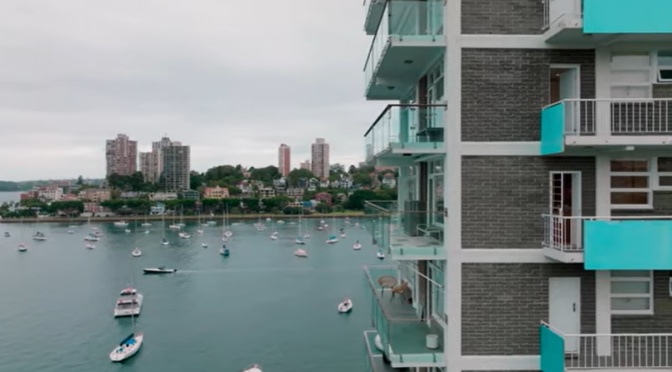

 The Local Project
 Boomers Daily