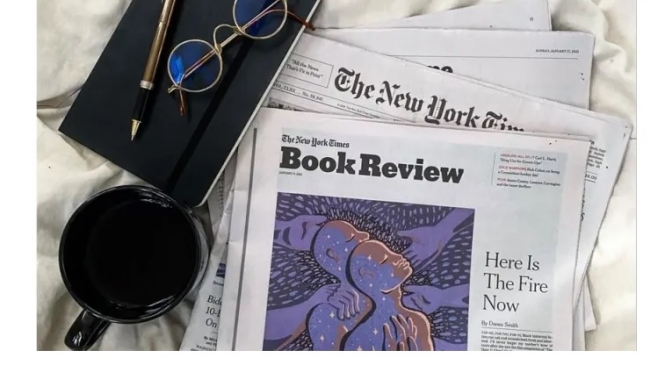
“Essex Dogs,” the first novel in a projected trilogy by the historian Dan Jones, imagines a hard-bitten band of mercenaries hired to invade France on behalf of their English king.
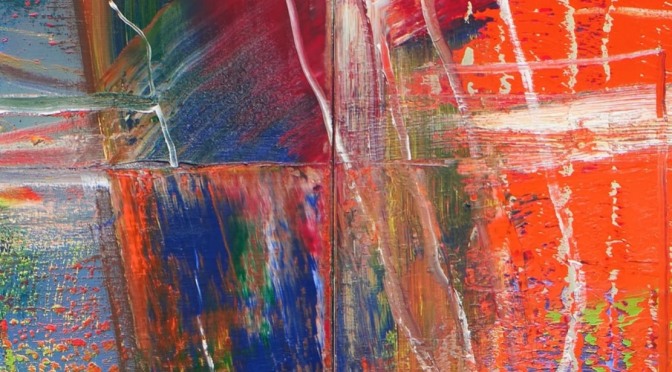
Sotheby’s (February 3, 2023) – Reminiscent of a landscape, or the strata of a Monet waterlily painting, the horizontal swathes of paint migrate across Abstraktes Bild in wave like-motion across the breadth of the canvas. Texture, colour and structure are here deployed with spectacular force, with the gliding scrape of the squeegee revealing the kaleidoscopic architectural structure of the artist’s underpainting.
It is a masterpiece created during the critical year of 1986, which saw the artist’s first large-scale touring retrospective and was also the year in which Richter first took up the squeegee as his principal compositional tool. He has only ever produced 24 Abstraktes Bild of this magnitude (with a width greater than 380 cm), of which half of these reside in museum collections across the globe.
Gerhard Richter was born in 1932 in Dresden, Germany. Throughout his career, Richter has negotiated the frontier between photography and painting, captivated by the way in which these two seemingly opposing practices speak to and challenge one another. From exuberant canvases rendered with a squeegee and acerbic color charts to paintings of photographic detail and close-ups of a single brushstroke, Richter moves effortlessly between the two mediums, reveling in the complexity of their relationship, while never asserting one above the other.
February 3, 2023: As we approach the first anniversary of the Russian invasion of Ukraine, The Art Newspaper has published an investigation that raises serious concerns that works of art taken by Russian troops from a museum in Kherson, Ukraine, in November 2022 may not be repatriated once the fighting ends.
Our London correspondent Martin Bailey tells us about his story. Plus, the Sharjah Biennial opens next week, and is the final biennial curated by Okwui Enwezor, who died in 2019, but set the blueprint for the show, entitled Thinking Historically in the Present. We talk to Nadine Khalil about the biennial and Sharjah’s place in the Middle Eastern art ecosystem.
And this episode’s Work of the Week is Invisible Man, Somewhere, Everywhere (1991) by the American photographer Ming Smith, a key piece in a new exhibition of Smith’s work at the Museum of Modern Art in New York. Oluremi Onabanjo, the curator of the show, tells us about the work.The Sharjah Biennial runs from 7 February to 11 June.Projects: Ming Smith, Museum of Modern Art, New York, 4 February-29 May. Ming Smith: Invisible Man, Somewhere, Everywhere, by Oluremi C. Onabanjo, Museum of Modern Art, New York, 48pp, $14.95/£17 (pb)
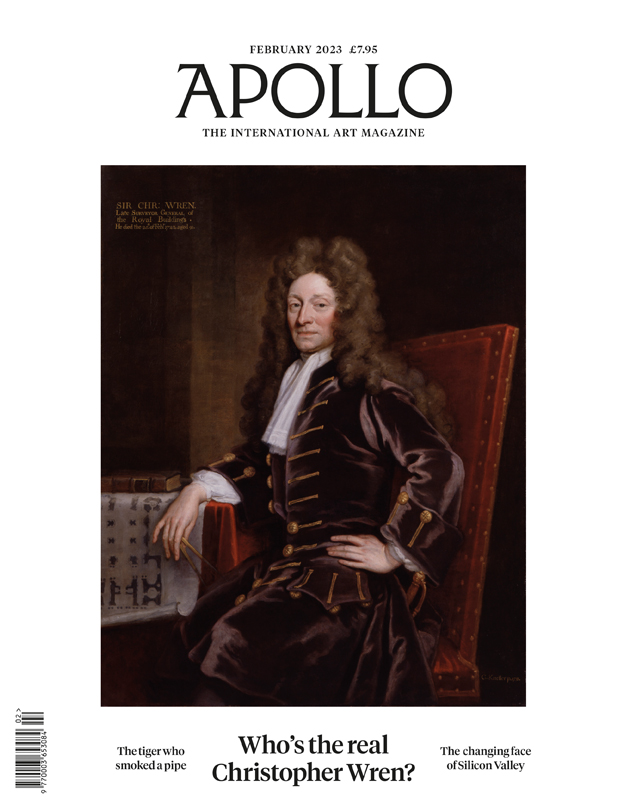
Plus: the uncertain market for Old Masters, the Cambridge colleges that have turned to wood, the artists who have taken young women seriously, and reviews of Guido Reni, Edward Hopper and the new museum at the Bibliothèque nationale
“Master Slave Husband Wife,” by Ilyon Woo, relates the daring escape from bondage in Georgia to freedom in the North by an enslaved couple disguised as a wealthy planter and his property.
In “The Wandering Mind,” the historian Jamie Kreiner shows that the struggle to focus is not just a digital-age blight but afflicted even those who spent their lives in seclusion and prayer.










 Boomers Daily