Tag Archives: Arts & Literature

Previews: The New Yorker Magazine – October 2, 2023

Image

The New Yorker – October 2, 2023 issue: The new issue features Barry Blitt’s “The Race for Office”.

Is an All-Meat Diet What Nature Intended?

The hyper-carnivory movement conjures a time when men hunted and lunch was literally on the hoof. What does the research say?

The Emotionally Haunted Electronic Music of Oneohtrix Point Never

Daniel Lopatin talks with Amanda Petrusich about his collaborations with the Weeknd and the Safdie brothers.

Amsterdam Exhibitions: ‘Van Gogh Along The Seine’

By the Seine – Vincent van Gogh Paris, May-July 1887

Van Gogh Museum (September 22, 2023) – In the 19th century, bridges and trains made it easier to visit places outside of Paris. And yet smoking factory chimneys increasingly dominated the horizon. This exhibition reveals how artists captured these changes in their artworks.

‘And when I painted landscape in Asnières this summer I saw more colour in it than before.’

Vincent van Gogh to his sister Willemien van Gogh, late October 1887

Bank of the Seine – Vincent van GoghParis, May-July 1887

‘Van Gogh along the Seine’

13 October 2023 until 14 January 2024

Five ambitious artists – Van Gogh, Seurat, Signac, Bernard and Angrand – travelled to the banks of the Seine to paint. Surrounded by green, they captured the changes ushered in by the burgeoning industry. Here they found new, contemporary motifs and developed their use of colour and painting techniques. Asnières had a particular impact on the artistic development of these artists.

More information

The New York Times Book Review – Sept 24, 2023

Image

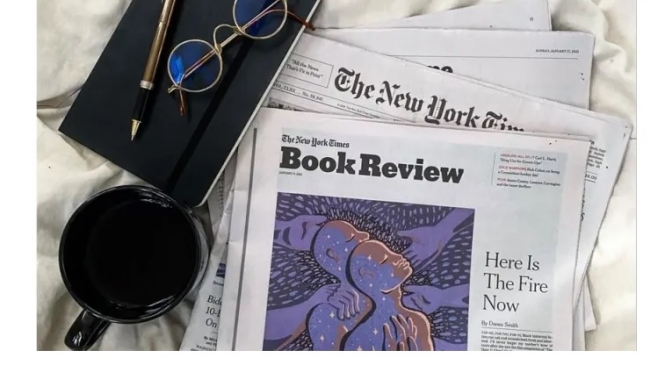
THE NEW YORK TIMES BOOK REVIEW (September 24, 2023): The latest issue features Walter Isaacson’s buzzy Elon Musk biography, which has already rocketed to No. 1 on the best-seller list.  Also, gorgeous historical novels from Lauren Groff and Daniel Masona remarkable new book about road ecologythe translation of a beloved, best-selling Japanese novel; “Doppelganger,” Naomi Klein’s investigation into the online underworld of conspiracies and misinformation; and Stephen King’s latest, “Holly,” to name just a few.

Elon Musk Wants to Save Humanity. The Only Problem: People.

This impressionistic illustration, composed of black ink and brushstrokes with accents of yellow and pink, shows Elon Musk’s face close-up. He is gazing at the viewer, his square jaw and high forehead immediately recognizable.

Walter Isaacson’s biography of the billionaire entrepreneur depicts a mercurial “man-child” with grandiose ambitions and an ego to match.

By Jennifer Szalai

At various moments in “Elon Musk,” Walter Isaacson’s new biography of the world’s richest person, the author tries to make sense of the billionaire entrepreneur he has shadowed for two years — sitting in on meetings, getting a peek at emails and texts, engaging in “scores of interviews and late-night conversations.” Musk is a mercurial “man-child,” Isaacson writes, who was bullied relentlessly as a kid in South Africa until he grew big enough to beat up his bullies. Musk talks about having Asperger’s, which makes him “bad at picking up social cues.” As the people closest to him will attest, he lacks empathy — something that Isaacson describes as a “gene” that’s “hard-wired.”

Lauren Groff’s Latest Is a Lonely Novel of Hunger and Survival

A color illustration of a girl wearing a torn blue coat and boots with a bag strapped around her back, looking back toward a coastal settlement as she enters the woods, covered in snowfall.

“The Vaster Wilds” follows a girl’s escape from a nameless colonial settlement into the unforgiving terrain of America.

By Fiona Mozley

Jamestown, Va., the first permanent English settlement in the Americas, very nearly didn’t survive. A few years into its existence, in the early 1600s, the majority of the population had succumbed to famine and disease. The period known as the Starving Time has taken on allegorical status. Jamestown is the colony that tried too much too soon; that underestimated the harsh climate, the foreign land, its existing, Indigenous population. Pilgrims went in search of heaven and found hell.

Books: The Booker Prize 2023 Shortlist Revealed

The Booker Prize (September 20, 2023) – The shortlist has been announced! It features six books by authors never previously shortlisted, including two debuts.

The Shortlist

The Bee Sting

Shortlisted for the Booker Prize 2023. A patch of ice on the road, a casual favour to a charming stranger, a bee caught beneath a bridal veil – can a single moment of bad luck change the direction of a life?

By Paul Murray

Western Lane

Shortlisted for the Booker Prize 2023. Chetna Maroo’s tender and moving debut novel about grief, sisterhood, a teenage girl’s struggle to transcend herself – and squash

By Chetna Maroo

Prophet Song

Shortlisted for the Booker Prize 2023. A mother faces a terrible choice, in Paul Lynch’s exhilarating, propulsive and confrontational portrait of a society on the brink

By Paul Lynch

This Other Eden

Shortlisted for the Booker Prize 2023. Full of lyricism and power, Paul Harding’s spellbinding novel celebrates the hopes, dreams and resilience of those deemed not to fit in a world brutally intolerant of difference

By Paul Harding

If I Survive You

Shortlisted for the Booker Prize 2023. An exhilarating novel-in-stories that pulses with style, heart and barbed humour, while unravelling what it means to carve out an existence between cultures, homes and pay cheques

By Jonathan Escoffery

Study for Obedience

Shortlisted for the Booker Prize 2023. In her accomplished and unsettling second novel, Sarah Bernstein explores themes of prejudice, abuse and guilt through the eyes of a singularly unreliable narrator

By Sarah Bernstein

Reviews: ‘The Week In Art’

The Week In Art Podcast (September 21, 2023): This week: the latest controversies prompted by the Unesco World Heritage Committee. As we mentioned last week, the 45th session of the committee is taking place in the Saudi Arabian capital, Riyadh, and continues until 25 September.

The founder of The Art Newspaper, Anna Somers Cocks, joins host Ben Luke to look at the latest sites granted World Heritage status and at the Committee’s decision not to add Venice to the organisation’s endangered list. We ask: is Unesco so mired in politics that it cannot adequately perform its role? The Colombian artist Fernando Botero died last week, aged 91, and we talk to the gallerist Stéphane Custot, of Waddington Custot galleries in London, about this painter and sculptor who drew ire from many critics but achieved widespread public acclaim.

And this episode’s Work of the Week is October’s Gone . . . Goodnight (1973) by Barkley L. Hendricks. As a group of paintings by Hendricks goes on display among the masters at Frick Madison in New York, Aimee Ng, co-curator of the exhibition, tells us about the painting.

Barkley L. Hendricks: Portraits at the Frick, Frick Madison, New York, until 7 January 2024.

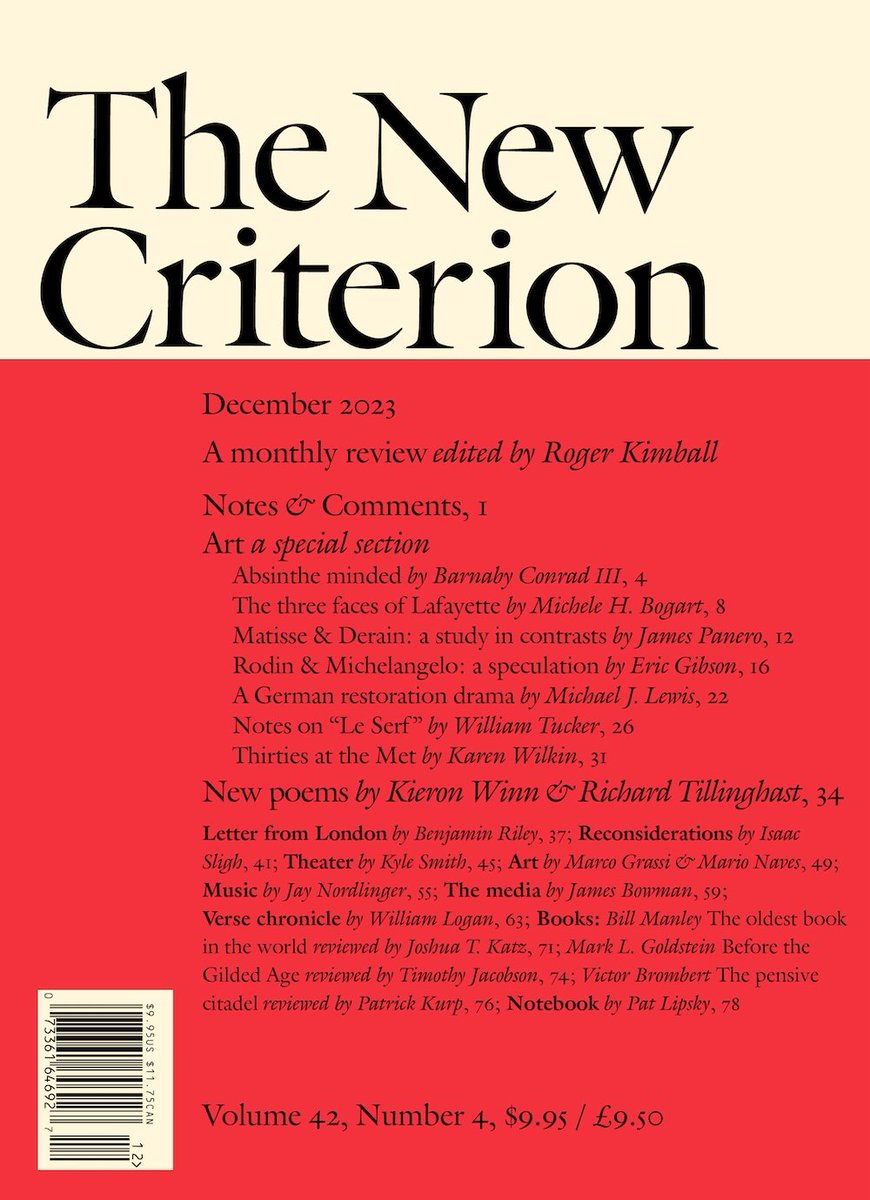
Arts & Culture: The New Criterion — October 2023

Image

The New Criterion – October 2023 issue:

The new conservative dilemma  a symposium

Today’s conservative dilemma  by James Piereson
Can conservatives still win  by Victor Davis Hanson
Conservatism reconfigured  by Daniel McCarthy
The promise of populism  by Margot Cleveland

New poems  by Daniel Brown, Sophie Cabot Black & W. S. Di Piero

Previews: The New Yorker Magazine – Sept 25, 2023

Diana Ejaitas “Lines of Beauty”
Art by Diana Ejaita

The New Yorker – September 25, 2023 issue: The new issue features the Fall Style & Design issue which showcases the work of Diana Ejaita, an artist who has herself dabbled in the world of fashion.

The Bloomsbury Group Is Back in Vogue

Lady Ottoline Morrell photographed by Cecil Beaton.

The bohemian English circle that included Virginia Woolf, Duncan Grant, and Vanessa Bell revolted against Victorian formality—and their casually ornamental style is inspiring designers today.

By Rebecca Mead

In July, 1918, Virginia Woolf spent a weekend at Garsington—a country home, outside Oxford, owned by Lady Ottoline Morrell, a celebrated hostess of the era, and her husband, Philip Morrell, a Member of Parliament. The house, a ramshackle Jacobean mansion that the Morrells had acquired five years earlier, had been vividly redecorated by Ottoline into what one guest called a “fluttering parrot-house of greens, reds and yellows.” One sitting room was painted with a translucent seafoam wash; another was covered in deep Venetian red, and early visitors were invited to apply thin lines of gold paint to the edges of wooden panels. The entrance hall was laid with Persian carpets and, as Morrell’s biographer Miranda Seymour has written, the pearly gray paint on the walls was streaked with pink, “to create the effect of a winter sunset.” Woolf, in her diary, noted that the Italianate garden fashioned by Morrell—with paved terraces, brilliantly colored flower beds, and a pond surrounded by yew-tree hedges clipped with niches for statuary—was “almost melodramatically perfect.”

A Young Architect’s Designs for the Climate Apocalypse

Pavels Hedström wearing the Inxect Suit.

Pavels Hedström believes that most architecture separates us from nature. He wants to make nonhuman life inescapable.

By Sam Knight

At the end of his first year at the architecture school of the Royal Danish Academy, Pavels Hedström went on a class trip to Japan. Hedström, a twenty-five-year-old undergraduate, revered Japanese culture and aesthetics, even though he had never visited the country. As a teen-ager growing up in rural Sweden, Hedström had been introduced to Zen meditation by his mother, Daina, and devoured manga and anime. In architecture school, Hedström was drawn to Japanese principles of design and how they applied to a world—and a profession—increasingly troubled by the climate crisis. Hedström was particularly influenced by Metabolism, a postwar Japanese architectural movement that imagined cities of the future as natural organisms: ephemeral, self-regulating, and subject to biological rhythms of growth, death, and decay. In 1977, Kisho Kurokawa, one of Metabolism’s founders, wrote, “Human society must be regarded as one part of a continuous natural entity that includes all animals and plants.”

Fiction: The 2023 National Book Awards Longlist

2023 National Book Awards Longlist for Fiction - National Book Foundation

2023 National Book Awards Longlist for Fiction – National Book Foundation

National Book Foundation (September 15, 2023) – The ten titles on the list were chosen from four hundred and ninety-six submissions by publishers. Three authors on the longlist, Nana Kwame Adjei-Brenyah, Jayne Anne Phillips, and Justin Torres, have been previously honored by the National Book Foundation. The full list is below.

Nana Kwame Adjei-BrenyahChain-Gang All-Stars
Pantheon Books / Penguin Random House

Aaliyah BilalTemple Folk
Simon & Schuster

Eliot DuncanPonyboy
W. W. Norton & Company

Paul HardingThis Other Eden
W. W. Norton & Company

Tania JamesLoot
Knopf / Penguin Random House

Jayne Anne PhillipsNight Watch
Knopf / Penguin Random House

Mona Susan PowerA Council of Dolls
Mariner Books / HarperCollins Publishers

Hanna PylväinenThe End of Drum-Time
Henry Holt and Company / Macmillan Publishers

Justin TorresBlackouts
Farrar, Straus and Giroux / Macmillan Publishers

LaToya WatkinsHoller, Child
Tiny Reparations Books / Penguin Random House

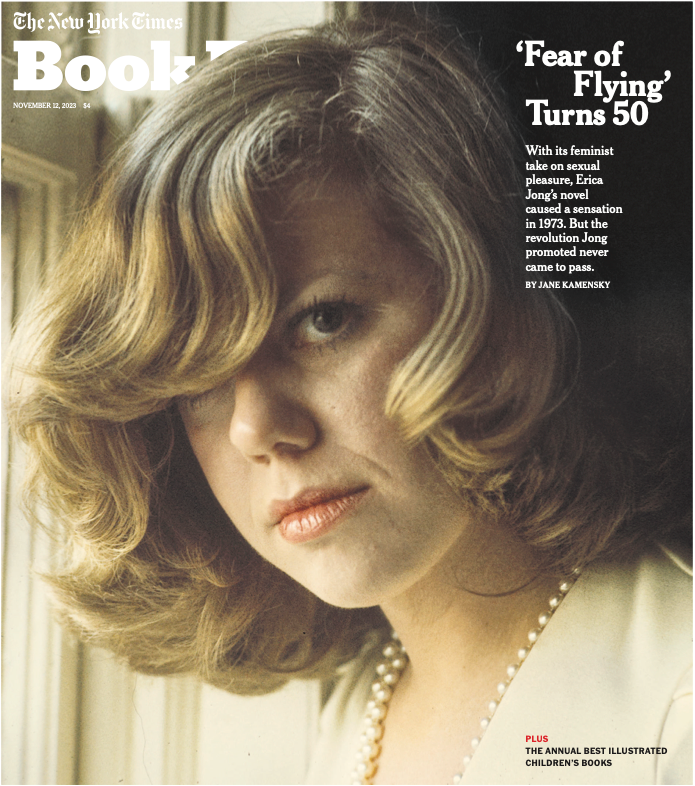
The New York Times Book Review – Sept 17, 2023

Image

THE NEW YORK TIMES BOOK REVIEW (September 17, 2023): The new issue features An Illustrated Guide to Toppling the Patriarchy, New Thrillers, Appalachian Literature, The Good Virus, and more…

An Illustrated Guide to Toppling the Patriarchy

In its first half-century, Ms. magazine upended norms, disrupted the print world and made trouble. It was a start.

By Anna Holmes

50 YEARS OF MS.: The Best of the Pathfinding Magazine That Ignited a Revolution, edited by Katherine Spillar and the editors of Ms.


I had my first conscious interaction with Ms. magazine as a small child when I read — or rather, had read to me — a story-poem called “Black Is Brown Is Tan.”

Part of the magazine’s delightful kids’ section, “Black Is Brown Is Tan” is about a mixed-race family not unlike my own who go about their daily routines like any other Americans. Though I was young, I remember the illustrations, by Emily Arnold McCully, with acute clarity: the rosy cheeks of the white dad, the short Afro and hoop earrings of the Black mom, and, perhaps most important, the sense of safety and warmth that permeated every page. In our house, where my mother was careful about the messaging of the media and toys we consumed, the “Stories for Free Children” section was always welcome. As for the magazine they appeared in? Well, it was canon.

A Rich, Capacious Family Saga, Bookended by Tragedy

In this photograph, an apartment building sits in the fore, with the destruction of the Grenfell Tower fire visible in the background.

In Diana Evans’s new novel, “A House for Alice,” a woman who immigrated to Britain for marriage must decide whether or not to return to her country of origin after her husband dies.

By Tiphanie Yanique

A HOUSE FOR ALICE, by Diana Evans


Houses in Diana Evans’s new novel, “A House for Alice,” are a metaphor for family. They’re filled with rooms for sleeping, lovemaking, fighting; contain corridors that lead to areas of welcome and comfort; shelter spaces that hold secrets. And like a house, a family can be burned to nothing and rebuilt anew.

Reviews: ‘The Week In Art’

The Week In Art Podcast (September 15, 2023): A Unesco conference and archeological summit in Saudi Arabia are the latest examples of the country’s increasing focus on culture as part of the so-called Vision 2030 programme.

We look at Saudi Arabia’s unprecedented and lavishly funded focus on contemporary and ancient culture and how that relates to ongoing concerns about artistic freedom and human rights abuses in the kingdom. Alia Al-Senussi, a cultural strategist, and senior advisor at Art Basel and to the Saudi Ministry of Culture, joins host Ben Luke to discuss the contemporary art scene, and Melissa Gronlund, a reporter on the Middle East for The Art Newspaper, tells us about the push to reveal hitherto underexplored Saudi heritage.

The Sierra Leone-born, London-based artist and poet Julianknxx this week unveiled a new project at London’s Barbican Centre, Chorus in Rememory of Flight. The multi-screen installation features performers and choirs from the African diaspora who Julianknxx met on a 4,000-mile trip around European cities with colonial histories, from Lisbon via Marseille, Rotterdam and Berlin to London. We talk to him about this epic endeavour. And this episode’s Work of the Week is among the greatest works on paper ever made: Michelangelo’s studies in red chalk for the Libyan Sibyl, one of the most distinctive figures on his Sistine Chapel ceiling. The drawing features in Michelangelo and Beyond at the Albertina in Vienna and one of its curators, Constanze Malissa, tells us more about it.

Art in Saudi Arabia: A New Creative Economy? by Rebecca Anne Proctor, with Alia Al-Senussi, published 30 November, Lund Humphries, £19.99.

Julianknxx: Chorus in Rememory of Flight, The Curve, Barbican Centre, London, and online on WePresent, until 11 February 2024; Julianknxx is in A World in Common: Contemporary African Photography, Tate Modern, until 14 January 2024.

Michelangelo and Beyond, Albertina, Vienna, 15 September-14 January 2024.