
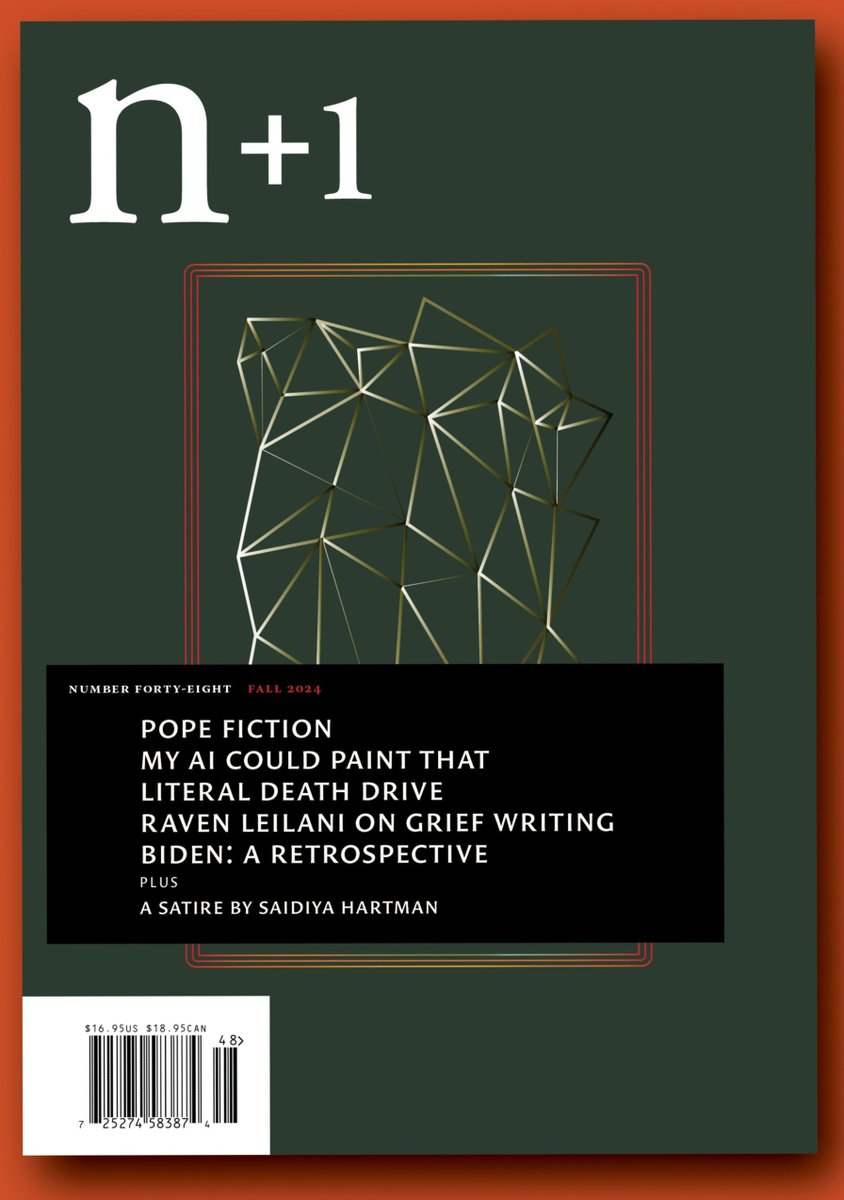

@nplusonemag (August 16, 2024): The ‘Inside Job’ issue features Pope Fiction, My AI Could Paint That, Literal Death Drive, Raven Leilani on Grief Writing; Biden – A Retrospective and A Satire by Saidiya Hartman…

@nplusonemag (August 16, 2024): The ‘Inside Job’ issue features Pope Fiction, My AI Could Paint That, Literal Death Drive, Raven Leilani on Grief Writing; Biden – A Retrospective and A Satire by Saidiya Hartman…


Rhian Sasseen swipes right on behalf of a fictional porn addict;
Francesca Peacock roots through the archives for a deeper understanding of scandal and speech;
Ruth Madievsky closes the gate on her college rumor mill;
and Emmeline Clein recounts an “American Icarus story” spelled out in diet pills and rhinestones.
Francesca Peacock roots through the archives for a deeper understanding of scandal and speech in an essay from the LARB Quarterly issue no. 42, “Gossip.”


Country Life Magazine (August 14, 2024): The latest issue features ‘Save the Albion Cow’ – It’s rarer than a Giant Panda; Old houses, new technology; Hot and Steamy – Why the pressure cooker is back and Whizz kids – What made Elizabeth I, Brunel and Nelson special…
Our treasured native livestock breeds are in danger of being lost, yet they have a crucial role to play, believes Kate Green

Anyone waiting with trepidations for the A-level results should take heart from the likes of Nelson and Brunel, says Alice Loxton
Old houses with poor wifi need not be denied new gadgets, from wireless lighting to kettles that can be switched on remotely. Julie Harding taps her screen
From a hollowed-out cow to autofocus and gyro-stabilised cameras, clever ideas continue to transform wildlife photography. Amie Elizabeth White takes a look down the lense.

Neil Buttery fires up the pressure cooker, back in our kitchens and tenderising those bones
Sturdy, hardworking and now prized for their rarity, farm wagons were key to rural life in times past. Jack Watkins rolls out the surviving examples.
Follow thou Toby Keel’s wise advice for digital life and thou shalt not be shunned in society
The new generation is building on a fine legacy of gardening and travel at Bryngwyn Hall in Powys, where Caroline Donald wanders among trees gathered from far-flung countries

John Wright sets off into the woods in search of meaty rot fungi, the magnificent chicken of the woods and its cousin, joy-inducing hen of the woods
It might be an acquired taste, but gazpacho — recipe of your choice — is worth tasting again. Tom Parker Bowles dips his spoon into a Spanish favourite


Do jokes express our otherwise taboo wishes? Or does everyone just need a pie in the face? By Emma Allen
The semi-serious science of why we laugh. By Tad Friend
Chaplin’s epochal fame has tended to obscure the influences and instincts that infused his art with childlike purity.


By James Butler
The first time the man heard God, he uprooted his entire life, though he was very old. Then God appeared to him in person, an event which would embarrass later thinkers. God made the man an impossible promise in the shape of a son. His wife was ninety, and she laughed. When the child arrived, it was hardly unreasonable to think it a miracle. They named the child after the laughter.
By Colin Burrow
In 1904 Henry James’s agent negotiated with the American publisher Charles Scribner’s Sons to produce a collected edition of his works. The New York Edition of the Novels and Tales of Henry James duly appeared in 1907-9. It presented revised texts of both James’s shorter and longer fiction, with freshly written prefaces to each volume. It didn’t include everything: ‘I want to quietly disown a few things by not thus supremely adopting them,’ as James put it. The ‘disowned’ works included some early gems such as The Europeans. The labour of ‘supremely adopting’ the stuff he still thought worthy was grinding. He worked on the new prefaces, which he described as ‘freely colloquial and even, perhaps, as I may say, confidential’ (though James’s notion of the ‘freely colloquial’ is perhaps not everyone’s) during the years 1905 to 1909. In some respects, the venture was not a success. ‘Vulgarly speaking,’ James said of the New York Edition, ‘it doesn’t sell.’
By Jean McNicol
A week before the start of the Paris Olympics, Shoko Miyata, the 19-year-old captain of the Japanese women’s gymnastics team, was forced to withdraw from the competition by her national association. She had been reported to the Japan Gymnastics Association for smoking and drinking (on separate occasions, once for each offence). The president of the JGA, Tadashi Fujita, announced that Miyata had been sent home, and bowed deeply.

Country Life Magazine (August 7, 2024): The latest issue features ‘Huts for Heroes’ – Where adventures start…
Could Queen Victoria’s consort, Prince Albert, be considered an architect? He thought so — and Michael Hall tends to agree
Carla Passino salutes the modest Henry Tate, whose name will live forever in the art world
Healing, revealing, defence against thieving, our wildflowers’ names tell the story of our ancestors. John Lewis-Stempel reads the leaves
An Antarctic explorer’s base or a Scottish fisherman’s shelter, the humble hut is a crucial element in stirring tales. Robin Ashcroft opens the doors

Even the most distasteful jobs could offer compensations to savvy servants in the Royal Household, finds Susan Jenkins
The great Netherlandish masters have no equal in admirers and influence, believes Michael Hall
The biscuiteer picks a haunting scene in a lonely hotel room
Carla Carlisle pays tribute to the memory of a farmer, honest broadcaster and dear friend
What do the white behinds of rabbits, deer and foxes really say? Laura Parker deciphers scuts, rumps and rears

Securing the harvest is the weather watcher’s concern in August, says Lia Leendertz
Hetty Lintell wraps up in style ready to hit the beach
A party-ready sitting room and stylish touches for a home office
The fourth generation to nurture the garden of Glin Castle, Co Limerick, Ireland, is doing her predecessors proud. Caroline Donald explores a windswept haven beside the Shannon

Melanie Johnson conjures up treats with courgette flowers
Even the tiniest town garden can offer views and wildlife to rival open countryside, believes city dweller Jonathan Notley
Pamela Goodman gives in to whimsy in Wales
Harry Hastings delights in the Art Deco Hotel Casa Lucía in Argentina
Rosie Paterson rounds up the best new openings in Greece

President Biden has proposed radical changes to the Court. Reviewing them is a reminder of why reform is so hard, despite dissatisfaction and a wealth of ideas.
By Amy Davidson Sorkin

Julie Benko, who hit it big after going on in place of Beanie Feldstein in “Funny Girl,” has a lot of advice for the Vice-President, now that she’s done with waiting in the wings.
By Zach Helfand
The third-party Presidential candidate has a troubled past, a shambolic campaign, and some surprisingly good poll numbers.
By Clare Malone


Literary Review – August 3, 2024: The latest issue features ‘Rise and Fall of the Cromwells’; Thom Gunn’s demons; Prams and paintbrushes; Children of Atatürk; Friedrich in nature…


Fifty years after Shirley Chisholm ran for the Presidency, we find ourselves yet again questioning the durability of outmoded presumptions about race and gender. By Jelani Cobb
In Milwaukee, with a candidate who had just cheated death, the resentment rhetoric of Trump’s 2016 campaign gave way to an atmosphere of festive certainty. By Anthony Lane
She became famous playing buttoned-up Agent Scully. But in midlife her characters often have a strong erotic charge—and now she’s edited “Want,” a book of sexual fantasies. By Rebecca Mead






 Boomers Daily