
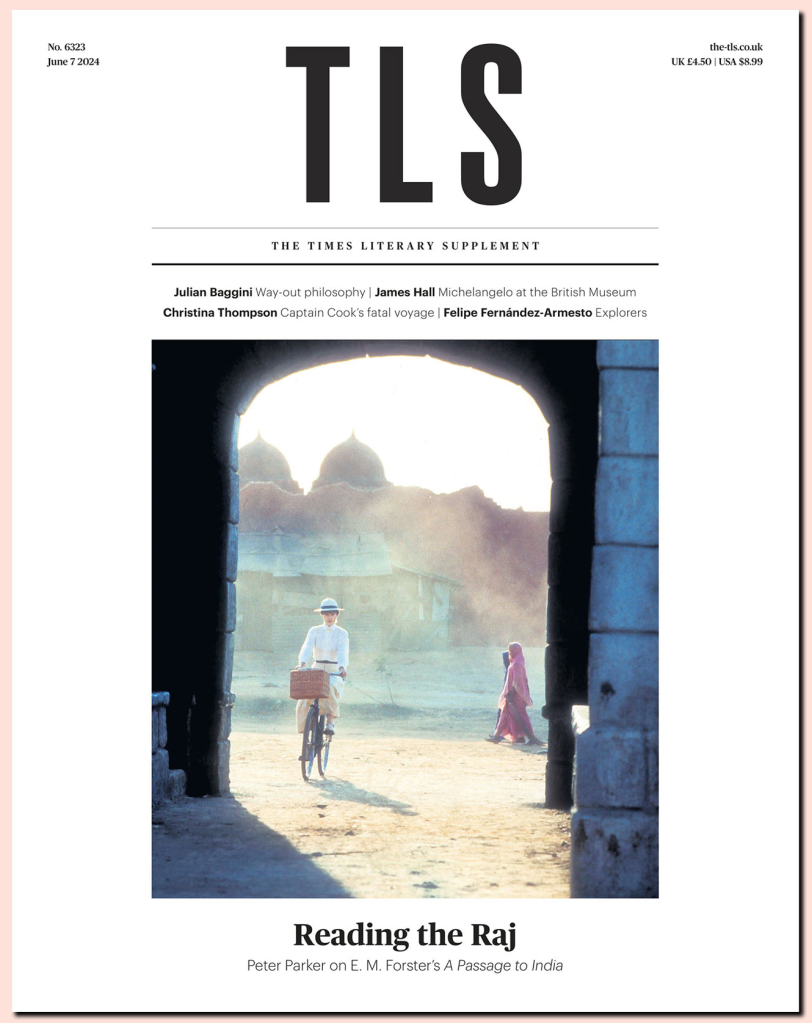
Times Literary Supplement (June 5, 2024): The latest issue features Reading the Raj – E.M. Forster’s ‘A Passage to India’, Way-Out Philosophy, Michelangelo at the British Museum…

Times Literary Supplement (June 5, 2024): The latest issue features Reading the Raj – E.M. Forster’s ‘A Passage to India’, Way-Out Philosophy, Michelangelo at the British Museum…


THE AMERICAN SCHOLAR (June 4, 2024): The latest issue features ‘An Olympian for the Ages’ – Why George Eyser’s feats at the 1904 Games deserve to be celebrated today; Joshua Prager on a forgotten Olympian, Mickalene Thomas and the art of remixing, new poetry from Ange Mlinko, and more…

Who was George Eyser, the one-legged German-American gymnast who astounded at the Olympic Games?

Mickalene Thomas and the art of remixing
Is the convergence of human and machine really upon us?
The Singularity Is Nearer: When We Merge with AI by Ray Kurzweil
In the fall of 2014, an MIT cognitive scientist named Tomaso Poggio predicted that humankind was at least 20 years away from building computers that could interpret images on their own. Doing so, declared Poggio, “would be one of the most intellectually challenging things … for a machine to do.” One month later, Google released an AI program that did exactly what he’d deemed impossible.
BARRON’S MAGAZINE – June 3, 2024 ISSUE:


Some preferred stock offers a far better yield than the 4.65% rate on 30-year Treasuries. Here’s what to know.

A series of the mergers and acquisitions are putting together the oil company that was broken up by the Supreme Court in 1911.



At a crucial moment they encapsulate the dilemma of how to handle populism

A backlash against abortion bans is energising the middle ground in America

They are saving like never before. But even that may not bring interest rates down

‘
Before its computer crashed, venerable NASA probe may have entered mysterious new region beyond the Solar System
Mouse study contradicts landmark finding, but some question its methodology
Pathogen that kills victims within days leaps from Caribbean to Red Sea

‘
Researchers are striving to reverse-engineer artificial intelligence and scan the ‘brains’ of LLMs to see what they are doing, how and why.
Geological survey reveals the remains of a major waterway that ancient Egyptian builders could have used to transport materials.
As researchers mark the loss of the first living recipient of a pig kidney, they share what they’ve learnt about xenotransplantation.

Times Literary Supplement (May 29, 2024): The latest issue features ‘Kafka’s Century’ – Karen Leeder, Becca Rothfeld, Gabriel Josipovici, Michael Hofmann et al…; Colm Toibin returns to Brooklyn; India under Modi; A Jim Crow insane asylum and Literary cricket…

BARRON’S MAGAZINE – MAY 13, 2024 ISSUE:

An income annuity might just be your lock on enough money for life. Here’s how to know.Long read
Their 5%-plus yield looks attractive—especially with the Federal Reserve unlikely to cut interest rates soon.Long read

‘
A cell-by-cell look at neuropsychiatric diseases
DNA sequences are connected to genes and functions in the developing and adult brain
DNA study implicates medieval warfare and colonial trade


Economies must adapt to baby busts instead
As birth rates plunge, many politicians want to pour money into policies that might lead women to have more babies. Donald Trump has vowed to dish out bonuses if he returns to the White House. In France, where the state already spends 3.5-4% of gdp on family policies each year, Emmanuel Macron wants to “demographically rearm” his country. South Korea is contemplating handouts worth a staggering $70,000 for each baby. Yet all these attempts are likely to fail, because they are built on a misapprehension.
Governments’ concern is understandable. Fertility rates are falling nearly everywhere and the rich world faces a severe shortage of babies. At prevailing birth rates, the average woman in a high-income country today will have just 1.6 children over her lifetime. Every rich country except Israel has a fertility rate beneath the replacement level of 2.1, at which a population is stable without immigration. The decline over the past decade has been faster than demographers expected.
The death of the president changes the power dynamic
A new generation of AI chips is on the way
The rainbow nation needs an alternative to decline under the ANC
Rishi Sunak’s election call makes no sense, but is good news




 Boomers Daily