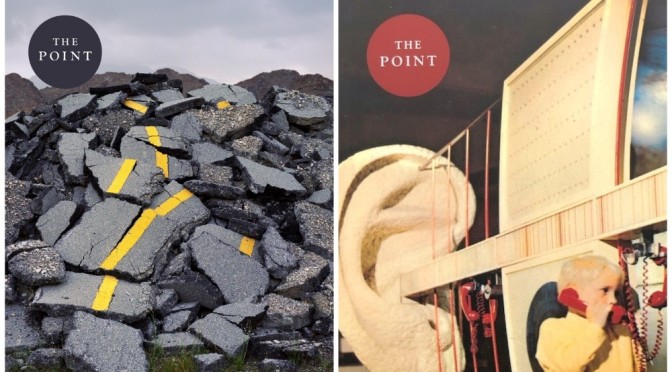
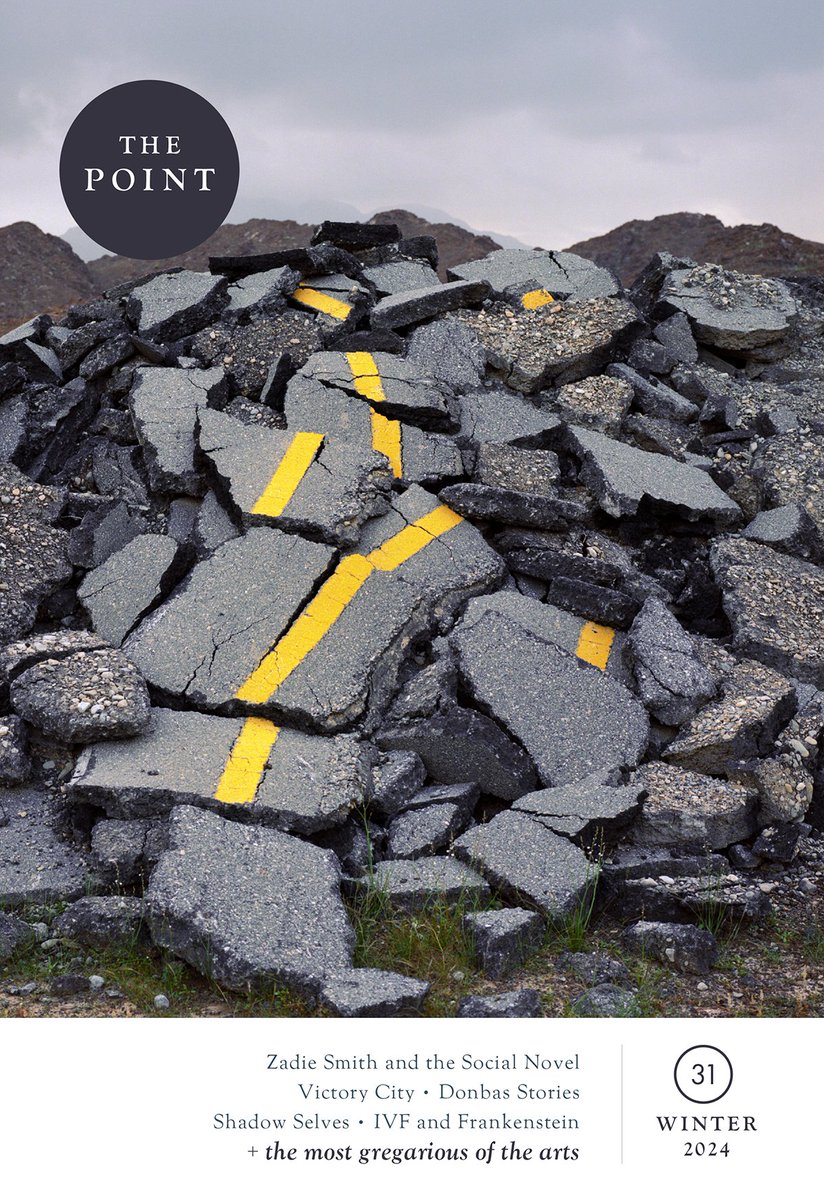
The Point Magazine (December 17, 2023) – The latest issue features ‘Entering History’ – Leave it to Zadie Smith to include a political Rorschach test in her latest novel; ‘Within the Pretense of No Pretense’ – Technology was the wonder of our age. It seemed to promise us power, and we took this power for our own; Venice Architecture Biennale – The city of Venice may very well be, as the architecture theorist Manfredo Tafuri once claimed, “an unbearable challenge to the world of modernity,”, and more….
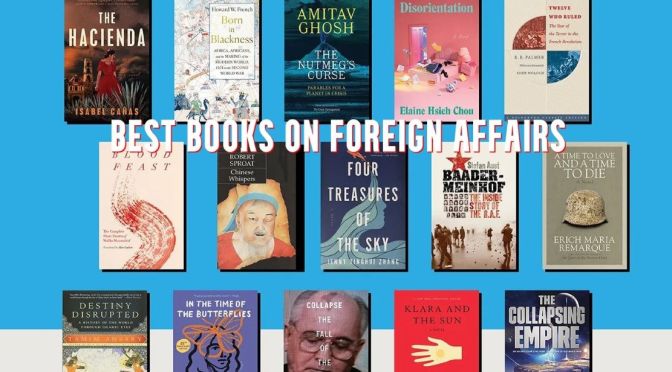
In a timely and thought-provoking book, Zahra delves into the tumultuous years between World War I and World War II to argue that it was resistance to globalism and globalization that ended up weakening Europe’s then-fragile democracies, eventually contributing to the continent’s slide into dictatorship. READ THE REVIEW
Bass’s magnificent book, an account of the post–World War II Tokyo war-crimes trial, encourages a deeper understanding of the Asian experience of war and occupation. His work also sheds light on an enduring debate about liberalism and international politics, showing how the trial played formative roles both in postwar Asian politics and in the making of the postwar global human rights regime. READ THE REVIEW
In a sophisticated and expansive account, Wolf, a veteran economics commentator, suggests that the root cause of today’s political and economic malaise lies in the breakdown of the relationship between capitalism and liberal democracy—and the failure of institutions to counter poverty and marginalization. READ THE REVIEW
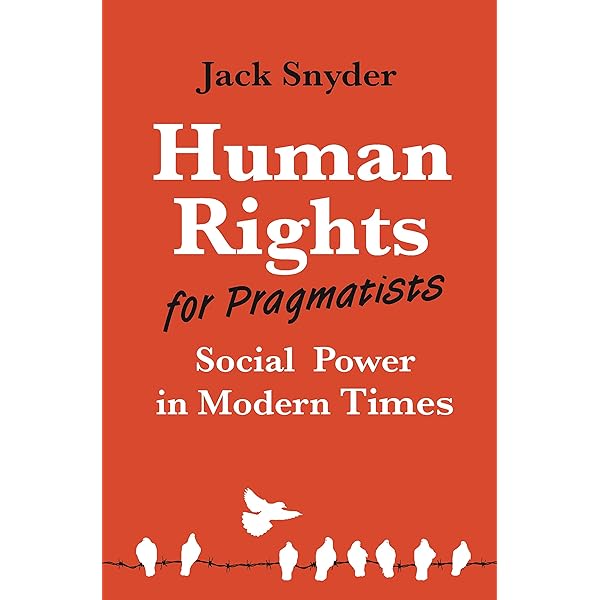
In this masterful work, Snyder offers a bold explanation for why, how, and when societies make progress in expanding political rights and freedoms, arguing that breakthroughs occur when human rights serve the interests of a country’s dominant political coalition .READ THE REVIEW
Trubowitz and Burgoon argue in this groundbreaking study that the current backlash against the Western-led liberal international order can be traced to the 1990s, when the United States and European governments encouraged globalization at the expense of social and economic protections at home. READ THE REVIEW
Moving beyond the standard account of the twentieth century as an epic struggle between democracy and autocracy, Maier examines how a wide range of actors tried to harness industrial modernity in the pursuit of power and material interests, weaving an alternative narrative about the explosive interplay of economic privilege and political grievance. READ THE REVIEW
Monocle on Sunday, December 17, 2023– Monocle’s editorial director, Tyler Brûlé, is joined by Florian Egli and Marcus Schögel to discuss the weekend’s biggest talking points.
Also, a check-ins with our friends and correspondents in London, Helsinki, Paris and Belgrade.
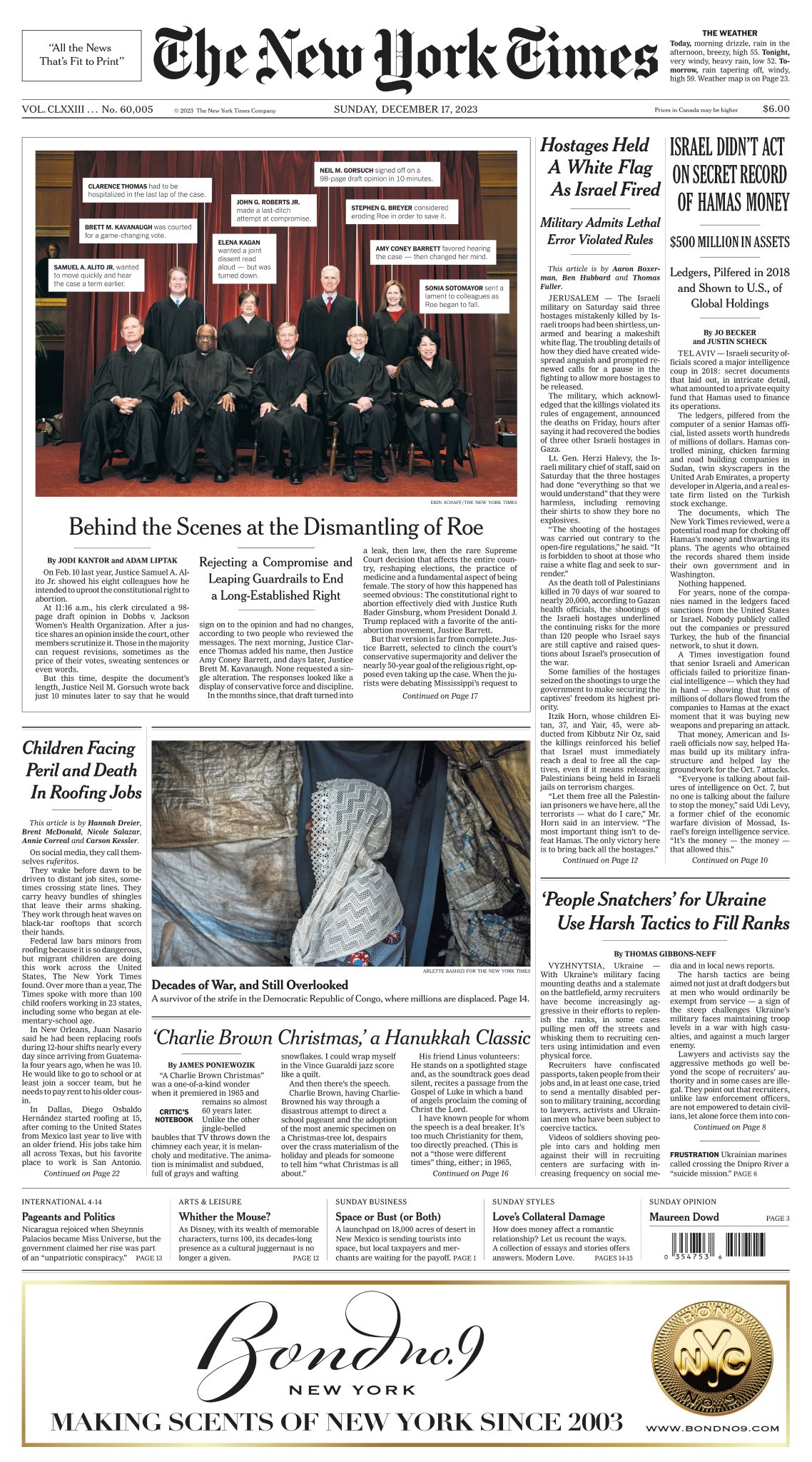
Agents worried as millions poured in. Hamas bought weapons and plotted an attack. The authorities now say the money helped lay the groundwork for the Oct. 7 assault on Israel.
This is the inside story of how the Supreme Court overturned the constitutional right to abortion — shooting down compromise and testing the boundaries of how the law is decided.
Six million have died, and more than six million are displaced after decades of fighting and the ensuing humanitarian crisis in the eastern region of the Democratic Republic of Congo, drawing in neighbors, mercenaries and militias. An upcoming election is inflaming tempers.
The Wall Street Journal (December 16, 2023) – How does Google Maps use satellites, GPS and more to get you from point A to point B? What is the tech that powers Spotify’s recommendation algorithm?
Video timeline: 0:00 Google Maps 9:07 LED wristbands 14:30 Spotify’s algorithm 21:30 Tap-to-Pay 28:18 Noise-canceling headphones 34:33 MSG Sphere 41:30 Shazam
From the unique tech that works in seconds to power tap-to-pay to how Shazam identifies 23,000 songs each minute, WSJ explores the engineering and science of technology that catches our eye. Chapters:
Yurara Sarara Films (December 15, 2023) – Collections of the beauty of Japanese gardens in Kyoto. There are many types of Japanese gardens, from the karesansui dry rock gardens that replicate the flow of water with rocks, to the strolling gardens that are built around a pond. Because of the relation these gardens have with Zen and the Japanese concept of wabi and sabi, they are most often found at temples, so this, of course, means there are many Japanese gardens in Kyoto.
Monocle on Saturday, December 18, 2023: Terry Stiastny joins Georgina Godwin for a look through the week’s news and culture. Ukraine’s president, Volodymyr Zelensky, fails to secure long-term financial aid from the US and the EU, Rishi Sunak attends a hard-right-wing political festival in Italy and we learn about Finland’s festive TV genre – reindeer noir. Plus: Grace Charlton discusses Monocle’s Christmas gift-giving guide.
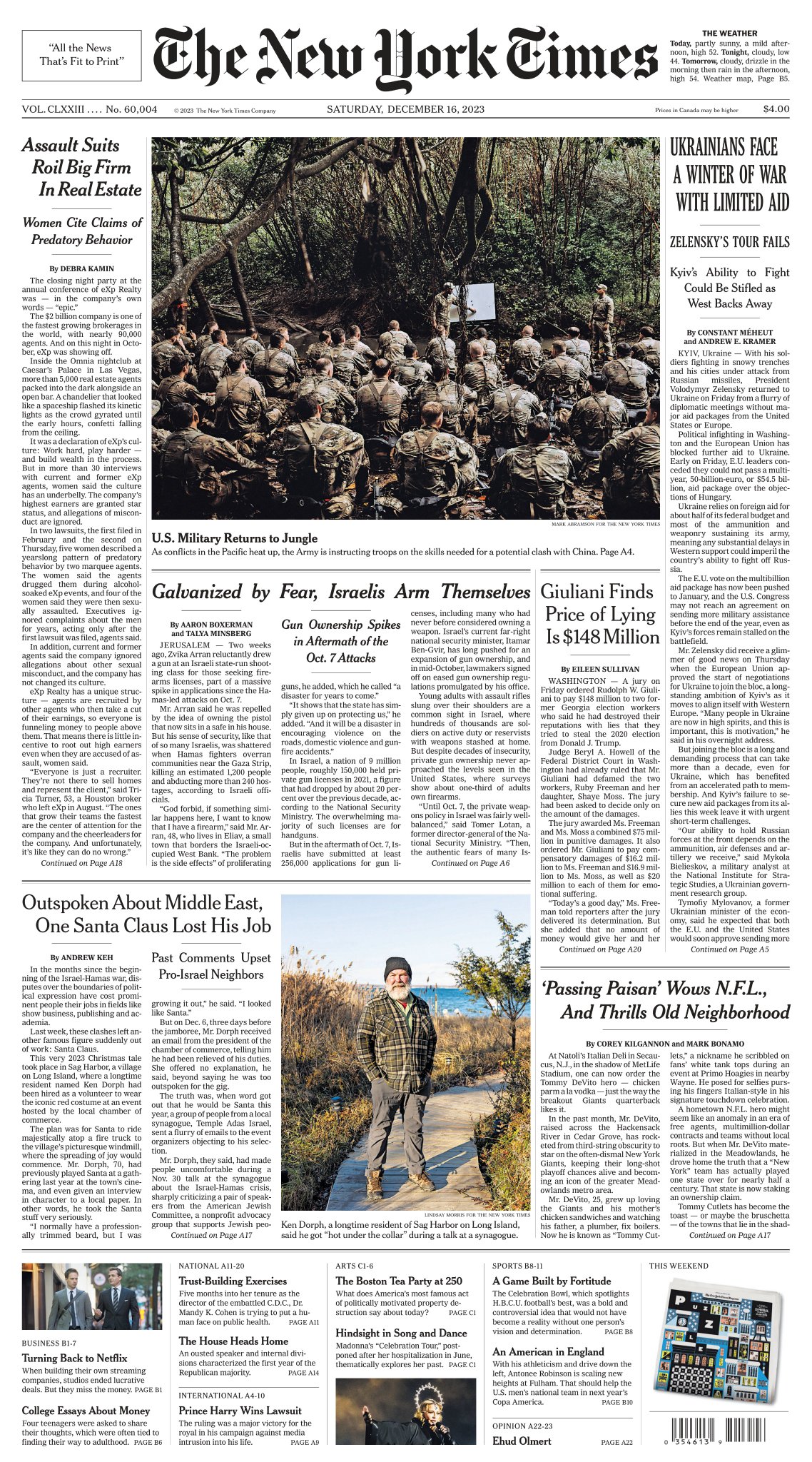
The European Union’s willingness to open accession talks will lift morale, but the more immediate prospects for financial support from allies is sobering.
In lawsuits, five women say eXp Realty long ignored complaints that two male agents were preying on their female peers at alcohol-fueled work events.
Private Gun Ownership in Israel Spikes After Hamas Attacks
In a country already bristling with armed soldiers and reservists, a new sense of insecurity is pushing civilians to seek more personal weapons.
Jury Orders Giuliani to Pay $148 Million to Election Workers He Defamed
Ruby Freeman and Shaye Moss, wrongfully accused by Rudolph W. Giuliani of having tried to steal votes from Donald J. Trump in Georgia, were awarded the damages by a federal court in Washington.
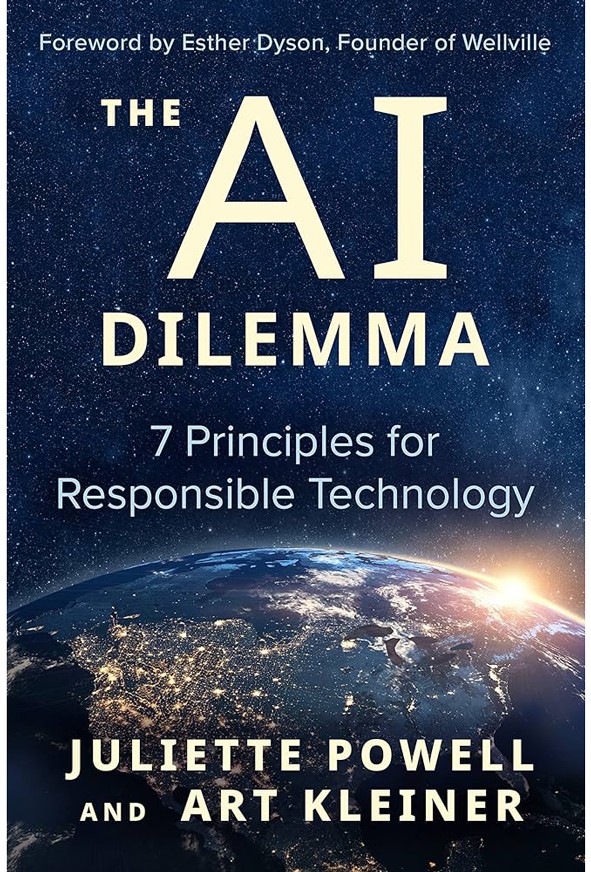
Juliette Powell & Art Kleiner Berrett-Koehler (2023)
The benefits and harms of social media are intimately tied to the ongoing debate about artificial intelligence (AI). Will AI systems trained partly on social media benefit or harm humanity? In their excellent, sometimes alarming, analysis of engineering, social justice, commerce and government, entrepreneur and technologist Juliette Powell and writer and educator Art Kleiner compare humans developing AI tools to first-time parents. They recommend guiding AI systems “as we would a child towards full adulthood”.
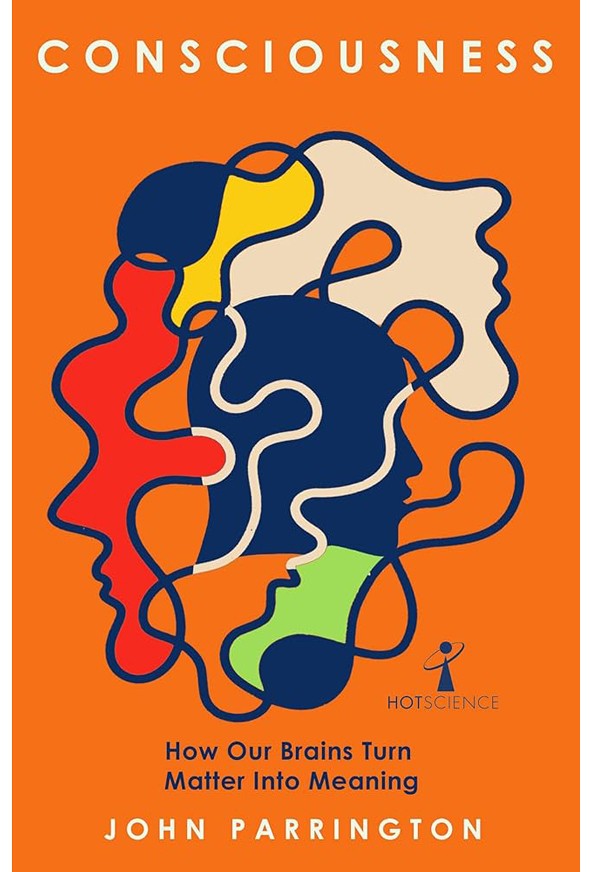
Consciousness
John Parrington Icon (2023)
“The material basis of human consciousness is one of the biggest unsolved issues in science,” admits cellular and molecular pharmacologist John Parrington in his pithy addition to a vast literature dating from the time of ancient Greek philosopher Aristotle. He considers many theories and proposes his own. Humans, he argues, are distinguished by conceptual thought and language, along with skills in designing tools and technologies. The evolution of these powers transformed our brains, creating meaning and consciousness.
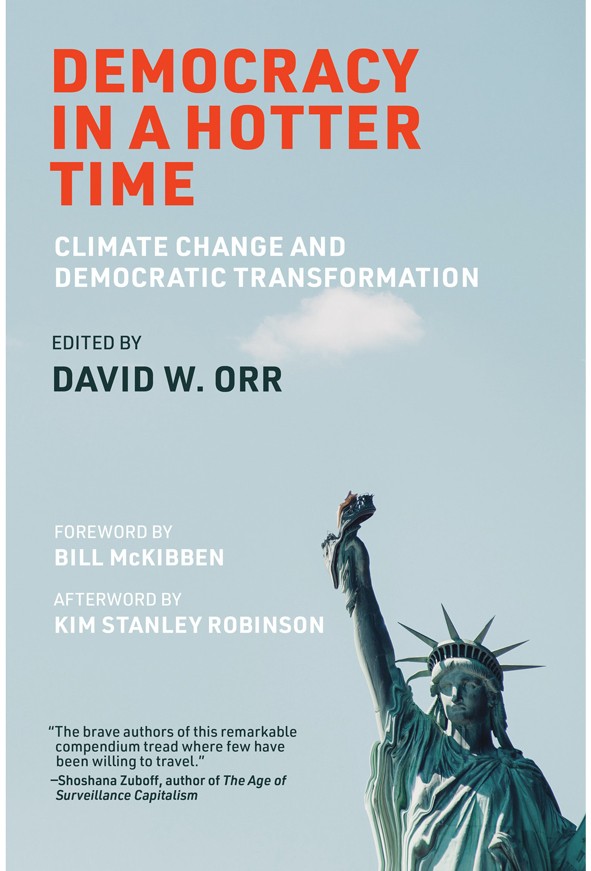
Democracy in a Hotter Time
Ed. David W. Orr MIT Press (2023)
Environmentalist David Orr writes in the introduction to this timely collection that the planet faces two interlinked crises: “rapid climate change and potentially lethal threats to democracy”. The US Constitution rigorously protects private property but does not mention ecological systems, he observes. Contributors — almost all US-based — from a wide range of fields examine the need for political reform. The book is in four parts: the nature of democracy; roadblocks to change; policy and law; and education, including academic culture.
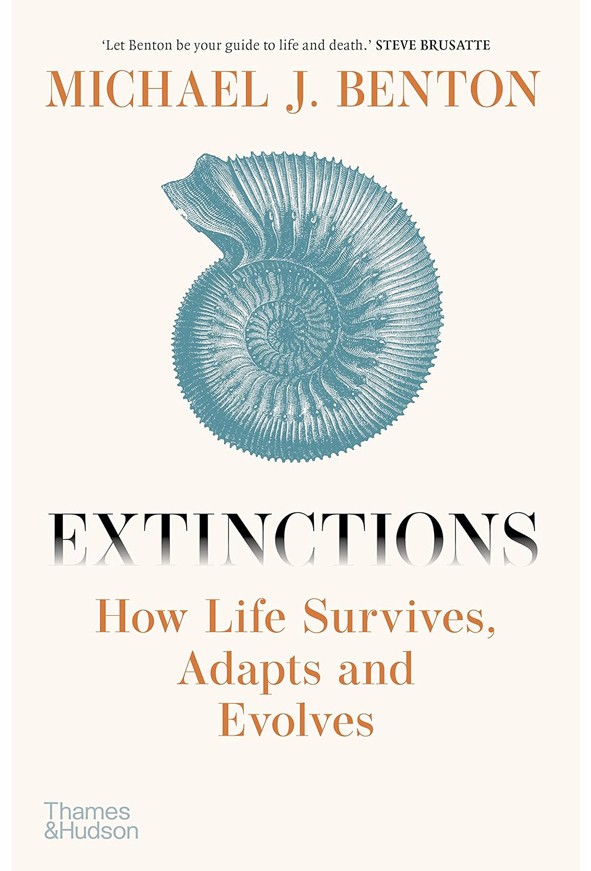
Extinctions
Michael J. Benton Thames & Hudson (2023)
When palaeontologist Michael Benton learnt about dinosaurs as a boy, he “loved the fact they were extinct”. They were like real science fiction. Perhaps he also intuited that their extinction permitted his existence. As his deeply informed and readable book reveals, the mass extinction at the end of the Cretaceous period 66 million years ago allowed a new cohort of creatures — including mammals — to “inherit the Earth”, as did four earlier extinction events. Living species represent less than 1% of all the species that have existed.
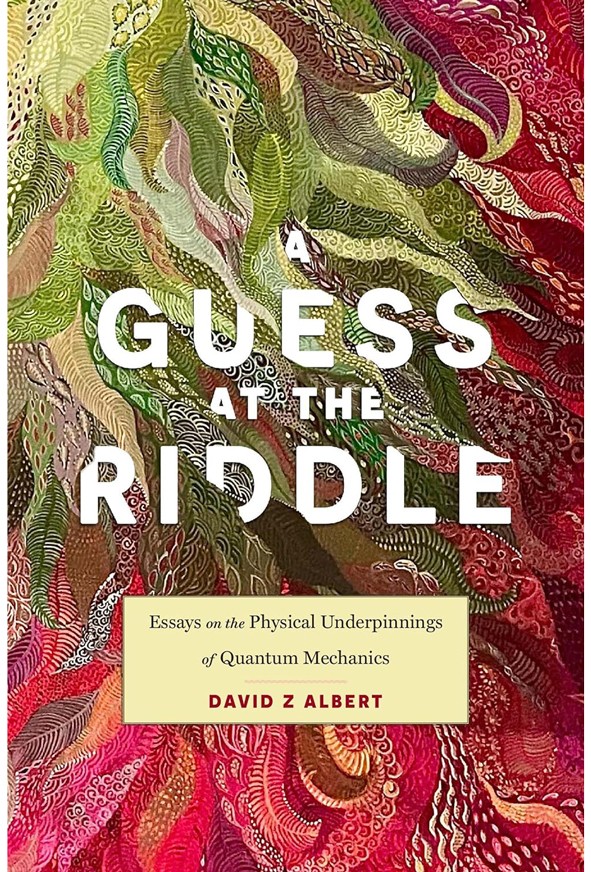
A Guess at the Riddle
David Z. Albert Harvard Univ. Press (2023)
The physical interpretation of quantum mechanics has been a controversial riddle since the 1920s, when Niels Bohr argued that the atom’s inner workings could not be described in physical terms. Today, many philosophers and physicists disagree, but there’s no consensus on an alternative. Philosopher David Albert’s provocative book argues, in three essays, that Bohr’s quantum-measurement problem starts to make sense if the wave function is understood as the fundamental physical ‘stuff’ of the Universe.
News, Views and Reviews For The Intellectually Curious



















 Boomers Daily