On the Mayo Clinic Radio program, Dr. Derek Lomas, a Mayo Clinic urologist, discusses prostate cancer, including a new biopsy method.
This interview originally aired Feb. 22, 2020. Prostate cancer is the second most common cancer — second to skin cancer — among men in the U.S. One in 9 men will be diagnosed with prostate cancer in his lifetime, according to the American Cancer Society. Screening is important because early detection greatly improves the chances of survival. While some types of prostate cancer grow slowly, and may need minimal or even no treatment, other types are aggressive and can spread quickly. If prostate cancer is suspected, a biopsy can confirm the diagnosis.
Filmed and Edited by: ADRIEN MAUDUIT (Night Lights Films)
Believe it or not, we didn’t have that much of a winter. Even in Arctic Norway! Since November, 13 consecutive extra-tropical cyclones have brushed the coast of Norway affecting even the coldest places of the country. As a consequence, lots of positive temperatures and rain on top of the snow, somehow destroying the typical arctic wonderland.
However in between the lukewarm rainstorms, the cold came back and allowed for short periods of freezing temperatures and snow. In these moments it was important for me to get out there whenever I could and capture all I could get. Cold also meant clearer skies and as a result aurora. Nonetheless it was never as easy as that because of the solar minimum we are at. It means lower auroral activity and fewer big shows.
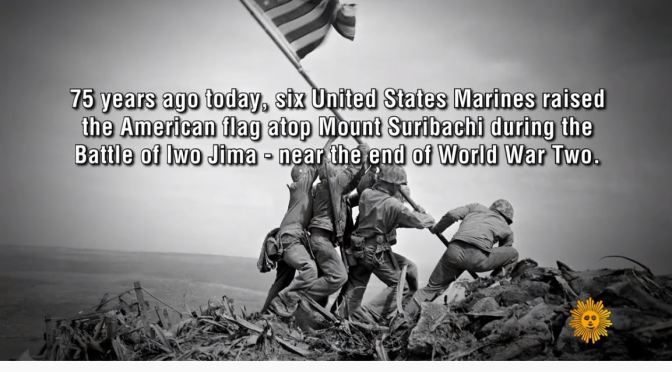
“Sunday Morning” looks to an iconic image of World War II, taken 75 years ago today.
Raising the Flag on Iwo Jima is an iconic photograph of six United States Marines raising the U.S. flag atop Mount Suribachi during the Battle of Iwo Jima in the final stages of the Pacific War. The photograph, taken by Joe Rosenthal of the Associated Press on February 23, 1945, was first published in Sunday newspapers two days later and reprinted in thousands of publications. It was the only photograph to win the Pulitzer Prize for Photography in the same year as its publication, and was later used for the construction of the Marine Corps War Memorial in 1954, which was dedicated to honor all Marines who died for their country since 1775. The memorial, sculpted by Felix de Weldon, is located in Arlington Ridge Park, near the Ord-Weitzel Gate to Arlington National Cemetery and the Netherlands Carillon. The photograph has come to be regarded in the United States as one of the most significant and recognizable images of World War II.
The flag raising occurred in the early afternoon, after the mountaintop was captured and a smaller flag was raised on top that morning. Three of the six Marines in the photograph – Sergeant Michael Strank, Corporal Harlon Block, and Private First Class Franklin Sousley – were killed in action during the battle. The other three Marines in the photograph were Corporals (then Private First Class) Ira Hayes, Harold Schultz, and Harold Keller; Block was identified as Sergeant Hank Hansen (helped raise the first flag and was present at the second flag raising) until January 1947, Schultz (was at both flag raisings) was identified as Sousley who was identified as PhM2c. John Bradley (was at both flag raisings) until June 2016, and Keller was identified as Rene Gagnon (carried the second flag up Mount Suribachi) until October 2019. All of the men served in the 5th Marine Division on Iwo Jima.
The Associated Press has relinquished its copyright to the photograph, placing it in the public domain.
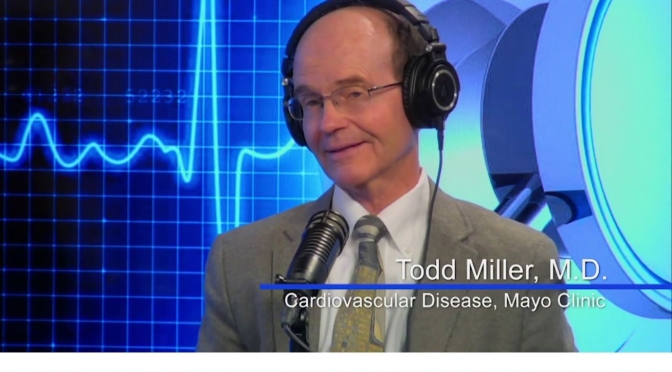
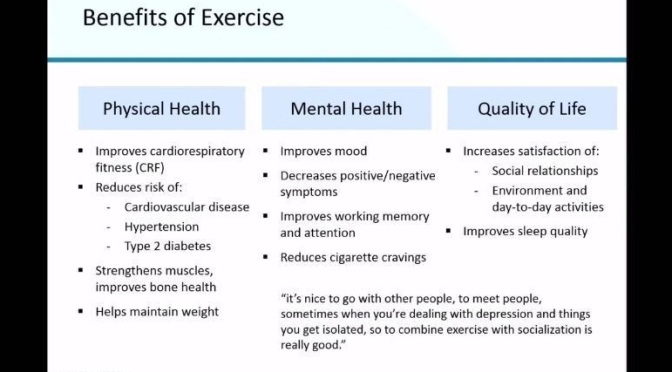
On the Mayo Clinic Radio program, Dr. Todd Miller, a Mayo Clinic cardiologist, explains how exercise affects the heart. This interview originally aired Feb. 22, 2020. Learn more about exercise and the heart: https://www.mayoclinic.org/healthy-li…
Syndicated columnist Mark Shields and New York Times columnist David Brooks join Judy Woodruff to discuss the latest political news, including how the Las Vegas debate changed the 2020 Democratic race, new reports of Russian election interference and President Trump’s response to them, the sentencing of Trump ally Roger Stone and the outcry over Trump’s flurry of pardons and commutations.
“After 96 years on this earth, Yona has moved up to build a Spatial City and install some Space Chains in the sky. The Fonds de Dotation Denise and Yona Friedman, which he founded last year, will continue his work.”
From an Instagram post (02/21/20)
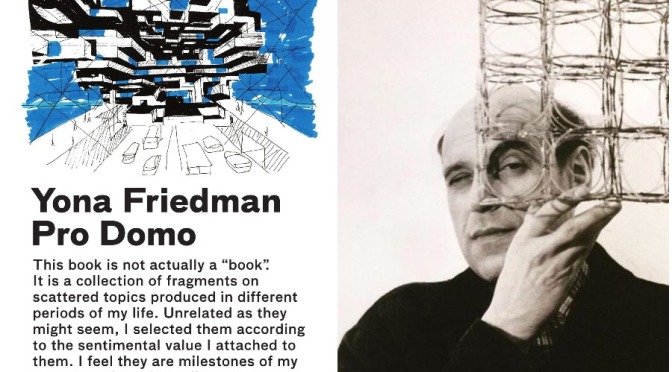
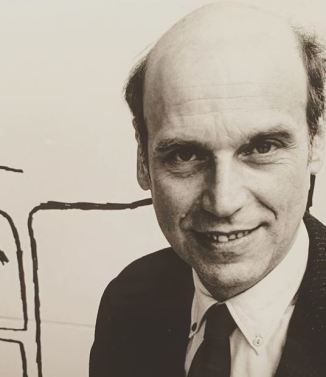
Yona Friedman (5 June 1923 – 21 February 2020) was a Hungarian-born French architect, urban planner and designer. He was influential in the late 1950s and early 1960s, best known for his theory of mobile architecture.
In 1958, Yona Friedman published his first manifesto : “Mobile architecture”. It described a new kind of mobility not of the buildings, but for the inhabitants, who are given a new freedom.
Mobile architecture is the “dwelling decided on by the occupant” by way of “infrastructures that are neither determined nor determining”. Mobile architecture embodies an architecture available for a “mobile society”. To deal with it, the classical architect invented “the Average Man”. The projects of architects in the 1950s were undertaken, according to Friedman, to meet the needs of this make-believe entity, and not as an attempt to meet the needs of the actual members of this mobile society.
The teaching of architecture was largely responsible for the “classical” architect’s under-estimation of the role of the user. Furthermore, this teaching did not embrace any real theory of architecture. Friedman proposed then teaching manuals for the fundamentals of architecture for the general public.
The spatial city, which is a materialization of this theory, makes it possible for everyone to develop his or her own hypothesis. This is why, in the mobile city, buildings should :
touch the ground over a minimum area
be capable of being dismantled and moved
and be alterable as required by the individual occupant.
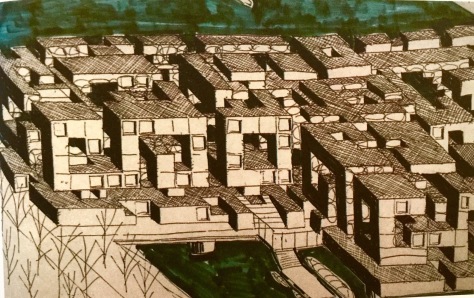
The Spatial City is the most significant application of “mobile architecture”. It is raised up on piles which contains inhabited volumes, fitted inside some of the “voids”, alternating with other unused volumes, making it look aesthetically pleasant. The basis of its design is that of trihedral elements which operate as “neighbourhoods” where dwellings are distributed without a price.
This structure introduces a kind of merger between countryside and city (compare to Paolo Soleri’s Arcology concept) and may span:
certain unavailable sites,
areas where building is not possible or permitted (expanses of water, marshland),
areas that have already been built upon (an existing city),
above farmland.
This spanning technique which includes container structures ushers in a new development in town-planning. Raised plans increase the original area of the city becoming three-dimensional. The tiering of the spatial city on several independent levels, one on top of the other, determines “spatial town-planning” both from the functional and from the aesthetic viewpoint. The lower level may be earmarked for public life and for premises designed for community services as well as pedestrian areas. The piles contain the vertical means of transport (lifts, staircases). The superposition of levels should make it possible to build a whole industrial city, or a residential or commercial city, on the same site. In this way, the Spatial City forms what Yona Friedman would call an “artificial topography”. This grid suspended in space outlines a new cartography of the terrain with the help of a continuous and indeterminate homogeneous network with a major positive outcome: this modular grid would authorize the limitless growth of the city.
The spaces in this grid are rectangular and habitable modular “voids”, with an average area of 25–35 square meters. Conversely, the form of the volumes included within the grid depends solely on the occupant, and their configuration set with a “Flatwriter” in the grid is completely free. Only one half of the spatial city would be occupied. The “fillings” which correspond to the dwellings only actually take up 50% of the three-dimensional lattice, permitting the light to spread freely in the spatial city. This introduction of elements on a three-dimensional grid with several levels on piles permits a changeable occupancy of the space by means of the convertibility of the forms and their adaptation to multiple uses.
In Yona Friedman’s own words “The city, as a mechanism, is thus nothing other than a labyrinth : a configuration of points of departure, and terminal points, separated by obstacles”.
Domestic sales of craft beers have grown to more than $27 billion annually, representing about a quarter of the American beer market. “Sunday Morning” producer Sara Kugel talked with Marcus Doucet, who opened Manchester, N.H.’s Backyard Brewery, one of more than 7,000 craft breweries in the U.S.
Watch a Q&A with Steven Chu, who’s devoted a large part of his scientific career to searching for solutions to our climate challenges.
0.06 – What does sustainability mean to you?
0.34 – What are the present challenges in sustainability?
1.50 – How can we help every person see the importance of being sustainable?
3.24 – What can I do to be more sustainable in my everyday life?
5.22 – What’s the most sustainable form of energy in your opinion?
6.44 – How do you try to do research in the lab in a sustainable way?
8.34 – Where do you see our world’s climate status in 50 years?
10.19 – Do you feel hope in humanity when it comes to tackling climate change?
Steven Chu born February 28, 1948) is an American physicist and a former government official. He is known for his research at the University of California at Berkeley and his research at Bell Labs and Stanford University regarding the cooling and trapping of atoms with laser light, for which he won the Nobel Prize in Physics in 1997, along with his scientific colleagues Claude Cohen-Tannoudji and William Daniel Phillips.
Chu served as the 12th United States Secretary of Energy from 2009 to 2013. At the time of his appointment as Energy Secretary, Chu was a professor of physics and molecular and cellular biology at the University of California, Berkeley, and the director of the Lawrence Berkeley National Laboratory, where his research was concerned primarily with the study of biological systems at the single molecule level. Chu resigned as energy secretary on April 22, 2013. He returned to Stanford as Professor of Physics and Professor of Molecular & Cellular Physiology.
Chu is a vocal advocate for more research into renewable energy and nuclear power, arguing that a shift away from fossil fuels is essential to combating climate change. He has conceived of a global “glucose economy”, a form of a low-carbon economy, in which glucose from tropical plants is shipped around like oil is today. On February 22, 2019, Chu began a one-year term as president of the American Association for the Advancement of Science.
This presentation by Julia Browne, PhD, a clinical and research fellow in the Center of Excellence for Psychosocial and Systemic Research at Massachusetts General Hospital and Harvard Medical School was part of Schizophrenia Education Day 2019.
News, Views and Reviews For The Intellectually Curious





 Boomers Daily