

Video timeline: 00:00 – What is generative AI? 00:46 – Breakthroughs and take-up of the technology 02:03 – Strengths 03:32 – Weaknesses

Video timeline: 00:00 – What is generative AI? 00:46 – Breakthroughs and take-up of the technology 02:03 – Strengths 03:32 – Weaknesses


He has since perfected his expandable home with 10 prototypes: his most recent model is robust enough to serve as a primary residence and has a bathtub and guest bed hidden in the floor. The house can be opened up – on sunny days, for nature-watching or just to sleep directly under the stars – with just a push.
The entire walls and ceiling of the house move, but anyone can propel this 3,000 kilograms (over 6000 pounds) room-on-rails because Schols created a system that is “super low friction”. To create a well-insulated home that has walls that move, Schols and his team designed the rails with wind labyrinths to trap the air and added brushes to any moving surface to prevent airflow.
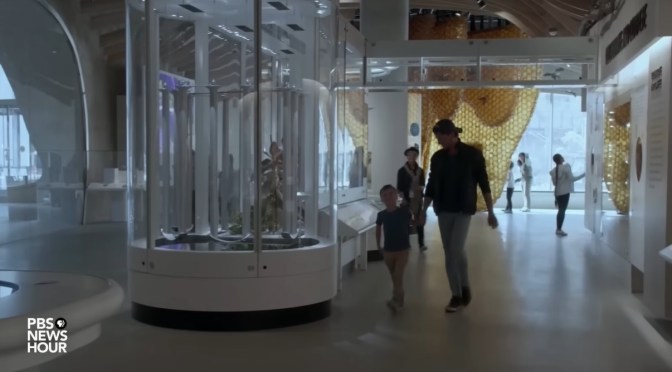
0:15 Why we need to consider AI development – Berkeley professor Stuart Russell is one of the world’s leading experts on AI, and one of more than 1,000 experts who recently signed an open letter calling for a 6-month pause in the development of AI systems for safety reasons. “I think there’s a lot of misunderstanding about the letter. Some people say it bans AI research and so on but what it really is saying is: we have developed this technology that’s pretty powerful, but we haven’t developed the regulation to go along with it. At the moment, the technology is moving very fast. Governments tend to move very slowly. So we need a pause on the development and release of still more powerful models so that, in a sense, regulation can catch up.”
5:43 Germany’s first 3D printed house – It took just 100 hours to print the walls thanks to a nozzle that moves at 1 metre per second. The fireplace, kitchen island and bathtub were all printed too. The house contains 160m2 of living space over 2 floors. It was designed by architects Mense Korte. Its walls are comprised of an inner and outer shell with insulation filling the gap between them.
7:11 Ocean search for 100,000 species begins – They’re launching dozens of explorations deep into the ocean to build a huge catalogue of as-yet-unknown marine life. An estimated 2.2 million species live in the ocean but just 10% of them have been discovered and named by scientists. It’s a race against time to document endangered marine animals before overfishing and climate change drive them to extinction.
8:56 How kids learn through play – These 3 to 5-year-olds are taking part in a programme called Play Labs. They spend their day on puzzles. Games outside playing with others and learning about the world. The programme boosts kids’ physical, social, cognitive and language development and helps them close the education gap with their peers.
_____________________________________________
The World Economic Forum is the International Organization for Public-Private Cooperation. The Forum engages the foremost political, business, cultural and other leaders of society to shape global, regional and industry agendas. We believe that progress happens by bringing together people from all walks of life who have the drive and the influence to make positive change.
0:15 Greece makes nearly 200 beaches wheelchair accessible – Seatrac bathing chairs glide into the sea. Wheelchair users reach the Seatrac by an accessible wooden path, transfer to a recliner, then ‘drive’ into the sea using a remote control. At the water’s edge, they can sit and cool off or go for a swim, heading back to the chair for a break. Seatrac chairs are solar-powered and Greek-designed. Enabling people with disabilities to enjoy the sea independently without negotiating the sand, which can be tricky for some.
1:39 This robot surfs over grain, protecting farmers – The robot crawls over grain heaps, while a smaller partner robot burrows in to check the grain is being stored efficiently. Farmers need to check the condition of stored grains such as wheat and barley regularly to protect them from mould and insects. Typically, a person walks on top of the grain bulk and samples it with spears but this method is arduous, time-consuming and dangerous as the grain can shift suddenly and trap them underneath. In 2019, 38 grain engulfments led to 23 deaths in the US alone. Some companies don’t monitor their grain at all because of the dangers involved. These robots are made by Edinburgh start-up Crover.
2:52 These simple measures could save 1 million babies a year – Globally, 1 in 4 babies are born either too soon or too small. Vulnerabilities like these are behind more than half of all newborn deaths and their foundations are laid during pregnancy. Doctors say 1 million neonatal deaths in the developing world could be avoided if we administer simple, low-cost measures during pregnancy. Such as progesterone, help to stop smoking and insecticide-treated mosquito nets. That’s according to a new study in The Lancet…
4:20 The link between green energy and forever chemicals – ‘Forever chemicals’ is a nickname given to some per- and polyfluoroalkyl substances (PFAS). Many PFAS are highly resistant to high temperatures, oil, water or corrosion. For this reason, they’re used in many products including some fundamental to the energy transition. From wind turbines to solar panels the batteries in electric vehicles and the semiconductor chips at the heart of energy technologies. They’re also used in thousands of everyday products, from non-stick pans to clothing and fire-repellent foam, but these chemicals pose risks to human health. PFAS have been linked to cancer, thyroid disease and low fertility among many other conditions.
_____________________________________________
The World Economic Forum is the International Organization for Public-Private Cooperation. The Forum engages the foremost political, business, cultural and other leaders of society to shape global, regional and industry agendas. We believe that progress happens by bringing together people from all walks of life who have the drive and the influence to make positive change.




The fight over payments systems is hotting up around the world. There may be surprising winners, says Arjun Ramani
Payment is one of the most fundamental economic activities. To buy anything, you need something the seller wants. One option is barter, but that is beset by friction (what are the chances of having something your counterparty wants at any exact moment?). Early forms of money, from cowrie shells to beads to metal coins, offered a solution: they were always in demand to settle transactions.

Chapters: 00:00 — Introduction 01:39 — Second Avenue Subway 06:45 — A national problem 08:37 — Subway costs 15:31 — Solutions
In several major cities – New York, Boston, Washington, D.C., and San Francisco – the subway and other rapid rail systems are key contributors to the prosperity of the city. In NYC for example, more than $37 billion of the Metropolitan Transportation Authority’s $54 billion budget goes to subways. But building subways in the U.S. is very expensive.
In fact, it’s the sixth most expensive country to build rail transit in the world. And even that is likely an understatement. High labor costs, overbuilt tracks and stations, and onerous regulations all jack up costs. NYC’s sheer population density makes it rather worth it – so many people ride the subway that the cost per rider is comparable to many European cities where total expenditures are substantially lower.
However, the high costs hurt the case for public transit in less dense areas of the country. Lowering those costs could go a long way toward building affordable and accessible public transit for smaller cities around the country and reducing traffic congestion, pollution and traffic accidents.
0:15 This volcanic bacteria eats CO2 – Scientists say they turn CO2 into biomass ‘astonishingly quickly’ and one day could help remove CO2 from the atmosphere. The microbes were discovered off the coast of the Italian island of Vulcano where the ocean is rich in CO2. They bubble up from volcanic vents on the seafloor. The microbes were discovered by scientists from the Two Frontiers Project who found that the bugs sink in water which could help to sequester the CO2 they absorb.
1:35 This Japanese soccer league is over 80s only – It kicked off in April with 3 teams going head-to-head boasting an average age of 83.5. Among the players is ex-national team forward Mutsuhiko Nomura. His career has spanned 70 years and 18 World Cups. Now, aged 83, he patrols the midfield for Red Star. But the league’s veteran is Shingo Shiozawa. The former racing car designer plays in net for the White Bears at the tender age of 93.
3:19 Why we need economic growth – Economic growth may not be the only measure of success but in many countries, it saves lives. But economic growth need no longer happen at the expense of the planet.
6:38 Women need investment, not just empowerment – Non-profit Grameen Foundation is helping millions of people lift themselves out of poverty by teaching women how to manage money, access loans and manage their businesses. Most importantly, Bai says, women need to have the knowledge to ask the right questions.
_____________________________________________
The World Economic Forum is the International Organization for Public-Private Cooperation. The Forum engages the foremost political, business, cultural and other leaders of society to shape global, regional and industry agendas. We believe that progress happens by bringing together people from all walks of life who have the drive and the influence to make positive change.


Video timeline: 0:00 Meet Patrick Quayle, a global network planning executive 0:27 The hub-and-spoke network structure 2:50 The linear route system, point-to-point 4:45 When to update route networks
It turns out legacy airlines like American and Delta and low-cost airlines like Southwest and Spirit use different models when planning their route networks. WSJ asked United’s global network planning expert to explain how airlines plan and manage their routes.





 Boomers Daily