Category Archives: Previews

Preview: London Review Of Books – Sept 21, 2023

Image

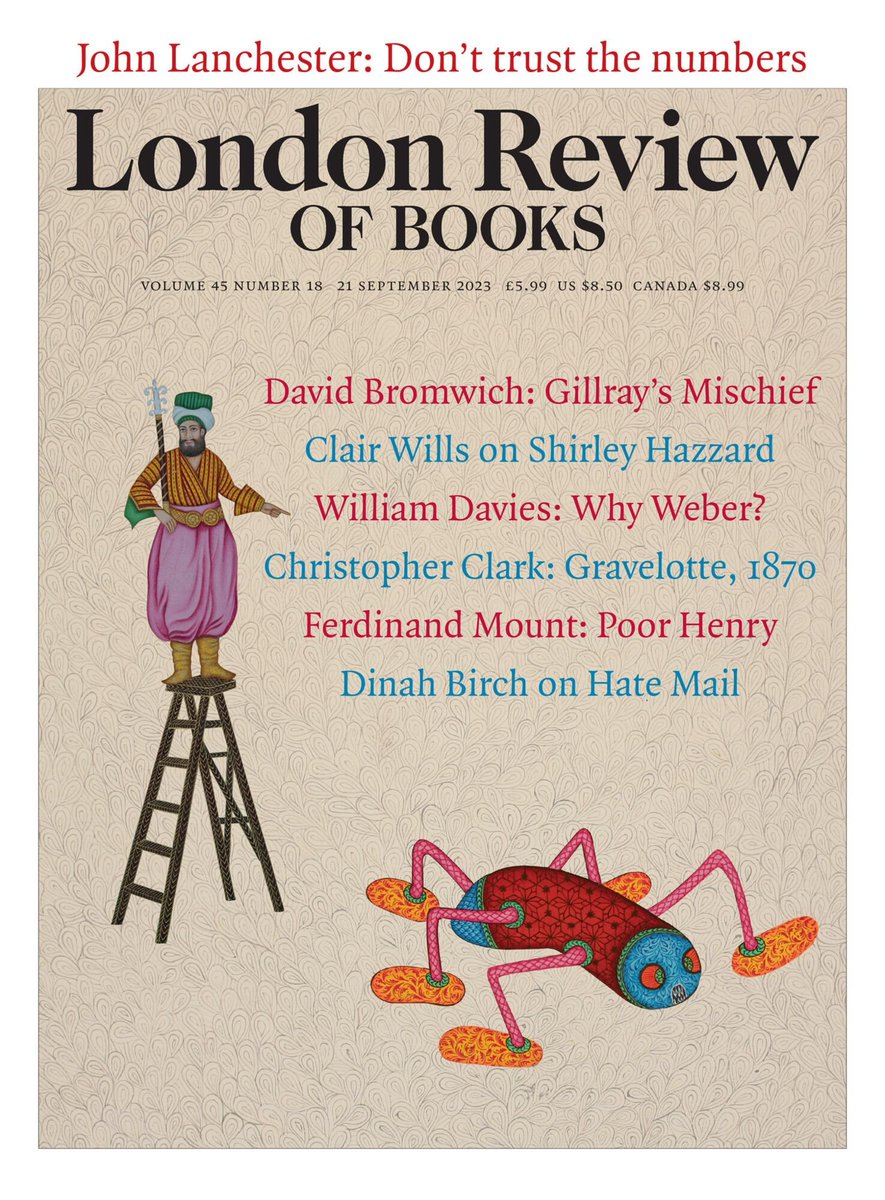
London Review of Books (LRB) – September 21, 2023: The new issue features John Lanchester on statistics, William Davies on Weber, nihilism and universities @dlbirch1 on hate mail, Ferdinand Mount on Henry III Clair Wills on Shirley Hazzard and a cover by Alexander Gorlizki.

Get a rabbit

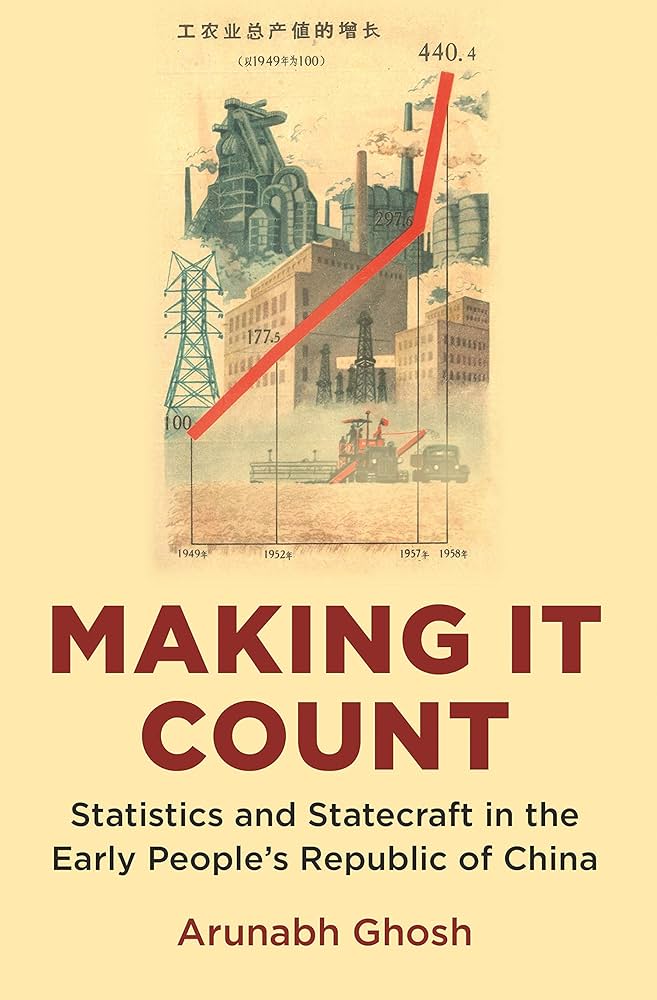
Making It Count: Statistics and Statecraft in the Early People's Republic  of China (Histories of Economic Life, 10): Ghosh, Arunabh: 9780691179476:  Amazon.com: Books

By John Lanchester

Making It Count: Statistics and Statecraft in the Early People’s Republic of China (Histories of Economic Life, 10) by Arunabh Ghosh

At a dinner​ with the American ambassador in 2007, Li Keqiang, future premier of China, said that when he wanted to know what was happening to the country’s economy, he looked at the numbers for electricity use, rail cargo and bank lending. There was no point using the official GDP statistics, Li said, because they are ‘man-made’. That remark, which we know about thanks to WikiLeaks, is fascinating for two reasons. First, because it shows a sly, subtle, worldly humour – a rare glimpse of the sort of thing Chinese Communist Party leaders say in private. Second, because it’s true. A whole strand in contemporary thinking about the production of knowledge is summed up there: data and statistics, all of them, are man-made.

Stay away from politics

By William Davies

Nihilistic Times: Thinking with Max Weber 
by Wendy Brown.

Politics: The Guardian Weekly – Sept 15, 2023

Image

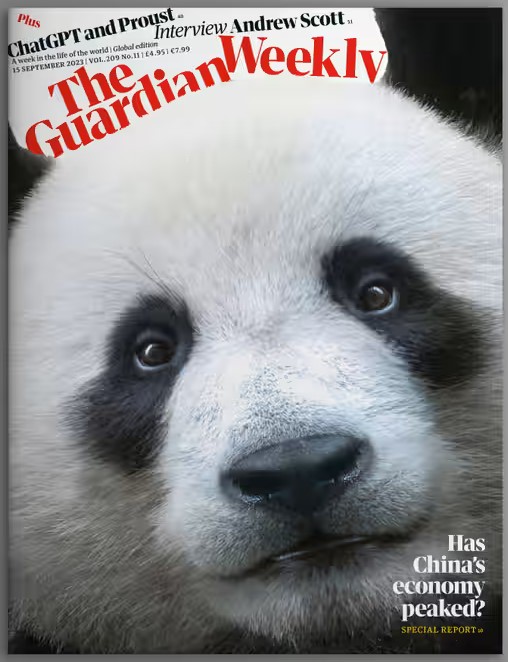
The Guardian Weekly (September15, 2023) The issue features  Amy Hawkins looking under the lid of China’s economy and asks if it has peaked?

Desperate searches for survivors continued in Morocco’s Atlas mountains after last Friday’s 6.8-magnitude earthquake, which killed thousands of people. Peter Beaumont reports from remote villages devastated by the country’s deadliest quake in six decades.

A worse disaster still appeared to be unfolding further along the north African coast in Libya, where up to 10,000 people were feared missing after flooding caused by the collapse of two dams. Details were only just emerging at the time of the Weekly going to press on Tuesday, but you can find the latest updates here.

First there were the bewildering DNA test results, then the long-forgotten fertility blog. Jenny Kleeman tells the remarkable tale of a discovery that would change the lives of two American families for ever.

Also in Features is American author Elif Batuman’s entertaining account of what happened when she asked the AI chatbot ChatGPT for assistance with a quote from Proust, leading her down a digital rabbit hole she never could have foreseen.

Literary Previews: The Paris Review – Fall 2023

Image

Paris Review Fall 2023 — The new issue features Robert Glück on the Art of Fiction: “When people would ask me—and sometimes they did—to write about them, I’d reply, ‘First, break my heart.’”; Lynn Nottage on the Art of Theater: “I embrace the fact that I write plays that are popular. Audiences make their own decisions.”

TABLE OF CONTENTS

Previews: Country Life Magazine – Sept 13, 2023

Country Life Magazine – September 13, 2023: The new issue features the more outlandish and risqué techniques plants have developed to spread their seed, a magical garden restoration at Aldourie Castle in Inverness-shire, the origins of Spetchley Park, Worcestershire, and more…

Fifty shades of green

John Wright investigates some of the more outlandish and risqué techniques plants have developed to spread their seed

A Scottish fairy tale

George Plumptre is spellbound by a magical garden restoration at Aldourie Castle in Inverness-shire

An architectural accident

In the first of two articles, John Goodall explores the origins of Spetchley Park, Worcestershire

Finance Preview: Barron’s Magazine – Sept 11, 2023

Image

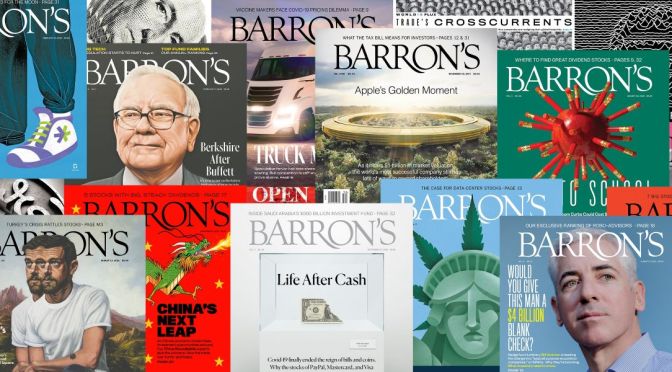
BARRON’S MAGAZINE – SEPTEMBER 11, 2023:

More Americans Are Working Into Their 80s. The Future of Labor.

More Americans Are Working Into Their 80s. The Future of Labor.

As the baby boomers age, it’s becoming more common for people to remain employed into their 70s and 80s. These octogenarians tell us why they still aren’t ready to retire.

Food Stocks Have Gotten Hit Hard. 6 to Buy Now.

Food Stocks Have Gotten Hit Hard. 6 to Buy Now.

Kraft Heinz, Kellogg, General Mills, and other leading snack makers could serve up gains of 20% or more. Their healthy dividends are a plus.

Almost All Workers Should Contribute to Roth Accounts. Here’s Why.

Almost All Workers Should Contribute to Roth Accounts. Here's Why.

No matter what your current income, saving part of your retirement money in a Roth after-tax account will give you more flexibility down the road.

The New York Times Book Review – Sept 10, 2023

Image

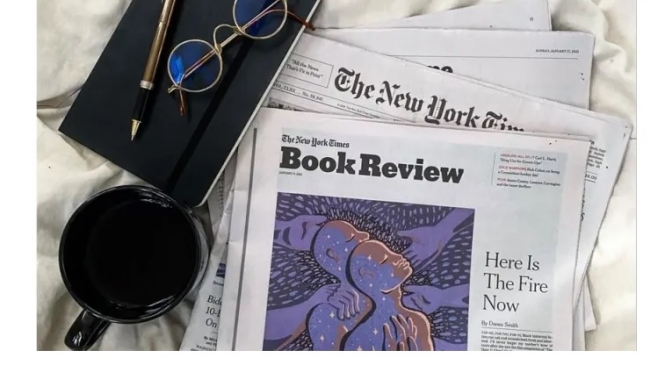
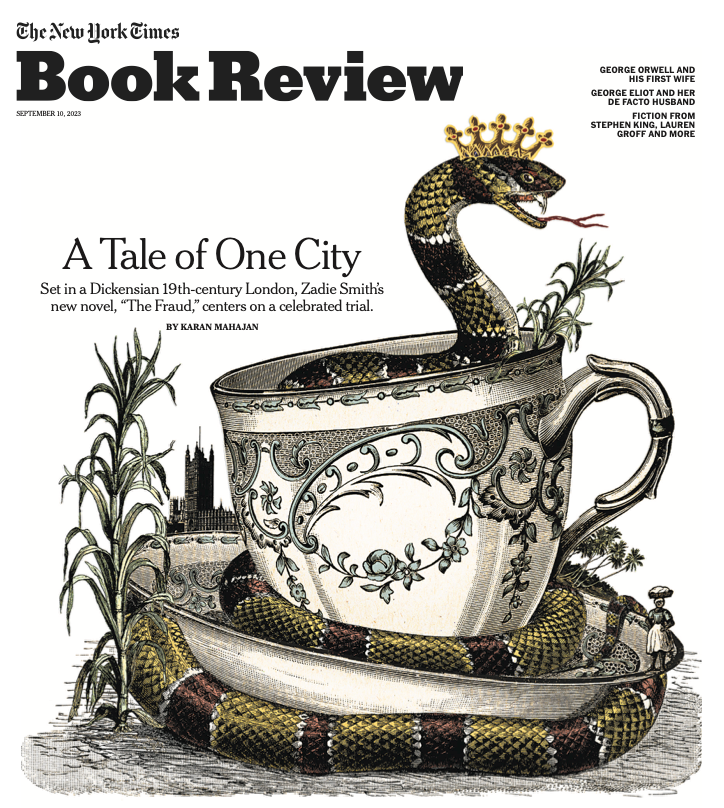
THE NEW YORK TIMES BOOK REVIEW (September 10, 2023): The new issue features Zadie Smith’s very Dickensian new novel, “The Fraud,” In nonfiction, the extremely different romantic lives of George Orwell and George Eliot are reviewed, and a biography of the con man who paved the way for all those “Nigerian prince” email scams.

Zadie Smith Makes 1860s London Feel Alive, and Recognizable

In this illustration, a serpent with maroon and gold bands and wearing a gold crown sits inside a delicate filigreed teacup, with its body coiled around the bottom of the cup and the saucer. The cup rests next to a sugar cane plant, and a London tower looms in the distance.

Her new novel, “The Fraud,” is based on a celebrated 19th-century criminal trial, but it keeps one eye focused clearly on today’s political populism.

By Karan Mahajan

All over the dorm in California glinted pale-orange and tabasco-red and steel-blue copies of Zadie Smith’s “White Teeth,” with their hard white bright lettering. The year was 2001, and “White Teeth” had been assigned as incoming reading for my freshman dorm. I remember loving the sprawling, rude, funny, slapdash narration, the magical way in which Smith brought it all together in the figure of a genetically engineered mouse.

Lauren Groff’s Latest Is a Lonely Novel of Hunger and Survival

A color illustration of a girl wearing a torn blue coat and boots with a bag strapped around her back, looking back toward a coastal settlement as she enters the woods, covered in snowfall.

“The Vaster Wilds” follows a girl’s escape from a nameless colonial settlement into the unforgiving terrain of America.

By Fiona Mozley

Jamestown, Va., the first permanent English settlement in the Americas, very nearly didn’t survive. A few years into its existence, in the early 1600s, the majority of the population had succumbed to famine and disease. The period known as the Starving Time has taken on allegorical status. Jamestown is the colony that tried too much too soon; that underestimated the harsh climate, the foreign land, its existing, Indigenous population. Pilgrims went in search of heaven and found hell.

Views: The New York Times Magazine – Sept 10, 2023

Image

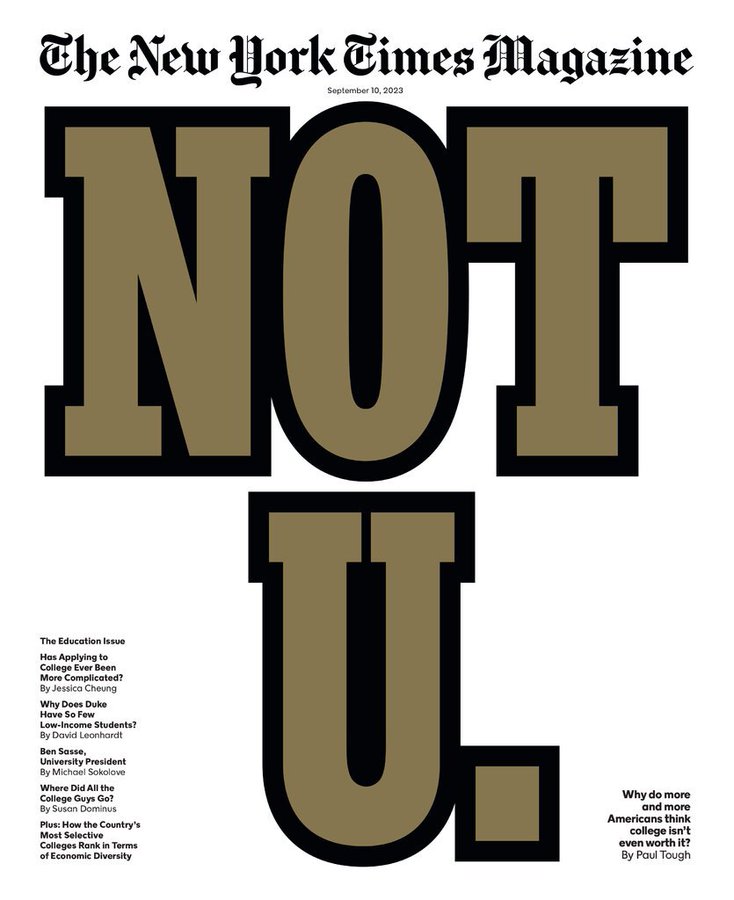
THE NEW YORK TIMES MAGAZINE (September 10, 2023): The Education Issue features Americans Are Losing Faith in the Value of College. Whose Fault Is That?; Affirmative Action Is Still in Effect. For Men, and more….

Americans Are Losing Faith in the Value of College. Whose Fault Is That?

For most people, the new economics of higher ed make going to college a risky bet.

By Paul Tough

A decade or so ago, Americans were feeling pretty positive about higher education. Public-opinion polls in the early 2010s all told the same story. In one survey, 86 percent of college graduates said that college had been a good investment; in another, 74 percent of young adults said a college education was “very important”; in a third, 60 percent of Americans said that colleges and universities were having a positive impact on the country. Ninety-six percent of parents who identified as Democrats said they expected their kids to attend college — only to be outdone by Republican parents, 99 percent of whom said they expected their kids to go to college.

Affirmative Action Is Still in Effect. For Men.

The scene outside a bar that is popular among Tulane students.

Declining male enrollment has led some colleges to adopt an unofficial policy that many find objectionable: “We need to admit men, and women are going to suffer.”

By Susan Dominus

In the spring of 2021, about 2,000 students on the campus of Tulane University in New Orleans received an email they were expecting. They had filled out an elaborate survey provided by Marriage Pact, a matchmaking service popular on many campuses, and the day had come for each of them to be given the name of a fellow student who might be a long-term romantic partner. When the results came in, however, about 900 straight women who participated were surprised by what the email offered: a friend match instead of a love interest. 

Research Preview: Science Magazine – Sept 8, 2023

Image

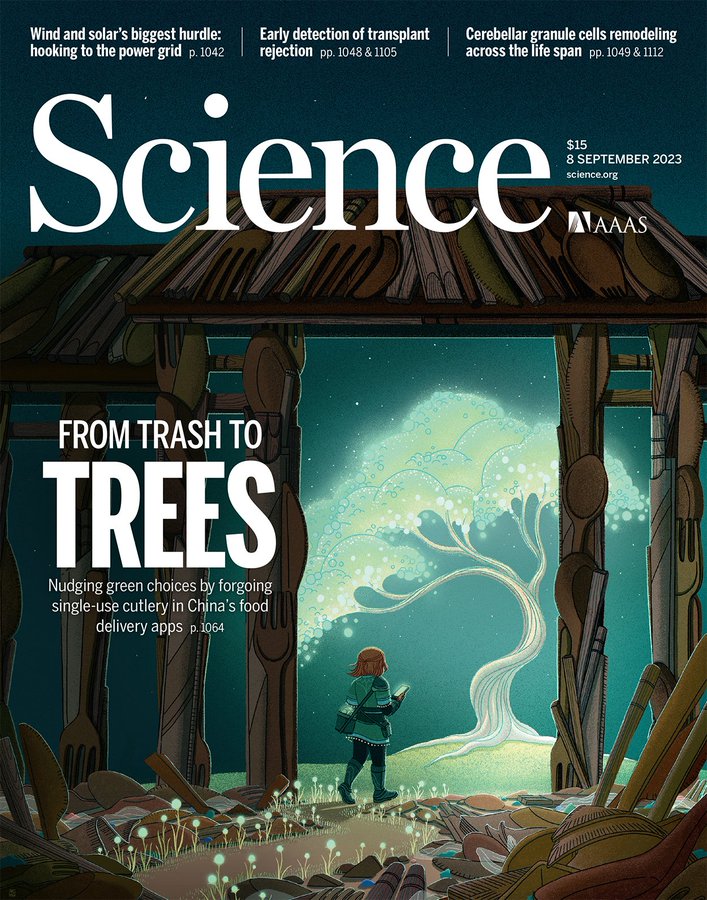
Science Magazine – September 8, 2023: Reducing single-use cutlery with green nudges: Evidence from China’s food-delivery industry; Anatomy of a volcanic eruption undersea, and more…

Anatomy of a volcanic eruption undersea

Submarine flows from the Hunga Tonga–Hunga Ha‘apai eruption decimated seafloor cables

In December 2021, an undersea volcano in the southern Pacific Ocean, the Hunga Tonga–Hunga Ha‘apai (hereafter called the Hunga volcano) began erupting. In January 2022 the eruption reached a powerful climax, triggering atmospheric waves that traveled around the globe and a tsunami that swept across the Pacific Ocean. An estimated 75% of Earth’s volcanoes are underwater, and 20% of all fatalities caused by volcanic eruptions since 1600 CE have been associated with underwater volcanism (3).

Reducing single-use cutlery with green nudges: Evidence from China’s food-delivery industry

China’s high demand for online food delivery resulted in an increase in the use of disposable, single-use cutlery. Disposable cutlery increases plastic pollution, and paper napkins and wooden chopsticks contribute to environmental degradation that endangers wildlife and marine species and compromises human health. Informed by the literature on “green nudges, ” which are prompts to promote environmentally friendly behaviors, He et al. collaborated with Alibaba to use its mobile food delivery platform, Eleme, in a longitudinal field study across China.

Previews: The Economist Magazine – Sept 9, 2023

The Economist Magazine (September 9, 2023): The new Middle East has more money and less mayhem. For now…; America’s Supreme Court should adopt new ethics standards How artificial intelligence will affect the elections; Javier Milei would be a danger for democracy in Argentina….

The new Middle East has more money and less mayhem. For now

Economies are booming and wars are fading. But climate change is looming

If you thought the Middle East was stagnant, think again. The Gulf economies are among the richest and most vibrant on the planet, helped by a Brent crude oil price that rose back to over $90 per barrel this week. A $3.5trn fossil-fuel bonanza is being spent on everything from home-grown artificial intelligence models and shiny new cities in the desert, to filling the coffers of giant sovereign-wealth funds that roam the world’s capital markets looking for deals.

America’s Supreme Court should adopt new ethics standards

Three judges are struggling to hold up the roof of the Supreme Court

Lifetime tenure can easily slip into entitlement

Next term will be agonising for the Supreme Court. Some combination of voters and courts will determine whether Donald Trump becomes president again and whether he goes to prison. President Joe Biden’s son has a case before the courts. Dozens of states have changed their voting laws since 2020 and the nine justices on the Supreme Court may be asked to look at them. If the presidential election in 2024 is close, the court may have to step in and adjudicate. With so much at stake, America needs a Supreme Court that is broadly seen as legitimate and, ideally, impartial. Regrettably, trust in the court is at its lowest point since pollsters began asking about it.

Research Preview: Nature Magazine – Sept 7, 2023

Volume 621 Issue 7977

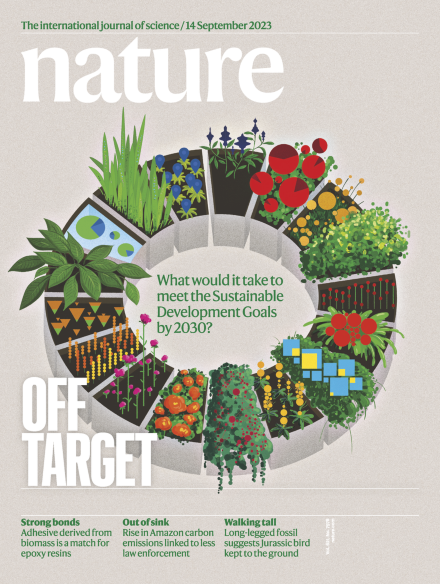
nature Magazine – September 7, 2023 issue:  In this week’s issue, Christopher Doughty and his colleagues reveal that a small percentage of leaves in tropical forest tree canopies might be approaching a critical temperature of 46.7 °C, above which photosynthesis begins to fail.

How would room-temperature superconductors change science?

A large-bore, full-scale high-temperature superconducting magnet built by Commonwealth Fusion Systems and MIT’s PSFC.

The prized materials could be transformative for research — but only if they have other essential qualities.

The wave of excitement caused by LK-99 — the purple crystal that was going to change the world — has now died down after studies showed it wasn’t a superconductor. But a question remains: would a true room-temperature superconductor be revolutionary?

With the arrival of El Niño, prepare for stronger marine heatwaves

A wide view of a snorkeler floating above major bleaching on a coral reef in French Polynesia

Record-high ocean temperatures, combined with a confluence of extreme climate and weather patterns, are pushing the world into uncharted waters. Researchers must help communities to plan how best to reduce the risks.

Oceans are warming up, and dangerously so. Since April this year, the average global sea surface temperature has been unusually high and rising; by August, oceans in the Northern Hemisphere had reached record-high temperatures, even surpassing 38 °C in one area around Florida.