

Emma Nelson and Stephen Dalziel delve into the Saturday papers. Plus, Guy De Launey on news in the Balkans and our contributing editor Andrew Mueller discusses the week’s stranger stories.
Category Archives: Politics
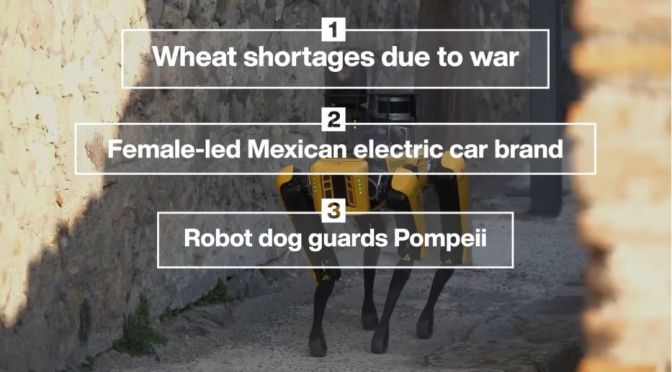
World Economic Forum: Top Stories – April 8, 2022
This week The World Economic Forum are highlighting 4 top stories – wheat shortages due to war, a female-led Mexican electric car brand, a robot dog guards Pompeii, and a plane fuelled by cooking oil.
Video timeline: 00:00 – Intro 00:15 – Wheat shortages due to war 02:17 – Female-led Mexican electric car brand 03:34 – Robot dog guards Pompeii 05:00 –
Plane fueled by cooking oil The World Economic Forum is the International Organization for Public-Private Cooperation. The Forum engages the foremost political, business, cultural and other leaders of society to shape global, regional and industry agendas. We believe that progress happens by bringing together people from all walks of life who have the drive and the influence to make positive change.

Morning News: French Election Polls, Russian Atrocities, Yemen War
We look at the polls ahead of the first round of this weekend’s French elections. Plus: the latest on the war in Ukraine, an update on Yemen as its president cedes power and Monocle’s Andrew Mueller on the week’s under-reported stories.
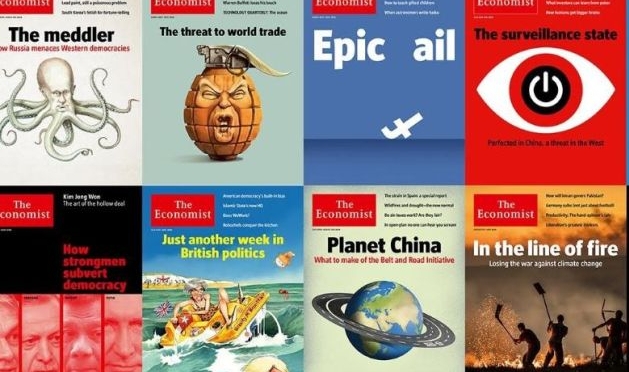
Previews: The Economist Magazine – April 9, 2022
Morning News: Russia Prepares Eastern Attack, Peru Political Crisis
Ukrainian member of parliament Yaroslav Yurchyshyn gives us the latest on the war in his country. Plus: a flick through today’s papers and a look at Peru’s political crisis.
Morning News: China’s Zero-Covid Crisis, Prisons Sweltering, Time Disputes
China’s zero-covid policy is being stretched to breaking point as the virus makes its way through the city. Supplies are low, residents are angry and there is no end in sight.
The debate about air conditioning in America’s sweltering prisons will only heat up further. And how a dispute about time from exactly a century ago remains timely today.
Morning News: Russian Attacks On Citizens, EU Calls To Cut Russian Oil
Ukrainian journalist Iryna Matviyishyn gives us the latest from Lviv as more reports of Russian attacks on civilians emerge. Plus: Anna Rosenberg of Signum Global on calls for the EU to cut off Russian oil imports, a review of today’s papers and aviation news.
Analysis: Ukraine Victory Importance, Anti-Media In China, Social Influencers
A selection of three essential articles read aloud from the latest issue of The Economist. This week, why a Ukrainian victory would transform the security of Europe, a terrible plane crash prompts a revealing anti-media backlash in China (11:20) and the serious business of social influencers (18:30).

Previews: The New Yorker Magazine – April 11, 2022
Morning News: Russia Withdraws To East, Serbia & Hungary Elections
The latest on the war in Ukraine. Plus Monocle’s Europe editor-at-large, Ed Stocker, discusses two pivotal elections in Serbia and Hungary, and personal finance specialist Annabelle Williams has today’s top business stories.
 Boomers Daily