ABC News In-depth (March 23, 2023) – Somalia is one of the most dangerous places on earth. Almost two decades of conflict with the al-Qaeda backed terrorist group al-Shabaab has taken a huge toll on the country. Now Somalia is experiencing its worst drought in 40 years.
“People say that this is the worst drought in 40 years, but that’s wrong,” says Adam Abdelmoula, the UN humanitarian coordinator for Somalia. “This is the worst drought in Somalia’s history, period.”
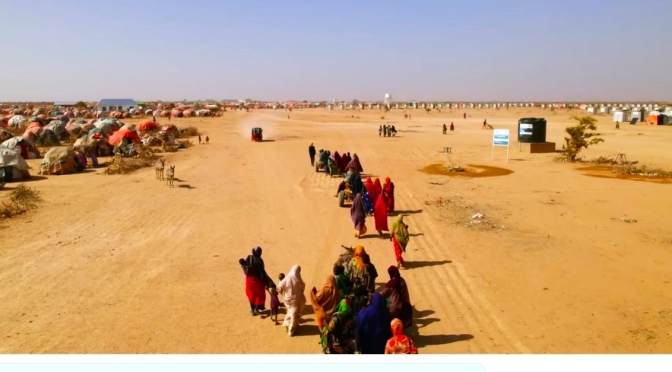
With the world distracted by the war in Ukraine, the crisis is escalating away from the public gaze. This week on Foreign Correspondent reporter Stephanie March and producer/cinematographer Matt Davis travel to Somalia where makeshift camps have become home to more than a million hungry children and their families.
There, they meet mothers with babies who have walked for days without food and very little water. They hear incredible stories of courage and survival in a landscape that is unforgiving and unsafe. And they also face their own safety problems when their security team worries al-Shabaab has been told of their whereabouts.
As the Somali government fights back against al-Shabaab, another threat, which they have no control over, is driving the extreme weather: climate change. In the midst of this turmoil, the Foreign Correspondent team meets extraordinary people who are determined to make their story one of survival.
March 23, 2023: A report on the Federal Reserve’s crucial decision on interest rates. Plus: protesters in Lebanon try to storm the government headquarters, plans for urban ‘floating’ swimming zones in Seoul, and art collectors flock to East Asia for Art Basel Hong Kong.
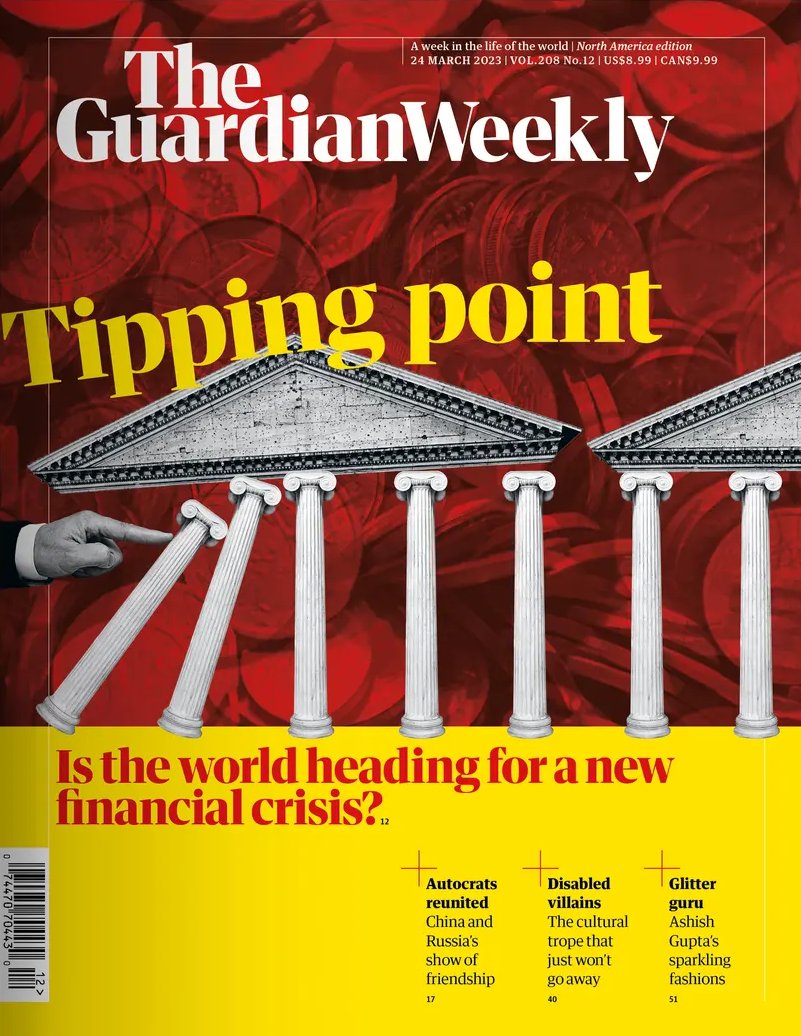
The Guardian Weekly (March 24, 2023)– You’d be forgiven for having allowed the collapse of the tech industry lender Silicon Valley Bank, earlier this month, to pass you by. Even the news that SVB’s UK operation had been salvaged in a deal brokered by the British government might not have registered too much. But the rescue this week of Switzerland’s second-largest lender Credit Suisse had a more ominous feel to it, a sense of fiscal dominoes cascading slowly into one another.
For our big story this week, Anna Isaac and Kalyeena Makortoff report on a week that brought back anxious memories of the 2008 financial crash, while economics editor Larry Elliott argues that only the era of ultra-low interest rates that followed the previous crash has prevented a further correction happening sooner.
Chinese president Xi Jinping’s visit to Russia this week had the feel of a pivotal momentfor global diplomacy. Russian affairs reporter Pjotr Sauer and senior China correspondent Amy Hawkins look at what the strengthening of the Sino-Russian alliance signifies for Moscow, Beijing and the rest of the world.
This week also saw the 20th anniversary of the US invasion of Iraq. Diplomatic editor Patrick Wintour reflects on a botched intervention that still haunts global politics to this day, while on the Opinion pages Randeep Ramesh argues that the US foreign policy debacle still serves to underline what he describes as “the capricious and self-centred nature of American global power”.
We ask what this reveals about how Asia views the conflict. Plus: the new Brexit deal faces its first parliamentary test in the UK and why the demand for transatlantic travel is soaring to record levels.
Plus: a look at the latest market turbulence after the Credit Suisse deal, how Greece was trying to attract new business opportunities at this year’s Mipim property trade fair and how Finns have reacted to the news that their country has been ranked the world’s happiest for the sixth year running.
March 20, 2023: A selection of three essential articles read aloud from the latest issue of The Economist. This week, what’s wrong with the banks? Also, we ask whether Bibi will break Israel (10:39) and why men should get a good night’s sleep to ensure vaccines work properly (19:03).
Rising interest rates have left banks exposed. Time to fix the system—again
Only ten days ago you might have thought that the banks had been fixed after the nightmare of the financial crisis in 2007-09. Now it is clear that they still have the power to cause a heart-stopping scare. A ferocious run at Silicon Valley Bank on March 9th saw $42bn in deposits flee in a day. svb was just one of three American lenders to collapse in the space of a week. Regulators worked frantically over the weekend to devise a rescue. Even so, customers are asking once again if their money is safe.
When Israel’s best and brightest are up in arms it is time to worry
This should have been Israel’s moment. As it approaches its 75th birthday in April the risk of a conventional war with neighbouring Arab states, for decades an existential danger, is at its lowest since 1948. The last Palestinian intifada, or uprising against occupation, ended 18 years ago. Israel’s tech-powered economy is more successful and globally relevant than ever. Last year gdp per person hit $55,000, making it richer than the eu.
Vaccines get all the glory, but it is really the immune system that does the heavy lifting. Indeed, those with weak immune systems often benefit little from vaccines. Aware of this, researchers have long thought that people deprived of sleep also ought to benefit less from vaccines, as sleeping less is thought to reduce immune function. A new analysis reveals that this is clearly the case—though only in men.
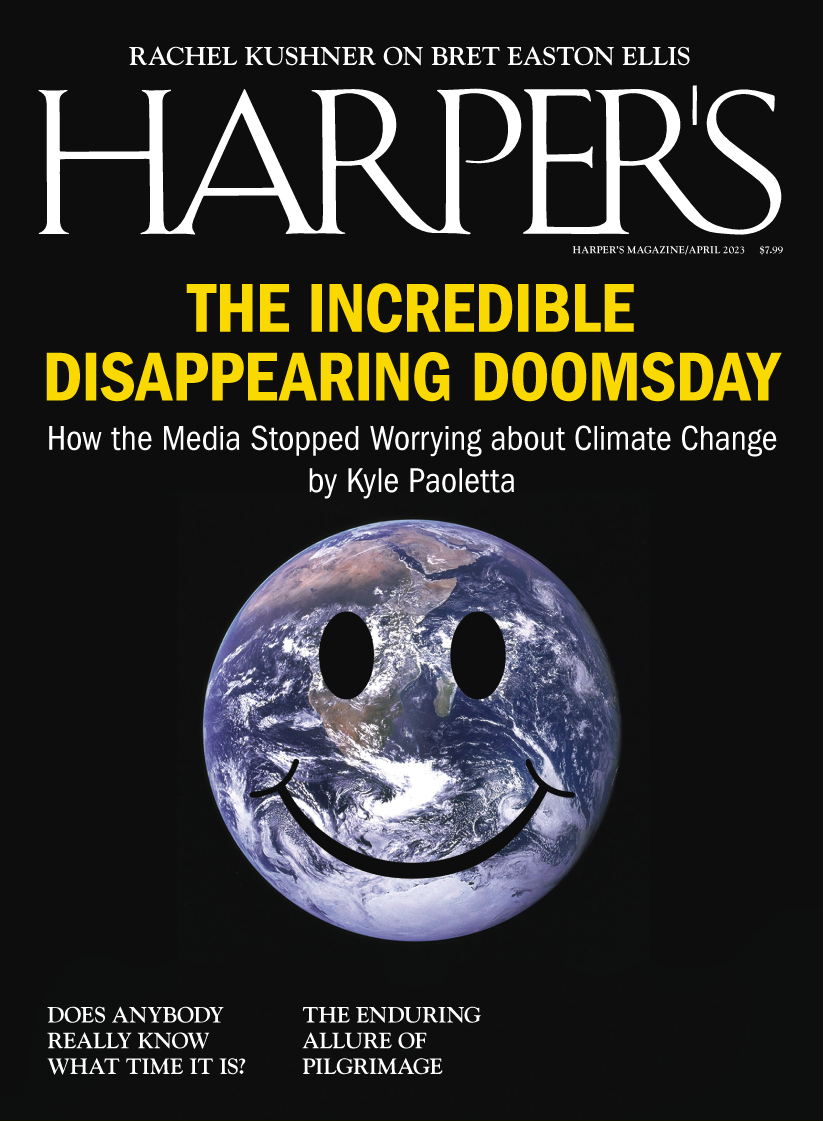
How the climate catastrophists learned to stop worrying and love the calm
The first signs that the mood was brightening among the corps of reporters called to cover one of the gravest threats humanity has ever faced appeared in the summer of 2021. “Climate change is not a pass/fail course,” Sarah Kaplan wrote in the Washington Post on August 9.
When I was a kid, in the touch-tone era in the Midwest, I often dialed, for no real reason, the “time lady”—an actress named Jane Barbe, it turns out—who would announce, with prim authority “at the tone,” the correct time to the second. I was, in those days, a bit obsessed with time.
A popular, growing class of drugs for obesity and diabetes could, in an ideal world, help us see that metabolism and appetite are biological facts, not moral choices.
March 20, 2023: Xi Jinping heads to Moscow to meet Vladimir Putin. Plus: an Asia-Pacific round-up, a flick through today’s papers, Saddam Hussein’s tourist-attraction superyacht and jewellers preparing for King Charles’s coronation.

















 Boomers Daily