Category Archives: Buildings

History: Planning And Building ‘The Pentagon’

The Pentagon is the headquarters building of the United States Department of Defense. As a symbol of the U.S. military, the phrase The Pentagon is also often used as a metonym for the Department of Defense and its leadership.

Located in Arlington County, Virginia, across the Potomac River from Washington, D.C., the building was designed by American architect George Bergstrom and built by contractor John McShain. Ground was broken on 11 September 1941, and the building was dedicated on 15 January 1943. General Brehon Somervell provided the major motivating power behind the project;[6] Colonel Leslie Groves was responsible for overseeing the project for the U.S. Army.

The Pentagon is the world’s largest office building, with about 6,500,000 square feet (150 acres; 0.60 km2) of floor space, of which 3,700,000 sq ft (85 acres; 0.34 km2) are used as offices.[7][8] Some 23,000 military and civilian employees,[8] and another 3,000 non-defense support personnel, work in the Pentagon. It has five sides, five floors above ground, two basement levels, and five ring corridors per floor with a total of 17.5 miles (28.2 km)[8] of corridors. The central five-acre (2.0 ha) pentagonal plaza is nicknamed “ground zero” on the presumption that it would be a prime target in a nuclear war.
Covid-19: ‘Ventilation Key To Limiting Spread’ (Video)

As the weather gets colder and people head indoors, the risk of catching Covid-19 is rising. WSJ explains why air ventilation and filtration are one of our biggest defenses against the coronavirus this winter.

Illustration: Nick Collingwood/WSJ

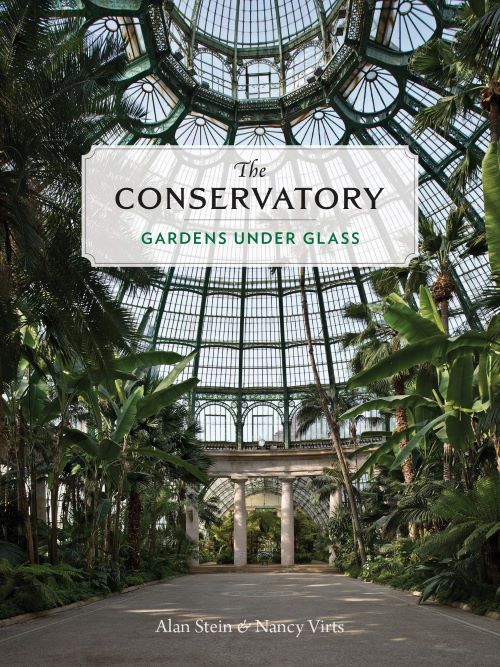
Architecture Books: ‘The Conservatory – Gardens Under Glass’ (Princeton)

Through evocative archival and contemporary photographs, drawings of landmark structures, and graceful, accessible text, The Conservatory  celebrates the patrons and designers who advanced the technology and architectural majesty of these light-filled structures. The importance of conservatories continues to grow with efforts to conserve phenomenal plants and their environments.

Elegant and magnificent, conservatories reveal fascinating social, cultural, botanical, and engineering advances as they have evolved across history. First appearing in the eighteenth century as simple structures designed to protect fruit trees and other delicate plants from harsh European winters, conservatories became grand glass houses that spread across the European continent, to the Americas, and ultimately around the world.

Alan Stein is President and Director of Architecture at Tanglewood Conservatories, Ltd., founded in 1993 with his wife and business partner, Nancy Virts. The company’s mission is to conceive and build the finest classical and modern glass conservatories. Tanglewood’s work has been published in Architectural Digest, Garden Design Magazine, The New York Times, Town & County and other periodicals around the world. Alan studied design at the California College of Art and graduated from the University of Maryland with a professional degree in architecture. He lives in Maryland.

Nancy Virts is cofounder of Tanglewood Conservatories, Ltd., with her husband and business partner, Alan Stein. The company conceives and builds the finest classical and modern glass conservatories. Tanglewood’s work has been published in Architectural Digest, Garden Design magazine, the New York Times, Town & Country, and other periodicals around the world.

Read more

City Architecture: ‘The World’s Top 16 Tallest Skyscrapers’ (Video)

Size Comparison of the Tallest Skyscrapers in the World.

Video timeline of tallest skyscrapers: 0:00 Intro 0:48 16: Shanghai World Financial Center 1:27 15: Taipei 101 2:05 14: China Zun 2:47 13: Tianjin CTF Finance Center 3:28 12: Guangzhou CTF Finance Center 4:04 11: One World Trade Center 5:08 10: Lotte World Tower 5:43 9: Ping An Finance Center 6:28 8: Abraj Al-Bait Clock Tower 6:59 7: Shanghai Tower 7:37 6: Merdeka 118 8:11 5: Shimao Shenzhen – Hong Kong International Center 8:38 4: Dubai One Tower 9:11 3: Burj Khalifa 9:46 2: Jeddah Tower 10:20 1: Burj Mubarak al-Kabir

Design: ‘Jewel Changi Airport’, Singapore By Safdie Architects (Video)

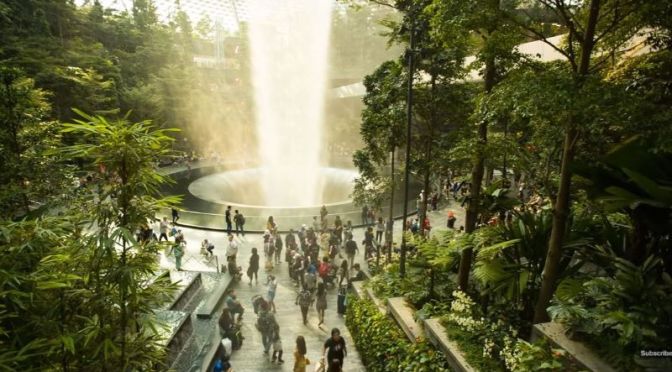
Fulfilling its mission as a connector between the existing terminals, Jewel combines two environments—an intense marketplace and a paradise garden—to create a new community-centric typology as the heart, and soul, of Changi Airport. Jewel re-imagines the center of an airport as a major public realm attraction. Jewel offers a range of facilities for landside airport operations, indoor gardens, leisure attractions, retail offerings and hotel facilities, all under one roof. A distinctive dome-shaped façade made of glass and steel adds to Changi Airport’s appeal as one of the world’s leading air hubs.

Based on the geometry of a torus, the building shape accommodates the programmatic need for multiple connections in the airport setting. At the heart of its glass roof is an oculus that showers water through a primary multistory garden, five stories through to the forest-valley garden at ground level. The core of the program is a 24-hour layered garden attraction that offers many spatial and interactive experiences for visitors. Four cardinal axes—north, south, east, and west—are reinforced by four gateway gardens, which orient visitors and offer visual connections to the internal surroundings and other airport terminals. By night, the glazed facade helps dematerialize the building, revealing the glowing garden within.

Buildings: ‘Battle To Build Transamerica Pyramid’ – San Francisco, 1969 (Video)

Unwelcome when it was first proposed, San Francisco’s Transamerica Pyramid has overcome public opinion, economics and the extreme challenges of its location to become one of the world’s most famous buildings.

Full story here – https://www.theb1m.com/video/the-batt…

The Transamerica Pyramid at 600 Montgomery Street between Clay and Washington Streets in the Financial District of San Francisco, California, United States, is a 48-story futurist building and the second-tallest skyscraper in the San Francisco skyline. 

Sustainable Architecture: ‘Anandaloy In Bangladesh’ – Made of Bamboo & Mud

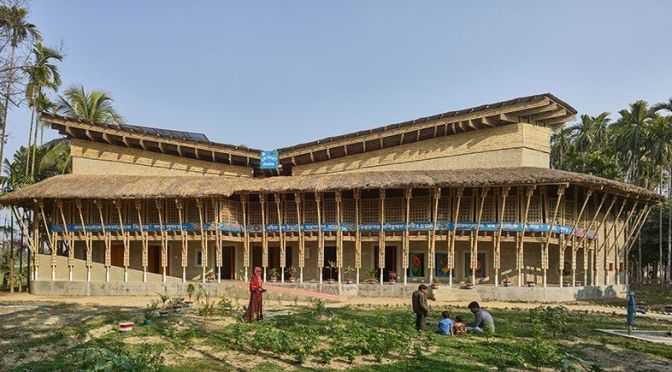
designed by german architect anna heringer, ‘anandaloy’ is a community center and workshop in bangladesh that is made from mud and bamboo. located in rudrapur, a village in the country’s dinajpur district, the two-storey building contains a therapy center for people with disabilities at ground level and a fair-trade textile manufacturing workshop for local women on the first floor. below a big ramp that connects the two levels, protective cave-like spaces provide settings for recreation or solitude.

Bangladesh, to the east of India on the Bay of Bengal, is a South Asian country marked by lush greenery and many waterways. Its Padma (Ganges), Meghna and Jamuna rivers create fertile plains, and travel by boat is common. On the southern coast, the Sundarbans, an enormous mangrove forest shared with Eastern India, is home to the royal Bengal tiger.

Classic Italian Buildings: ‘Palazzo Serristori’ In Florence (Video Tour)

Palazzo Serristori, a historical and prestigious palace currently under restoration is for sale by the river Arno, at a stone’s throw from Florence’s city centre, an internationally-renowned city for its history, art and culture.

The palace dates back to the 16th century and has changed a lot over the years, especially in the 19th century when the Demidoff family gave it its current looks. The property has four floors above ground, a basement and a mezzanine floor. The interiors are embellished with fine finishes and materials, such as walls and ceilings enriched with frescoes and decorations and inlays of great artistic importance. Of the original sixteenth-century palace, only the corner facade where the main entrance opens up is preserved.