Category Archives: Books

THE NEW YORK REVIEW OF BOOKS – NOVEMBER 6, 2025

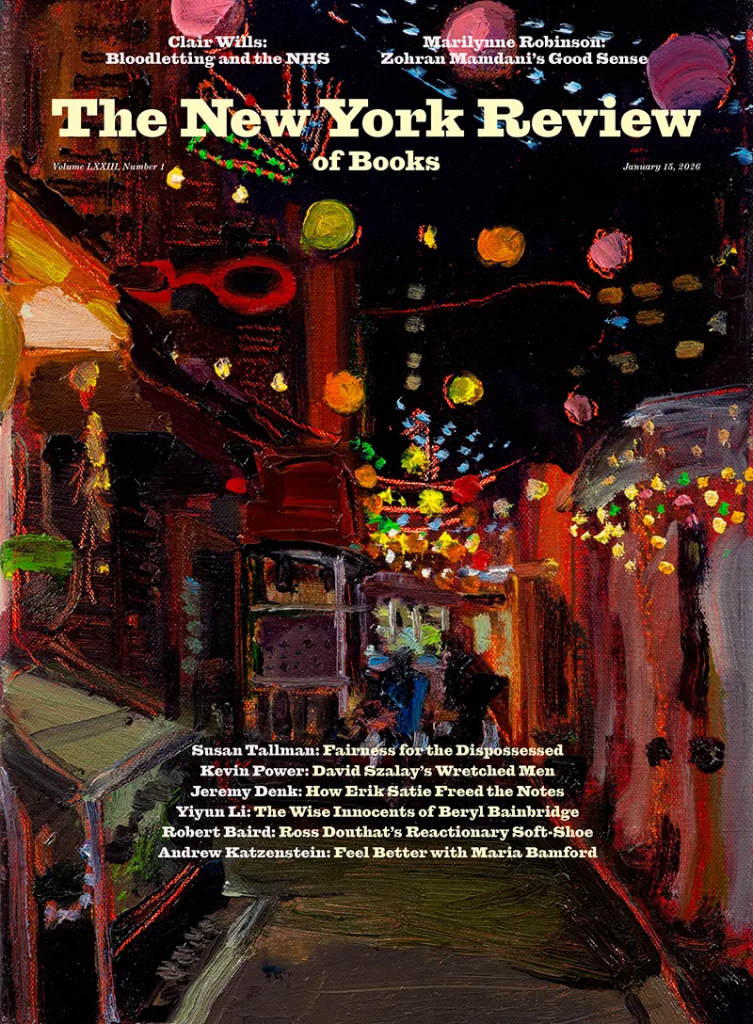
THE NEW YORK REVIEW OF BOOKS: The latest issue features Jed Perl on critical thinking, Mark Lilla on the MAGA nation, Ben Lerner on his heart, Clare Bucknell on female critics in early modern England, Cora Currier on twenty-five years of the “war on terror,” Peter E. Gordon on the religion of sociology, Wyatt Mason on Guy Davenport, Josephine Quinn on St. Augustine of Africa, Geoffrey O’Brien on Kavalier and Clay at the Met, Nitin K. Ahuja on the science of death, Darryl Pinckney on James Baldwin, a painting by Maira Kalman, poems by April Bernard and Amit Majmudar, and much more.


Impassioned Ferocity

A critic’s power lies in the testing of deeply held beliefs about the nature of art and art’s place in the world against the experience of specific artworks.

Authority by Andrea Long Chu

All Things Are Too Small: Essays in Praise of Excess by Becca Rothfeld

Those Passions: On Art and Politics by T.J. Clark

Criticism and Truth: On Method in Literary Studies by Jonathan Kramnick

No Judgment by Lauren Oyler

Storm Warnings

The MAGA movement is not fed by conservative ideas but by a nihilistic, apocalyptic determination to stage a counterrevolution against the Sixties, against liberalism, against even democracy itself.

When the Clock Broke: Con Men, Conspiracists, and How America Cracked Up in the Early 1990s by John Ganz

Furious Minds: The Making of the MAGA New Right by Laura K. Field

A Brief Literary Emancipation

Early modern female writers, who were denied the sort of authority usually needed to write literary criticism, were also freed from its constraints.

Sex and Style: Literary Criticism and Gender in Early Modern England by Elizabeth Scott-Baumann

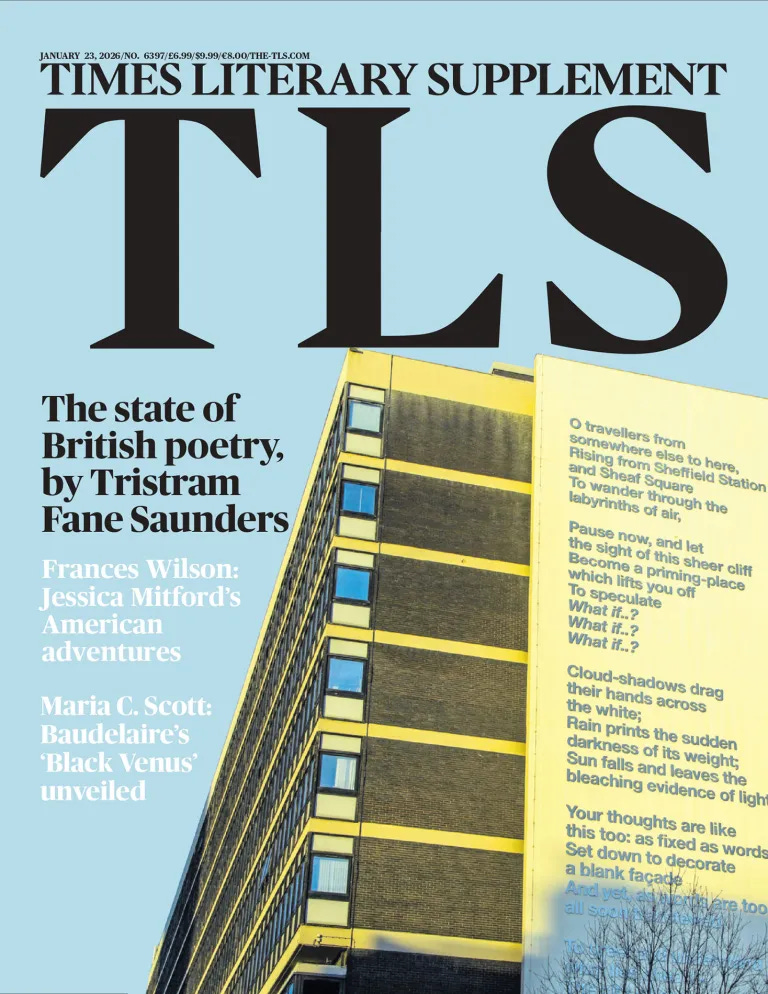
TIMES LITERARY SUPPLEMENT – OCTOBER 17, 2025 PREVIEW

TIMES LITERARY SUPPLEMENT: The latest issue features ‘Artist in the making: Joyce Carol Oates on Sally Mann’s photographic craft’

Peer group

The British upper classes today By Michael Hall

Uniquely hers

A how-to book by ‘one of the greatest’ American photographers’ By Joyce Carol Oates

Master of the apocalypse

László Krasznahorkai, Nobel laureate in literature By George Szirtes

Thoroughly modern maenads

Religion, immigration, gender politics and severed heads By Mary Beard

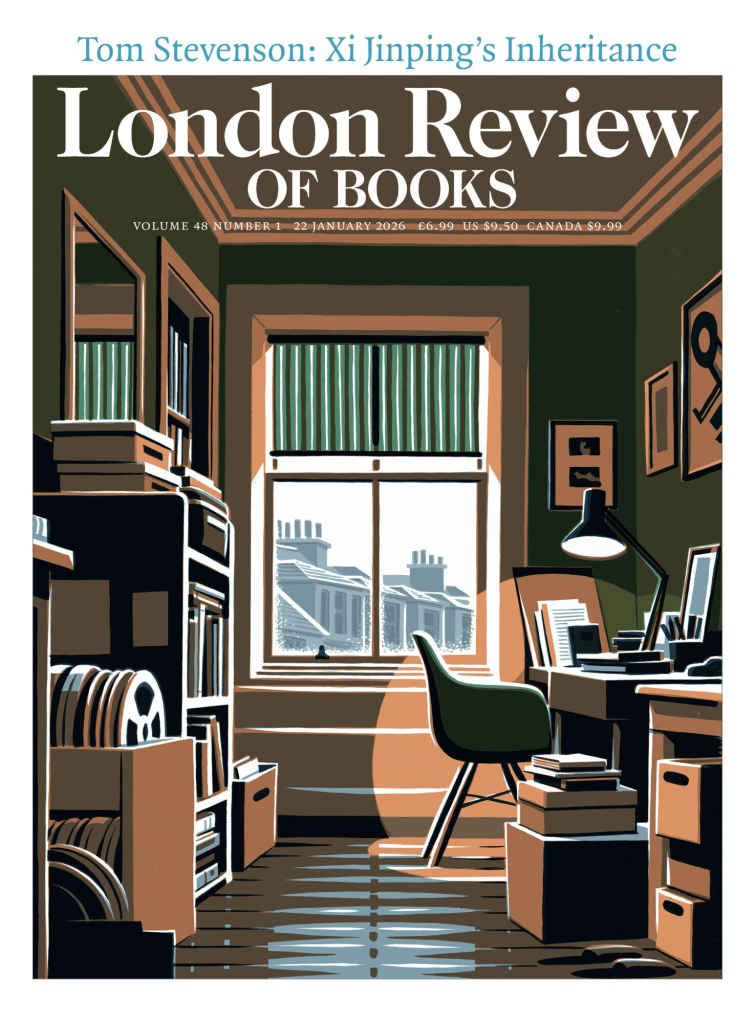
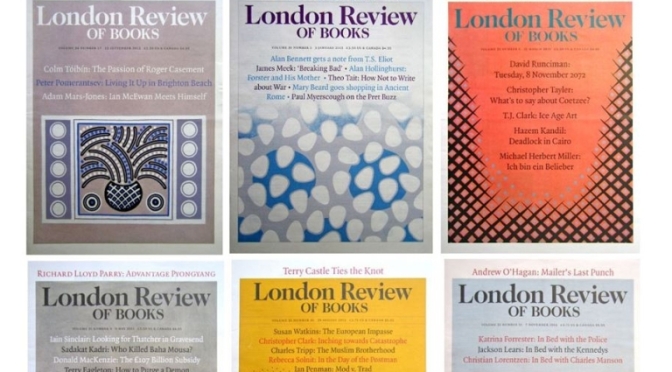
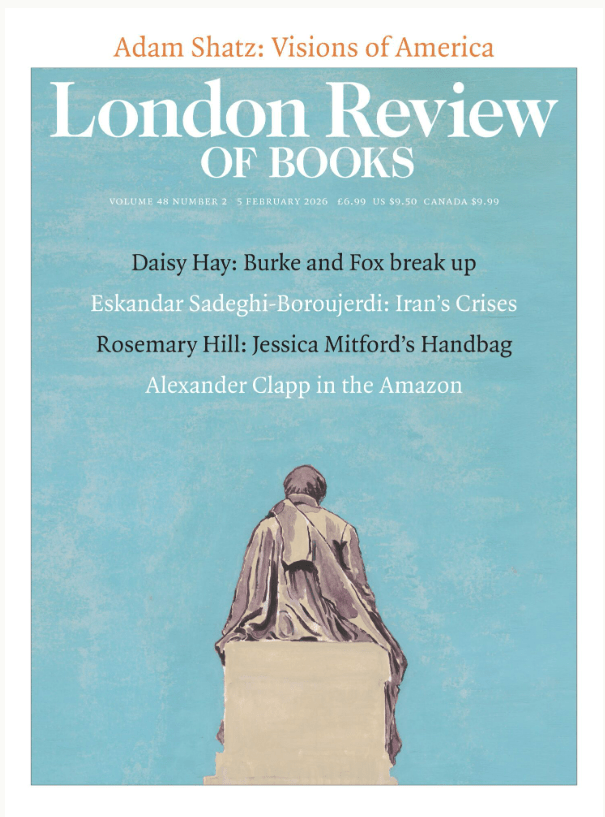
LONDON REVIEW OF BOOKS – OCTOBER 23, 2025 PREVIEW

London Review of Books

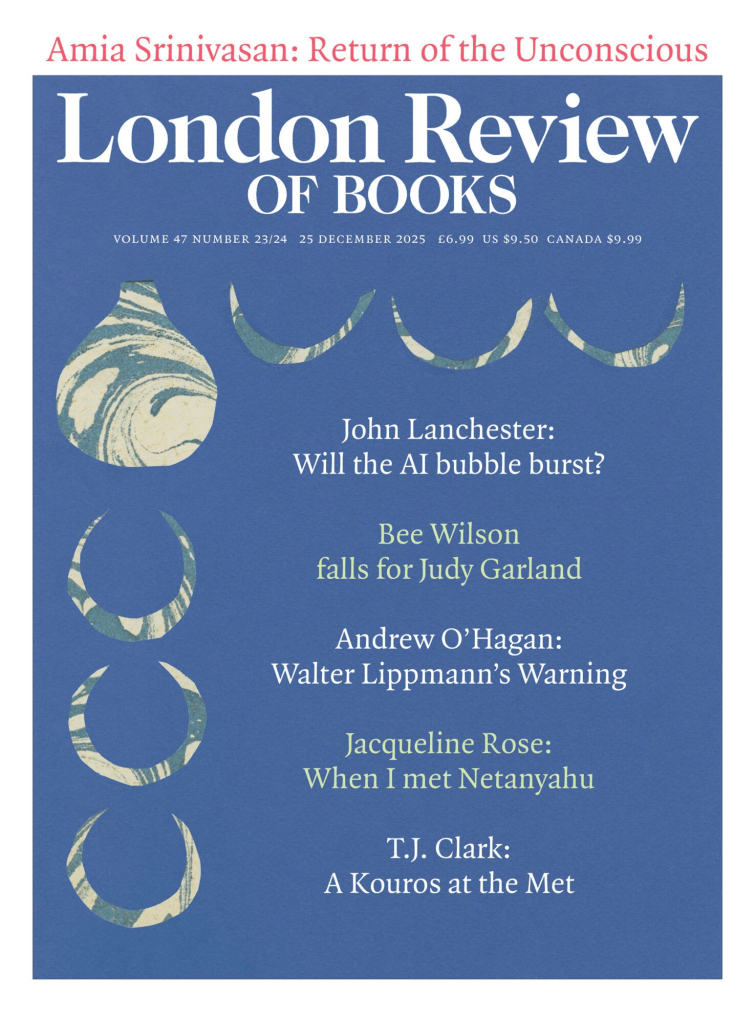
LONDON REVIEW OF BOOKS: The latest issue features ‘Mrs. Dalloway’s Demons

Unconditional Looking

The Inner Life of ‘Mrs Dalloway’ 
by Edward Mendelson.
Columbia, 137 pp., £20, September, 978 0 231 22171 9

‘Mrs Dalloway’: Biography of a Novel 
by Mark Hussey.
Manchester, 222 pp., £18.99, May, 978 1 5261 7681 3

Mrs Dalloway 
by Virginia Woolf, edited by Edward Mendelson.
NYRB, 208 pp., £15.99, September, 978 1 68137 998 2

Mrs Dalloway 
by Virginia Woolf, edited by Trudi Tate.
Oxford, 224 pp., £7.99, May, 978 0 19 285985 3

Ouvriers de luxe

Gustave Flaubert et Michel Lévy: Un couple explosif 
by Yvan Leclerc and Jean-Yves Mollier.
Le Livre de Poche, 224 pp., €8.40, November 2024, 978 2 253 94112 5

Fish in the Wrong Place

Liquid Empire: Water and Power in the Colonial World 
by Corey Ross.
Princeton, 447 pp., £35, September 2024, 978 0 691 21144 2

In Praise of Floods: The Untamed River and the Life It Brings 
by James C. Scott.
Yale, 220 pp., £20, February, 978 0 300 27849 1

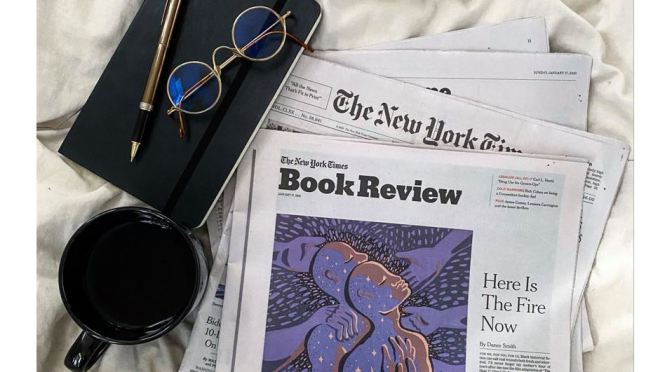
THE NEW YORK REVIEW OF BOOKS – OCTOBER 23, 2025

Home | The New York Review of Books

THE NEW YORK REVIEW OF BOOKS: The latest issue features Jacob Weisberg on deep fake news, Elaine Blair on istoriya feminisma, Eric Foner on the underground railroad at sea, Andrew Katzenstein on Pynchon’s Shadow Ticket, Suzanne Schneider on Friedrich Hayek’s bastard children, Nicole Rudick on Ben Shahn’s compassion, Jay Neugeboren on the working homeless, Vicente L. Rafael on an American massacre in the Philippines, Ariel Dorfman on Pinochet’s favorite Nazi, David Cole on Trump’s summary killings in international waters, a poem by Victoria Chang, and much more.

Algorithm Nation

Fights about digital filtering tools have turned more and more bitter. That’s because of their extraordinary power to shape both political opinion and mass culture.

Invisible Rulers: The People Who Turn Lies into Reality by Renée DiResta

Character Limit: How Elon Musk Destroyed Twitter by Kate Conger and Ryan Mac

Filterworld: How Algorithms Flattened Culture by Kyle Chayka

Equality Without Feminism?

The Soviet Union’s ambitious program of gender equality could never be separated from its abuses of power.

Motherland: A Feminist History of Modern Russia, from Revolution to Autocracy by Julia Ioffe

The Big Cheese

Shadow Ticket is brisker than Thomas Pynchon’s other work, but it’s full of his usual vaudevillian sensibility, and it addresses his favorite theme: how to live freely under powerful systems of control.

Shadow Ticket by Thomas Pynchon

LONDON REVIEW OF BOOKS – OCTOBER 9, 2025 PREVIEW

LONDON REVIEW OF BOOKS: The latest issue features Pico in Purgatory; Can cellos remember?; Britain’s Europe Problem

Pico in Purgatory

Pico’s Oration contravenes the very idea of human possibility that we think the Renaissance is about – yet we think of the Renaissance this way partly because of a centuries-long misreading of it. In which case, does Pico really belong to the Renaissance? Or is our whole idea of the Renaissance hopelessly flimsy, nothing but a collection of fantasies about what it means to be modern and human?

Britain’s Europe Problem

From Macmillan to Wilson to Heath to Thatcher to Major to Blair to Cameron, a succession of prime ministers persuaded themselves that their country was somehow different from the rest: it could pick and choose from the menu of European options in the way that suited it best. They were all mistaken. 

Computers that want things

For all the fluency and synthetic friendliness of public-facing AI chatbots like ChatGPT, it seems important to remember that existing iterations of AI can’t care. The chatbot doesn’t not care like a human not caring: it doesn’t care like a rock doesn’t care, or a glass of water. AI doesn’t want anything. But this is bound to change.

LITERARY REVIEW – OCTOBER 2025 ISSUE PREVIEW

LITERARY REVIEW : The latest issue features….Read All About It; Goethe’s Grand Ideas; The Basquiat Boom; Ministers & Monarchs; Operation Baku…

Strong Constitution: ‘Power and the Palace: The Inside Story of the Monarchy and 10 Downing Street’ By Valentine Low

Blood, Rage & Terror: ‘The Revolutionists: The Story of the Extremists Who Hijacked the 1970s’ By Jason Burke

Stocks & Scares: ‘1929: The Inside Story of the Greatest Crash in Wall Street History’ By  Andrew Ross Sorkin

TIMES LITERARY SUPPLEMENT – OCTOBER 3, 2025 PREVIEW

TIMES LITERARY SUPPLEMENT: The latest issue features ‘Sylvia Plath’s Ariel at sixty; The case against progress; Patricial Lockwood’s bag of scraps…

Lioness of God    

The sixtieth anniversary ‘heritage’ edition of Ariel By Seamus Perry

The Puritan reflex

Thomas Pynchon’s haunted vision of history By James Marcus

A dashed clever fellow

The wisdom of Bertie Wooster By Tim Lake

Printed by herself

The precocious poetry of Charlotte Brontë By Samantha Ellis

THE PARIS REVIEW – FALL 2025

THE PARIS REVIEW : The latest issue features interviews with Maggie Nelson and Eliot Weinberger, prose by Bud Smith and Yan Lianke, poetry by Patricia Lockwood and Ishion Hutchinson, art by Martha Diamond and Talia Chetrit, a cover by Issy Wood, and more…

Eliot Weinberger on the Art of the Essay: “I have no interest in first-person investigation. Personally, I’ve never found myself an interesting person.”

Maggie Nelson on the Art of Nonfiction: “It’s important to notice when the spark of magic or curiosity is there and what snuffs it out, and being around too many writers, for me, snuffs it out.”

Prose by Anne Carson, Renny Gong, Aurora Huiza, Jordy Rosenberg, Bud Smith, and Yan Lianke.

Poetry by Roque Dalton, Ishion Hutchinson, Patricia Lockwood, Mariano Melgar, Eileen Myles, Katie Peterson, and authors unknown.

Art by Talia Chetrit, Martha Diamond, and Jamian Juliano-Villani; cover by Issy Wood.

THE ACADEMY AT CAREGGI

Marsilio Ficino and the Lost Art of Intellectual Friendship

By Michael Cummins, Editor, September 15, 2025

Earlier that day, a letter had arrived at each doorstep—written in Ficino’s careful Latin, sealed with the Medici crest. Come tonight, it read, for the stars are in accord and the soul requires company. It was invitation and summons at once. Poliziano scoffed at the astrology but tucked the note into his cloak. Pico, fresh from disputation, still had ink smudged on his fingertips when he broke the seal. Landino read it slowly, savoring the phrasing, then closed his worn Dante with a sigh. Gozzoli sharpened a charcoal stick and packed it beside a folded manuscript. Lorenzo glanced at the letter, smiled at its formality, and placed it beneath a pile of state papers, as if to remind himself that philosophy and politics were two halves of his life.

As evening drew in, the roads up to Careggi darkened. Lanterns swung from servants’ hands, lighting the cypresses along the ascent. Cloaks were drawn close, breath visible in the winter air. One by one they arrived—Poliziano striding quickly, as though words themselves propelled him; Pico lingering at the threshold, whispering a Hebrew phrase before stepping inside; Landino slow but steady, leaning on a servant’s arm; Gozzoli already sketching the turn of a staircase as he climbed; Lorenzo last, but never late, carrying the ease of a man for whom arrival was itself a ceremony.

In January 1486, at the Villa Medici in Careggi—north of Florence, in the hills of Rifredi—the villa seemed less a house than a harmony. Designed by Michelozzo di Bartolomeo, it bore the quiet precision of geometry translated into stone. Arcaded loggias opened onto citrus groves, terraces descended into the valley like measures of music, and every cornice seemed tuned to a mathematics of grace. Outside, the air was sharp with winter, the olive trees skeletal against a pale sky. But within the great hall, a fire crackled, filling the chamber with warmth. The walls, frescoed decades earlier, flickered as if alive in the candlelight. Tonight the villa was not a residence but a stage, and its occupants not merely guests but players in a drama older than Florence itself.

They gathered as friends, but each carried into the room the weight of reputation.

Poliziano, barely past thirty, was already Florence’s most brilliant poet. His Stanze per la Giostra, an unfinished hymn to Giuliano de’ Medici’s tournament, glittered with myth and memory. Quick of wit and sharper of tongue, he was both loyal to Lorenzo and ready to strike at those who questioned his genius.

Cristoforo Landino, older, stooped with age, was Florence’s commentator-in-chief. His lectures on Dante had turned the Commedia into a civic scripture, binding Florence’s destiny to its poet. If Poliziano was a flame, Landino was the lamp in which it burned steadily.

Giovanni Pico della Mirandola entered like lightning. Only twenty-three, he was preparing his audacious Oration on the Dignity of Man, a text that would dare to place human freedom on the same plane as angelic being. He had announced his intention to defend nine hundred theses, culled from Greek philosophy, Kabbalah, scholasticism, and Islamic thinkers, in a disputation that threatened to scandalize Rome. His learning was encyclopedic, his confidence dangerous, his youth incandescent.

Benozzo Gozzoli was quieter. His great achievement, the fresco cycle of the Procession of the Magi in the Medici chapel, was both sacred and political: angels mingled with courtiers, and the Holy Family arrived in Florence disguised as the Medici themselves. He preferred charcoal to disputation, sketching the turn of a head or the crease of a robe rather than wielding syllogisms. For him, philosophy was not abstract argument but the line that revealed the soul.

And then Lorenzo de’ Medici, il Magnifico, the center of the Florentine orbit. He had steered the city through the Pazzi conspiracy, outmaneuvered papal wrath, and cultivated a culture in which poets, painters, and philosophers could thrive. Half-banker, half-prince, he wrote verses of his own, presided over festivals, and wielded patronage as both weapon and blessing. His presence at Careggi made the evening not only intimate but official.

Marsilio Ficino, their host, sat at the head of the long table. Cloaked in scholar’s black, fingers resting on a lyre, he was the gravitational center of this circle. He had translated Plato, giving Florence back its philosophical ancestry, and wrote the Platonic Theology, arguing that the soul was immortal and divine. In his quieter moments, he prescribed music as medicine, believing that certain modes could cure melancholy as surely as herbs. He practiced a cautious astrology, binding celestial rhythms to bodily health.

Now, as the fire crackled, Ficino tuned his lyre and looked at his companions with quiet joy. These men—so brilliant, so flawed—were his constellation. He thought of Plato’s cave, of Plotinus’s ascent, of Florence’s restless brilliance, and wondered whether beauty could save it. Tonight, he wanted not to translate but to live a dialogue. He plucked a chord and listened not to the sound, but to the silence it left behind.

What survives when the body falls silent?

Landino spoke first, quoting Dante: L’anima nostra, che di sua natura è immortale… Death was no end but transition. His tone was measured, his gaze steady, as though Florence itself were listening.

Poliziano leaned forward, impatient. “But Plato required myth to prove it. Immortality may lie not in substance but in song. What survives is the echo, not the essence. My verses, your commentaries—those are what endure.”

Pico’s eyes burned. He leaned back slightly, his gaze still locked on Poliziano. “No, Angelo. The soul is indivisible, free, eternal. Your echoes are ash if not tethered to truth. Without immortality, justice collapses. Would you have us live as beasts, hoping only for memory?”

Gozzoli raised his parchment, showing the curve of a face. “I have painted expressions that gaze back centuries later. If souls endure, perhaps they endure through pigment and gesture. A fresco is a kind of eternity.”

Lorenzo swirled his goblet, amused. He let the silence linger before speaking. “You cling to your own crafts—reason, verse, paint. But power is remembered longer. Rome honors her emperors not for their souls but for their laws. If Florence endures, it will be for institutions, not verses.”

The fire snapped. Smoke traced its slow scroll into the rafters.

Is love a hunger, or a ladder to the divine?

Poliziano was quick, his words bright as sparks. “Love is hunger—sweet, bitter, wounding. It gnaws at the poet until words burst forth. To dress it as a ladder is to kill its fire. No poet climbs—he burns.”

Pico bristled, voice sharp. He gestured with his hand as though sketching the ladder in the air. “Plato teaches otherwise. In the Symposium, love begins in desire but ascends rung by rung until it gazes upon the divine. Hunger is only the first step. To remain in it is to remain chained.”

Landino, steady, mediated. “Love is both appetite and ascent. Dante saw it: love moves the sun and the other stars. The soul is pulled in both directions, and in that tension it lives.”

Gozzoli brushed a fleck of charcoal from his sleeve. “In art, love is light. Without it, color dies. When I painted angels, I painted not desire nor ascent, but radiance. That radiance is love.”

Lorenzo raised his goblet, amused. “If love is ascent, politics must climb as well. Yet a republic cannot live on love alone. Too little, it collapses; too much, it drowns. Love must be measured like wine—enough to warm, not enough to flood.”

The candles guttered.

Can beauty make a city just?

Landino’s answer was firm. “Yes. Beauty educates. A city shaped by harmony breeds citizens shaped by harmony. Florence’s dome, its piazzas, its frescoes—they teach order.”

Poliziano shook his head. “But beauty deceives. A poem can gild cruelty. A tyrant can mask injustice with marble. False beauty is the danger.”

Pico leaned forward, eyes alight. “Beauty is the soul recognizing itself in form. But to conscript it for politics is degradation. Beauty belongs to God.”

Gozzoli’s voice dropped. He smudged the charcoal with his thumb, as if testing his own words. “Every fresco I painted was persuasion. I gave Florence angels and saints, but I knew I was giving Lorenzo legitimacy. Was it justice or illusion? I cannot say. I only know that without beauty, citizens despair.”

Lorenzo’s smile was thin. He tapped the rim of his goblet. “Power without beauty is brutality. Beauty without power is decoration. Florence must have both, or she will falter.”

Do the stars heal, or do they bind?

Landino frowned. “Astrology is poetry mistaken for science. The stars inspire, but they do not compel.”

Poliziano smiled. “Yet I have written verses under moonlight as though cadence were whispered from above. If they bind, they bind in music.”

Pico’s voice cut sharp. “The stars compel nothing. To surrender to them is heresy. Grace alone governs man. To believe otherwise is to betray freedom.”

Gozzoli lifted his sketch of a face crowned with constellations. “The stars do not bind. They illuminate. They remind shepherds and kings alike that we are not alone in the dark.”

Lorenzo tilted his head. “The stars are politics written across the sky. Farmers plant, sailors sail, princes strike—all by their guidance. If they heal, it is belief. If they bind, it is because rulers use belief.”

Finally Ficino spoke, his tone calm but decisive. “The stars incline, but do not compel. Herbs, stones, melodies—all are instruments. They tune the body, but the soul remains free. Wisdom lies between denial and surrender—in harmony.”

The hall was quiet. Outside, olive groves bent in the winter wind. Inside, five men leaned closer, their words crossing like beams of light. It was not debate but something more fragile, more luminous: friendship turned into philosophy.

Centuries later, across the Atlantic, another landscape received that resonance. In the Hudson Valley of New York, winter light lay across the river like a mirror. At Olana, Frederic Church painted sunsets as though they were revelations, the sky itself a scripture of color. The Hudson River School sought not just landscape but transcendence: light as theology, horizon as hymn. A few miles north, at Bard College, a library with floor-to-ceiling windows overlooked the river’s bend, its glass walls holding a different kind of symposium.

Here, a circle gathered again—not princes or poets, but a painter, a philosopher, a civic activist, and a poet of the local hills. The painter spoke of light as memory, insisting every canvas was less depiction than resurrection. The philosopher invoked Spinoza, saying that God was not above but within, diffused through river, stone, and thought. The activist leaned forward, half in jest, half in earnest, and asked whether zoning laws might embody Platonic ideals. The poet, notebook open, wrote fragments, catching echoes of Careggi.

The fire was modern, a wood stove; the wine, from the Finger Lakes; the instruments, not lyres but laptops sleeping on a side table. Yet the air trembled with the same listening that had once filled Ficino’s villa. The Hudson, like the Arno, carried history but also invitation.

The true legacy of Ficino’s Academy is this: thought, when shared in friendship, becomes a kind of music.

THIS ESSAY WAS WRITTEN AND EDITED UTILIZING AI