From a Sotheby’s Online Magazine (March 26, 2020):
From Sargent to Sorolla, Jonas Wood to Winston Churchill, Berkshire to Bali — how artists have found solace and inspiration in gardens the world over.
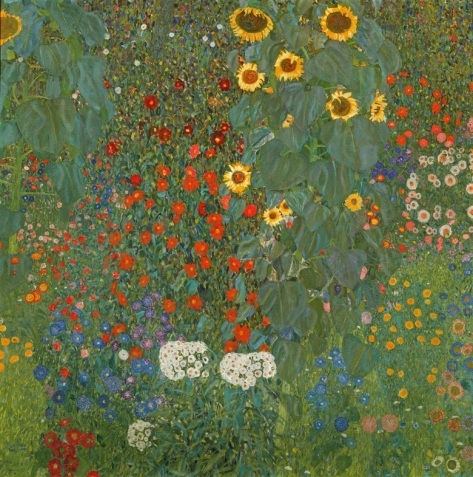


From a Sotheby’s Online Magazine (March 26, 2020):
From Sargent to Sorolla, Jonas Wood to Winston Churchill, Berkshire to Bali — how artists have found solace and inspiration in gardens the world over.
From a Yatzer.com online article (March 14, 2020):
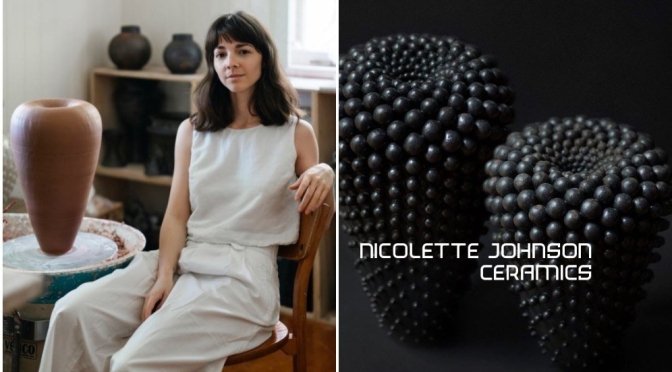
Hand-crafted through a laborious, almost ritualistic process, which sometimes has Nicolette individually sculpting and applying hundreds of protrusions to one vessel for days, her work transcends the dichotomy between artefact and artwork.
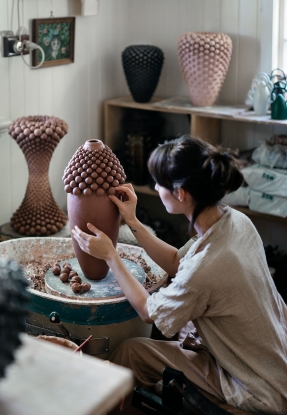 Whether it’s a reaction to the intangible aspect of our digital age, or a consequence of the trend-setting power of Instagram, there’s been a resurgence of ceramics in the last few years, both as an art form and a hobby. Perhaps it’s quite telling then that London-born, Australia-based ceramic artist Nicolette Johnson recreationally begun taking pottery classes just a few years ago as a counterbalance to her day job as a photographer.
Fast forward five years and Nicolette has distinguished herself as an acclaimed ceramist artist through the enchanting sophistication and painstaking craftsmanship of her work that channels ancient forms with contemporary precision.
Nicolette Johnson is a ceramic artist whose work explores symmetry, motifs, and the importance of the artefact.
Nicolette was born in London, England in 1990, grew up in Texas, USA, and today is based in Brisbane, Australia. Working in stoneware and employing wheel-throwing, coiling, and sculpting techniques, Nicolette applies a modern aesthetic to re-imagined ancient forms. Her work is included in the permanent collections of The National Gallery of Victoria and the Museum of Brisbane.
With a background in photographic art and social documentary, Nicolette began studying ceramics in 2015 and is continuing her practice-led exploration into functional and sculptural ceramic vessels, hand-making and firing each of her works in her Brisbane home studio.
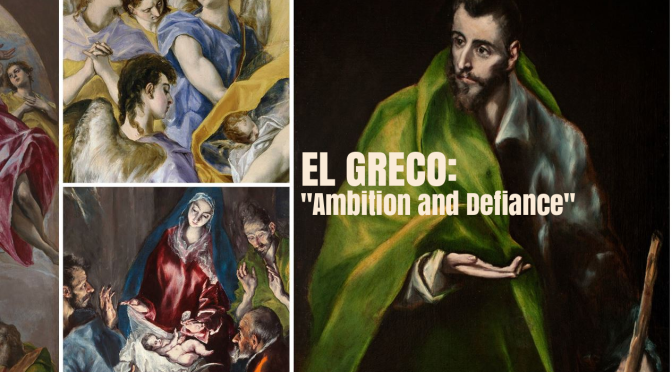
 Explore the exhibition “El Greco: Ambition and Defiance” with curator Rebecca Long and research associate Jena Carvana. Follow along as they lead you through the galleries and share some of the reasons El Greco and his work continue to fascinate us.
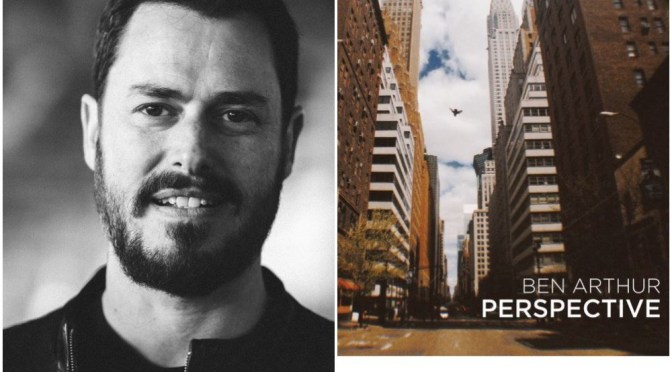
 Ben Arthur is a songwriter and producer who hosts and interviews notable literary figures on his podcast SongWriter, where he explores stories and “answer songs”. It’s now his turn to be interviewed.
 Ben Arthur is an American singer-songwriter and novelist. He has released multiple full-length recordings and novels, and shared stages with several notable acts. Arthur is also a producer and the host of the songwriting video series SongCraft Presents.
From the New York Times (March 26, 2020):
I have seen Naples from his vantage of a ship anchored offshore — one of the most sublime locations in the world, that sweep of coast stacked with apricot, carmine, azure and rose villas; the blue, blue U of the harbor; the emphatic Vesuvius anchoring the view.
In October of 1820, typhus raged in Naples. With his artist friend, Joseph Severn, the British poet John Keats rocked in the city’s harbor for 10 days, not nearly the quaranta giorni — 40 days — that give us our word quarantine.
Before this journey, Keats always felt intense melancholy. In “On Seeing the Elgin Marbles for the First Time,” he wrote “… mortality / Weighs heavily on me like unwilling sleep.” (And in the smooth pentameter of “Ode to a Nightingale”: “I have been half in love with easeful death.”) Not a holiday, this voyage out of England was a desperate trip to the sunny climate of Italy. His cough had grown steadily worse. Since the morning he’d seen a splotch of blood on his pillow, he knew he had little chance of surviving the consumption that had invaded his lungs. His last-ditch: Go to Rome. Meanwhile, exile at sea.
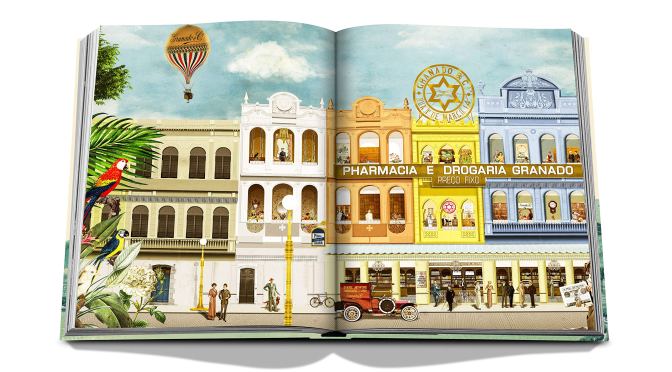
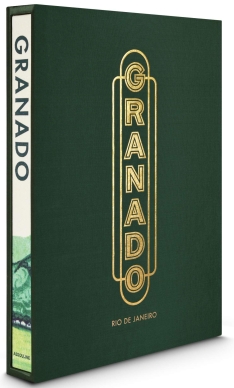 Since it first opened its doors in Rio de Janeiro in 1870, Granado has remained true to its founding mission: to concoct local, natural remedies and cosmetics, crafted from flora of Brazil. Such a formula is responsible for Granado’s endurance through time and its current standing as Brazil’s oldest pharmacy and apothecary.
This stunning and fascinating addition to Assouline’s Legends Collection chronicles Granado’s triumphant transformation from a small Rio shop into an international brand lauded for creating sustainable and stunningly-packaged products made from plants, herbs and flowers native to the region.
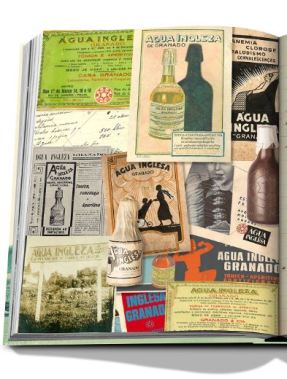 Today, Granado has three boutiques in Paris and a significant online presence in Europe; but the story of Granado’s rise begins with the tale of one man’s singular vision. At a time when medicines used toxic substances such as mercury and arsenic, José Antonio Coxito Granado began to develop natural alternatives that would quickly revolutionize the world of pharmaceuticals in Brazil. In a text enlivened by more than 200 images that capture the bright colors, botanical terrain, and vibrant aesthetics of Rio, writer Hermés Galvao traces the brand’s history, from its modest roots to its time as the Official Pharmacy of the Brazilian Imperial Family and its eventual growth into a global brand under a new family’s ownership. Featuring an illustrious cast of characters and overlapping with some of the most influential eras in Brazilian history, the story of Granado is a tale as rich as the land that yields its products.
Hermés Galvão was born in 1975 in Rio de Janeiro. He is the author of Como Viajar Sozinho em Tempos de Crise Financeira e Existencial, published in the Brazilian market in 2016. He was a columnist for Vogue Brasil for five years and contributes to GQ and Casa Vogue, writing about travel and urban behavior around the world. Galvão conducted the image research for Assouline’s 2016 title In the Spirit of Rio; Granado is his his first book for Assouline as a writer.
Bruno Astuto is a Brazilian journalist and has been contributing to Vogue Brasil for more than a decade. A worldwide ambassador of Brazil’s fashion and lifestyle, and a bibliophile who owns more than 10,000 books, he is the author of several books, including Catarina de Médicis, Somos Todos Iguais, and In the Spirit of Rio.
 During these tough times, Rick Rubin wanted to have a chat with an artist he finds inspiring. Top of mind was John Legend. So he called him up via Zoom, while both were sheltering in place, for a quick chat about his career and the creative process behind two of his biggest songs.
Listen to John Legend’s new single “Actions” below and check for a new album later this year.
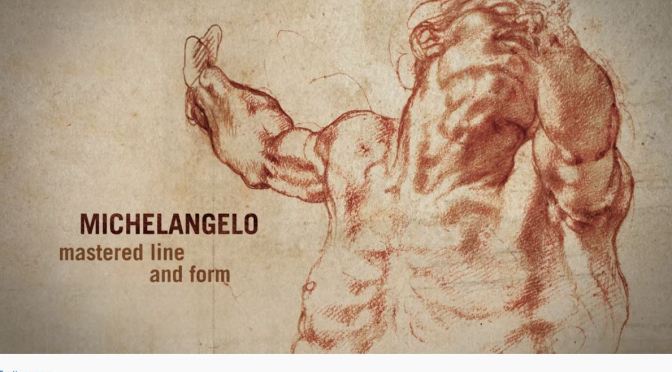
Take a visual journey into the mind of Michelangelo, a painter, sculptor, architect, draftsman, and one of the most creative and influential artists in the history of Western art. See how he used drawings to create, explore, and prepare for some of his most famous works of art. Produced for the J. Paul Getty Museum’s exhibition, “Michelangelo: Mind of the Master.” https://www.getty.edu/art/exhibitions…
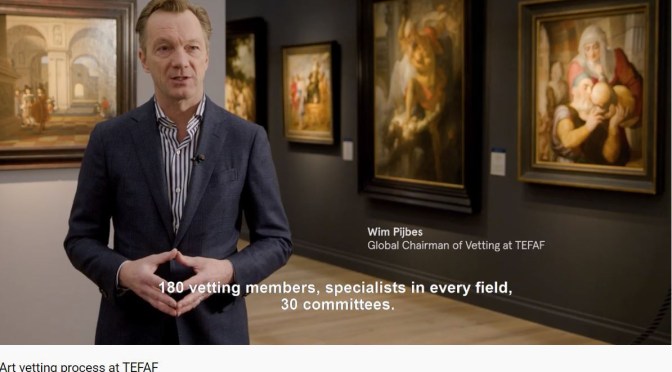
TEFAF (The European Fine Art Fair) brings together the world’s leading experts across a multitude of disciplines to implement and adhere to TEFAF’s vetting procedures and regulations. This allows TEFAF to create a standard that applies across all of its fairs.
Established in 1988, TEFAF is widely regarded as the world’s pre-eminent organization for fine art, antiques, and design. TEFAF runs three Fairs internationally – TEFAF Maastricht, which covers 7,000 years of art history; TEFAF New York Spring, focused on modern and contemporary art & design; and TEFAF New York Fall, covering fine and decorative art from antiquity to 1920. TEFAF gives international dealers the platform to present museum-quality works of all eras and genres to a broad base of collectors and connoisseurs.
“I draw literally and figuratively from the natural world. My drawing and mark making refer to and derive from botanical and biological anatomies, including marine life, as well as, the structures of both macro and micro cosmologies and writing systems, such as logograms.”
Sigrid Burton is an American painter, long based in New York City, whose semi-abstract work is known for its use of expressive, atmospheric color fields and enigmatic allusions to natural and cultural realms. Burton has had solo exhibitions in New York City, Los Angeles, San Francisco, Chicago and Osaka, including at Artists Space and the Michael C. Rockefeller Arts Center, and been included in shows at A.I.R. Gallery, the John and Mable Ringling Museum of Art, and the Carnegie Art Museum, Oxnard. Her work belongs to the public collections of the Metropolitan Museum of Art, Rockefeller Foundation, and Palm Springs Desert Museum, and has been reviewed in Arts Magazine, Arts & Antiques, Jung Journal, Chicago Tribune and LA Weekly.
Writers most frequently observe that Burton’s atmospheric works recall artists such as J.M.W. Turner, Odilon Redon, Pierre Bonnard and Mark Rothko, as well as the light of her native California. Art & Antiques described her approach as “chromatic expressionism” in which color is “her undisputed protagonist”. Peter Frank observed, “The dialectic between color and form has always inflected, even impelled” Burton’s painting, with color the more omnipresent element, and form the more persistent. Art historian William C. Agee wrote, “The domains she explores […] meet, intersect, fuse, and then disappear, like apparitions, in liquid pools of mist and color. Her pictorial odyssey refers simultaneously to both a higher order, a timeless cosmic vastness, as well as to a private, interior world, abounding in personal histories and memories.” Burton has lived and worked in Pasadena, California since 2013.
From Wikipedia



 Boomers Daily