Top New Science Podcasts: Restoring Notre Dame & The Body’s “Tough Skin”

science-magazine-podcastsOn this week’s show, freelance writer Christa Lesté-Lasserre talks with host Sarah Crespi about the scientists working on the restoration of Notre Dame, from testing the changing weight of wet limestone, to how to remove lead contamination from four-story stained glass windows. 

As the emergency phase of work winds down, scientists are also starting to use the lull in tourist activity to investigate the mysteries of the cathedral’s construction.

Also this week, Felipe Quiroz, an assistant professor in the biomedical engineering department at the Georgia Institute of Technology and Emory University, talks with Sarah about his paper on the cellular mechanism of liquid-liquid phase separation in the formation of the tough outer layer of the skin. Liquid-liquid phase separation is when two liquids “demix,” or separate, like oil and water. In cells, this process created membraneless organelles that are just now starting to be understood. In this work, Quiroz and colleagues create a sensor for phase separation in the cell that works in living tissue, and show how phase separation is tied to the formation of the outer layers of skin in mice.

How China And South Korea Are Containing “Coronavirus / Covid-19”

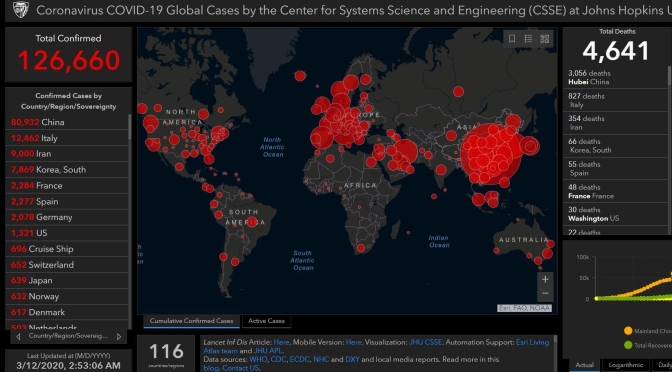
Global health officials have praised China and South Korea for the success of their efforts to contain the coronavirus. What are those countries getting right — and what can everyone else learn from them?

Real-Time Covid-19 Update

Guest: Donald G. McNeil Jr., a science and health reporter for The New York Times. For more information on today’s episode, visit nytimes.com/thedaily.

Background reading:

  • While world leaders are finally speaking out about the gravity of the pandemic, their response lacks unity with the United States absent from its traditional conductor role in managing global crises.
  • Stocks tanked again as the outbreak was officially declared a pandemic and policies to address its impact proved lacking or ineffective.
  • All flights to the U.S. have been suspended from Europe. Many schools announced they would close indefinitely, some nursing homes banned visitors, and workplaces across the country have urged their employees to work from home. Here are the latest updates.

Travel & Sports: “Madman Trails Of Bhutan” – Short Film By Scott Secco (2020)

Director/Cinematographer/Editor: Scott Secco

The kingdom of Bhutan — wedged like a hanging Garden of Babylon in the mighty eastern Himalayas — is the new frontier in the world of Enduro mountain biking. The arrival of the sport has been late but timely, as it enables riders to traverse the numerous ancient trails that make up an intricate web of pathways and dirt paths that dot and connect the kingdom’s diverse twenty districts, providing a backdrop for a ride in what is easily one of the world’s most pristine landscapes.

Website

Medical: “Elbow Pain” – Diagnosis And Treatments (Cleveland Clinic Video)

When is elbow pain an emergency? Can the elbow joint be replaced? What’s that weird feeling when you hit your funny bone? Orthopedic Surgeon, William Seitz Jr., MD, sits down to answer these questions and more.

Read more

“Telemedicine” Is The Way To Treat “Coronavirus / Covid-19” Pandemic (NEJM)

From a New England Journal of Medicine article (March 11, 2020):

New England Journal of Medicine logoA central strategy for health care surge control is “forward triage” — the sorting of patients before they arrive in the emergency department (ED). Direct-to-consumer (or on-demand) telemedicine, a 21st-century approach to forward triage that allows patients to be efficiently screened, is both patient-centered and conducive to self-quarantine, and it protects patients, clinicians, and the community from exposure. 
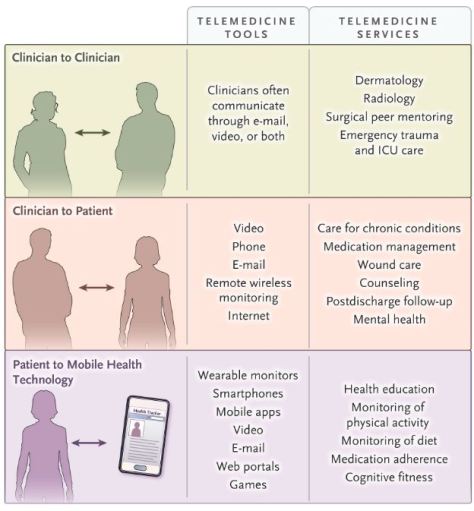
It can allow physicians and patients to communicate 24/7, using smartphones or webcam-enabled computers. Respiratory symptoms — which may be early signs of Covid-19 — are among the conditions most commonly evaluated with this approach. Health care providers can easily obtain detailed travel and exposure histories. Automated screening algorithms can be built into the intake process, and local epidemiologic information can be used to standardize screening and practice patterns across providers.

Telemedicine for Coronavirus Covid-19 New England Journal of Medicine March 11 2020

More than 50 U.S. health systems already have such programs. Jefferson Health, Mount Sinai, Kaiser Permanente, Cleveland Clinic, and Providence, for example, all leverage telehealth technology to allow clinicians to see patients who are at home. Systems lacking such programs can outsource similar services to physicians and support staff provided by Teladoc Health or American Well. At present, the major barrier to large-scale telemedical screening for SARS-CoV-2, the novel coronavirus causing Covid-19, is coordination of testing. As the availability of testing sites expands, local systems that can test appropriate patients while minimizing exposure — using dedicated office space, tents, or in-car testing — will need to be developed and integrated into telemedicine workflows.

Read full article

Health News Video: FDA Launches (And Explains) New Nutrition Facts Label

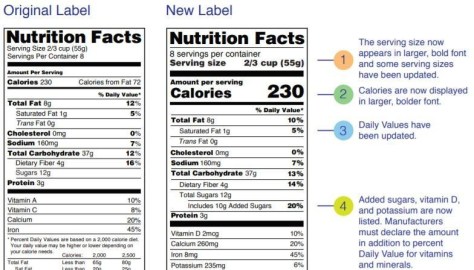
What’s new about the new Nutrition Facts label? Watch this Q&A with Susan T. Mayne, Ph.D., Director of FDA’s Center for Food Safety and Applied Nutrition. 

New FDA Nutrition Facts Label March 2020

For more information

Health Update: Comparing “Coronavirus / Covid-19” And “Influenza” (W.H.O.)

From an MIT Technology Review article (March 11, 2020):

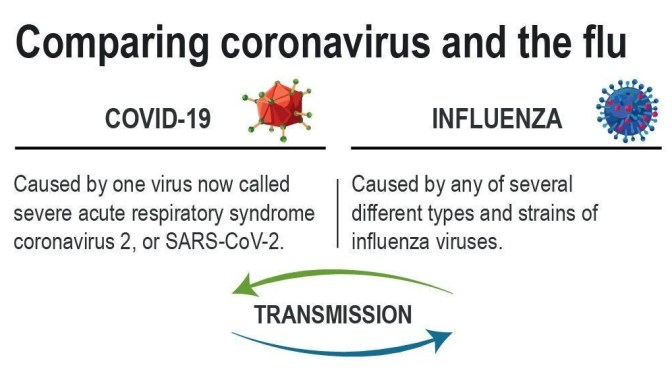
Here are six differences between coronavirus and the flu:

  • World Health Organization WHOCoronavirus appears to spread more slowly than the flu. This is probably the biggest difference between the two. The flu has a shorter incubation period (the time it takes for an infected person to show symptoms) and a shorter serial interval (or the time between successive cases). Coronavirus’s serial interval is around five to six days, while flu’s gap between cases is more like three days, the WHO says. So flu still spreads more quickly.
  • Shedding: Viral shedding is what happens when a virus has infected a host, has reproduced, and is now being released into the environment. It is what makes a patient infectious. Some people start shedding the coronavirus within two days of contracting it, and before they show symptoms, although this probably isn’t the main way it is spreading, the WHO says.
  • Secondary infections. As if contracting coronavirus wasn’t bad enough, it leads to about two more secondary infections on average. The flu can sometimes cause a secondary infection, usually pneumonia, but it’s rare for a flu patient to get two infections after the flu. The WHO warned that context is key (someone who contracts coronavirus might already have been fighting another condition, for example).
  • Coronavirus Protection from getting sick W.H.O.Don’t blame snotty kids—adults are passing coronavirus around. While kids are the primary culprits for flu transmission, this coronavirus seems to be passed between adults. That also means adults are getting hit hardest—especially those who are older and have underlying medical conditions. Experts are baffled as to why kids seem protected from the worst effects of the coronavirus, according to the Washington Post. Some say they might already have some immunity from other versions of the coronavirus that appear in the common cold; another theory is that kids’ immune systems are always on high alert and might simply be faster than adults’ in battling Covid-19.
  • Coronavirus is far deadlier than the flu. Thus far, the mortality rate for coronavirus (the number of reported cases divided by the number of deaths) is around 3% to 4%, although it’s likely to be lower because many cases have not yet been reported. The flu’s rate is 0.1%. 
  • There is no cure or vaccine for the coronavirus. Not yet, anyway, although work is under way. There is, however, a flu vaccine—and everyone should get it, not least because being vaccinated could help lessen the load on overstretched medical services in the coming weeks.

Read WHO report

Read full article

A New Species Of “Bird-Like Dinosaur” Discovered, Preserved In Amber (Video)

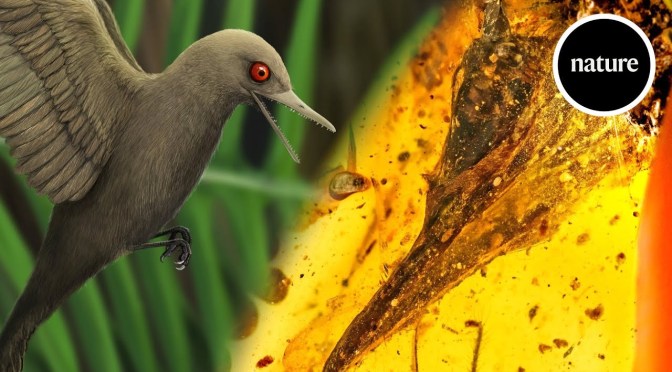
A tiny new species of bird-like dinosaur has been discovered, preserved in a lump of 99-million-year-old amber. The tooth-filled skull is only 7.1mm long, suggesting that this ancient creature would have been the size of a hummingbird – far smaller than other dinosaurs known from that time. Unusual features include large, side-facing eyes and a large number of sharp teeth suggesting a predatory lifestyle. The species has been named Oculudentavis khaungraae and is evidence of previously unimagined biodiversity in the Mesozoic era.

Read more

Top New Science Podcasts: 100-Million-Year-Old Bird In Amber And Viking Dental Hygiene (Nature)

nature-podcastsHear the latest science news, brought to you by Shamini Bundell and Nick Howe. This week, a newly discovered bird species from the time of the dinosaurs, and microbes hundreds of metres below the ocean floor.

In this episode:

00:44 A tiny, toothy, ancient bird

Researchers have found a perfectly preserved bird fossil trapped in amber, with some rather unusual features. Research Article: Xing et al.News and Views: Tiny bird fossil might be the world’s smallest dinosaur

08:09 Research Highlights

Dental hygiene in the time of the Vikings, and wildebeest bones feed an African ecosystem. Research Article: Bertilsson et alResearch Article: Subalusky et al.

10:21 Deep sea life

Scientists have uncovered traces of life 750m below the ocean’s surface. Research article: Li et al.

17:31 News Chat

Updates on the Coronavirus outbreak, and peer review in predatory journals. News: Coronavirus: latest news on spreading infectionNews: Labs rush to study coronavirus in transgenic animals — some are in short supplyNews: Hundreds of scientists have peer-reviewed for predatory journals

Art: “Eve” Sculpture By Auguste Rodin (1899)

John Swarbrooke from Dickinson Gallery explains the beauty and play of light behind the cast of Auguste Rodin’s Eve.

François Auguste René Rodin (12 November 1840 – 17 November 1917) was a French sculptor. Although Rodin is generally considered the progenitor of modern sculpture, he did not set out to rebel against the past. He was schooled traditionally, took a craftsman-like approach to his work, and desired academic recognition, although he was never accepted into Paris’s foremost school of art.

Eve is a nude sculpture by the French artist Auguste Rodin. It shows Eve despairing after the Fall.

n 1880 Rodin was commissioned to produce The Gates of Hell, for which he exhibited Adam at the 1881 Paris Salon. In a sketch for Gates Rodin showed a central silhouette possibly intended as Eve (both the sketch and Gates are now in the Musée Rodin), but in October 1881 he decided to produce Eve as a pair for Adam, with the two sculptures flanking a huge high-relief bas-relief. This would be the first free-standing female sculpture he had produced since the destruction of his Bacchante in an accident between 1864 and 1870. He began Eve in 1881, later abandoning his intended colossal version of it when he realised his model, probably Adèle Abruzzesi, was pregnant. It was first exhibited to the public at the 1899 Paris Salon. It shows a strong influence from Michelangelo, picked up by Rodin in Italy in 1876.

He also produced an autograph white marble version in 1884 (now in the Museo Soumaya in Mexico City), a version in patinated plaster and a much-reproduced 71 cm high bronze version in 1883 (known as the Petite Ève or Little Eve, whose original is also in the Musée Rodin in Paris). He also reused the same figure of Eve in his marble Eve and the Serpent (1901) and his plaster Adam and Eve (1884).

From Wikipedia