Tag Archives: Reviews

Previews: The New Yorker Magazine – March 25, 2024

A woman wears a dress with a pattern that resembles a crossword puzzle. A man writes a letter on her back.

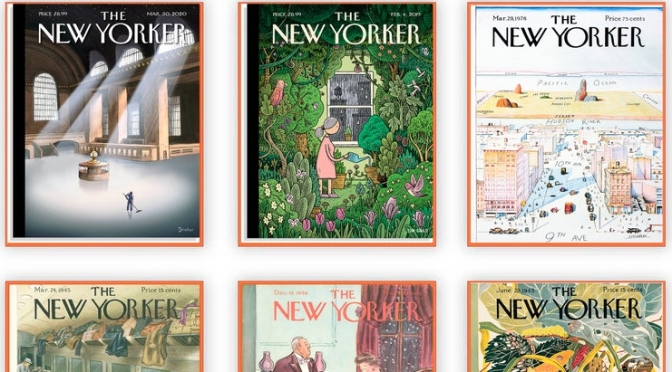
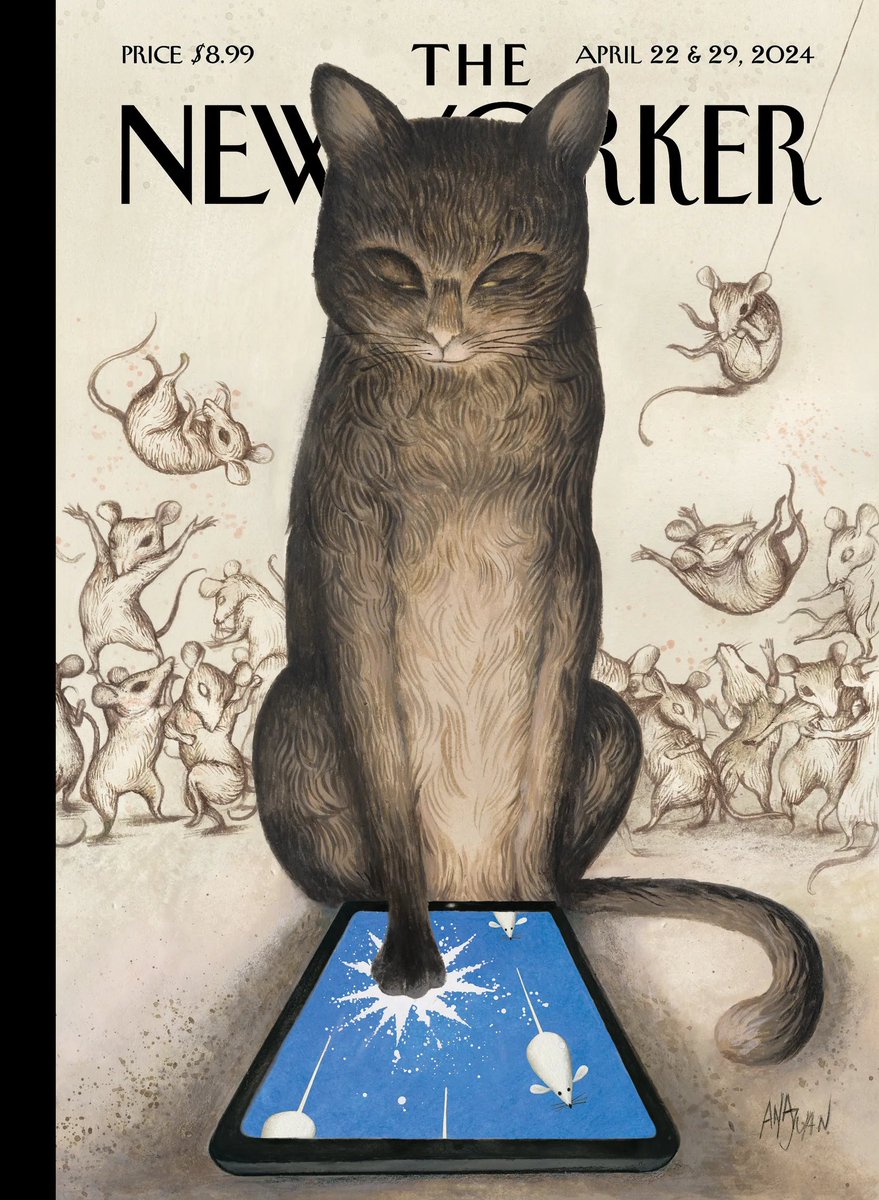
The New Yorker (March 18, 2024): The new issue‘s cover features Klaas Verplancke’s “On the Grid” – The artist blends the preferred pastimes and stylish attire of New York’s commuters. By Françoise Mouly with Art by Klaas Verplancke.

The Place to Buy Kurt Cobain’s Sweater and Truman Capote’s Ashes

A mannequin wears a dress next to displays of other items.

As the art market cools, Julien’s Auctions earns millions selling celebrity ephemera—and used its connections to help Kim Kardashian borrow Marilyn Monroe’s J.F.K.-birthday dress.

By Rachel Monroe

The sidewalks of Lower Broadway in downtown Nashville are filled with people moving among neon-lit venues owned by celebrity musicians: Kid Rock’s Big Ass Honky Tonk & Rock ‘n’ Roll Steakhouse, Jason Aldean’s Kitchen & Rooftop Bar, Miranda Lambert’s Casa Rosa. The Hard Rock Café, which opened in 1994, when the neighborhood could still reasonably be called eclectic, sits at the far edge of the strip, overlooking the Cumberland River. One evening last November, Julien’s Auctions took over a private room at the restaurant for a three-day sale in honor of the company’s twentieth anniversary. There was a spotlighted stage full of objects that musicians had worn or touched or played: a scratched amber ring that Janis Joplin wore onstage at the Monterey Pop Festival, in 1967; Prince’s gold snakeskin-print suit, small enough to fit on an adolescent-size mannequin; ripped jeans that had belonged to Kurt Cobain.

Mike Johnson, the First Proudly Trumpian Speaker

A black and white photo of men in suits walking inside a building.

Though he has adopted a “nerd constitutional-law guy” persona, he is in lockstep with the law-flouting former President.

By David D. Kirkpatrick

The Capitol Hill Club, in a white brick town house a few blocks from the House of Representatives, is a social institution exclusively for Republicans. One evening in October, Representative Mike Garcia was eating there alone when Representative Mike Johnson stopped to chat. Garcia is a first-generation immigrant and a retired Navy pilot from a Democratic-leaning district in Southern California. His predecessor, a Democrat, resigned after a scandal four years ago, and Garcia highlighted disagreements with his party to win reëlection in 2022. He was also a loyalist to former House Speaker Kevin McCarthy, a fellow-Californian who had just been ousted by a small band of hard-line conservative rebels annoyed at his willingness to compromise on budget disputes. Garcia had formally nominated McCarthy as Speaker at the beginning of 2023, and his removal deprived Garcia of a patron.

The New Criterion – April 2024 Arts/Culture Preview

Image
The New Criterion – The April 2024 issue features:

Poetry a special section
Black poetry  by William Logan
Shakespeare’s words  by Amit Majmudar
Bachmann: the unspeakable spoken  by Peter Filkins
The new & the old  by Katie Hartsock
The answer to Lord Chandos  by Pascal Quignard

New translations  by Ryan Choi, Frederick Amrine, Patrick Whalen & Beverley Bie Brahic

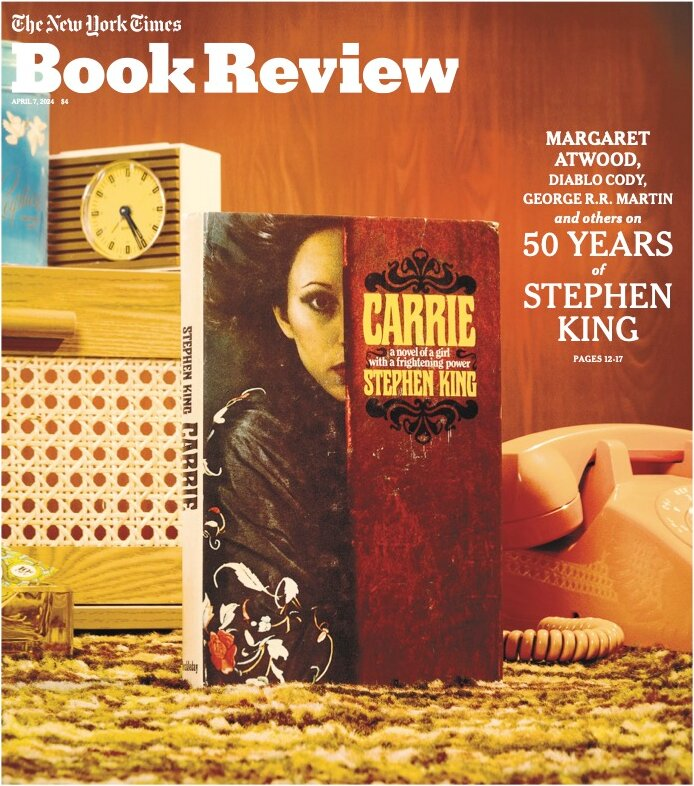
The New York Times Book Review – March 17, 2024

Image

THE NEW YORK TIMES BOOK REVIEW (March 16, 2024): 

22 of the Funniest Novels Since ‘Catch-22’

Catch-22 eBook by Joseph Heller, Christopher Buckley | Official Publisher  Page | Simon & Schuster

Because we could all use a laugh.

By Dwight GarnerAlexandra Jacobs and Jennifer Szalai

When it comes to fiction, humor is serious business. If tragedy appeals to the emotions, wit appeals to the mind. “You have to know where the funny is,” the writer Sheila Heti says, “and if you know where the funny is, you know everything.” Humor is a bulwark against complacency and conformity, mediocrity and predictability.

With all this in mind, we’ve put together a list of 22 of the funniest novels written in English since Joseph Heller’s “Catch-22” (1961). That book presented a voice that was fresh, liberated, angry and also funny — about something American novels hadn’t been funny about before: war. Set during World War II and featuring Capt. John Yossarian, a B-25 bombardier, the novel presaged, in its black humor, its outraged intelligence, its blend of tragedy and farce, and its awareness of the corrupt values that got us into Vietnam, not just Bob Dylan but the counterculture writ large.

You’re Not Being Gaslit, Says a New Book. (Or Are You?)

“On Gaslighting,” by the philosophy professor Kate Abramson, explores the psychological phenomenon behind the hashtags.

A still from a black-and-white movie portrays a couple in Victorian dress. The man, in a dark suit, looks down disdainfully at a woman in a gown and pompadour as she gazes into the distance.

By Dodai Stewart

ON GASLIGHTING, by Kate Abramson


Don’t be so sensitive.

You’re overreacting.

You’re imagining things.

These are things gaslighters say, writes Kate Abramson.

As she explains in “On Gaslighting,” the term originated in the 1944 film “Gaslight,” and after entering the therapeutic lexicon of the 1980s, steadily made its way into colloquial usage.

As a society we have become adept at classifying actions within interpersonal relationships using therapy-speak. From “attachment style” to “trauma-bonding,” personal judgments have become diagnoses — without the assistance of a licensed professional: Anyone with a social media account or a jokey T-shirt can get in on the action. (In 2021, the flippant phrase “gaslight, gatekeep, girlboss” became a popular, snide social-media shorthand for a certain kind of capitalist feminism.)

The New York Times Magazine – March 17, 2024

Image

THE NEW YORK TIMES MAGAZINE (March 16, 2024):

The ‘Colorblindness’ Trap: How a Civil Rights Ideal Got Hijacked

The fall of affirmative action is part of a 50-year campaign to roll back racial progress.

By Nikole Hannah

Anthony K. Wutoh, the provost of Howard University, was sitting at his desk last July when his phone rang. It was the new dean of the College of Medicine, and she was worried. She had received a letter from a conservative law group called the Liberty Justice Center. The letter warned that in the wake of the Supreme Court’s decision striking down affirmative action in college admissions, the school “must cease” any practices or policies that included a “racial component” and said it was notifying medical schools across the country that they must eliminate “racial discrimination” in their admissions. If Howard refused to comply, the letter threatened, the organization would sue.

What Deathbed Visions Teach Us About Living

A photo illustration of two peoples’ silhouettes.

Researchers are documenting a phenomenon that seems to help the dying, as well as those they leave behind.

By Phoebe Zerwick

Chris Kerr was 12 when he first observed a deathbed vision. His memory of that summer in 1974 is blurred, but not the sense of mystery he felt at the bedside of his dying father. Throughout Kerr’s childhood in Toronto, his father, a surgeon, was too busy to spend much time with his son, except for an annual fishing trip they took, just the two of them, to the Canadian wilderness. Gaunt and weakened by cancer at 42, his father reached for the buttons on Kerr’s shirt, fiddled with them and said something about getting ready to catch the plane to their cabin in the woods. “I knew intuitively, I knew wherever he was, must be a good place because we were going fishing,” Kerr told me.

Finance Preview: Barron’s Magazine – March 18, 2024

Magazine - Latest Issue - Barron's

BARRON’S MAGAZINE – MARCH 18, 2024 ISSUE:

100 Top Women in Finance: Blazing New Trails in the Markets, the Economy, and Industry

100 Top Women in Finance: Blazing New Trails in the Markets, the Economy, and Industry

Barron’s annual list of 100 Most Influential Women in U.S. Finance honors established and emerging leaders in the field.

What’s Next for Social Security Depends On Who Wins the White House

What's Next for Social Security Depends On Who Wins the White House

Biden has vowed to protect the program, while Trump has floated benefit cuts. What it means for future retirees.3 min read

As Peltz Takes on Disney’s Bob Iger, Here’s a Scorecard for Their Battle

As Peltz Takes on Disney's Bob Iger, Here's a Scorecard for Their Battle

Trian Partners has secured control of more than $3 billion worth of Disney stock and is demanding two board seats.

How AI Is Sparking a Change in Power

How AI Is Sparking a Change in Power

Energy companies increasingly cite AI as a major driver of electricity demand. But the grid could hold everything back.

PayPal Stock Has Fallen Far Enough. It’s Time to Buy.

The once-highflying payments company now trades at a valuation more suitable for a midsize bank. The good news: The path to a comeback is simpler than the Street expects.

Commentary Magazine – April 2024 Opinion Preview

Image

Commentary Magazine (March 15, 2024) The latest issue features ‘The Elite War On The American Middle Class…And How To End It’; The Big Lies about Israel’s Big Bombs…

The Elite War on the American Middle Class—and How to End It

by Christine Rosen

Being middle class in America used to mean something—something socially transformative, something even revolutionary. The American middle class represented a form of national social order never before seen on this earth—cultural domination not by the very rich and very educated, or the political domination either by tyrants or the mob, but by a mass of people, relatively well-to-do, who felt themselves fortunate in their circumstances. That was what made the American middle class different from the French or English bourgeoisie. Its members believed, and the country believed, that they were the nation’s backbone, its true governing class, and its moral compass.

The Four Questions of 2024

by Matthew Continetti

President Joe Biden and former president Donald Trump squared off four years ago and are on track for the first major-party rematch since 1892. Biden and Trump are the oldest presidential candidates in history, and each man has an established political brand. Biden first won federal office in 1972, and it’s been over a decade since the GOP nominated someone other than Donald Trump. The 2024 election is like all the SIRIUS XM oldies stations—Classic Vinyl, Classic Rewind, Rock and Roll Hall of Fame Radio—rolled into one.

The Hateful Candace Owens

by Christine Rosen

If you had never heard of Candace Owens until recently, you aren’t alone. Less than a decade ago, she was an unknown college dropout working as a marketing professional in New York, writing pieces for her company’s website about the “bat-s—t crazy antics of the Republican Tea Party.” Then, suddenly, she claimed to have experienced a political conversion. She told the libertarian political commentator Dave Rubin in 2017, “I became a conservative overnight. . . . I realized that liberals were actually the racists. Liberals were actually the trolls.”

Research Preview: Science Magazine – March 15, 2024

Image

Science Magazine – March 15, 2024: The new issue features ‘Fast Moving Magma’ – A large diking event preceded Iceland’s recent eruptive episodes…

Efforts to screen kids for type 1 diabetes multiply

Blood tests can detect the disease process early, avoiding complications and aiding treatment

‘Damning’ FDA inspection report undermines Alzheimer’s drug

Inspectors faulted analyses of clinical trial samples by Hoau-Yan Wang for drug developer Cassava Sciences

Seafloor fiber-optic cables become sensor stations

“Smart cables” will detect earthquakes, tsunamis, and global warming

‘I’m not Tony’: Anthony Fauci’s heir vows new direction at NIAID

Jeanne Marrazzo, an HIV prevention researcher, sees need for more “holistic” approach to community health problems

Previews: The New Yorker Magazine – March 18, 2024

A skier skis from snow onto grass.

The New Yorker (March 11, 2024): The new issue‘s cover features Peter de Sève’s “Downhill” – The artist depicts carving up the slopes, straight into spring.

Among the A.I. Doomsayers

A large robotic foot hovers above a figure.

Some people think machine intelligence will transform humanity for the better. Others fear it may destroy us. Who will decide our fate?

By Andrew Marant

Katja Grace’s apartment, in West Berkeley, is in an old machinist’s factory, with pitched roofs and windows at odd angles. It has terra-cotta floors and no central heating, which can create the impression that you’ve stepped out of the California sunshine and into a duskier place, somewhere long ago or far away. Yet there are also some quietly futuristic touches. High-capacity air purifiers thrumming in the corners. Nonperishables stacked in the pantry. A sleek white machine that does lab-quality RNA tests. The sorts of objects that could portend a future of tech-enabled ease, or one of constant vigilance.

Have the Liberal Arts Gone Conservative?

A column with a pencil tip.

The classical-education movement seeks to fundamentally reorient schooling in America. Its emphasis on morality and civics has also primed it for partisan takeover.

The New York Times Magazine – March 10, 2024

Image

THE NEW YORK TIMES MAGAZINE (March 9, 2024):

Kate Winslet Pushes Her Characters, and Herself, to the Edge

A black-and-white photograph of Kate Winslet.

As a young star, she endured Hollywood’s brutal treatment of women. Now she’s putting her resilience and grit on full display.

Kate Winslet was standing in front of a microphone, breathing hard. Sometimes she did it fast; sometimes she slowed it down. Sometimes the breathing sounded anxious; other times, it was clearly the gasping of someone who was winded. Before beginning a new take, Winslet stood stock still, hands opening and closing at her sides; she looked like a gymnast about to bound into a floor routine. Every breath seemed high-stakes, even though she was well into a long day of recording in a dim, windowless studio in London.

Why Power Eludes the French Left

A close-up photograph of Jean-Luc Mélenchon.

France has often been the vanguard of leftist politics — but support in the streets doesn’t always translate to votes at the ballot box.

By Elisabeth Zerofsky

The signs that a protest is happening in Paris are nearly always the same: the quiet of blocked-off streets; the neat rows of police vans containing the gendarmerie stretching down the boulevard; the sound of drumbeats and whistles and the neon red flares that spit smoke into the sky. For six months last year, those signs were constant and ubiquitous, as furious, sometimes violent marches and general strikes protesting President Emmanuel Macron’s pension reforms brought Paris to a standstill. Students and activists, public-transit operators, custodial staff, medics, mechanics, teachers, oil-rig workers, writers and celebrities all gathered to rail against Macron’s plan to raise the national retirement age by two years, to 64.

Preview; Literary Review Of Canada – April 2024

Home | Literary Review of Canada

Literary Review of Canada -April 2024: The latest issue features:

In Left Field – Ed Broadbent and the future of the NDP

Seeking Social Democracy: Seven Decades in the Fight for Equality: Broadbent,  Edward, Abele, Frances, Sas, Jonathan, Savage, Luke: 9781770417380:  Amazon.com: Books

Seeking Social Democracy: Seven Decades in the Fight for Equality by Ed Broadbent, with Frances Abele, Jonathan Sas, and Luke Savage

On July 6, 1975, Ed Broadbent, then a thirty-­nine-year-old member of Parliament from Oshawa, Ontario, delivered a speech at the New Democratic Party convention in Winnipeg, capping off his campaign to become just the third leader in the young party’s history. It was a tumultuous time. Across the rich world, the social democratic settlement that had been brought about by the twin catastrophes of the Great Depression and the Second World War was beginning to unravel with the collapse of the Bretton Woods monetary system, the oil shock precipitated by the Arab-­Israeli conflict, the beginning of industrial decline, and the emergence of persistent inflation. The year before, the NDP had suffered a significant electoral setback when, after supporting the minority Trudeau government in Parliament since 1972, it lost almost half its seats despite seeing its vote share decline by only 2.4 percent.

Motor City Meltdown – Catherine Leroux’s alternative history

The Future by Catherine Leroux; Translated by Susan Ouriou

The Future by Catherine Leroux, translated by Susan Ouriou | CBC Books

In The Future’s reimagined history, the French never ceded Fort Détroit to the British in 1760, and the British never ceded it to the United States as part of the Treaty of Paris in 1783. Instead, the community has remained proudly French Canadian for centuries. (“Never forget we were two shakes away from becomin’ American,” a current resident proclaims.) But while the Motor City was once “full of people, full of music, full of words,” it now struggles in economic ruin — ravaged by pollution, poverty, and crime. It is “a place devoid of faith or law,” with poison in the river and pictures of missing children posted everywhere.