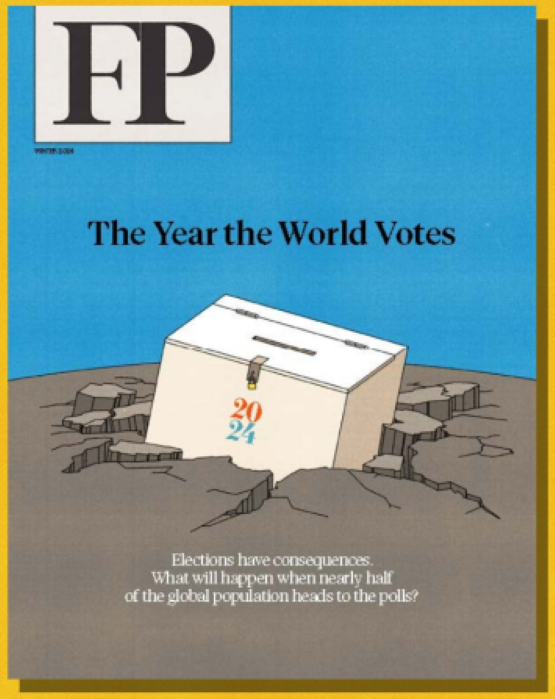


Foreign Policy Magazine – December 28, 2023: The new issue features ‘The Year The World Votes’ – Elections have consequences. What will happen when nearly half of the global population heads to the polls?
The world’s most dismal science could make Eurasia safe for illiberalism and predation—or protect it from those forces.
By Hal Brands, a professor of global affairs at the Johns Hopkins School of Advanced International Studies.
Alexander Dugin is a bit of a madman. The Russian intellectual made headlines in the West in 2022, when his daughter was killed, apparently by Ukrainian operatives, in a Moscow car bombing likely meant for Dugin himself. Dugin would have been targeted because of his unapologetic, yearslong advocacy for a genocidal war of conquest in Ukraine. “Kill! Kill! Kill!” he screeched after Russian President Vladimir Putin’s first invasion of that country in 2014, adding: “This is my opinion as a professor.” Even at his daughter’s funeral, Dugin stayed on message. Among her first words as an infant, he claimed, were “our empire.”
The Economist (December 28, 2023) – What are the stories set to shape 2024? From the biggest election year in history, to how to control AI and even taxis that fly, The Economist offers its annual look at the world ahead.
Video timeline: 00:00 – The World Ahead 2024 00:33 – Vital votes 03:34 – Taxis take off 07:10 – AI rules 10:19 – Industry cleans up? 13:48 – BRICS build
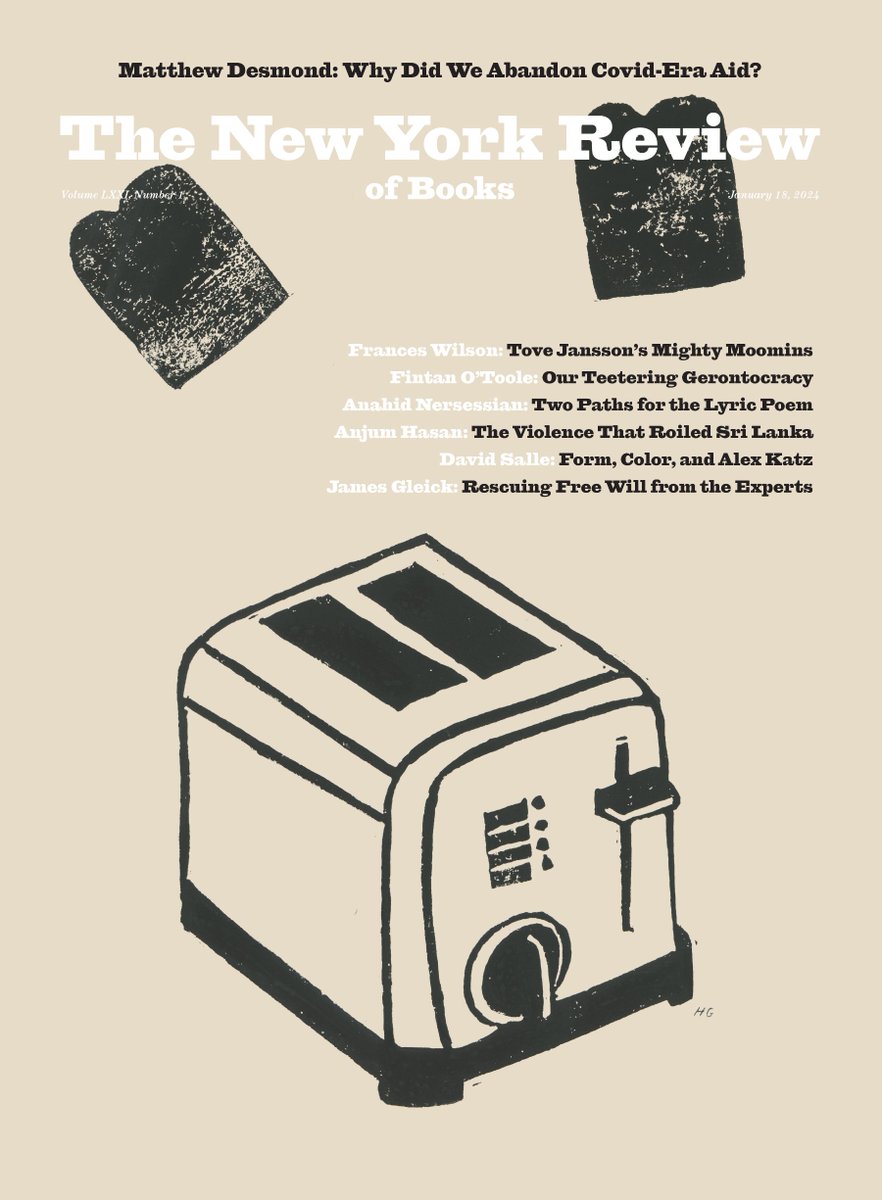
The New York Review of Books (December 28, 2023) – The latest issue featuresBen Tarnoff on Elon Musk, Julian Bell on Peter Paul Rubens, Fintan O’Toole on the American gerontocracy, Anjum Hasan on recent Sri Lankan fiction, Matthew Desmond on America’s Covid-era experiment with a social safety net, Francine Prose on a vampiric celluloid Pinochet, James Gleick on the science of free will, Frances Wilson on Tove Jansson and the Moomintrolls, Álvaro Enrique on indigenous Americans in Europe, Katie Trumpener on Alexander Kluge, two poems by Jack Underwood, and more.
Nobody was holding a gun to your head when you started reading this. You made a choice. Surely it felt that way, at least. A sense of agency—of control over our actions, of continual decision-making—is part of the experience of being human, moment by moment and day by day. True, we sometimes just drift, like robots or zombies, but at other times we gird our loins and exert our will. David Hume defined will nearly three centuries ago as “the internal impression we feel and are conscious of, when we knowingly give rise to any new motion of our body, or new perception of our mind.” The feeling was universal then and it’s universal now.
Country Life Magazine – December 27, 2023: The latest issue features ‘This Splendid Land’ – Landscapes, Landmarks, Houses and Gardens; The Art of Knot Tying; Winston Churchill’s interior-design tips; A unicorn in the garden – fantastic beasts tamed…
Long-standing Country Life contributor Charles Quest-Ritson is literally the man who wrote the book on roses — specifically The RHS encyclopedia of Roses — and back in June, he shared some tips on sharing and planting cuttings which proved enormously popular.
The New Yorker – January 1 & 8, 2024 issue: The new issue‘s cover featuresBianca Bagnarelli’s “Deadline” – The artist evokes a moment suspended between the old and the new.
He began as more of a tutor than a talent. But in his final decade he lent a keen eye-in-the-sky view to the Paris streets, rendering miracles of kinetic characterization.
It’s one of the stranger anomalies of French intellectual life that Impressionist painting—by far the most influential of French cultural enterprises—has received so little attention from the most ambitious French critics and philosophers. One can page through André Gide’s journal entries, a lot of them on art, or through Albert Camus’s, and find very little on Claude Monet or Edgar Degas (and much more on the Symbolists, a group that was far easier for a literary man to “get”). Marcel Proust cared passionately for painting, and his hero-painter Elstir has touches of Monet, but in order to make him interesting Proust had to model him on the more histrionic James McNeill Whistler, with samplings from a forgotten American painter added in.
Following Hamas’s October 7th attack and Israel’s invasion, Mosab Abu Toha fled his home with his wife and three children. Then I.D.F. soldiers took him into custody.
Tesla and China-based BYD are financially similar. Both car makers generated almost identical operating profit in the third quarter. The one big difference: their valuations.Long read
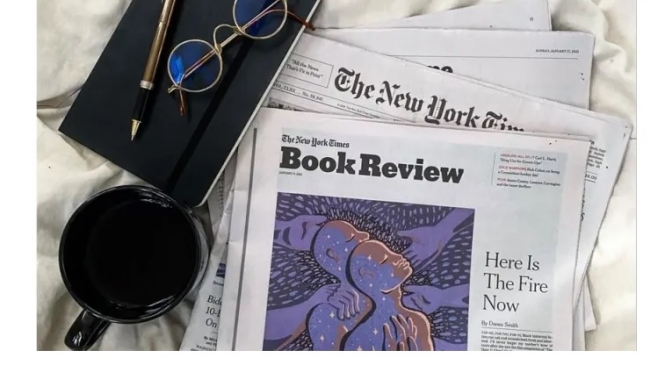
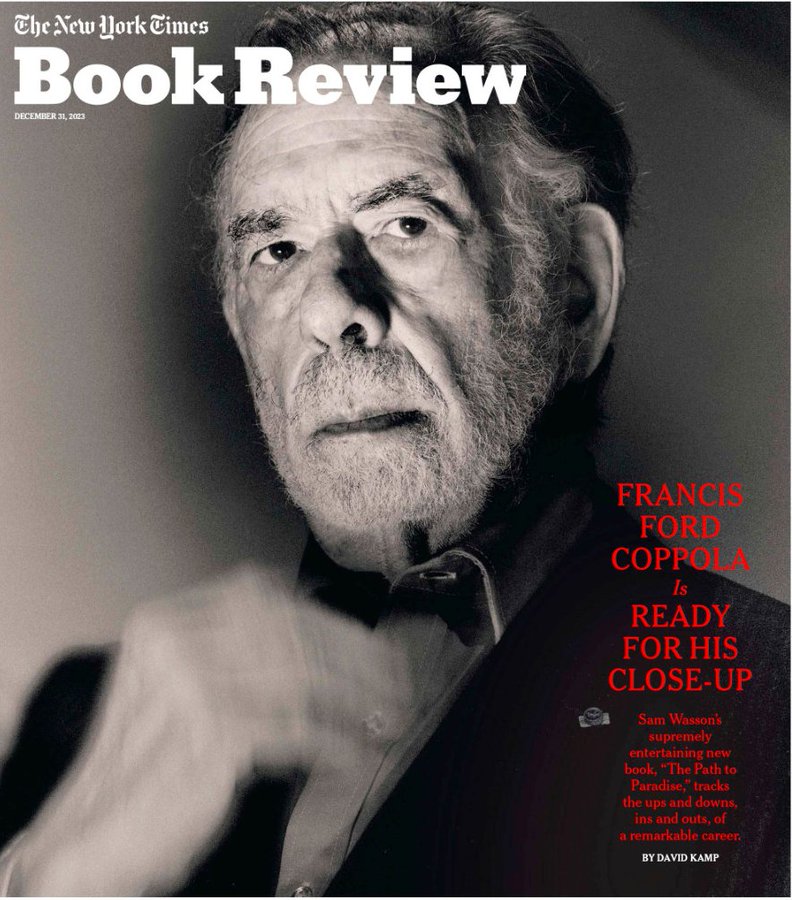
THE NEW YORK TIMES BOOK REVIEW (December 22, 2023): The latest issue features MAGIC: The Life of Earvin “Magic” Johnson, by Roland Lazenby; My Jewish Charlie Brown Christmas – The Peanuts special is the most overtly Christian TV holiday classic. So why does it speak to me so deeply?; Seven Fishes (Not Seven Dishes) for Christmas Eve – A modern Italian American take on the Feast of the Seven Fishes offers a streamlined menu any family can pull off….
Roland Lazenby’s big biography of Magic Johnson gives us a wealth of detail, a huge cast of characters and, in a way, the tapestry of our time.
By Thomas Beller
MAGIC: The Life of Earvin “Magic” Johnson, by Roland Lazenby
I once asked a portrait photographer why no one ever smiled in her pictures, and she replied, “A smile is a mask.”
I thought of this aphorism as I read Roland Lazenby’s 800-page biography of Magic Johnson. Sports Illustrated declared his smile to be one of the two greatest smiles of the 20th century. (The other was Louis Armstrong’s.) As Missy Fox, the daughter of his high school coach, says in the book, “That is the one thing he’s always had, that smile.”
My Jewish Charlie Brown Christmas
The Peanuts special is the most overtly Christian TV holiday classic. So why does it speak to me so deeply?
“A Charlie Brown Christmas” was a one-of-a-kind wonder when it premiered in 1965 and remains so almost 60 years later. Unlike the other jingle-belled baubles that TV throws down the chimney each year, it is melancholy and meditative. The animation is minimalist and subdued, full of grays and wafting snowflakes. I could wrap myself in the Vince Guaraldi jazz score like a quilt.
Decades after I left hustling to become a writer, why did I seek out the man who drew me into that world?
By Mitchell S. Jackson
O.G. rings me in the a.m. to say he’s just touched down in Phoenix. It’s the day before he said he’d arrive, and while there was a time when I’d treat the seeming opacity of his plans as par, the call’s a minor surprise. He asks for my address and tells me he can drop by as soon as he grabs his rental car. “Cool,” I say, as if the call ain’t ramped my pulse, as if my crib is presentable for guests. It isn’t. So I shoot out of bed and get to cleaning and straightening the first floor, going so far as to light a candle. It’s been umpteen years since I’ve seen O.G. — Lonnie’s his name — and God forbid he judge me anything less than hella fastidious.
The story of 2.3 million Palestinian refugees in Jordan has been shaped by generations of war and exile.Photographs
by MOISES SAMAN
How Do You Make a Movie About the Holocaust?
With “The Zone of Interest,” Jonathan Glazer is just the latest director to confront the problem.
Poetry makes nothing happen, W.H. Auden said in 1939, when words must have seemed especially impotent; but cinema is another matter. For several decades after the end of the Second World War, what’s come to be seen as its central catastrophe — the near-total destruction of the European Jews — was consigned to the status of a footnote. The neglect was rooted in guilt: Many nations eagerly collaborated in the killing, while others did nothing to prevent it. Consumed by their own suffering, most people simply didn’t want to know, and a conspiracy of silence was established.
News, Views and Reviews For The Intellectually Curious