
 A selection of three essential articles read aloud from the latest issue of The Economist. This week, the next catastrophe and how to survive it; (9:40) the risks of annexation for Israel; (21:50) and the Wirecard scandal.
Tag Archives: News

Coronavirus Update: State Of The Pandemic After Six Months (Nature Podcast)
 We take a look back over the past six months of the pandemic, and discuss how far the world has come. It’s been a period of turmoil and science has faced an unprecedented challenge. What lessons can be learned from the epidemic so far to continue the fight in the months to come?
Also in this episode:
12:55 Unanswered questions
After months of intensive research, much is known about the new coronavirus – but many important questions remain unanswered. We look at the knowledge gaps researchers are trying to fill.
Nature Medicine: Real-time tracking of self-reported symptoms to predict potential COVID-19
20:36 How has lockdown affected fieldwork?
The inability to travel during lockdown has seriously hampered many researchers’ ability to gather fieldwork data. We hear from three whose work has been affected, and what this means for their projects.

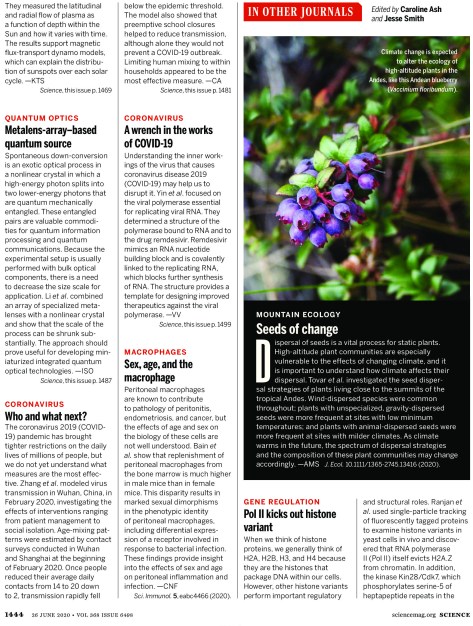
TOP JOURNALS: RESEARCH HIGHLIGHTS FROM SCIENCE MAGAZINE (JUNE 26, 2020)


Covid-19: “Superspreading Events” Responsible For Up To 80% Of Infections
From Scientific American (June 23, 2020):
 In fact, research on actual cases, as well as models of the pandemic, indicate that between 10 and 20 percent of infected people are responsible for 80 percent of the coronavirus’s spread.
Researchers have identified several factors that make it easier for superspreading to happen. Some of them are environmental.
- Poorly ventilated indoor areas seem especially conducive to the virus’s spread – A preliminary analysis of 110 COVID-19 cases in Japan found that the odds of transmitting the pathogen in a closed environment was more than 18 times greater than in an open-air space.
- Places where large numbers of people congregate – As a group’s size increases, so does the risk of transmitting the virus to a wider cluster. A large group size also increases the chance that someone present will be infectious.
- The longer a group stays in contact, the greater the likelihood that the virus will spread among them – The benchmark used for risk assessment in her contact-tracing work is 10 minutes of contact with an infectious person, though the CDC uses 15 minutes as a guideline.
- Some activities seem to make it easier to spread respiratory gunk – Speech emits more particles than normal breathing. And emissions also increase as people speak louder. Singing emits even more particles, which may partially explain the superspreader event at the Washington State choir practice. Breathing hard during exercise might also help the spread of COVID-19.
Top New Science Podcasts: Universities Post-Covid And Drones Fighting Mosquito-Borne Disease
 Senior Correspondent Jeffrey Mervis joins host Sarah Crespi to talk about how universities are dealing with the financial crunch brought on by the coronavirus. Jeff discusses how big research universities are balancing their budgets as federal grants continue to flow, but endowments are down and so is the promise of state funding.
Mosquito-borne infections like Zika, dengue, malaria, and chikungunya cause millions of deaths each year. Nicole Culbert and colleges write this week in Science Robotics about a new way to deal with deadly mosquitoes—using drones. The drones are designed to drop hundreds of thousands of sterile male mosquitoes in areas with high risk of mosquito-borne illness. The idea is that sterile male mosquitoes will mate with females and the females then lay infertile eggs, which causes the population to decline. They found this drone-based approach is cheaper and more efficient than other methods of releasing sterile mosquitoes and does not have the problems associated with pesticide-based eradication efforts such as resistance and off-target effects.
Global: The Power Of Protest, Great Cities Post-Covid & Bartleby Columns
 A selection of three essential articles read aloud from the latest issue of The Economist. This week, the power of protest and the legacy of George Floyd; (11:07) life in great cities after the pandemic; (17:55) and the lessons from one hundred Bartleby columns on work and management.
Top New Science Podcasts: Quantum States In Space Lab, Barcode Bacteria
 This week, the spaceborne lab that allows investigation of quantum states, and the debate surrounding how mountain height is maintained.
In this episode:
01:18 Space lab
Scientists have built a lab on the international space station, allowing them to remotely investigate quantum phenomena in microgravity. Research Article: Aveline et al.; News and Views: Quantum matter orbits Earth
08:37 Research Highlights
Trackable ‘barcode’ bacteria, and physicists simulate near light speed cycling. Research Highlight: ‘Barcode’ microbes could help to trace goods — from lettuce to loafers; Research Highlight: What Einstein’s theory means for a cyclist moving at almost light speed
10:48 Maintaining mountain height
For a long time many researchers have thought that mainly erosion controls the height of mountains, but new research suggests that tectonic forces play a bigger role. Research Article: Dielforder et al.; News and Views: Mountain height might be controlled by tectonic force, rather than erosion
16:12 Pick of the Briefing
We pick our highlights from the Nature Briefing, including how sleep deprivation kills, and a monumental Maya structure hidden in plain sight. Quanta Magazine: Why Sleep Deprivation Kills; National…
Global: Police Violence In America, China Trade & Pushkin’s Lockdown
A selection of three essential articles read aloud from the latest issue of The Economist. This week: Police violence, race and protest in America, How will China’s Belt and Road Initiative survive? (10:30) And, Alexander Pushkin’s productive lockdown (23:10).
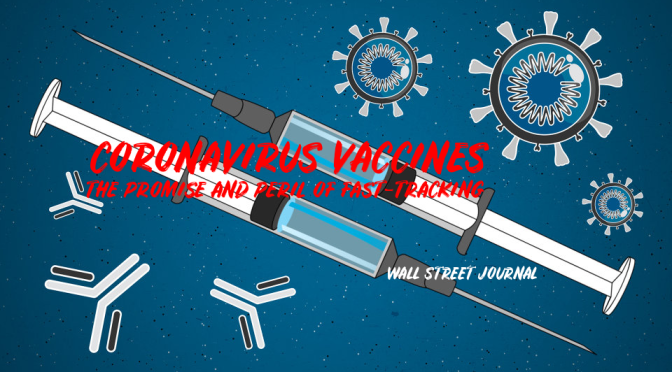
Coronavirus Vaccines: The Promise And Peril In Fast-Tracking (WSJ Video)
As the coronavirus continues to spread around the globe, companies and academic labs are racing to develop a vaccine that would help society get back to normal. But there could also be costs to moving too quickly.
WSJ’s Daniela Hernandez explains. Photo illustration: Laura Kammermann
Coronavirus: “Confusing Hydroxychloroquine Studies” (Nature Podcast)
President Trump’s preferred coronavirus treatment is the focus of a new study suggesting it could cause more harm than good, but not everybody agrees. We discuss the fallout as trials around the world are paused and countries diverge over policy advice.
12:12 Are we rushing science?
Coronavirus papers are being published extremely quickly, while normally healthy scientific debate is being blown up in the world’s press. Is there a balancing act between timely research and accurate messaging?
18:49 One good thing
Our hosts pick out things that have made them smile in the last week, including hedgerow brews and a trip into the past using AI.
Recipe: Elderflower ‘Champagne’
Video: Denis Shiryaev restores historic footage with AI
22:30 The latest coronavirus research papers
Noah Baker takes a look through some of the key coronavirus papers of the last few weeks.
News: Coronavirus research updates
medRxiv: Full genome viral sequences inform patterns of SARS-CoV-2 spread into and within Israel
Harvard Library: Reductions in commuting mobility predict geographic differences in SARS-CoV-2 prevalence in New York City
Science: DNA vaccine protection against SARS-CoV-2 in rhesus macaques
 Boomers Daily