
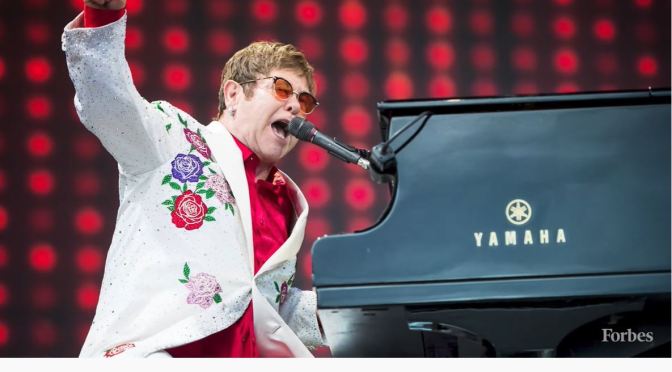
In this episode of Building Fortunes, we look how Elton John became one of the best-selling artists of all time. In 2020, Elton John’s yearly earnings amounted to $81 million. His Farewell Yellow Brick Road Tour grossed $212 million in 2019, the second-highest tally in the business. With the pandemic postponing his North American tour dates in April, the Rocket Man will have to wait to complete his 300-show, five-continent tour. In April, the Rocket Man’s Elton John AIDS Foundation announced a $1 million emergency fund to help those with HIV maintain their care amid Covid-19.
Tag Archives: Music
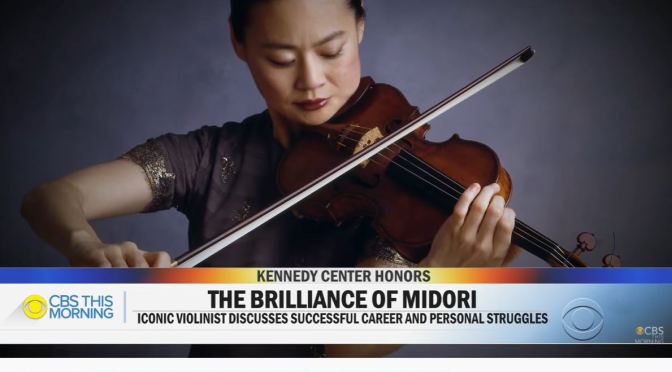
Musical Profile: Violin Virtuoso Midori Honored
Violin virtuoso Midori, a former child prodigy compared to Mozart, is honored by the prestigious Kennedy Center. Her life of music is dedicated to teaching others, while she continues to learn herself. She speaks with Vladimir Duthiers about her career and the honor.
Midori Goto who performs under the mononym Midori, is a Japanese-born American violinist. She made her debut with the New York Philharmonic at age 11 as a surprise guest soloist at the New Year’s Eve Gala in 1982.
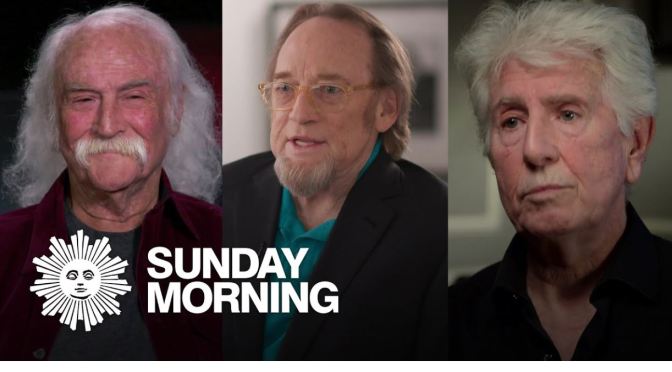
Music: 50th Anniversary Of “Déjà vu” By Crosby, Stills, Nash & Young
Half a century ago, Crosby, Stills, Nash & Young released one of the greatest albums of the rock era, “Déjà vu.” The record would sell eight million copies, but the band, and the friendships, did not endure. “CBS This Morning” co-host Anthony Mason talks with David Crosby, Stephen Stills and Graham Nash about their shared history and the timeless music they produced, as “Déjà vu” gets a delayed 50th-anniversary expanded release.
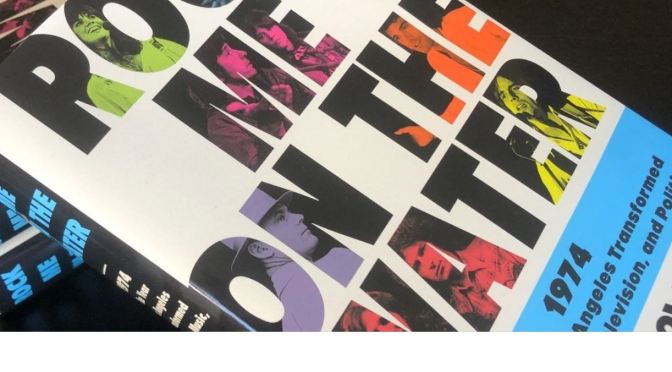
1970’s Books: ‘Rock Me On The Water’- How Movies, TV & Music Changed Culture
A new book argues the 1970’s was a moment when TV, movies, and music all shifted into a new gear, changing the cultural landscape in ways that continue to today. Jeffrey Brown has a conversation with author Ron Brownstein about his book “Rock Me on the Water: 1974-The Year Los Angeles Transformed Movies, Music, Television, and Politics.” This segment is part of our arts and culture series, CANVAS.
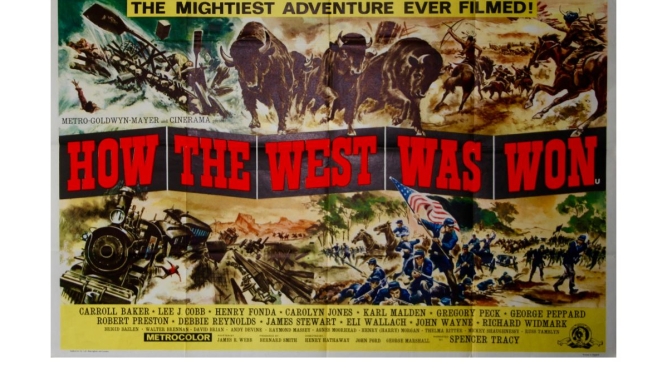
Great Movie Themes: ‘How The West Was Won’ (1962)
How the West Was Won is a 1962 American epic Western adventure film directed by Henry Hathaway (who directs three out of the five chapters involving the same family), John Ford, and George Marshall, produced by Bernard Smith, written by James R. Webb, and narrated by Spencer Tracy. Originally filmed in true three-lens Cinerama with the according three-panel panorama projected onto an enormous curved screen, the film stars an ensemble cast consisting of (in alphabetical order) Carroll Baker, Lee J. Cobb, Henry Fonda, Carolyn Jones, Karl Malden, Gregory Peck, George Peppard, Robert Preston, Debbie Reynolds, James Stewart, Eli Wallach, John Wayne, and Richard Widmark. The supporting cast features Brigid Bazlen, Walter Brennan, David Brian, Ken Curtis, Andy Devine, Jack Lambert, Raymond Massey as Abraham Lincoln, Agnes Moorehead, Harry Morgan as Ulysses S. Grant, Thelma Ritter, Mickey Shaughnessy, Harry Dean Stanton, Russ Tamblyn and Lee Van Cleef.
How the West Was Won is widely considered one of Hollywood‘s greatest epics.[1] The film received widespread critical acclaim and was a box office success, grossing $50 million on a budget of $15 million.[2] At the 36th Academy Awards, it earned eight nominations, including Best Picture, and won three, for Best Story and Screenplay Written Directly for the Screen, Best Sound, and Best Film Editing. In 1997, it was selected for preservation in the National Film Registry by the Library of Congress as being “culturally, historically, or aesthetically significant”.

Tributes: Google Honors The Life Of Singer Luther Vandross (1951-2005)
Google celebrated the life of Luther Vandross with an animated Doodle by Atlanta-based guest artist Sam Bass, on what would have been his 70th birthday.
Vandross was born in 1951 and began performing and writing songs while in high school, singing at the 1969 pilot of Sesame Street with the Apollo Theater’s performing arts group. His first big break came when his song Everybody Rejoice featured in the 1974 Broadway musical The Wiz.
Vandross went on to record 14 studio albums that went either platinum or multi-platinum, and he was nominated for 33 Grammy Awards, of which he won eight. Vandross suffered from diabetes and hypertension and had a severe stroke in 2003 that left him in a wheelchair. He died of a heart attack on 1 July 2005 at the age of 54.
Read more here: https://www.independent.co.uk/arts-en…
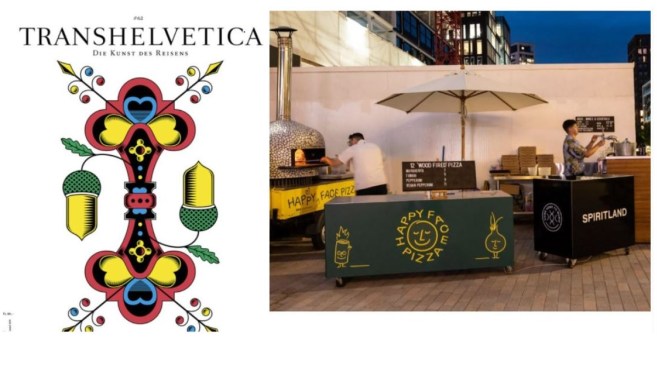
Media: Swiss Magazine ‘Transhelvetica’ And London’s ‘Spiritland’
We visit two bold companies finding canny ways to pivot their product for changing audiences. Transhelvetica, a Swiss magazine, and Spiritland, a London-based hospitality and audio venture, are each shaping the media landscape for the better. To discover more about Monocle magazine head to http://www.monocle.com

Classical Views: Ballerina Dances To ‘La Follia’ By Antonio Vivaldi (Video)
Music Ensemble: Il Giardino Armonico, Milano, Italy Dancer & Choreography: Margarita Ermachenko
Antonio Vivaldi
Antonio Vivaldi (1678–1741) grew up in Venice, Italy where his father, a professional violinist, taught him to play the violin and introduced him to some of the finest musicians and composers in the city. At the age of 15, he also began studying to become a priest. Because of his red hair, he was known as il Prete Rosso (“the Red Priest”). Vivaldi had to leave the clergy due to health issues, and he accepted several short-term musical positions funded by patrons in Mantua and Rome. It was in Mantua that he wrote his four-part masterpiece, The Four Seasons. He was also known for his operas, including Argippo and Bajazet. Vivaldi’s work, including nearly 500 concertos, influenced many later composers, including Bach.
The collection of Twelve Trio Sonatas Op. 1 was published by the Venetian house of Giuseppe Sala in 1705. Similarly to the other published collections by Vivaldi, it became known throughout Europe and reprinted four more times within the composer’s lifetime. It was dedicated to Count Annibale Gambara.
At the turn of the 17th and 18th centuries, the trio sonata was one of the most popular genres of instrumental music in Italy. The composers modelled their work on four sonata collections by Arcangelo Corelli. Mastery in the genre was generally seen as a test of composing talent, allowing a display of the ability to simultaneously shape the melody and the counterpoint.
Vivaldi, similarly to Albinoni and Caldara, made his debut with a collection of twelve trio sonatas. They were written for two violins and a cello (more precisely a violone) or a harpsichord. The earliest preserved Vivaldi pieces, they are characteristic in their individual and fully-formed style.

Musical Instruments: ‘The Ancient Oud Of Lebanon’
Nazih Ghadban is one of the few remaining makers of the oud instrument. He’s handcrafted them at his small Lebanese village since 1976.
The oud is a short-neck lute-type, pear-shaped stringed instrument, usually with 11 strings grouped in 6 courses, but some models have 5 or 7 courses, with 10 or 13 strings respectively. The oud is very similar to modern lutes, and also to Western lutes.
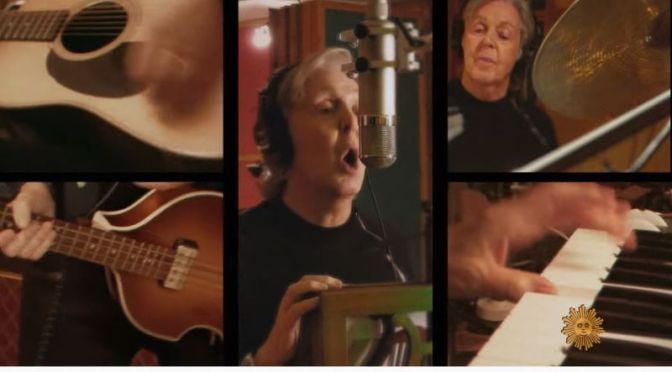
Video Interview: Paul McCartney On His New Album ‘McCartney III”
While he was in pandemic lockdown, Sir Paul McCartney was writing new music for his latest solo album, “McCartney III,” on which the 78-year-old not only served as songwriter and producer but also played nearly every instrument. Correspondent Seth Doane talked with McCartney about the former Beatle’s “rockdown,” and his songwriting relationship with John Lennon, who was killed 40 years ago this month.
 Boomers Daily