
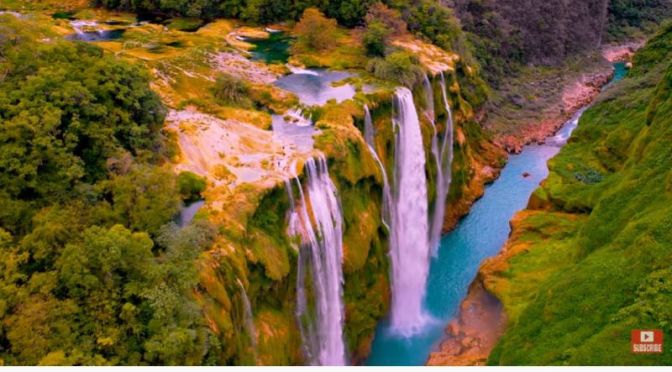
Mexico, officially the United Mexican States, is a country in the southern portion of North America. It is bordered to the north by the United States; to the south and west by the Pacific Ocean; to the southeast by Guatemala, Belize, and the Caribbean Sea; and to the east by the Gulf of Mexico.
Tag Archives: Mexico

Travel: ‘Chasing Mexica’ – The Color, Beauty And Passion Of Central Mexico
Filmed and Directed by: Louis Lam
This has been the most wonderful film production road trip from the western Jalisco to central Mexico of Guanajuarto, not only for it’s Spanish colonial history and architecture, but also through my experience with many humble local families and over 20 talented artists who participated in this film production. I like to show my audience the color, beauty, passion of the heart of Mexico. This is by far the most exciting travel film production ever. I am forever grateful to the Villafranco family, Stephi my location manager, and Edrei Arvad my production assistant for making it happen! Please enjoy!

World News Podcast: Joe Biden, Green Innovation & Mexico’s Coca-Cola Habit

A selection of three essential articles read aloud from the latest issue of The Economist. This week, why it has to be Joe, green innovation (14:35) and the fight against Mexico’s Coca-Cola habit (20:10). Zanny Minton Beddoes hosts.
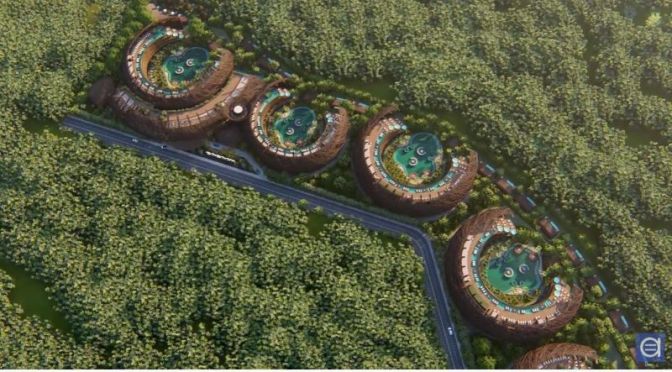
Future Of Ecotourism: ‘Cocoon Hotel & Resort’ – Tulum, Mexico (Video)
The “Cocoon Hotel & resort”, Tulum, Mexico– a new concept of eco-tourism, and a great opportunity of connection with Nature, Community, Ourselves, inspired by the sea and the exotic forest. The project consists of 46.181 m2 offering 3 residential and 2 hotel buildings “COCOON” with 204 apartments and 167 rooms as well as 16 private villas.Every feature serves to give a unique experience and create a magical place for the guest, at the same time making him identify what is Mexico.
The complex offers luxury community spaces integrated into nature such as jungle gardens, magical outdoor living spaces-villas, multipurpose pavilion, indoor community spaces, leisure areas, restaurant, and a panoramic Nest with unrestricted and breath-taking views. All to achieve a wide vocabulary of visual elements to mutate into designing language, in materials and shapes, for a bio-mimicry architecture.
The idea was to create “Cenotes”- natural freshwater ponds, to which the Mayans gave a sacred use, thus allowing to experience the real Mayan´s rituals. The project makes an emphasis on sustainability concept respecting ecosystem and biodiversity, contributing to the usage of natural materials that minimizes the impact of building and generation of waste. The water collection concept is also respected and represents a recovery of rainwater for sewage treatment. The solar panels are implemented to achieve sustainable electricity.
Finally, the “dry” construction system is used, meaning no wet binders, shorter execution time, and increased safety and sustainability. Source by dna Barcelona.
A As Architecture – Discover Architecture http://aasarchitecture.com/

World News: The Demise Of Offices, Third World Land Reform, Mexico’s Jet
A selection of three essential articles read aloud from the latest issue of The Economist. This week, is the office finished? Land reform in poor countries (09:55), and Mexico’s unsellable presidential jet (18:10).
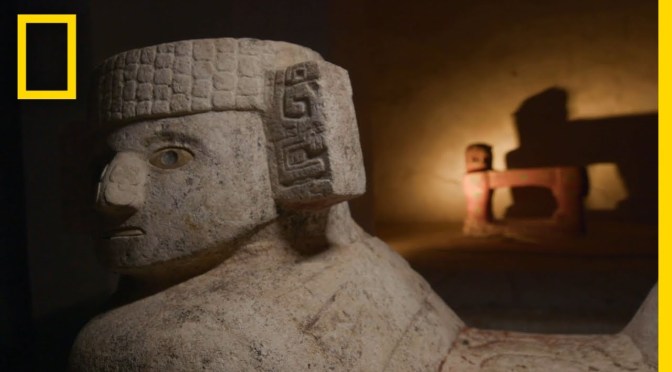
Travel & Exploration: The Secrets Of “Mayan Pyramid El Castillo” (NatGeo Video)
Two National Geographic Explorers enter the Mayan Pyramid, El Castillo, in search of a hidden entrance to an underground cave. While inside they explain the significance of jaguar throne and human sacrifice.

Global News: The New Macroeconomic Era, EU’s Big Deal & Mexico’s Youth
A selection of three essential articles read aloud from the latest issue of The Economist. This week, the new era of macroeconomics; (9:25) the EU after striking a huge deal; (17:00) and the challenges for Mexico as its youth departs.

Top New Science Podcast: UAE’s New Mars Mission, ‘Enhanced Weathering’ & Mexico’s Deep Caverns
 On this week’s podcast, an ambitious Mars mission from a young space agency, and how crumbling up rocks could help fight climate change.
In this episode:
00:46 Mars hopes
In a few weeks the UAE’s first mission to Mars is due to launch. We speak to the mission leads to learn about the aims of the project, and how they developed the mission in under six years. News Feature: How a small Arab nation built a Mars mission from scratch in six years; News Feature: Countdown to Mars: three daring missions take aim at the red planet
09:53 Research Highlights
Pluto appears to be losing its atmosphere, and solving the mystery of a pitch-black prehistoric mine. Research Highlight: Goodbye, Pluto’s atmosphere; Research Highlight: Why ancient people pushed deep into Mexico’s pitch-black caverns
12:12 Climate rocks
Researchers have assessed whether Enhanced Weathering – a technique to pull carbon dioxide out of the air – has the potential to help battle climate change. Research Article: Beerling et al.
18:41 Briefing Chat
We take a look at some highlights from the Nature Briefing. This time we talk about an outbreak of flesh-eating bacteria in Australia, and how flatworms can regrow their nervous systems. The Atlantic: Australia Has a Flesh-Eating-Bacteria Problem; The New York Times: A Worm’s Hidden Map for Growing New Eyes

Top New Science Podcasts: Biodiverse Oasis In Mexico, Thermoacoustic Speakers
 First up this week, News Intern Rodrigo Pérez-Ortega talks with host Meagan Cantwell about an oasis of biodiversity in the striking blue pools of Cuatro Ciénegas, a basin in northern Mexico. Researchers have published dozens of papers exploring the unique microorganisms that thrive in this area, while at the same time fighting large agricultural industries draining the precious water from the pools.
David Tatnell, a postgraduate researcher at the University of Exeter, talks with host Sarah Crespi about using heat to make sound, a phenomenon known as thermoacoustics. Just like the sound of fire or thunder, sudden changes in temperature can create sound waves. In his team’s paper in Science Advances, Tatnell and colleagues describe a thermoacoustic speaker that uses thin, heated films to make sound. This approach cuts out the crosstalk seen in mechanical speakers and allows for extreme miniaturization of sound production. In the ultrasound range, arrays of thermoacoustic speakers could improve acoustic levitation and ultrasound imaging. In the hearing range, the speakers could be made extremely small, flexible, and even transparent.

New Landscape Videos: “Eight Great Gardens Of The World” (Nowness)
Do you love plants and all things to do with gardens? In our #GreatGardens series, we revisit our top eight episodes which feature the planet’s wildest sub-tropical landscapes and quintessential rural retreats.
 Boomers Daily