

This week’s Times Literary Supplement for April 29, 2022 @TheTLS, featuring Carol Tavris on Darwinian feminism; @TomFStevenson on geopolitics; @TobyLichtig on Compartment No. 6; Edmund Gordon on the new Jennifer Egan; @hjccochrane on Primo Levi; @rinireg on borders – and more.
Tag Archives: Magazines

Previews: Archaeology Magazine – May/June 2022

Previews: The Atlantic Magazine – May 2022


International Art: Apollo Magazine – May 2022 Issue

• The method in Jackson Pollock’s madness
• The problem with Russian money in the art world
• What war photography looks like today
• Philip Guston’s uneasy quest for freedom
Plus: The women artists gazing at men, the portraits of Glyn Philpot, and Elizabeth David’s taste in Old Masters; and reviews of Donatello in Florence, Boilly in Paris, Kafka’s drawings and Stephen Shore’s memoir.

Preview: New York Times Magazine – April 24, 2022

Cover Preview: Discover Magazine – May/June 2022


Cover Preview: Science Magazine – April 22, 2022

Preview: New Scientist Magazine – April 23, 2022

- COVER STORIES
- FEATURES What psychology is revealing about ‘ghosting’ and the pain it causes
- FEATURES How four big industries are driving the exploitation of our oceans
- NEWS MS reversed by transplanted immune cells that fight Epstein-Barr virus
- NEWS Blind Mexican cave fish are developing cave-specific accents
- NEWS Rediscovered orchid was presumed extinct for almost a century
- NEWS Tiny structures in rock may be fossils of earliest known life on Earth
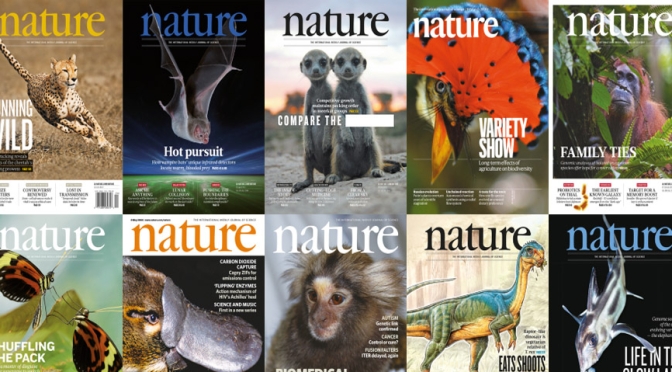
Cover Preview: Nature Magazine – April 21, 2022
Life speed
Cells acquire mutations throughout life, a process that is known to give rise to cancer and has been proposed to contribute to ageing. There is little knowledge, however, about the rate at which mutations accumulate in species other than humans, and whether this rate is influenced by biological traits such as lifespan or body size. In this week’s issue, Alex Cagan, Adrian Baez-Ortega and colleagues address these questions. The researchers studied the speed at which mutations accumulate during life in 16 mammalian species and found that the number of mutations increases by a roughly constant amount each year. They also observed that the molecular processes causing mutations are broadly similar across species. Crucially, the team identified a strong anticorrelation between lifespan and mutation rate: longer-lived species accrue mutations at a slower pace than shorter-lived ones, such that different species have roughly the same number of mutations by the end of their respective lifespans.

 Boomers Daily