Tag Archives: Imagination

Culture: New Humanist Magazine – Autumn 2025

The cover of New Humanist's Autumn 2025 issue is an illustration of an astronaut surrounded by stars

NEW HUMANIST MAGAZINE: This issue is all about how the battle over space – playing out unseen above us – concerns us all.

Space and society

In the latest edition of our “Voices” section, we ask five experts – from scientists to philosophers – how to protect space for the benefit of all of humanity.

“When people hear the term ‘space technology’, they tend to picture rocket launches, or maybe missions to the Moon … Other types of space activity with strong social impact tend to get less attention”

The satellite war

We speak to security expert Mark Hilborne about space warfare – and how it could be the deciding factor in the conflict between Russia and Ukraine.

“The public doesn’t understand how much we rely on space as a domain of warfare”

Sexism in space

When Nasa prepared a message to aliens with the Pioneer probes in the 1970s, sexism skewed how they represented humankind. Within the next decade, we may have another chance to send a message deep into space – and this time, we must do better, writes Jess Thomson.

“Only five objects we have crafted here on Earth are now drifting towards infinity, and four of them tell a lie about half of humankind”

American alien

The new Superman movie offers the vision of a kinder, more tolerant United States – saved by an immigrant, in this case a literal alien. But should we really pin our hopes on a superhero?

“Trump has even shared photoshopped images of himself as Superman. The idea that superheroes can save us all, if we just let them break all the rules, is one that the Maga followers find congenial”

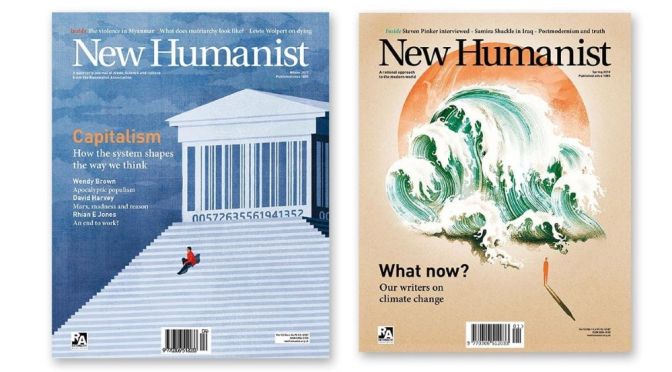
Culture: New Humanist Magazine – Winter 2024-25

New Humanist's winter 2024 cover shows a futuristic blue face with the words: 'Our cyborg future?'

NEW HUMANIST MAGAZINE – WINTER 2024/2025 ISSUE: The new issue features ‘Our Cyborg Future?’

The new age of the cyborg?

Neurobiologist and journalist Moheb Costandi explores the rapidly-developing world of brain-computer interfaces. For some people, these devices are already transforming lives – but the technology is quickly overtaking the ethics.

A dangerous calculation

Peter Ward unpicks the dark philosophy of the tech billionaires and how it is infiltrating some of our most powerful organisations.

There’s a product for that

A recent film, The Substance, explored the growing pressure on all of us – particularly women – to modify our bodies, not only through make-up and cosmetic procedures but also through digital filters. Clare Chambers, professor of political philosophy at the University of Cambridge, talks to us about the power of resistance and allowing our bodies to be “good enough”.

New life in the veins

Peter Salmon recounts the bizarre history of blood transfusion – and why the super-rich remain fascinated by its possibilities.

Previews: New Humanist Magazine – Spring 2024

Image

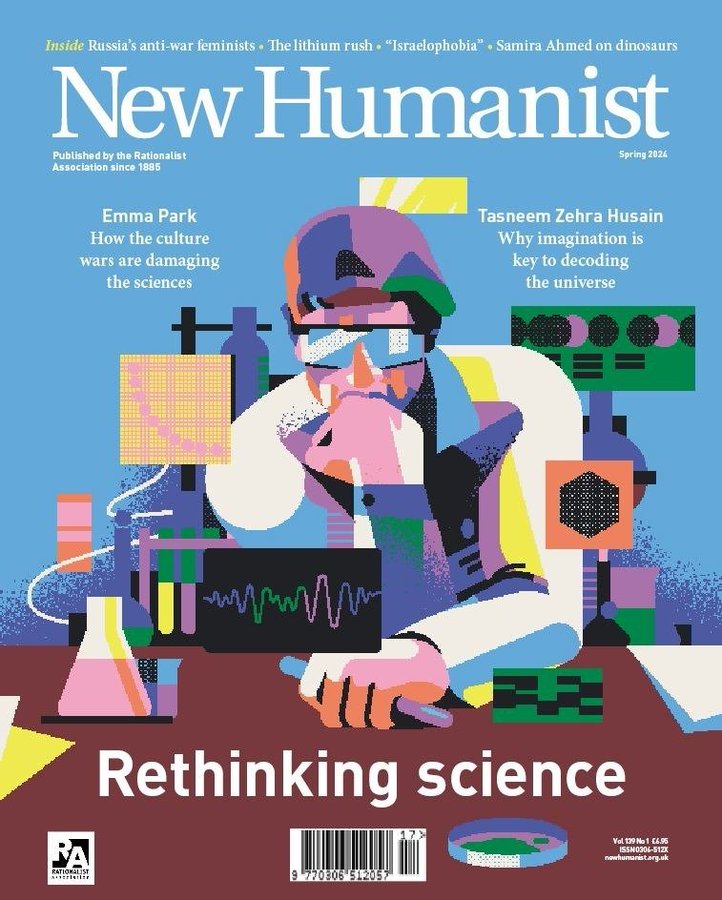
NEW HUMANIST MAGAZINE – SPRING 2024 ISSUE: The new issue features Emma Park on how the culture wars are damaging the sciences, theoretical physicist Tasneem Zehra Husain on why the imagination is key to decoding the universe, and Alom Shaha on what can be gained by thinking like a scientist

Beyond the two cultures

Amid a polarised debate, science and art seem further apart than ever. Emma Park, editor of The Freethinker, explores what humanism has to teach us about the apparent conflict between these ways of thinking and how to bridge the divide.

“While humanities scholars are often (not without justification) accused of being Luddites, those on the science and technology side could also benefit from the knowledge that the humanities have accumulated over the centuries … [And] no intellectual activity worth the name can flourish in a politically repressive environment: freedom of expression and enquiry should be an issue to unite artists, scholars and scientists.”

The poetry of science

Metaphors are key to unlocking the secrets of the universe – scientists should do more to harness their power, writes acclaimed physicist Tasneem Zehra Husain.

“Metaphors aren’t only a means of description, they can also lead to revelations. Centuries ago, Newton was able to calculate the gravitational attraction between two objects … [but] would ‘feign no hypothesis’ as to why it was so. He had the equation, but he did not understand gravitation … With Einstein, we finally have a metaphor. When we picture space-time as a dynamic ‘fabric’ … we begin to understand what gravity means.”

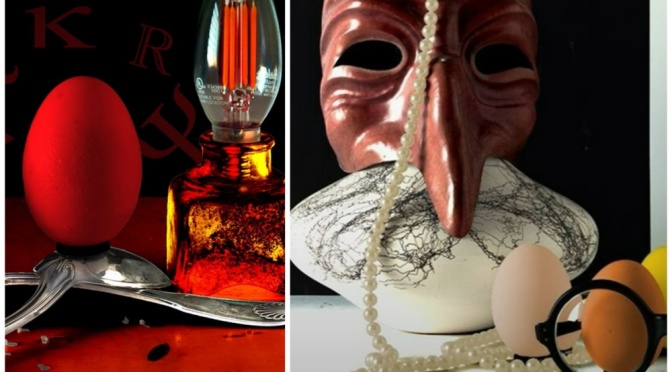
Art: Photographer Wayne Parsons’ “Imagined Images”

FRAMES (January 13, 2024) – Wayne is a New York City-based photographer. His education includes a BA in physics from the University of Mississippi and a Ph.D. in political science from Columbia University.

He was a late-comer to photography, buying his first camera when he turned forty and studying black-and-white technique at the International Center of Photography. His interests expanded to color imagery when he adopted digital photography in 2001.

He also reviews photography exhibitions for the New York Photo Review. He is a long-time member and past president of Soho Photo Gallery.

Explore more of Wayne’s work on his website at https://www.rwayneparsons.com/.

Arts/Books: Times Literary Supplement – May 12, 2023

Image

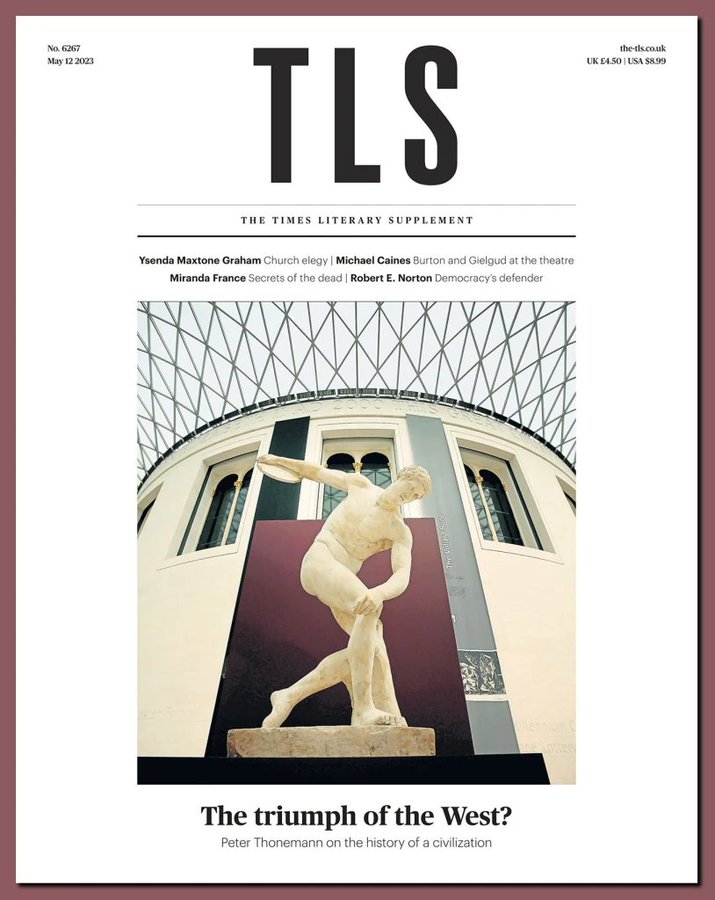
Times Literary Supplement (May 12, 2023) – This week’s @TheTLS, features Peter Thonemann on The Triumph of the West; @joemoransblog on imagination; @michaelscaines on The Motive and the Cue; @DrAliceKelly on graphic novelizations of Gatsby; @helenlpgordon on stones; @rinireg on surveillance – and more.

Research: New Scientist Magazine – April 15, 2023

New Scientist | Science news, articles, and features

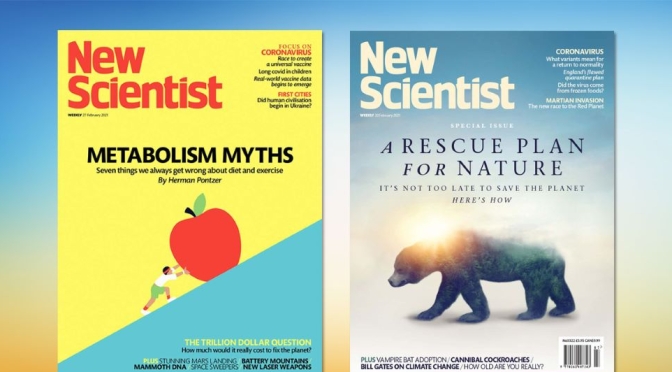
New Scientist Magazine April 15, 2023 issue:

How do we know that therapy works, and which kind is best for you?

How do we know that therapy works, and which kind is best for you?

Psychotherapy has never been more available and yet, with so many options, it can be hard to know where to start. Thankfully, researchers are getting to grips with what really works and why

The Power of Language review: What speaking many languages can do

Physicist David Wolpert on how to study concepts beyond imagination

Interviews: Author Peter Boxall On His Book “The Prosthetic Imagination”

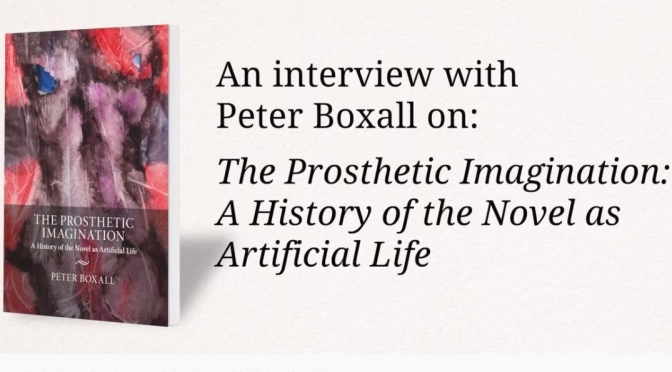
In this interview, Peter Boxall answers questions about his new title, The Prosthetic Imagination: A History of the Novel as Artificial Life. If the novel has helped to give our world a human shape, it also contains forms of life that elude our existing human architectures: new amalgams of the living and the non-living that are the hidden province of the novel imagination.
.
These latent conjunctions, Boxall argues, are preserved in the novel form, and offer us images of embodied being that can help us orient ourselves to our new prosthetic condition.
.
Discover more about this title at: https://www.cambridge.org/academic/su…

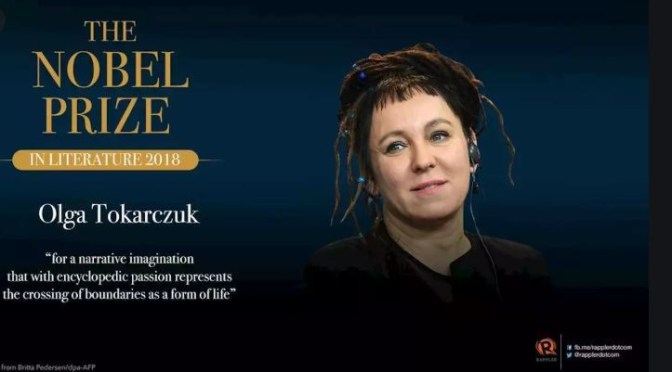
Video Interviews: 58-Year Old Nobel Prize Author Olga Tokarczuk (2020)

In this interview from the Nobel Banquet on 10 December 2019, Literature Laureate Olga Tokarczuk talks about her childhood dream of being a scientist, curiosity as motivation and the importance of translators.

Olga Tokarczuk, (born January 29, 1962, Sulechów, Poland), Polish writer who was known for her wry and complex novels that leap between centuries, places, perspectives, and mythologies. She received the 2018 Nobel Prize for Literature (awarded belatedly in 2019), lauded for her “narrative imagination that with encyclopedic passion represents the crossing of boundaries as a form of life.” A best-selling author in Poland for decades, Tokarczuk was not well known outside her homeland until she became the country’s first author to win the Man Booker International Prize in 2018 for Flights (2017)—the English translation of her sixth novel, Bieguni (2007).

From Encyclopedia Britannica

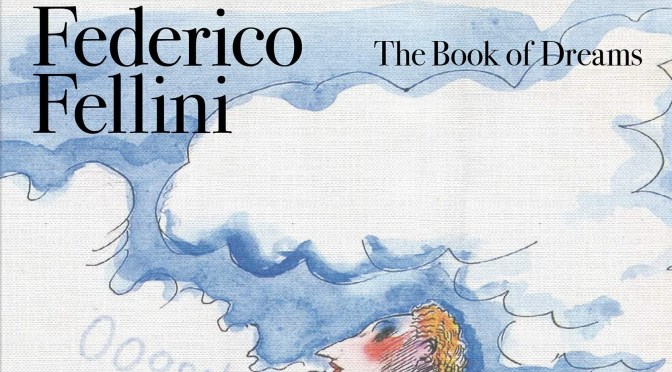
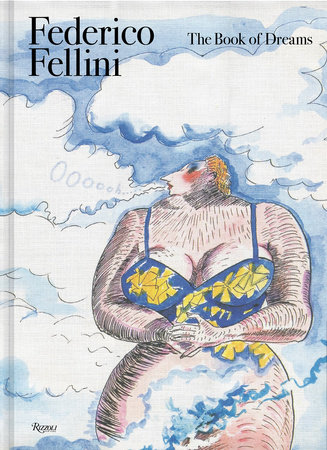
New Arts & Culture Books: “Federico Fellini – The Book Of Dreams” (Rizzoli)

Federico Fellini The Book of Dreams Rizzoli 2020The volume will be released to coincide with the centenary of Federico Fellini’s birth (January 2020), which will be celebrated in Italy with a traveling exhibition on the director that will start its journey from Milan in December 2019.

A highly colorful journey into the boundless territory of a genius’s imagination, this is a work that added a fundamental element to the study of Federico Fellini and his creative experience. From the late 1960s until 1990, the great director used this diary to represent his nocturnal visions in the form of drawings or, as he himself described them, “scribbles, rushed and ungrammatical notes.”

About The Author

Sergio Toffetti, born in Turin in 1951, is president of the Museo Nazionale del Cinema and has published essays on Italian and international cinema, and on the conservation and restoration of film. Felice Laudadio is president of the Fondazione Centro Sperimentale di Cinematografia in Rome. He has overseen numerous cinema events, such as MystFest, EuropaCinema, and RomaFictionFest. Gian Luca Farinelli has been director of the Cineteca of Bologna since 2000. In 1986 he created, together with Nicola Mazzanti, Il Cinema Ritrovato an event dedicated to the history of cinema and the activity of film libraries. Together with Martin Scorsese, Raffaele Donato, Thierry Frémaux, and Alberto Luna he founded the World Cinema Foundation, which brings together about twenty great international directors for the restoration of third-world films.

To review or purchase