Tag Archives: December 2022

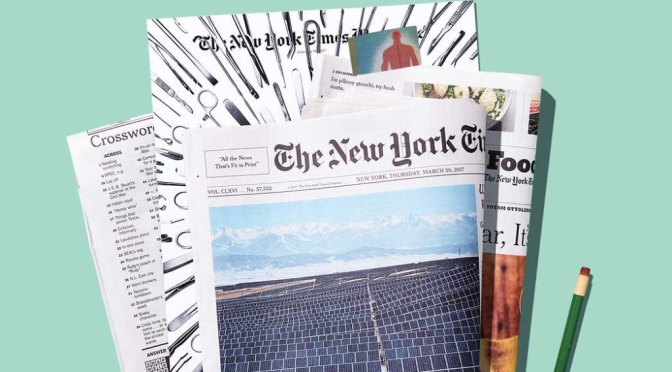
Front Page: The New York Times – December 12, 2022

Image

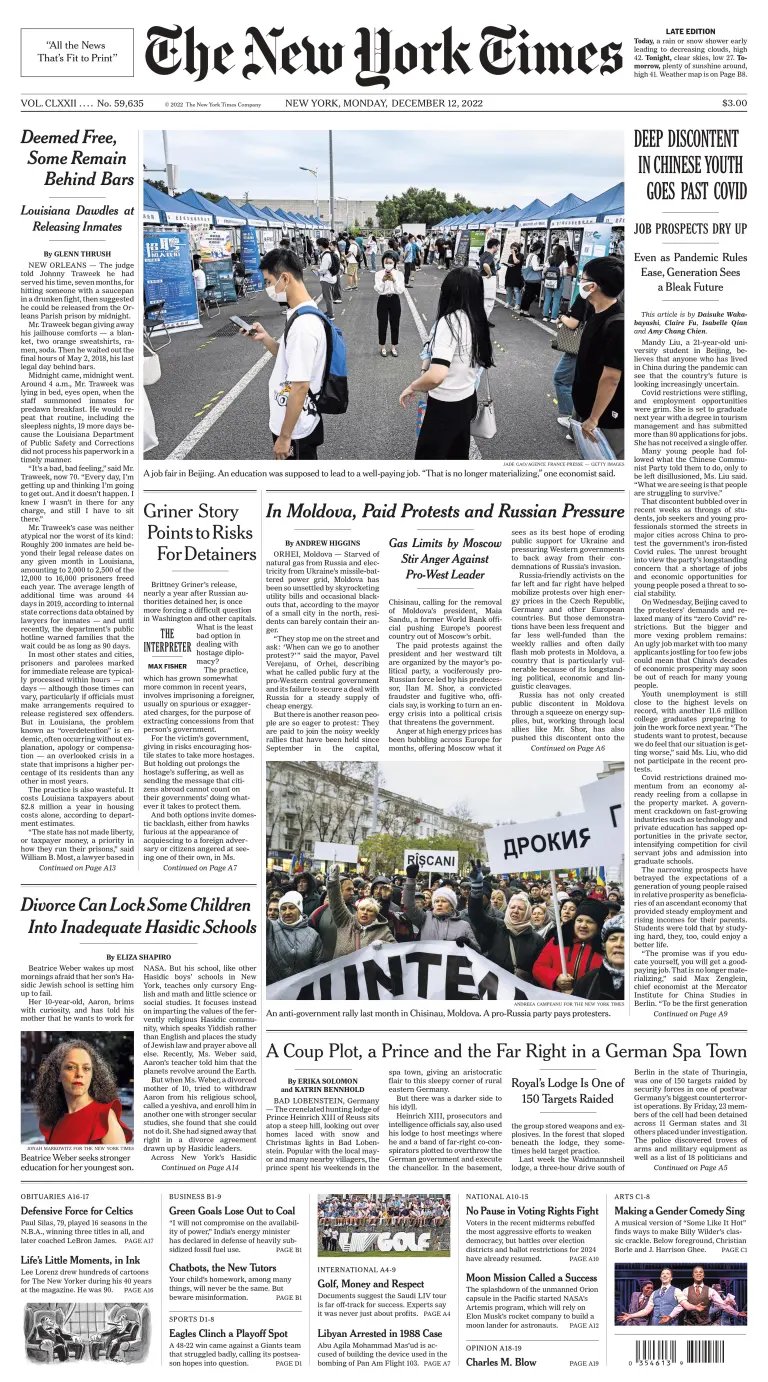
Even as China Eases Covid Rules, Some Youths Still Fear a Grim Future

A sluggish economy continues to leave many young people unemployed, with few job prospects or hopes to tap into the rising incomes their parents enjoyed during boom times.

Some Prisoners Remain Behind Bars in Louisiana Despite Being Deemed Free

About 200 to 250 inmates are held beyond their legal release dates in any given month, with the average additional time lasting around 44 days in 2019.

War Next Door Brings Energy Crunch, and Paid Protests, to Moldova

The tiny country, starved of natural gas and electricity because of the conflict in neighboring Ukraine, is confronting street rallies bankrolled by a pro-Russian politician to target its pro-Western government.

In Hostage Diplomacy, It’s Often the Hostage-Takers Who Pay

Detaining foreigners to wring concessions from their home country’s government holds perils for both sides, but especially, perhaps surprisingly, for the hostage takers.

Austrian Views: Hiking The Rosengartenschlucht

The Flying Dutchman (December 2022) – This natural gorge is located on the edge of Imst and represents one of the most important biotopes in Tirol. The Rosengartenschlucht measures 1.5 kilometres in length and is traversed by the rushing Schinderbach river starting at the enchanting Blue Grotto. Wooden walkways, paths blasted into the rock and small tunnels through the mountainside invite visitors to explore this fantastic landscape. The entrance to the gorge is a highlight in its own right, with a number of houses which have been built into the rockface. The gorge is open from May until October. Sturdy footwear is required.

Books: The New York Times Book Review – Dec 11, 2022

The New York Times Book Review - December 11, 2022 | Magazine PDF

@nytimesbooks December 11, 2022 features:

2022 Reading Picks From Times Staff Critics

The books they read this year that have stayed with them.

When It Comes to Picture Books, Santa Sells

At this time of year, the best-selling books for children are all Christmas, all the time. And they’re not even new!

A Family Drama, Taiwan History and Murder Case, Rolled Into One

“Ghost Town,” a novel by Kevin Chen, recounts the overlapping — and hotly contested — memories of a Taiwanese family.

Opinion: The End Of Cheap Money, Great Britain’s Tier 2 Cities, Age Of ‘Boring AI’

December 11, 2022: A selection of three essential articles read aloud from the latest issue of The Economist. This week features ‘The End of Cheap Money’, Britain’s Second-Tier Cities & The Age of ‘Boring AI‘.

Front Page: The New York Times – December 11, 2022

Image

The New Landscape of the Abortion Fight

After the midterm elections, abortion rights advocates hope to harness public support for the long term, while abortion foes look to advance new laws in sympathetic courts and legislatures.

Thousands of Teens Are Being Pushed Into Military’s Junior R.O.T.C.

In high schools across the country, students are being placed in military classes without electing them on their own. “The only word I can think of is ‘indoctrination,’” one parent said.

‘Cuba Is Depopulating’: Largest Exodus Yet Threatens Country’s Future

The pandemic and tougher U.S. sanctions have decimated Cuba’s economy, prompting the biggest migration since Fidel Castro rose to power.

Behind New York City’s Shift on Mental Health, a Solitary Quest

The psychiatrist E. Fuller Torrey has been advocating tougher involuntary psychiatric treatment policies for 40 years. Now it’s paying off.

Culture: The American Scholar – Winter 2023

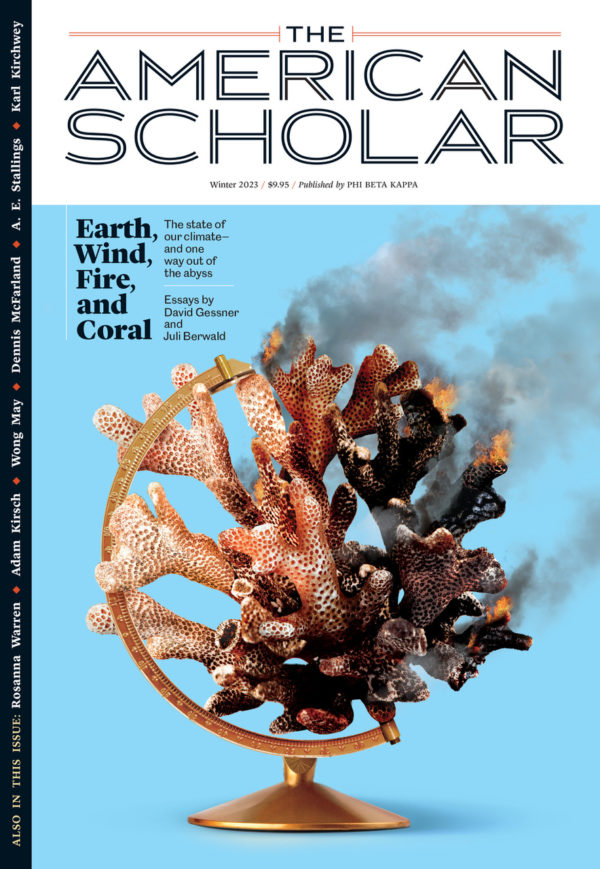
Winter 2023

@TheAmScho Winter 2023 issue:

The Road to Paradise and Back

Fires in the West, hurricanes in the East—what it’s like on the ground as we confront our rapidly changing world

The Corals and the Capitalist

The key to avoiding an ecological catastrophe might be found in the wealth of nations and the spirit of innovation

Our Founding Contradiction

The entrenched dichotomy at the center of the national story

Analysis: Is Traditional Agriculture Sustainable?

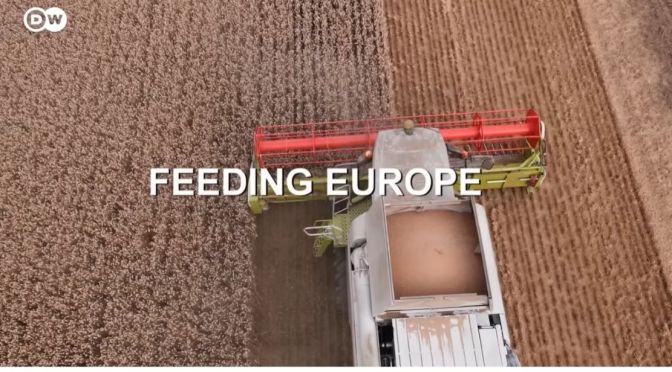
DW Documentary (December 10, 2022) – Is sustainable agriculture possible in Europe? From Spain’s “plastic sea” of greenhouses, to farmer suicides in France, the organics boom and high-tech production, it’s clear that Europe’s agricultural sector is in a period of extreme flux. And it needs to change: Agricultural landscapes are shaped by the history of our continent and inextricably bound up with its identity.

But farmers are struggling. They’re under constant pressure to produce more, at lower prices and can no longer hold out against the stiff competition. Most European farms are still family-run businesses, but it’s the large-scale enterprises that benefit from EU subsidies. These companies practice intensive farming, which we now know has a detrimental effect on biodiversity and human health.

This kind of agricultural system is also very bad for soil quality and is now seen as obsolete. With every crisis that occurs, its shortcomings become more evident. The pace of climate change now requires rapid responses to crucial questions: How to sustainably feed more than 500 million Europeans? What steps can be taken to stem the catastrophe resulting from the dramatic rise in meat consumption (up 60 per cent in 60 years) and its associated intensive production of cereal crops?

Solutions are presenting themselves, and many farmers have already seized the initiative. Throughout the European continent, they are the main drivers of a vital 21st century agricultural revolution: a return to traditional farming methods, intelligent or urban agriculture, fewer mass imports, research into in-vitro meat and meat substitutes. These are just some of the approaches being explored by European farmers in a bid to protect biodiversity, the landscape and the health of human beings.

Reviews: The Seven Best Books On Politics In 2022

The Economist – Best books on politics in 2022:

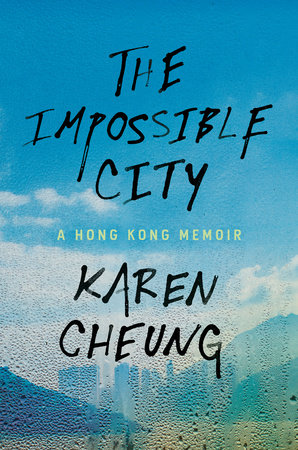
The Impossible City By Karen Cheung

The Impossible City by Karen Cheung

An illuminating and moving personal account of how Hong Kong descended into the mass street unrest of 2019, and of the pandemic-abetted repression that has crushed it since. The author speaks powerfully for a desperate generation of young Hong Kongers conscious that their home city has lost what made it home.

There Are No Accidents. By Jessie Singer

There Are No Accidents

A look at why Americans are so much more likely to suffer violent “accidents” than people in other rich countries. The author shows how poor road design, rather than bad driving, explains the persistence of car crashes and how factories use rule books and disciplinary procedures as a cheap substitute for real safety improvements.

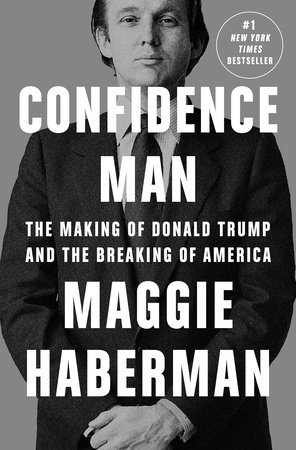
Confidence Man. By Maggie Haberman

Confidence Man by Maggie Haberman

A chronicle of the life and lies of the 45th president of the United States, from outer-borough brat to White House bully. This portrait of a master scammer is by a New York Times journalist who covered Donald Trump for decades. He learned early, she notes, that celebrity was power.

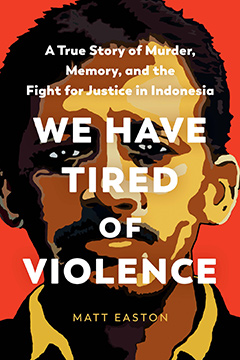
We Have Tired of Violence. By Matt Easton

We Have Tired of Violence

meticulous narration of the efforts to bring to justice the killers of Munir, a prominent Indonesian human-rights activist murdered in 2004. It reads like an enthralling legal-procedural whodunnit, as evidence is slowly unearthed from telephone records, lost documents are retrieved from deleted computer files and intriguing new witnesses emerge.

The Naked Don’t Fear the Water By Matthieu Aikins

In 2016 the author, a Canadian journalist, went undercover to accompany an Afghan friend on his perilous journey to a new life in Europe—always knowing that, if push came to shove, he could fall back on his Western citizenship, while his friend would have to rely on his luck. The result is a devastatingly intimate insight into the refugee crisis.

The Age of the Strongman By Gideon Rachman

It is striking how many of today’s leaders fit the strongman mould, notes a columnist for the Financial Times (formerly of The Economist). His subjects, including Xi Jinping and Prince Muhammad bin Salman, are a threat not only to the well-being of their own countries, he says, but to a world order in which liberal ideas are increasingly embattled.

The Economic Weapon By Nicholas Mulder

A fortuitously timed history of the use of economic sanctions during the interwar period of the 20th century. Their mixed success cautions against hoping that the West’s sanctions against Russia can bring about an end to war in Ukraine.