
From Classic Driver Magazine (April 18, 2020):
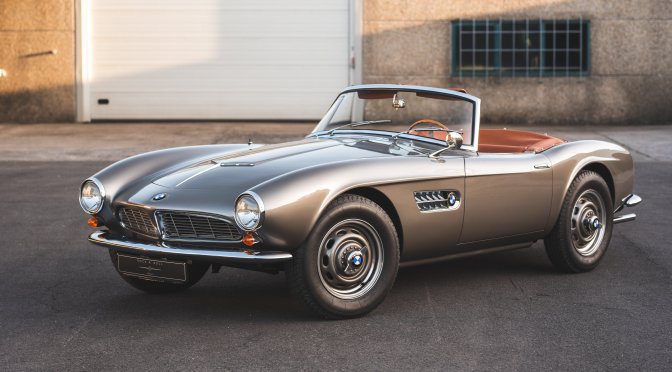
 “Astonishing” is the word we are looking to describe this BMW 507. A word we use a lot if it comes to selling classic cars, but only a little few deserve this ‘title’ like this 507 does. When an exceptional model, with an unique story, from what the historical documents are well archieved, it just makes us going crazy. Add matching numbers and -colors tot his list and we are losing it totally. That’s no different with this 507.
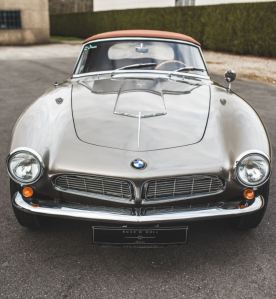 Max Hoffman convinced BMW that if they built a competitor to the Mercedes-Benz 300SL, he would sell it profitable in the United States. The BMW was intended to fill the gap between the affordable sports cars like the triumph and MG and the exclusive cars like the Mercedes-Benz 300SL and Ferrari 250 GT California. Though, BMW couldn’t achieve their target price, for what the BMW 507 was even more expensive than the 300SL. BMW found itself in a financial difficult situation and almost went bankrupt. At the end of the day, BMW recovered from this “failure” and the 507 even became a true flagship in the whole history of automotive.
 In the ‘50s BMW disposed over all fundamental ingredients which would make the 507 complete. An all-aluminium 3.2-litre V8 engine was placed in a shortened chassis of the 502. This ingenious masterpiece produced no less than 150hp and sounds like a guitar solo in your ears. To save weigt, the body was made of aluminium, which results in a 1280kg’s for a fully finished 507. Besides the phenomenal results, BMW wanted to offer luxury as well. Both aspects are just spot on.

 Packard Super Eight was the name given to the larger of the two eight-cylinder luxury automobiles produced by the Packard Motor Car Company of Detroit, Michigan. It shared frames and some body types with the top model Packard Twelve. Following the discontinuation of the Seventeenth Series Packard Twelve after the 1939 model year, a new Super Eight One-Eighty was derived from the Super Eight as the new top car range. The Super Eight was renamed the Packard Super Eight One-Sixty.
 After 1942, Packard concentrated on the new Clipper styling that was developed for an upper-class sedan the previous year. There were Super Clippers and Custom Super Clipper in the One-Sixty and One-Eighty tradition until 1947. After a heavy facelift, the name Clipper was dropped. The most senior Super Eight One-Eighty became the Custom Eight, while its slightly lower-priced sibling, the Super Eight One-Sixty, once again became simply the Super Eight. Clipper Custom Super Eights and Custom Eights were very close relatives to their respective Super models, distinguished outside by the lack of an eggcrate grille and small rear chrome trim moulding under the trunk lid on Supers. In 1949, a new Super Eight Deluxe was added to the line. This car had also the Custom Eight’s eggcrate grille, but not the rear trim.
 The Cord 810, and later Cord 812, was a luxury automobile produced by the Cord Automobile division of the Auburn Automobile Company in 1936 and 1937. It was the first American-designed and built front wheel drive car with independent front suspension. It followed the 1934 Citroën Traction Avant and the Cord L-29, both of which also had front wheel drive. Both models were also the first to offer hidden headlights.
 The styling of the Cord 810 was the work of designer Gordon M. Buehrig and his team of stylists, which included young Vince Gardner and Alex Tremulis. While the first American front-wheel-drive car with independent front suspension, it had an archaic tube rear axle with semi-elliptic rear springs. Power came from a 4,739 cc (289 cu in) Lycoming V8 of the same 125 hp (93 kW) as the L-29. The semi-automatic four-speed transmission (three plus overdrive) extended in front of the engine, like on a Traction Avant. This allowed Buehrig to dispense with the driveshaft and transmission tunnel; as a result, the new car was so low it required no running boards. It had a 125 in (3,175 mm) wheelbase (shared with several 812 body styles), and in 1936 came in four models: the entry-level sedan at US$1995, the Beverly sedan ($2095), Sportsman ($2145), and Phaeton ($2195). The 1937 812s had the same models, priced $2445, $2545, $2585, and $2645, plus two more, on a 132 in (3,400 mm) wheelbase, the $2960 Custom Beverly and $3060 Custom Berline.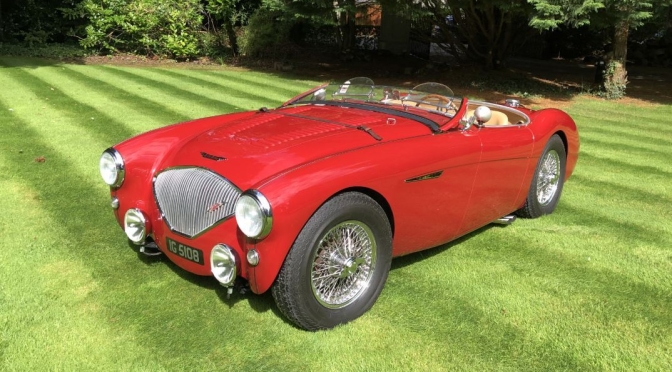
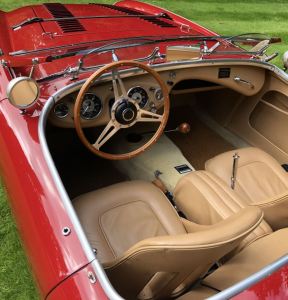 The Austin-Healey 100 is a sports car that was built by
  Lord struck a deal with Healey to build it in quantity; bodies made by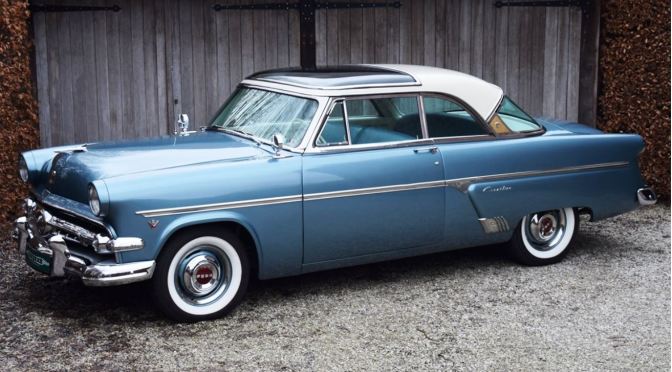
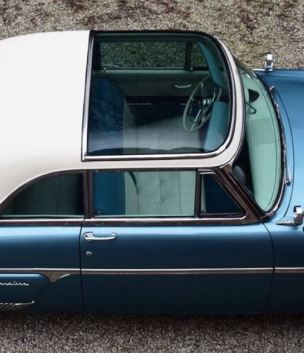 In 1954, Ford added a new niche model to the top-of-the-line Crestline series : the Skyliner. The car had a glass roof section over the front seats, made of blue-green tinted acrylic and letting a diffused yet filtered light through. Ford claimed that 60% of the sunrays were filtered out.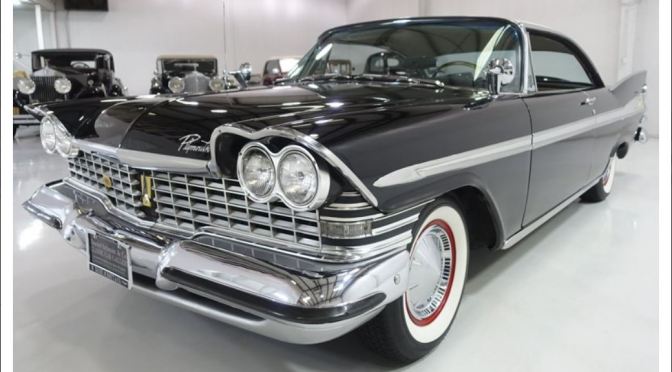
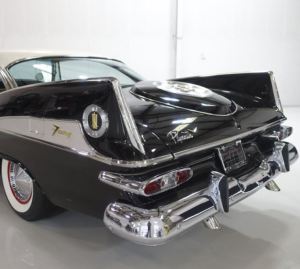 In 1959, Plymouth introduced the Sport Fury as its top model, and the Fury as its second from the top model to replace the Plymouth Belvedere at the top of the Plymouth line-up. The Fury range was now available as a four-door sedan and station wagon, as well as a two-door hardtop and sedan. The Sport Fury series had only a two-door hardtop and convertible. The Sport Fury was dropped at the end of 1959, but was reintroduced in mid-1962 and discontinued in 1971.
 The Plymouth Fury is a model of automobile which was produced by Plymouth from 1955 to 1989. It was introduced for the 1956 model year as a sub-series of the Plymouth Belvedere, becoming a separate series one level above the contemporary Belvedere for 1959. The Fury was a full-size car from 1959 to 1961, then a mid-size car from 1962 to 1964, again a full-size car from 1965 to 1974, and again a mid-size car from 1975 to 1978. From 1975 to 1977 the Fury was sold alongside the full-size Plymouth Gran Fury.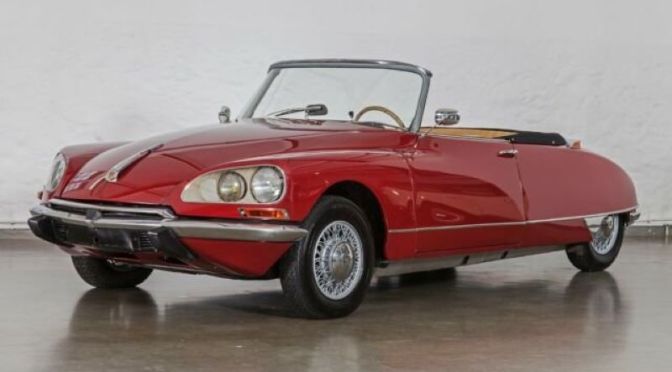
 The Citroën DS is a front-engine, front-wheel-drive executive car that was manufactured and marketed by the French company Citroën from 1955 to 1975 in sedan, wagon/estate and convertible body configurations across three series/generations.
 the hydropneumatic self-levelling suspension. Citroën sold 1,455,746 examples, including 1,330,755 manufactured at the manufacturer’s Paris Quai André-Citroën production plant.
 During this year’s Monterey Car Week, all four of Bugatti’s hallowed Type 59s were reunited for the first time since 1935. We spoke to the man who pulled off arguably the most historically significant automotive rendezvous of the decade…
 driving forces behind the introduction of the twin-cam engine, Ettore Bugatti created the ultimate expression of his jewel-like Grand Prix car.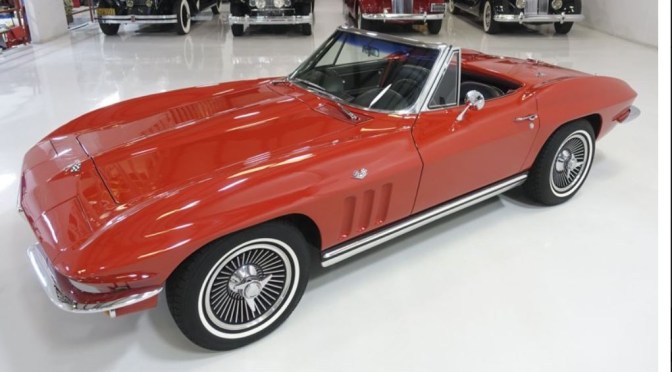
 For its third season, the 1965 Corvette Sting Ray further cleaned up style-wise and was muscled up with the addition of an all-new braking system and larger powerplants. 1965 styling alterations were subtle, confined to a smoothed-out hood now devoid of scoop indentations, a trio of working vertical exhaust vents in the front fenders that replaced the previous nonfunctional horizontal “speedlines,” restyled wheel covers and rocker-panel moldings, and minor interior trim revisions. The 1965 Corvette Sting Ray became ferocious with the mid-year debut of the
  1965 also added another 350 hp small block engine (Option L79) which used hydraulic rather than solid lifters, a milder camshaft and a modestly redesigned smaller oil pan.
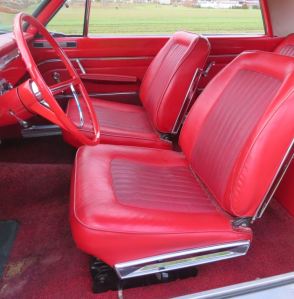 The Plymouth Valiant (first appearing in 1959 as simply the Valiant) is an
  The Valiant was totally reskinned for 1963 with a 0.5 in (13 mm) shorter wheelbase; it had a wide, flat hood and a flat square rear deck. The upper belt feature line ran from the rear body, in a gentle sweep, to the front fender tip. Here it was ‘veed’ back and down to the trailing edge of the front fender. The roofline was flatter and sharpened in profile. The grille was a variation of the inverted trapezoid shape that characterized contemporary Chryslers, with a fine mesh insert. Advances in body structure, many accessories and a new spring-staged choke were promotional highlights. The Valiant was offered as a 2-door
  Boomers Daily