Tag Archives: Australia

Architectural Tours: Malvern House – 100-Year Old ‘Modern’ In Australia

Malvern House sees Lande Architects convert a one-hundred-year-old house into a modern home with a minimal addition. Traditionally, when architects convert a one-hundred-year-old house into a refreshed dwelling, they take care to preserve the heritage features of the property – Malvern House was no different.

Video Timeline: 00:00 – Blueland 00:09 – Introduction to the 100 Year Old House 00:45 – Modernising a Weatherboard Victorian Cottage 01:23 – The Client Brief 02:08 – Green Motif Throughout the House 03:30 – Utilising Natural Light 04:10 – Outdoor Areas 04:25 – Working Together with the Clients 04:58 – Blueland Home Cleaning Products 06:24 – Final Look at the Converted House

Lande Architects retains the original, decorative front of the Victorian weatherboard cottage, maintaining a connection to the defining architecture of the location. Lande Architects reconfigures the extension of Malvern House – located to the rear of the structure and comprising of the kitchen, living and dining spaces – to propose a larger footprint. Seven internal courtyards are added in adherence to the brief, which stipulated that the pockets of green space should feature within the interior design.

Softly defined by functional glazing, the courtyards form an important part of the overall scheme as Lande Architects convert a one-hundred-year-old house into a modern home. The design of Malvern House champions efficiency. Lande Architects insulates the home with double brick walls and a large concrete slab positioned to the north orientation, with the slab absorbing heat during the day and radiating the heat back into the house overnight.

Cross-flow ventilation is provided via the seven courtyards. Such mastery over the internal environment of Malvern House sees Lande Architects convert a one-hundred-year-old house into a home that can meet 21st century standards of liveability. Whilst the heritage front of Malvern House remains purposefully untouched, the rear extension is changed for the better. Lande Architects converts a one-hundred-year-old-house into a residence with a rich and evolving narrative.

Modern Homes: Bunkeren In Newcastle, Australia

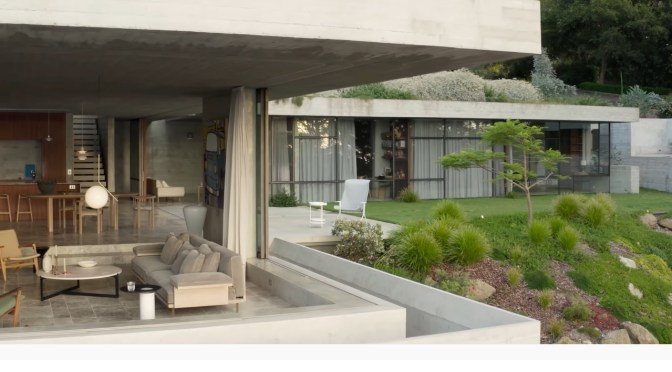
Crafted by James Stockwell Architect, Bunkeren could be the best modern house in the world. Considered more landscape than building, the concrete dwelling is a robust insertion within the surrounding natural context. Embedded into a rocky forest edge just south of Newcastle,

Video Timeline: 00:00 – Introduction to the Best Modern House in the World 00:40 – The Concept 01:30 – Designing for Family and the Landscape 02:09 – House Inspired by Danish Design 02:25 – Intimate Spaces 02:44 – Bunker within the Landscape 03:20 – Benefits of a Concrete Bunker House 04:20 – Bringing Natural Light into the House 04:55 – The Cellar 05:30 – Materiality 06:12 – Indoor-Outdoor Living 07:05 – Highlights of the House 07:28 – The Architect’s Favourite Part of the House

Bunkeren sits on the land of the Awabakal people. Externally, the building is reminiscent of the inspiring botanical garden that once occupied the location in the late 1800s; sprouting greenery covers the top of floating concrete platforms where, beneath, the internal spaces are held. A sense of architectural freedom is permitted by minimising necessary supporting columns and removing the need for load-bearing walls, lending structural significance and an impressive silhouette to what is considered the best modern house in the world.

A house tour of Bunkeren – named according to the Danish translation of ‘bunker’ – reveals the negotiated peaks and pitfalls of the bunker configuration. In materiality and position, the home expresses a reassuring invulnerability; partly shielded by the rocky landscape and comprised of concrete, Bunkeren can retain its structural integrity in the event of a bushfire or storm. Crafted by the architect to be low maintenance, the home does not require painting and cannot be eroded by mould or termites. The enveloping botanical element of the design supports the forest ecosystem and microclimates by interacting with natural species. James Stockwell Architect designs the interior to combat the limited natural light and ventilation associated with the architecture of a traditional bunker. Skylights and an internal garden draw light into the underground aspects of the home in an aesthetically engaging manner, whilst the elevated nature of the concrete platforms allows space for fresh air to travel through the dwelling. The interior design of Bunkeren contributes to its potential as the best modern house in the world. Whilst utilising the work of local artists, James Stockwell Architect also takes care to reflect the influence of Danish design culture in consideration of the homeowners’ lifestyle. In application of the Danish principle of proportion, all decoration is scaled to human level, emphasising the togetherness of the family unit. The design also champions the Danish furniture inherited by the homeowners. A restrained approach to styling sees each space defined by a sense of intimacy, with the absence of elaborate ornamentation establishing an unimposing, experientially gentle atmosphere. The most unique aspect of the home – through which James Stockwell Architects proposes Bunkeren as the best modern house in the world – is the cellar, situated at the lowest level. Inside the space, the rock into which the residence is settled within is left exposed, providing visual drama, natural tactility and a reflection of the external environment, blurring the line between the home and landscape. Warmed by the additional materials of wood, concrete and brass, the cellar exudes individuality. In 20 years, the foliage surrounding Bunkeren will have grown, until the building cannot be clearly distinguished from its natural context. It is this foresight that allows Bunkeren to be considered the best modern house in the world.

Morning News: On The Ground In Kyiv, Australia Floods, Grammar School

Our correspondent finds Ukraine’s capital already accustomed to an eerie war footing. People are getting married and playing music, even as medicine runs out and a new volunteer army braces for fighting.

Australia’s barely fathomable floods show freakish weather is becoming increasingly common there. And the case for reforming how grammar is taught.

Art Exhibits: Australian Painter Jeffrey Smart

‘Suddenly I will see something that seizes me – a shape, a combination of shapes, a play of light or shadows, and I send up a prayer because I know I have seen a picture.’

JEFFREY SMART The year 2021 marks one hundred years since the birth of acclaimed Australian artist Jeffrey Smart. This major exhibition celebrates and commemorates this significant centenary. One of Australia’s most celebrated artists, Smart sought inspiration from the world around him – looking to the environment of urban and industrial modernity – which he transformed through his imaginative sense of theatre and intimate understanding of geometry and composition.

These potent and intriguing images have become emblematic of 20th and 21st century urban experience. Building on the foundational work already undertaken on Smart, this exhibition will bring fresh perspectives to his artistic contribution so that his remarkable legacy will be kept alive in the present. Curators: Dr Deborah Hart, Henry Dalrymple Head of Australian Art and Dr Rebecca Edwards, Sid & Fiona Myer Curator of Ceramics and Design

Architecture: SRG House In Sydney, Australia (Video)

As an architect’s own home, SRG House by Studio Johnston balances its heritage context with contemporary design aesthetics. Facing the nearby water, the family home retains natural qualities through a strong connection to the surrounding bushland. Despite its inner-city location, the structure has an almost tree house-like quality to it, relating to its waterfront position in subtle and interesting ways.

The original building was dilapidated and had a number of unsympathetic alterations. Being an architect’s own home and after being stripped back, SRG House was reimagined to capture an element of discovery, seen through the materials used and maintained. The house stands as three storeys with an entrance at its middle level. To the left sits the kitchen, and adjacent to this is the dining area with inbuilt furniture.

The house tour then follows the floor plan out to the living space that looks out towards the water. In the original structure, the downstairs space was underutilised and was transformed to become bedrooms and a lounge room overlooking the pool.

Video Timeline: 00:00 – Introduction to the Architect’s Own Home 00:40 – Heritage and History of the Tree House 01:27 – House Design of the Architect’s Own Home 02:10 – Reimagining and Utilising Materials 03:40 – The Aspect of the Tree House 04:23 – The Architect’s Favourite Part of the Home 04:58 – Materials, Products and Furniture Round-Up

Morning News: Australia & U.S. Meeting, Hong Kong Zero-Covid Policy, Oscars

We discuss US secretary of state Antony Blinken’s trip to Australia and weigh up Hong Kong’s zero-Covid policy. Plus: the latest business news and a run-down of the Oscar nominations.

Morning News: U.S. Voting Reform, Afghanistan Aid Appeal, Djokovic Visa Row

We discuss Joe Biden’s attempts to push through voting reform, which he describes as ‘the biggest test of America’s democracy since the civil war’. Plus: the UN’s aid appeal for Afghanistan and Novak Djokovic’s visa row.

Views: Fly Fishing In Cocos Keeling Islands, Australia

For the past two years Australians have been limited to travel within their own country. This is not all bad news when you realise the diversity of fishing options in Australian waters. In early 2021, Josh Hutchins, of Aussie Fly Fisher, and film-maker, Kane Chenoweth, set off to one of Australia’s most remote regions in search of clean water, tropical vibes and big fish – the Cocos Keeling Islands.

With bountiful bonefish, intermittent shark-dodging, and relaxed Island vibes – Cocos was full of surprises.

Despite schools of bonefish and the odd-GT distraction, we had a primary goal for the trip: a Bumphead Parrotfish. We’d seen it done in the Seychelles, and we wanted to catch one in our home waters. Let the mission begin…

Location: Australia

Morning News: Australia Denies Tennis Star Visa, Empty Airline Flights

We get the latest on the withdrawal of Novak Djokovic’s Australian visa due to his vaccination status and explore how Europe is dealing with the spread of the Omicron variant. Plus: the environmental impact of empty flights and a look at what we’ve learned this week. From Milan: Salone highlights, interviews and a daily running guide. 

Views: D’Aguilar National Park In Eastern Australia

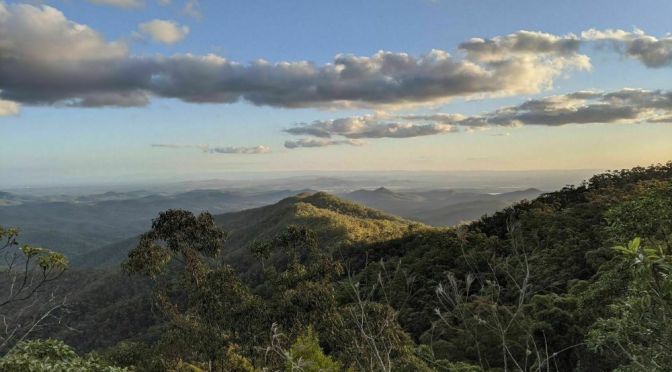
D’Aguilar National Park is a national park in Queensland, Australia. It contains the D’Aguilar Range and is located along the northwest of the Brisbane metropolitan area. The park is traversed by the winding scenic Mount Nebo Road and Mount Glorious Road.