Tag Archives: Arts & Literature

20th Century Art: “The New Realists – Radical Rebellion In 1960’s Europe”

Sothebys LogoIn the 1960s, while America was being wowed by Pop art, Europe had its own answer to bringing life and art closer together. In this episode of Expert Voices, learn about Nouveau Réalism – a groundbreaking movement in which artists created radical and rebellious sculptures and paintings in protest against the rise of consumerism.

Our upcoming Art Contemporain Day Sale (24 June | Paris) features an exceptional private European collection of historical New Realist art, including works by Niki de Saint Phalle, Arman, Daniel Spoerri, Mimmo Rotella and Christo and Jean-Claude.

Art History Videos: Italian Early Renaissance Painter Sandro Botticelli (15th C.)

An extract from the Christie’s Education online course, The Great Masters of European Art 1350–1850. Florence in the 1400s, a city of wealthy guilds and merchants, in particular the Medici family, who commissioned astonishing works of art to show off their success and cultivation.

Here we are introduced to one of the great artists the Medicis favoured: Sandro Botticelli, and his most famous works: ‘Primavera’ and ‘The Birth of Venus’.

Alessandro di Mariano di Vanni Filipepi (c. 1445 – May 17, 1510), known as Sandro Botticelli, was an Italian painter of the Early Renaissance. He belonged to the Florentine School under the patronage of Lorenzo de’ Medici, a movement that Giorgio Vasari would characterize less than a hundred years later in his Vita of Botticelli as a “golden age”. Botticelli’s posthumous reputation suffered until the late 19th century; since then, his work has been seen to represent the linear grace of Early Renaissance painting.

Art History: Rembrandt’s Portraits – “Love And Loss” At The National Gallery

A revealing look at Rembrandt’s most intimate portraits, on display in the locked-down National Gallery in London. The Guardian’s art critic Jonathan Jones reveals his favourite portraits, of vulnerable and unpretentious people the artist had known and loved. Jones asks what we can learn from these great masterpieces, especially during lockdown.

Arts & Culture: David Hockney’s “Lockdown Sunrise” And Other Masterpiece Dawns (Video)

David Hockney created a glorious depiction of a sunrise on his iPad in April and emailed it from his lockdown in Normandy to the Guardian’s art critic Jonathan Jones. He has made pictures from nature every day through this bitter spring as his artistic stand against despair – and what is more hopeful than the sun coming up? Jones describes how the picture reminded him of all the sunrises shut away inside the National Gallery, in London. From Bellini to Monet, Titian to Turner, a private view of some of the greatest masters’ sunrises

Artist Profiles: Russian Watercolor Painter Eleanor Mill – “Exacting”

From MyModernMet (May 25, 2020):

Eleanor Mill Watercolor Artist“Buildings and constructions once created by people but now fallen into oblivion have an inspirational value for me,” Mill tells My Modern Met. “They are silent witnesses of history. These giants towering over densely populated cities preserve the memories from the moment of their creation until the last stone drops off their walls.”

Eleanor Mill Watercolor ArtistRussian graphic designer and watercolor painter Eleanor Mill has a knack for capturing the spirit of place. Through her architectural watercolor sketches, she documents buildings with exacting detail. At the same time, Mill imbues her work with the color and light that gives each environment character. This allows viewers to come along with her as she places the memories of her travels down on paper.

Read more

Literature: “Shakespeare And Company” Digitizes Reading Library Of Joyce, Hemingway & De Beauvoir

Shakespeare and Company lending library cards

Shakespeare And CompanyGertrude SteinJames JoyceErnest HemingwayAimé CésaireSimone de BeauvoirJacques LacanWalter Benjamin.

What do these writers have in common? They were all members of the Shakespeare and Company lending library.

In 1919, an American woman named Sylvia Beach opened Shakespeare and Company, an English-language bookshop and lending library in Paris. Almost immediately, it became the home away from home for a community of expatriate writers and artists now known as the Lost Generation. In 1922, she published James Joyce’s Ulysses under the Shakespeare and Company imprint, a feat that made her—and her bookshop and lending library—famous around the world. In the 1930s, she increasingly catered to French intellectuals, supplying English-language publications from the recently rediscovered Moby Dick to the latest issues of The New Yorker. In 1941, she preemptively closed Shakespeare and Company after refusing to sell her last copy of Joyce’s Finnegans Wake to a Nazi officer.

The Shakespeare and Company Project uses sources from the Beach Papers at Princeton University to reveal what the lending library members read and where they lived. The Project is a work-in-progress, but you can begin to explore now. Search and browse the lending library members and books. Read about joining the lending library. Download a preliminary export of Project data. In the coming months, check back for new features and essays.

Website

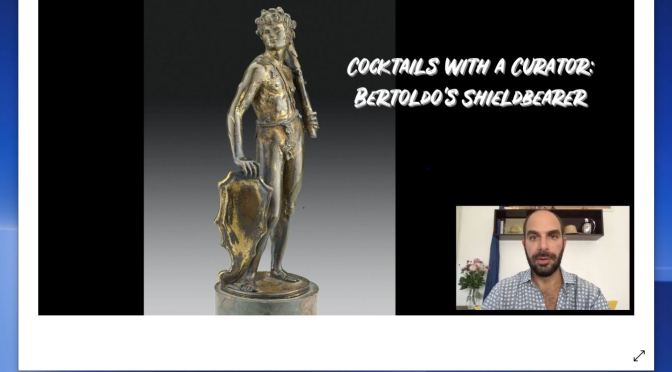
Art: “Cocktails With A Curator – Velázquez’s ‘King Philip'” (The Frick)

In this week’s episode of “Cocktails with a Curator,” join Xavier F. Salomon, Peter Jay Sharp Chief Curator, as he discusses the sole Velázquez painting at the Frick, “King Philip IV of Spain,” while enjoying a Fitifiti, the popular Spanish cocktail. Examine the extraordinary details and painterly skills that illustrate why the artist is regarded by many (including Xavier) as the greatest European painter who ever lived, and why this work was Henry Clay Frick’s favorite

Read more

New Art Books: “Titian – Love, Desire, Death” By Matthias Wivel (May 2020)

Titian Love Desire DeathTitian (active 1506–1576) produced a masterful group of paintings for Philip II of Spain, celebrating the loves of gods, goddesses, and mortals. Depicting scenes from Ovid’s narrative poem Metamorphoses, Titian named them “poesie” and considered the works as visual equivalents of poetry.

This volume presents a detailed study of the complete series—Danaë, Venus and Adonis, Perseus and Andromeda, Diana and Actaeon, Diana and Callisto, and The Rape of Europa, as well as The Death of Actaeon—lavishly illustrated with details of these emotionally charged paintings. The book explores Titian’s creative process and technique, in addition to his use of literary and visual sources and his correspondence with Philip II.

The artistic legacy of the series for later European painting is also examined in the works of artists such as Rubens, Velázquez, and Rembrandt. Offering the most comprehensive overview of these remarkable works, Titian: Love, Desire, Death is an indispensable resource for scholars and admirers of Renaissance painting.

Read more or purchase

Cocktails With A Curator: Boucher’s ‘A Lady On Her Daybed’ (Frick Collection)

In this episode of “Cocktails with a Curator,” Xavier F. Salomon, Peter Jay Sharp Chief Curator, examines the life and work of French painter François Boucher, with a focus on “A Lady on Her Daybed.” Discover why Boucher was said to epitomize the taste of the eighteenth century.

This week’s complementary cocktail has a kick: the potent French 75, named after the powerful French 75mm field gun.

Read more

Literary Arts: New Website Archives Work Of British Illustrator And Designer Peter Campbell (1937-2011)

The website is about the work of the designer, writer and illustrator Peter Campbell (1937‑2011). The intention is to present an archive of Peter’s illustration, design and editorial work, as well as occasional selections from his writing.

British Illustrator Peter Campbell - London Review of Books

When asked what he did for a living, Peter would usually say he was a designer, or, a typographer. Designing for print – books, exhibition catalogues, magazines, posters – Peter Campbell - Self-Portraittook up the most substantial part of his time, at the BBC in the 1960s and 1970s and thereafter as a freelance. He was also an illustrator, a journalist, an author of children’s books, an editor and a publisher. The great range of his professional work, and his encompassing interest in the work of others, made him a collaborator sought out by writers, publishers and artists.

Diana Souhami, who worked with Peter often, wrote in the Guardian after his death: “He had the ability to conceptualise what each publishing project needed and to get it right. He was hugely and diversely productive, but seldom hit a wrong note.”

Discussing his journalism in her appreciation in the London ReviewMary‑Kay Wilmers wrote: “There are people whom getting a grip doesn’t suit, who don’t want to be confined. One can honour the world in depth or across a wide range and there were few aspects of the world that Peter didn’t wish to honour.”

He probably would have been delighted by – and certainly modestly sceptical of – Alan Bennett’s appraisal, in the posthumous publication of a catalogue of his pictures in Artwork, that he was “an heir to Ardizzone, Bawden and Ravilious.”

Peter Campbell was born in Wellington, New Zealand in 1937. In 1960 he emigrated to London where he lived for the rest of his life. He died in 2011.

Website