National Geographic Traveller Magazine (November 15, 2024): The latest issue features a Canadian wilderness governed by its Indigenous inhabitants; a vibrant Mexican city where mariachi music reigns supreme; and a remote corner of New Zealand where the rare kiwi bird is making a comeback — uncover unmissable travel destinations for the year ahead.
From a jungle treehouse in Mexico to a California-inspired sun ranch in Australia, these are the best new and improved hotels, according to National Geographic Traveller (UK)’s annual Hotel Awards.
Could this be Europe’s best hut-to-hut hiking trail?
On the northwest border of Slovenia is a mountain range as dramatic as it is accessible, offering hut-to-hut hiking on multi-day adventures — with plenty of hearty food and local tales to sustain the journey.
What it’s like to travel along the West Coast on a train
One of the most beautiful train journeys in the US, the Coast Starlight’s route unspools along the Pacific Ocean from Los Angeles via Sacramento to Seattle. With miles of coastline, towering mountain ranges and glistening cityscapes, this is the ultimate American slow travel experience.
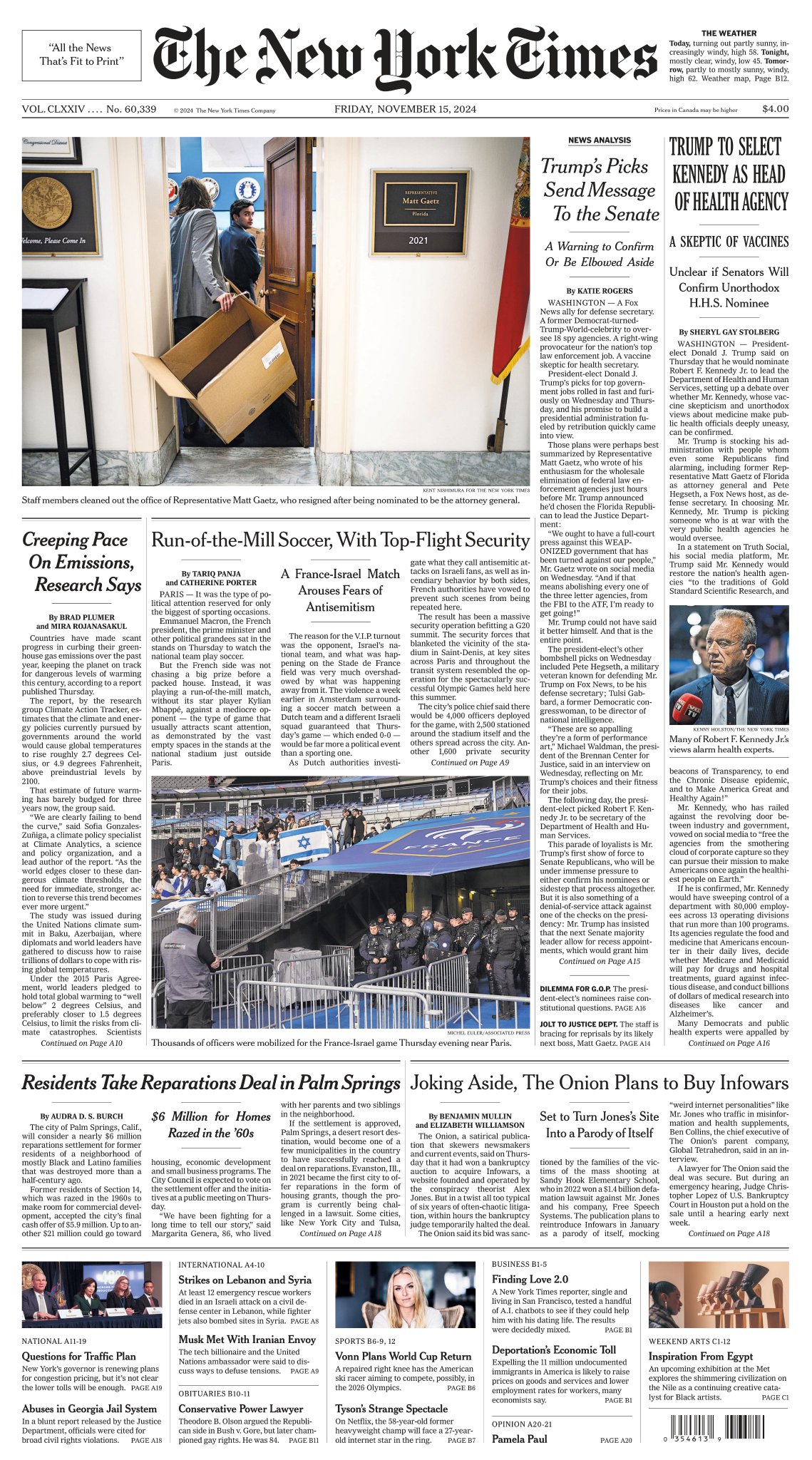
The president-elect’s choice of combative loyalists who could have trouble being confirmed has raised constitutional questions about executive power and the Senate’s prerogatives.
Elon Musk Met With Iran’s U.N. Ambassador, Iranian Officials Say
The tech billionaire, a top adviser to President-elect Donald J. Trump, was reported to have discussed ways to defuse tensions between Iran and the United States.
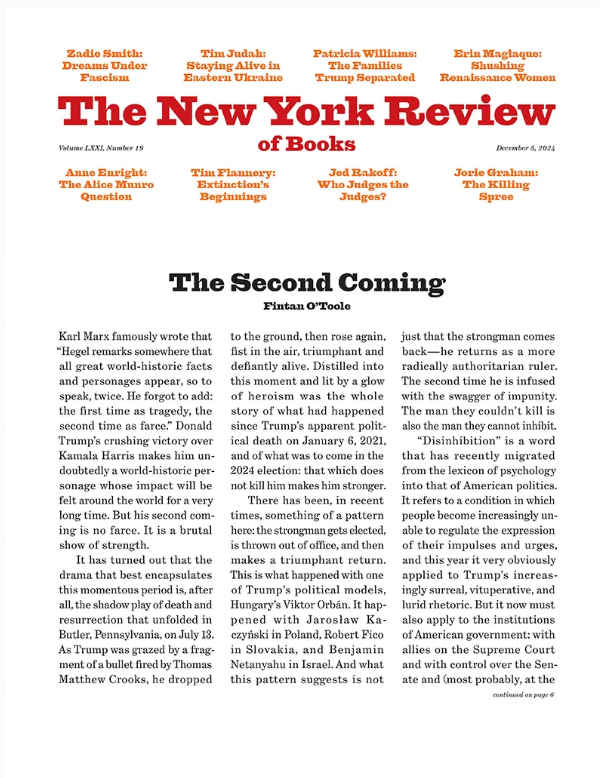
In late Renaissance Florence one in five women lived behind institutional walls whose rule was sensory mortification. Historians are struggling to recover their inexpressible secrets.
“A Veil of Silence: Women and Sound in Renaissance Italy” by Julia Rombough
In a special edition of the Guardian Weekly, our Washington bureau chief David Smith and diplomatic editor Patrick Wintour reflect on how Trump 2.0 is likely to play out for the US and for the rest of the world.
We look at the role played by the president-elect’s key supporter, Elon Musk, and ask what the world’s richest man can now expect back in return. We also trace the rise of the vice-president elect JD Vance, who is now just a heartbeat away from the presidency.
And senior US political reporter Joan E Greve considers the Democrats – bereft, broken and facing an internal civil war after a campaign that ended in disaster.
1 Spotlight | Odour of oil and return of Trump hang heavy over Cop29 As the annual UN climate summit got under way in Azerbaijan this week, Fiona Harvey sizes up the hopes for progressThe video player is currently playing an ad. You can skip the ad in 5 sec with a mouse or keyboard
2 Science | Unravelling the paradoxes of plankton Scientists are sequencing the DNA of microscopic marine life – to help us learn more about ourselves, reports Brianna Randall
3 Feature | When adult children cut the cord Grownups who cut of f contact with their family are often trying to break away after a traumatic childhood. But sometimes the estrangement can be totally unexpected for parents. ByGaby Hinsliff
4 Opinion | Trump unleashed will be even worse than last time’s dress reherarsal From a public health crisis to the end of Nato, the threats are clear, writes Jonathan Freedland
5 Culture | Sportswriters and arts critics swap jobs How does the English National Opera compare to the Premier League … or the NFL to a West End musical? Our sports and culture experts found out
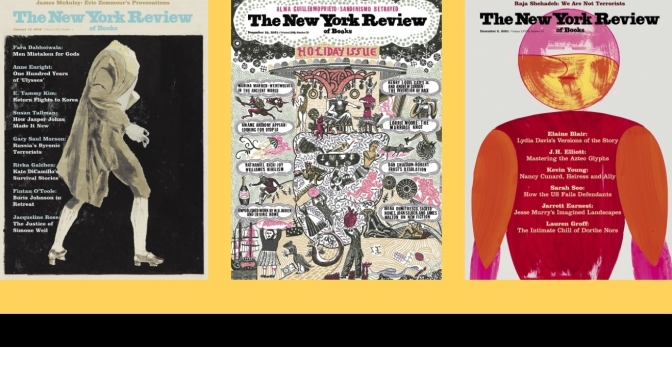
‘Being the party of normality has its appeal, but it reinforces precisely the wrong instinct. The polycrisis that is unfolding demands not a return to the status quo but urgent, progressive answers both at home and abroad. To formulate and articulate those, the Democrats need politicians, not algorithms. They need personalities capable of responding to the profound questions facing contemporary America.’
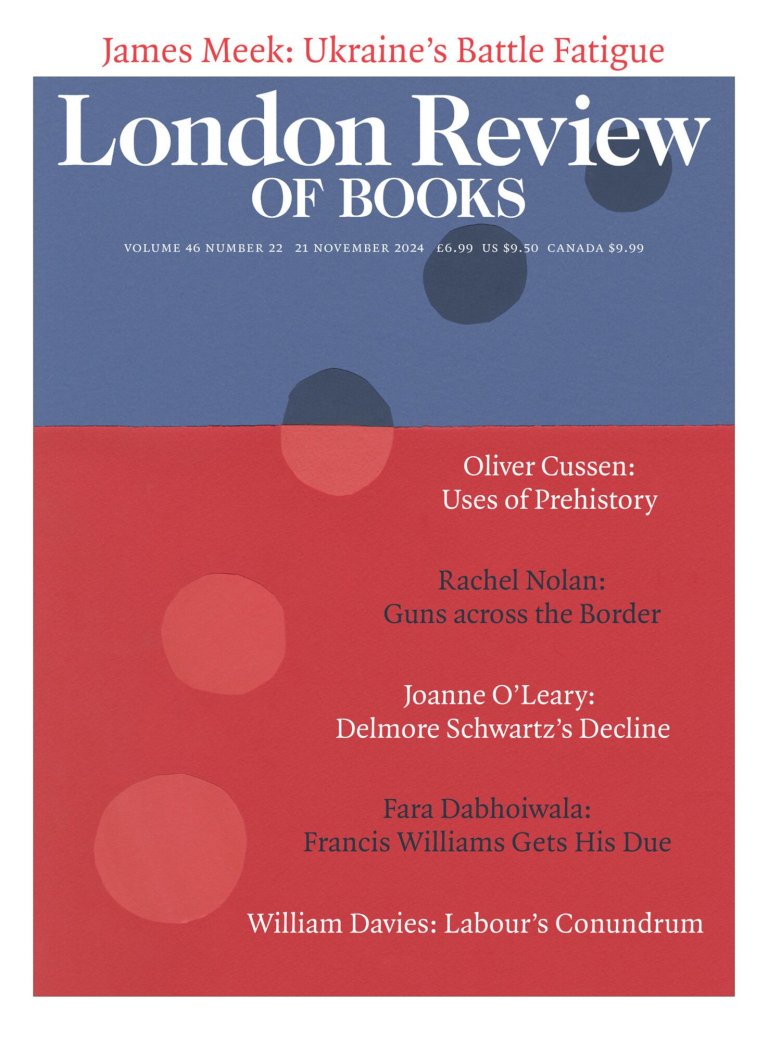
‘Would the army as a whole rise up against a government that made territorial concessions to Russia? Perhaps. But the more widely the recruiters spread their net, the more the army reflects a society that is starting to talk openly, if bitterly, about swapping land for peace.’
Exit Wounds: How America’s Guns Fuel Violence across the Border by Ieva Jusionyte
Soldiers and Kings: Survival and Hope in the World of Human Smuggling by Jason de León
The Florida congressman, a polarizing figure on Capitol Hill, could give President-elect Donald J. Trump an ally at the top of the Justice Department who would not resist his directives.
The Local Project (November 12, 2024): Inside an iconic mid-century home designed by Steven Harris Architects, Palm Springs Residence is a study in restraint, honouring both the existing structure and the work of those who came before. This sensitive renovation reimagines the original house, known as Charney House, designed by Donald Wexler in 1956.
Video timeline:00:00 – Introduction to the Iconic Mid-century Home 00:52 – The Original Plan and Inspiration 02:18 – A Minimal Layout 02:48 – The Afternoon Light and Vibes 03:46 – A Very California House 04:05 – Proud Moments
“Wexler was brilliant, with an extraordinary sense of syntax and grammar; everything lines up with everything,” says Steven Harris, partner at Steven Harris Architects. Interestingly, Harris and his partner bought the house accidentally. “We were helping another friend with their house and fell in love with the place,” recalls Harris. After spending time inside an iconic mid-century home designed by Wexler, Harris’s vision was rooted in preserving as much of the original as possible. “Almost everything here is original to the house,” he notes. “For me, the greatest liability would be for someone to drive by on the street and immediately say, ‘oh! that’s a Steven Harris house.’”
Alterations inside the iconic mid-century home designed by Wexler were largely stylistic and inspired by a Wassily Kandinsky painting. “If you look at it from the air, you will see flashes and curves and various shapes, which on one hand is quite graphic, and on the other, almost every view is perspectival because the things you’re looking at are only oblique. Things shift off of each other in a very curious and interesting way.” Stepping inside an iconic mid-century home designed by Wexler, the front door is indicated by a covered passage, flanked by an oblique terrazzo sidewalk extending from the driveway.
The United States is the biggest trading partner for the European Union and Britain, whose economies could be at risk from the president-elect’s policies.
The strike hit a house in the city of Jabaliya, which has repeatedly come under attack as the Israeli military has pressed an offensive in northern Gaza.
President-elect Donald J. Trump’s momentary talk of unity on election night may underestimate the depth of his resentment after multiple impeachments, investigations, indictments and lawsuits.
Government unions, service worker unions and industrial unions all face possible repercussions from Donald Trump’s victory, but not necessarily all the same kind.
The White House Will Be Shedding Its Union Label
After gains by organized labor under President Biden, a second Trump administration is likely to change course on regulation and enforcement.
News, Views and Reviews For The Intellectually Curious















 Boomers Daily