Three Musicians, 1921 by Pablo Picasso Three Musicians is a large painting measuring more than 2 meters wide and high. It is painted in the style of Synthetic Cubism and gives the appearance of cut paper. Picasso paints three musicians made of flat, brightly colored, abstract shapes in a shallow, boxlike room.
Tag Archives: Art History
Art History Video: ‘The Ordrupgaard Museum Impressionist Collection’
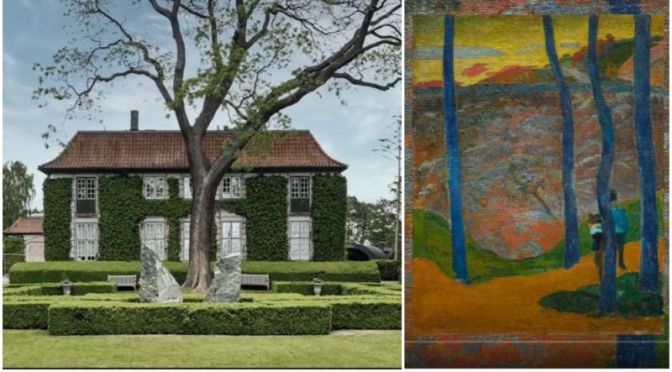
Our latest exhibition, Gauguin and the Impressionists: Masterpieces of the Ordrupgaard Collection, has humble roots in the home of Wilhelm and Henny Hansen.
In this video produced by Ordrupgaard, discover how the Hansens transformed their private home into a jewel in the crown of the Danish art scene.
The Ordrupgaard museum in Denmark is the permanent home of important works by French Impressionists as well as Danish art from the Golden Age. Learn about the lives of Wilhelm and Henny Hansen, and what circumstances led them to begin this exceptional, methodically acquired collection – part of which is now featured at the Royal Academy.
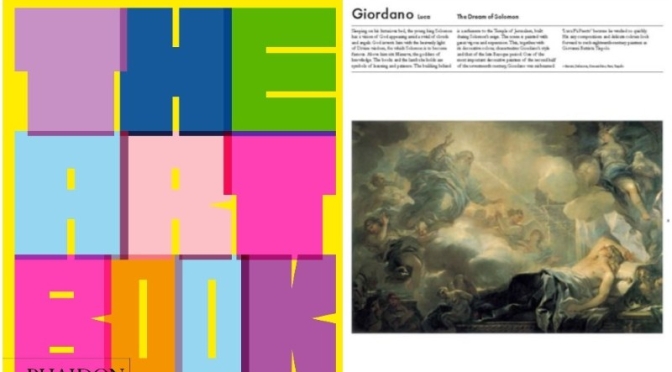
Top New Art Books: “The Art Book” – Over 600 Artists Profiled (Phaidon)
A brand-new revised and updated edition of Phaidon’s accessible, acclaimed A-Z guide to the most important artists of all time
Updated for only the third time in its 16-year history, this new edition of the award-winning landmark publication has been refreshed with more than 40 important new artists, including many previously overlooked and marginal practitioners. The new edition spotlights more than 600 great artists from medieval to modern times. Breaking with traditional classifications, it throws together brilliant examples from all periods, schools, visions, and techniques, presenting an unparalleled visual sourcebook and a celebration of our rich, multifaceted culture.
Artists featured for the first time in this edition include: Berenice Abbott, Hilma af Klint, El Anatsui, Romare Bearden, Mark Bradford, Cao Fei, Cecily Brown, Judy Chicago, John Currin, Guerrilla Girls, Lee Krasner, Jacob Lawrence, Kerry James Marshall, Joan Mitchell, Zanele Muholi, Takashi Murakami, Louise Nevelson, Clara Peeters, Jenny Saville, Wolfgang Tillmans, and more.
History: “The Unchained Art Of The Renaissance”
Waldemar Januszczak challenges the traditional notion of the Renaissance having fixed origins in Italy and showcases the ingenuity in both technique and ideas behind great artists such as Van Eyck, Memling, Van der Weyden, Cranach, Riemenschneider and Durer.
Giorgio Vasari, (born July 30, 1511, Arezzo [Italy]—died June 27, 1574, Florence), Italian painter, architect, and writer who is best known for his important biographies of Italian Renaissance artists.
Cocktails With A Curator: “Böttger’s Teapot” (Video)
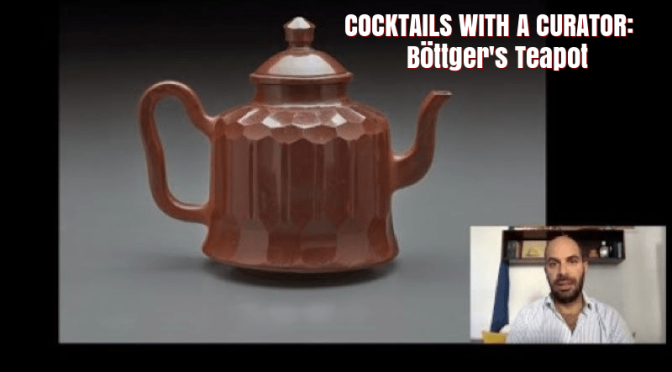
In this week’s episode of “Cocktails with a Curator,” Deputy Director and Peter Jay Sharp Chief Curator Xavier F. Salomon delves into the significance of a deceptively simple teapot designed by Johann Friedrich Böttger and given to the Frick by the great German-born collector Henry H. Arnhold (1921–2018). Enjoy a Saxon cocktail while exploring the complicated history behind Böttger’s quest to discover the formula for porcelain in a clifftop fortress outside Dresden in the early 18th century.
To see this object in detail, please visit our website: https://collections.frick.org/objects…
Top New Art Exhibitions: “Monet And Chicago” (Art Institute Chicago Videos)
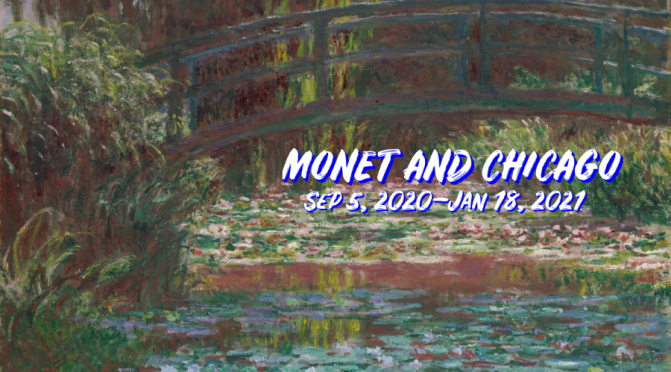
Monet And Chicago Sep 5, 2020–Jan 18, 2021
Learn how the changes Monet made to this painting captured the seaside town he remembered from his youth rather than the tourist destination it had since become.
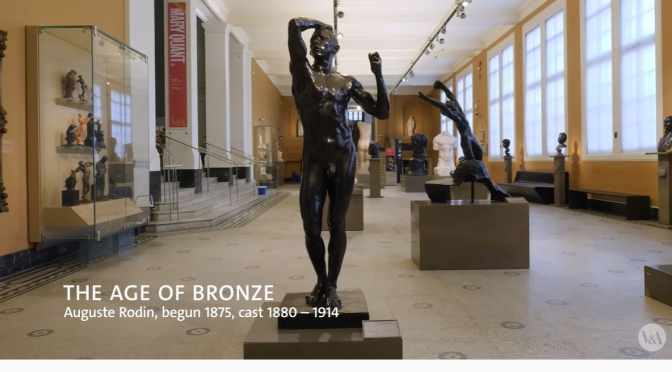
Art History: “Auguste Rodin – Challenging Beauty” (V&A Video)
The V&A holds 23 sculptures by French sculptor Auguste Rodin. Between the 1870s and the 1890s he came to challenge traditional notions of beauty and appropriateness – and paved the way for modern sculpture.
This film, presented by V&A curator Alicia Robinson, shows in detail 6 works by Rodin – exploring his earlier work inspired by classical sculpture, Michelangelo and Donatello, and his development into spectacular explorations of patina, light and emotion.
In 1914 Rodin gave his work to the V&A as a symbol of the friendship between the people of France and Great Britain.
Cocktails With A Curator: Ingres’s ‘Comtesse d’Haussonville’ (Video)
In this week’s episode of “Cocktails with a Curator,” Curator Aimee Ng explores the history behind one of the audience favorites at the Frick, Jean-Auguste-Dominique Ingres’s “Comtesse d’Haussonville.” Sometimes referred to as the “poster girl” of The Frick Collection, the subject of this celebrated portrait led a fascinating life, taking piano lessons from Chopin and writing biographies of Lord Byron and the Irish revolutionary Robert Emmet. (She published the books anonymously to avoid a scandal.) This week’s complementary cocktail calls for an ounce of absinthe, an anise-flavored spirit invented in Switzerland, the country of her birth.
COCKTAILS WITH A CURATOR: “TITIAN’S ARETINO” (VIDEO)
In this week’s episode of “Cocktails with a Curator,” celebrate the 444th anniversary of Titian’s death by delving into the tumultuous life of Pietro Aretino, one of the most celebrated—and reviled—literary figures of the Italian Renaissance. Deputy Director and Peter Jay Sharp Chief Curator Xavier F. Salomon examines Titian’s portrait of Aretino at the Frick and the friendship between the Venetian painter and the acid-tongued writer, known to his contemporaries as the “scourge of princes.” This week’s complementary cocktail is the Bellini, a mixture of Prosecco and white-peach puree created by the Cipriani family in Venice and named for Titian’s teacher, Giovanni Bellini.
Tiziano Vecelli or Vecellio, known in English as Titian, was an Italian painter during the Renaissance, considered the most important member of the 16th-century Venetian school. He was born in Pieve di Cadore, near Belluno. During his lifetime he was often called da Cadore, ‘from Cadore’, taken from his native region.
Top Art History Podcasts: “Michelangelo’s Drawings – Mind Of The Master”

Michelangelo is among the most influential and impressive artists of the Italian High Renaissance. His lifelike sculptures and powerful paintings are some of the most recognizable works in Western art history. He also drew prolifically, making sketch after sketch of figures in slightly varying poses, focusing on form and gesture.
However, remarkably few of these drawings remain today, many of them burned by the artist himself, others lost or damaged over the centuries.
A recent exhibition at the J. Paul Getty Museum, Michelangelo: Mind of the Master, brought together more than two dozen of Michelangelo’s surviving drawings—including designs for the Sistine Chapel ceiling and The Last Judgment—to shed light on the artist’s creativity and working method. In this episode, co-curators of this exhibition, Julian Brooks and Edina Adam, discuss the master and what we can learn from his works on paper.
For images, transcripts, and more, visit getty.edu/podcasts.