

As severe drought in the West forces states to make drastic water cuts, Las Vegas offers a road map to making the most out of every drop of water. Since 2002, Southern Nevada has cut its Colorado River water use by 26% while its population has grown by 750,000.
Tag Archives: Analysis

Analysis: Saudi Arabia’s Hyper-Planned “Line City”
The Line is a proposed smart linear city in Saudi Arabia in Neom, Tabuk, currently under construction, which is designed to have no cars, streets or carbon emissions.
The Line is being described as a one-building vertical city outfitted with exterior mirrors, big enough to house 9 million people — along with everything they need, from parks and waterfalls to flying taxis and robot maids. There are even plans to include an artificial moon for residents to gaze upon.
With its proposed width of only 656 feet, The Line will rely primarily on its height to encompass its residents and a host of modern trappings, such as a high-speed rail to connect sections of the 106-mile city. Saudi Arabian officials claim The Line will be otherwise devoid of roads, cars or emissions and will be powered strictly by clean energy (although details have not been released). Here are a few of most notable proposed features of The Line:
- vertically layered homes, offices, public parks and public schools.
- year-round climate control of all indoor and outdoor spaces.
- high-speed rail that will transport residents from end-to-end in 20 minutes.
- a five-minute walk to all amenities.
- accessibility to parks and natural elements within a two-minute walk.

News Analysis: Midterm Election, Nuclear Threat
New York Times columnist David Brooks and Washington Post associate editor Jonathan Capehart join Amna Nawaz to discuss the week in politics, including October surprises in the U.S. and crises on the world stage with just a month until the midterms.
News Analysis: Hurricane Ian, Right-Wing Politics
New York Times columnist David Brooks and Washington Post associate editor Jonathan Capehart join Judy Woodruff to discuss the week in politics, including the state and federal response to Hurricane Ian and recent election victories by right-wing political parties across Europe.
Political Analysis: Brazil – A Fractured Nation (FT)
Latin America’s largest nation is facing its most important election in decades as Jair Bolsonaro and Luiz Inácio Lula da Silva square off amid deep political and cultural polarisation. FT Brazil bureau chief Bryan Harris travels the nation to look at the enormous economic and social challenges facing the next president. He meets wealthy farmers, truckers, evangelicals and those facing food insecurity. Read more at https://on.ft.com/3Cjrg5T
Brazil, officially the Federative Republic of Brazil, is the largest country in both South America and Latin America. At 8.5 million square kilometers and with over 214 million people, Brazil is the world’s fifth-largest country by area and the seventh most populous.
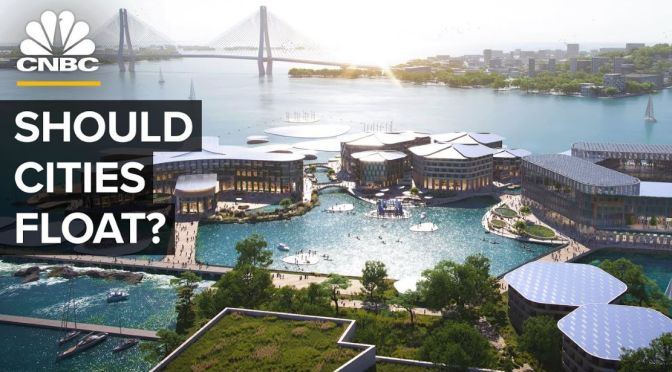
Urban Planning: Will The Cities Of The Future Float?
A new industry of floating infrastructure is emerging to help adapt to rising sea levels. There are two distinct approaches that are being put forth as possible solutions: retrofitting homes to be amphibious and building floating cities.
Amphibious homes can preserve the accessibility of the house and maintain the congenial front porch culture in places like Louisiana, said Elizabeth English, founder and director of The Buoyant Foundation Project. English’s design places a steel frame beneath a house, and then below that, in the crawl space, buoyancy elements. Her team then recommends adding elements to prevent lateral movement so the home will not float away while on the surface of floodwaters.
She estimated that a contractor could do such a retrofit for about $20 to $30 per square foot, but cautioned the Federal Emergency Management Agency currently discourages this type of building practice. Modern floating cities are the brainchild of architect Bjarke Ingels. He told CNBC he hopes his Oceanix City, which is currently slated to be built in the harbor near Busan,
South Korea, will be “a city that is the most resilient city you can imagine, but at the same time, the most enjoyable city that you can imagine.” “We really hope that it will be a successful project and we would like to replicate it in other parts of the world,” Maimunah Mohd Sharif, executive director of the United Nations Human Settlements Programme, told CNBC of the Oceanix development.
She said the world must look more into adaptation and hopes that the project can help mitigate or even solve the problem of sea-level rise. Would you live in a floating city or retrofit your home so it floats during floods? Watch the video above to learn more about what life could be like in these innovative climate change adaptations.

Ukraine War Analysis: Time Magazine – Oct 10, 2022

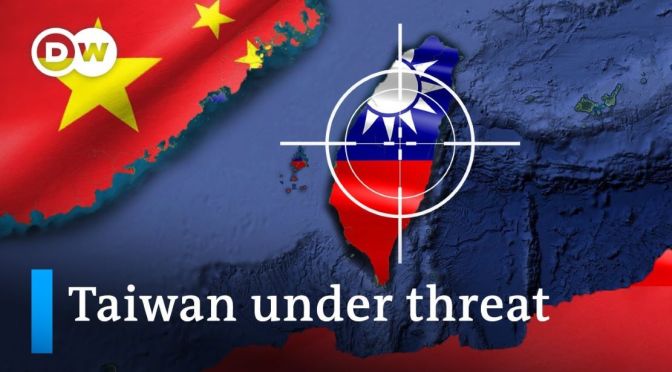
Analysis: How Taiwan Is Facing Threat From China
Taiwan is a democracy with a strong human rights record and a high standard of living. But despite the country’s economic strength and elected government, the island state struggles to receive international recognition. Even in terms of corruption, Taiwan’s track record is better than that of some European states.
The problem is that Beijing regards democratic Taiwan, which seceded from the mainland in 1949, as a renegade province rather than an independent state. China is trying to isolate it internationally. Many fear that China has plans to attack Taiwan in the near future: The President of the People’s Republic of China, Xi Jinping, has made it clear that his country is prepared to claim the island by military means. Beijing has been adopting this threatening stance for decades.
Thus far, the goal has been to annex the island to the mainland at some undefined point in the future. China’s historically questionable worldview would see this as reunification; from Taiwan’s perspective, it would be annexation. Both countries are highly armed – a war would inevitably cost many people their lives.
The film throws open a window on a nation that has been in a state of existential threat for decades; a country that is home to people who will defend their freedom at all costs – and also those who yearn for an imminent annexation with China.
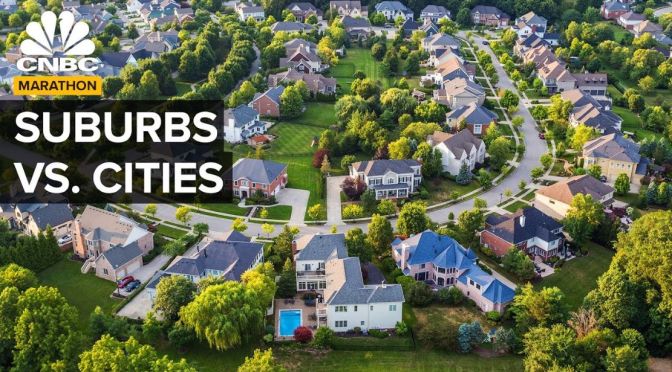
Economic Analysis: Are Cities Or Suburbs Better?
CNBC Marathon reviews why a cost-of-living crisis is unfolding across America’s housing infrastructure. CNBC explores what that means for apartments in the cities and houses in the suburbs. Inflation data shows that costs for items such as rent and groceries are increasing quickly across the Sun Belt and coastal cities.
Chapters: 00:00 Introduction 00:39 How to make the suburbs more affordable (Published April. 2022) 13:22 How suburban sprawl shapes the U.S. economy (Published Feb. 2022) 26:34 Are major cities still worth it? (Published May 2022)
Now years removed from the darkest days of the pandemic, people are asking: Is a return to the city worth it? Metropolitan regions have sprawled in recent years, raising budget concerns and quality-of-life issues for the people who remain downtown. Meanwhile the absence of commuters is slowing the recovery in leisure and hospitality. About 46% of renters in the U.S. are struggling to make ends meet, according to Harvard University researchers.
Builders say conditions for renters will get worse before they get better. A snarled supply chain, a labor shortage, and rising interest rates are worsening what some call a “throwaway” development pattern. Several real estate industry experts have ideas about how to make housing more attainable. Some of the most popular ideas include mixed-use districts and master-planned communities.
America’s suburbs are sprawling again. Over the 20th century, real estate developers built large tracts of single-family homes outside of major cities. The builders were following mortgage underwriting standards first introduced by the Federal Housing Administration in the 1930s. Over the century, those guidelines created housing market conditions that explicitly shut out many minorities. Experts say it is possible to update these old building codes to create equity while fixing some, but not all of the problems of American suburbia. CNBC Marathon brings together the best of CNBC’s coverage on the U.S. housing crisis and how life in the suburbs impacts city living.

World Hunger: Is Biofuel Feeding A Food Crisis?
The UN’s World Food Programme has described 2022 as “a year of unprecedented hunger”, with millions of people in dozens of countries facing famine. At the same time, significant amounts of farmland are being used to produce so-called biofuels. But could a global food crisis change that?
Biofuels are liquid fuels produced from renewable biological sources, including plants and algae. Biofuels offer a solution to one of the challenges of solar, wind, and other alternative energy sources. These energy sources have incredible potential to reduce our dependence on fossil fuels and yield environmental and economic benefits. But many of these sources have a limitation: they can’t replace liquid fuels such as jet fuel, gasoline, and diesel fuel that are critical to our transportation needs. That’s where biofuels could help.
 Boomers Daily