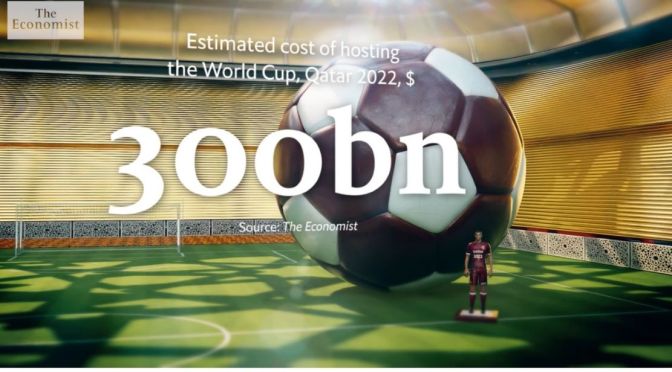
The Economist – Qatar is about to host the most expensive World Cup ever, costing as much as $300bn. Why has this small, gas-rich kingdom chosen to host football’s most prestigious event, and how does it fit into its broader plans for economic transformation?
Video timeline: 00:00 – Why is Qatar hosting the World Cup? 00:57 – World Cups are expensive competitions 01:56 – Qatar’s human rights violations 02:36 – Qatar’s place in the Gulf 04:43 – Qatar distinguishes itself from its neighbours 05:50 – Qatar bids to host the World Cup 07:18 – Qatar’s neighbours issue a blockade 10:12 – What might happen after the World Cup?
0:15 Global Population Reaches 8 Billion – That’s 8 times more humans than existed in 1800. Even so, the world’s population is growing at its slowest rate since 1950 due to a declining global fertility rate. Today there are an average of 2.3 births per woman. In 1950 it was 5. The world’s population is projected to peak at 10.4 billion by 2080.
1:49 The Economic Case for Climate Adaption – Climate adaptation means preparing our ecological, social and economic systems so they can cope with the future impacts of climate change. Heatwaves, storms, wildfires: the costs of climate change are already mounting but so far only 20% of climate finance has gone towards adaptation.
3:44 French Start Up Blends Wind and Solar Energy – Unéole’s energy system combines a photovoltaic rooftop panel with 2 compact wind turbines, generating 40% more energy than an ordinary rooftop panel. Solar panels work best in strong sunlight but Unéole’s units generate power when it’s overcast or during winter and can turn through the night to ensure a steady flow of power. The turbines are silent, so they don’t disturb building occupants and they’re built from mostly recycled aluminium and steel.
4:54 Lab Grown Blood Used in World First – UK scientists have transfused lab-grown blood into humans for the first time. It could revolutionize treatment for people with rare blood types, especially those who need regular transfusions. Two people were injected with 1-2 teaspoons of the synthetic blood to see how how their bodies respond. So far, so good – the trial participants are fit and healthy with no reported side effects.
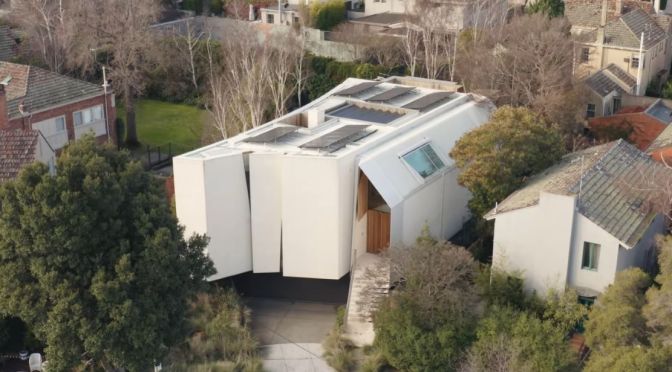
The Local Project – Crafted by John Wardle Architects, this sustainable off-grid house is best explored by means of a house tour. Combining seamless interior design and architecture with a minimal environmental impact, Limestone House forms a cohesive celebration of functionality.
Video timeline:00:00 – Introduction to the Sustainable Off-Grid House 00:41 – The Location and The Vacant Lot 01:22 – Architects Declare 01:39 – The Living Building Challenge 02:06 – Passive House Standards 02:40 – The Shading Systems 03:04 – What’s Behind the Walls 03:19 – The Energy Supply 03:35 – Requirements of the Living Building Challenge 03:50 – The Two Main Materials Used 04:12 – An Interesting History Behind the Timber 04:42 – The Handmade Aspects 05:01 – Floating on a Sea of Native Grasses
Located in the Melbourne suburb of Toorak, Limestone House rests on the Wurundjeri Land of the Kulin Nation. Initially vacant, the project site excited the clients with the possibility of building a sustainable off-grid house. Paying homage to the environmental agenda, the landscape design of Limestone House sees the building float above a sea of native grass. Guiding the design of Limestone House is the Living Building Challenge and Passivehaus, two rigorous standards of sustainability.
In order to satisfy the standards, John Wardle Architects ensures that the home operates as a sustainable off-grid house, harvesting its own water and disposing of all of its waste water. Externally, a set of edible plantings on the terrace meets the requirement for food production on site. The Passivehaus standard sees a tightly-sealed, sustainable off-grid house emerge. While a passive ventilation system consistently delivers fresh air into the home at a slow speed, an airtight barrier seals heat into the dwelling, maximising energy efficiency.
Similarly, high-performance insulation is applied to the walls, roof and floor and the home features triple-glazed windows. Shading systems take the form of motorised venetian blinds to the northeast and west, as well as operable timber louvres at roof level over the courtyard. Internally, the material palette of Limestone House consists primarily of stone and timber. Concrete benchtops and Queensland siltstone complement the calming tonal character of the scheme alongside hydrowood oak. Many of the trees used for the oak come from a valley that was flooded during a 1940s hydroproject – now the timber comprises a bespoke dining room table.
A sustainable off-grid house, Limestone House produces its own energy and a surplus of five per cent that is exported to the grid. While meeting the design brief, John Wardle Architects ensures that the residence forms a unique embracement of natural serenity, in distinction from other sustainable dwellings of the past.
Ben Luke talks to Hannah McGivern, a correspondent for The Art Newspaper who has just been to Qatar, about the vast number of public art projects that will accompany the FIFA Men’s World Cup that begins there on Sunday 20 November.
She also discusses the museums that Qatar plans to open by 2030. How does this explosion of cultural initiatives sit with Qatar’s record on human rights and treatment of low-paid migrant workers in the building of its cultural venues and World Cup stadia? It has been a heady fortnight of auctions in New York.
Ben speaks to Georgina Adam, an editor-at-large at The Art Newspaper, about the highs and lows, and whether we can expect even more sales of blockbuster collections in the coming years.
And this episode’s Work of the Week is an untitled painting by Luis Meque, an artist born in Mozambique who came to fame in the 1980s and early-1990s in Zimbabwe. Tandazani Dhlakama, the curator of the exhibition When We See Us: A Century of Black Figuration in Painting at Zeitz Museum of Contemporary Art Africa in Cape Town, tells us about Meque’s painting and his brief and brilliant life.When We See Us: A Century of Black Figuration in Painting, Zeitz Museum of Contemporary Art Africa, Cape Town, South Africa, 20 November-3 September 2023 Hosted on Acast. See acast.com/privacy for more information.
Lena Pillars is the name given to a natural rock formation along the banks of the Lena River in far eastern Siberia. The pillars are 150–300 metres high, and were formed in some of the Cambrian period sea-basins. The highest density of pillars is reached between the villages of Petrovskoye and Tit-Ary.
Yakutia (Russian: Яку́тия, yah-KOO-tee-yuh), also known as the Republic of Sakha, is located in the Russian Far East, and is notable for being the world’s largest subnational governing body by area. Yakutia covers an area of more than 3 million km², representing about 18 percent of the Russian Federation, and making it roughly the size of India, despite having a population smaller than that of Rhode Island. The republic’s capital is Yakutsk.
As the Asia-Pacific Economic Cooperation forum kicks off, how is US influence in the region being received? Plus: Turkey’s Nato demands for Sweden as the country implements anti-terror measurements and Finland’s border-fence proposal.
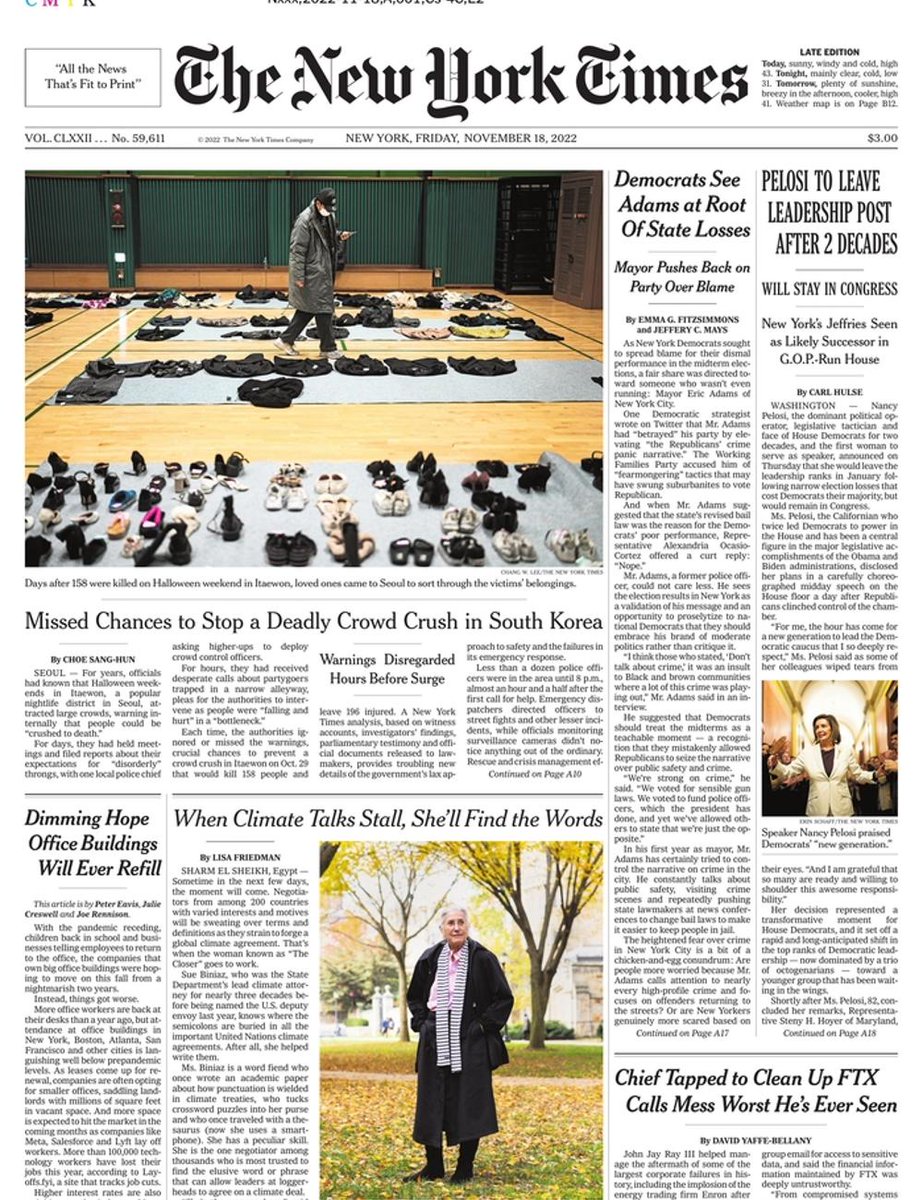
“For me, the hour has come for a new generation to lead the Democratic caucus that I so deeply respect,” Speaker Nancy Pelosi said. She has led her party in the House for two decades.
The New York City mayor focuses relentlessly on crime, and critics say he lent legitimacy to Republicans who played up the issue in their midterms campaigns.
An analysis, based on official documents and parliamentary testimony, reveals that authorities in South Korea missed crucial chances to prevent a crowd crush that would kill 158 people.
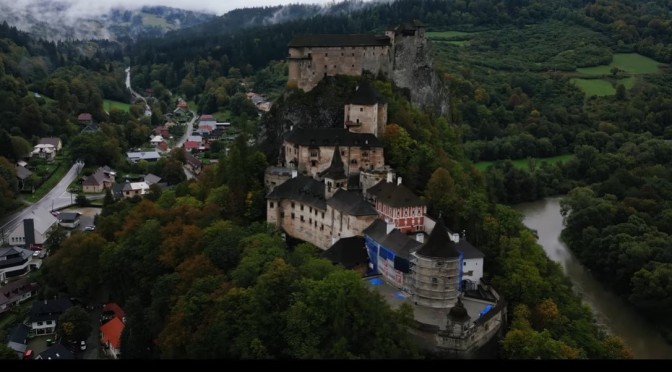
I traveled around Slovakia September 2022 for a week, Here is my experience. It’s a small country so I was able to see many places & was really happy to create a travel video from my fathers country.
The places you will find in the film were mainly regional which included: The Tatra Mountains, Spiš Castle at the village of Žehram, Oravam Castle at the village of Oravský, Podzámok, Banská Štiavnica, Trnava (Folk singing & dancing), The Trenčín Castle, The Strečno Castle, Čičmany village, The Likava Castle.
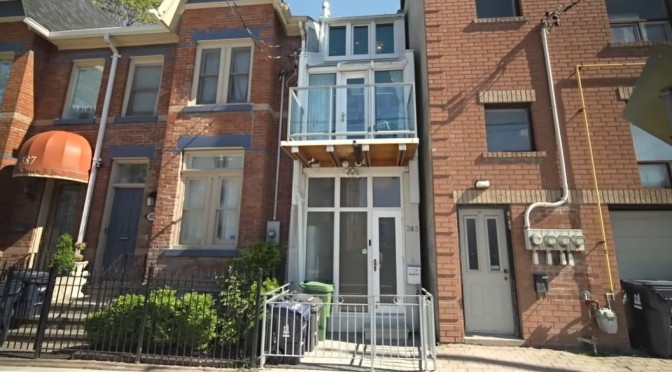
This ultra-narrow house looks modern on the outside, but inside it’s a cozy and welcoming home with multiple levels designed around a meandering set of stairs that run up the center of the home. With lots of wood, exposed copper pipes, and small dimensions, the owner often describes the house as feeling like a boat or a treehouse.
While it might seem like the house was recently built as an in-fill house or accessory dwelling unit, there has actually been a narrow single-story structure on the property since at least 1880. It wasn’t until 1980 – a full century later – that the then-owner, an architect, applied to the committee of adjustments to build the house as it is today.
With such a long and narrow floorplan, an important feature of the house is the full glass walls and skylights at both ends of the house, which lets natural light flow into each room and prevents the house from feeling dark and confined.







 Boomers Daily