
Photography Exhibitions: ‘Bernd & Hilla Becher’- The Splendor Of The Everyday

CBS Sunday Morning (March 26, 2023) – To photographers Bernd and Hilla Becher, the rapidly vanishing industrial architecture of Western Europe and North America were works of art. The German couple’s documentary images of transmission towers, gas tanks, blast furnaces and smokestacks – structures that signified the end of an industrial era – are being celebrated in a comprehensive retrospective now at the San Francisco Museum of Modern Art. Lee Cowan offers us a tour.

Bernd & Hilla Becher

logo red

December 17, 2022–April 2, 2023

The renowned German artists Bernd and Hilla Becher (1931–2007; 1934–2015) changed the course of late twentieth-century photography. Working as a rare artist couple, they focused on a single subject: the disappearing industrial architecture of Western Europe and North America that fueled the modern era.

Their seemingly objective style recalled nineteenth- and early twentieth-century precedents but also resonated with the serial approach of contemporary Minimalism and Conceptual art. Equally significant, it challenged the perceived gap between documentary and fine art photography.

Exhibition Preview

Bernd and Hilla Becher, Framework House, Auf der Hütte 45, Gosenbach, Siegen, Germany, 1961; The Metropolitan Museum of Art, New York, purchase, Vital Projects Fund Inc. gift, through Joyce and Robert Menschel, Denise and Andrew Saul Fund, Louis V. Bell, Harris Brisbane Dick, Fletcher, and Rogers Funds and Joseph Pulitzer bequest, and Jade Lau gift, 2018 (2018.463); © Estate Bernd & Hilla Becher, represented by Max Becher
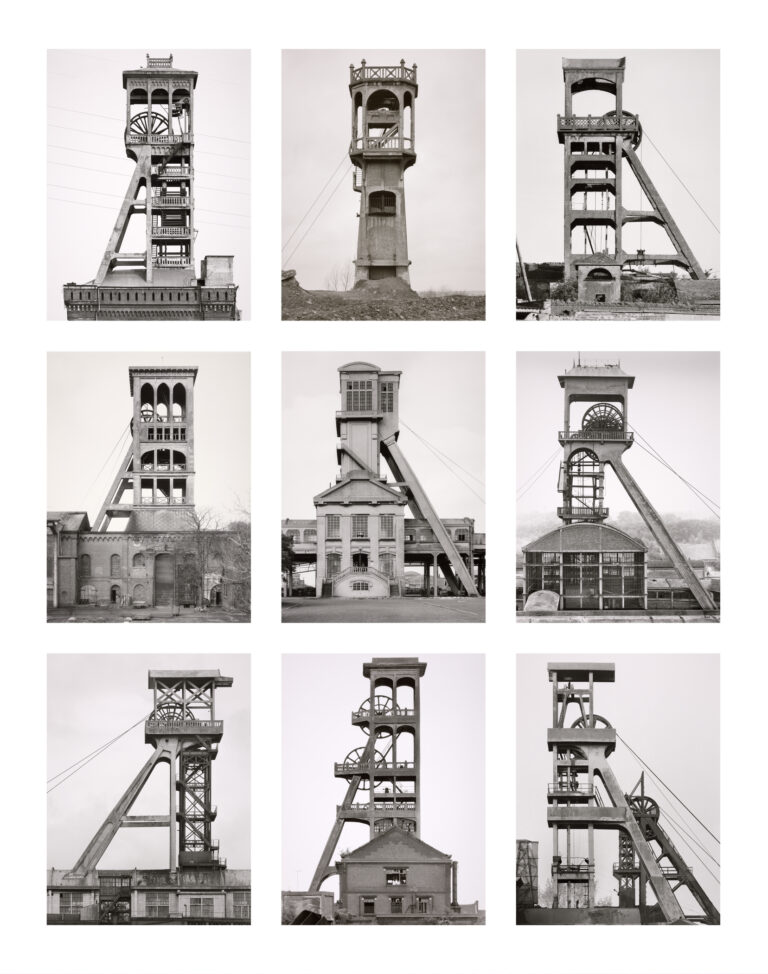
Bernd and Hilla Becher, Fördertürme, Belgien, Frankreich (Winding Towers, Belgium, France), 1967-1988; The Doris and Donald Fisher Collection at the San Francisco Museum of Modern Art; © Estate of Bernd and Hilla Becher; photo: Don Ross

Bernd and Hilla Becher, Water Towers (Germany, France, Belgium, United States, and Great Britain), 1963–80; The Metropolitan Museum of Art, New York, Warner Communications Inc. Purchase Fund, 1980 (1980.1074a–p); © Estate Bernd & Hilla Becher, represented by Max Becher

Bernd and Hilla Becher, Zeche Hannover, Bochum-Hordel, Ruhr Region, Germany, 1973; The Metropolitan Museum of Art, New York, purchase, Vital Projects Fund Inc. gift, through Joyce and Robert Menschel, 2011 (2011.67); © Estate Bernd & Hilla Becher, represented by Max Becher

‘Abyss Of Time’: How James Hutton Founded Geology & ‘Earth’s Age’ In Scotland

BBC News (March 26, 2023) – In the 1700s, geologist James Hutton discovered a rock formation in Scotland that transformed how we think about time. Through studying the rocky headland of Siccar Point, Hutton identified the existence of ‘deep time’ – proving that Earth is millions, not thousands, of years old.

James Hutton (1726–1797), a Scottish farmer and naturalist, is known as the founder of modern geology. He was a great observer of the world around him. More importantly, he made carefully reasoned geological arguments. Hutton came to believe that the Earth was perpetually being formed; for example, molten material is forced up into mountains, eroded, and then eroded sediments are washed away.

He recognized that the history of the Earth could be determined by understanding how processes such as erosion and sedimentation work in the present day. His ideas and approach to studying the Earth established geology as a proper science.

Nature In Vienna: The ‘Beavers Of The Danube’

BBC Earth (March 26, 2023) – Vienna’s Danube is known for its bustling nightlife and mighty skyscrapers, but one surprising resident has also found a home here. Animals are learning to survive and thrive in one very surprising habitat – cities. Join wildlife presenter Hannah Stitfall as she sets out on a mission to meet our new neighbours. #CoExistence

Eurasian Beaver (Castor fiber)

The beaver is the “master builder” of riverine landscapes. By felling trees, the beaver makes a significant contribution to biodiversity by providing habitats for many other species.

In Austria, in the Danube-March-Thaya wetlands; migrates to the Weinviertel (“Forest Quarter”) and the Vienna Woods, but also from the Inn and Salzach down the Danube to Linz.

Endangerment and Conservation Status
In Austria, beavers had been extinguished by the middle of the 19th century. Starting in the 1970s, they were restored on the Salzach and Inn rivers as well as in the Danube wetlands east of Vienna. Protecting the riparian forests is essential to the conservation of the beaver.

Arts & Literature: Kenyon Review – Spring 2023

Kenyon Review – Spring 2023 issue includes a folio of literature in translation guest edited by award-winning translators Jennifer Croft, Anton Hur, and Jeremy Tiang. The issue also includes poetry by Kwame Dawes, Timothy Donnelly, K. Iver, and Danusha Lameris; fiction by Sam J. Miller, Michael Tod Powers, J. T. Sutlive, and Lindsay Turner; nonfiction by A. J. Bermudez; and the winner of the 2022 Short Fiction Contest, judged by Karen Russell. The cover art is by Pamela Phatsimo Sunstrum.

“A Field Guide to the Bear-Men of Leningrad” : a rare non-speculative thing from me, about boyhood & masculinity & human monstrosity in 1930s Russi… https://instagr.am/p/CqDkW1jsCI5/

Spring 2023: Jacarandas Blooming In Mexico City

March 26, 2023: For nearly 100 years, Mexico City residents have enjoyed jacaranda season: a “fascinating sorcery” that brings a little bit of the Amazon rainforest to urbanites’ doorstep, as Alberto Ruy Sánchez wrote in his 2019 book “Dicen las Jacarandas.” And when the flowers fall, “the sky blooms on the ground,” an unexpected burst of color at one’s feet.

Island Views: A Walking Tour Of Kihei, Maui, Hawaii

Uploaded March 25, 2023: The southwest shore of Maui is home to the lovely town of Kihei, one of the sunniest places on the island- with only about a foot of rain per year. As the climate is sweltering and dry, it was once called Kama’ole, which means ‘barren.’ 

Video timeline: 00:00 Video Preview 01:10 Start of Video, Kihei, Maui, Hawaii 02:17 Kalama Park 09:30 South Kihei Road 12:20 Cove Beach Park 17:07 Charley Young Beach 22:45 Kamaole Beach Park I 29:57 Kamaole Beach Park II

Filmed on February 13, 2023 by: Walking Ambience

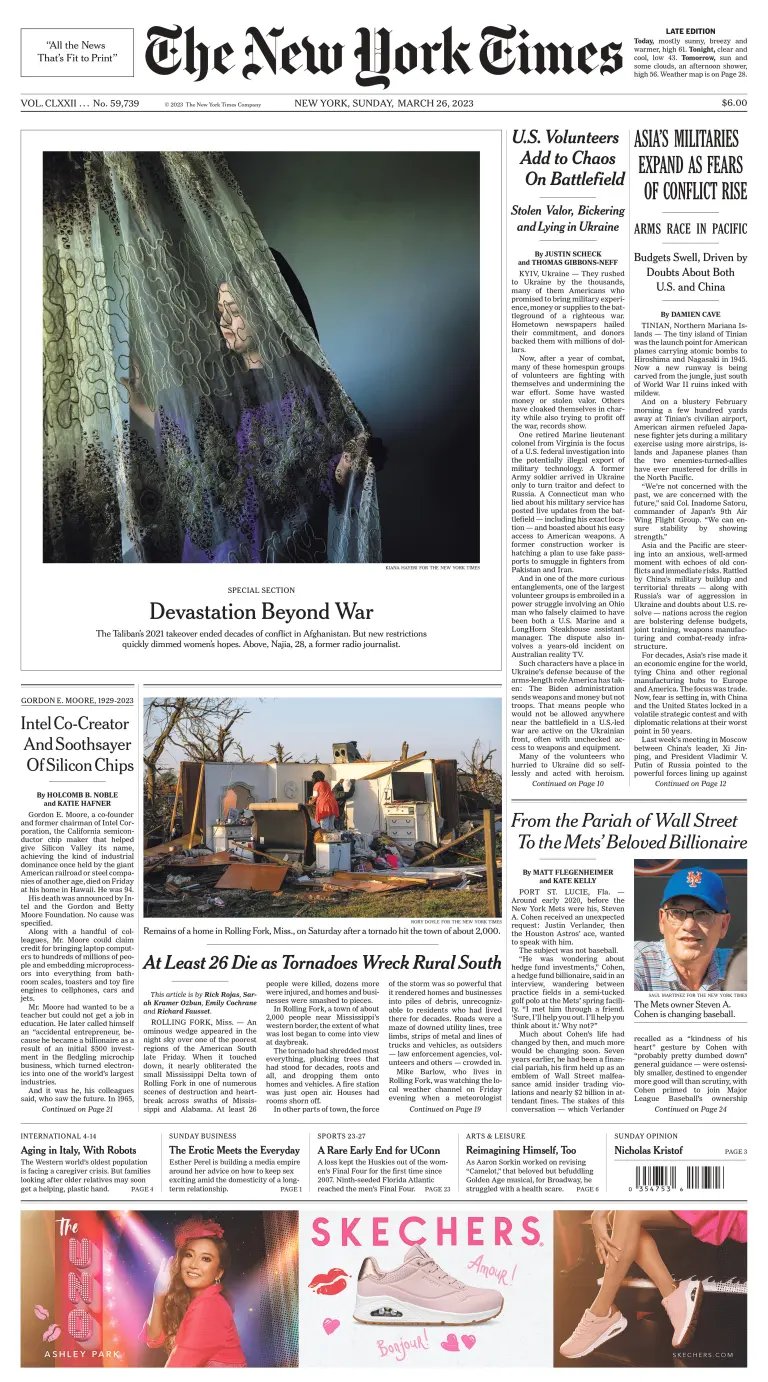
Front Page: The New York Times – March 26, 2023

Image

An Anxious Asia Arms for a War It Hopes to Prevent

Doubts about both China and the United States are driving an arms race in the Indo-Pacific with echoes of World War II and new levels of risk.

Stolen Valor: The U.S. Volunteers in Ukraine Who Lie, Waste and Bicker

Axel Vilhelmsen trained Ukrainian soldiers last year as part of the Mozart Group, which two former Marines established to help Ukraine. It disbanded after one founder sued the other, alleging theft and harassment.

People who would not be allowed anywhere near the battlefield in a U.S.-led war are active on the Ukrainian front, with ready access to American weapons.

Loss Piles on Loss for Afghan Women

The Taliban’s takeover ended decades of war. But their restrictions, and the economic fallout, threw many women into a new era of diminished hopes.

Steve Cohen’s Amazin’, Maddening, Money-Losing Bid to Own New York

Once a symbol of Wall Street excess, Cohen has invested lavishly in the Mets, becoming the most beloved billionaire in Queens. Is that enough to reverse team history?

Pangolins: The World’s Most Smuggled Animal

DW Documentary (March 25, 2023) – Pangolins, native to Asia and Africa, are threatened with extinction. Their meat is considered a delicacy in Africa and their scales are sold as a health remedy in Asia. The protected animals are poached and smuggled on a large scale.

Pangolins are the most smuggled animals in the world – and demand is growing. Asian pangolins recently made headlines when they were suspected of being carriers of the COVID-19 coronavirus. On the banks of the Congo River, the pangolin sells for just a few euros.

But in cities like Kinshasa, its meat sells for a hundred times that price and – although illegal – is eaten in the best restaurants. Even more profitable is the sale of pangolin scales, which are highly prized in Asia for their supposed medicinal properties. The native Asian pangolins are already nearly extinct.

The film shows how just a handful of these animals can be rescued during police raids, then reintroduced into the wild by dedicated conservationists. From hunters in the bush of the Democratic Republic of Congo to bushmeat markets to the backrooms of Vietnam, reporters follow pangolin smugglers as they ply their trade.

World Economic Forum: Top Stories- March 25, 2023

World Economic Forum (March 25, 2023) – This week’s top stories of the week include:


0:15 NASA launches space based pollution monitor – It’s called TEMPO, which stands for Tropospheric Emissions: Monitoring of Pollution. Built by Ball Aerospace, TEMPO will measure levels of major air pollutants every hour from a geostationary orbit 22,000 miles above the equator. It will monitor a huge region of North America from Canada’s oil sands in northern Alberta to below Mexico City at a resolution of up to 4 square miles. Air pollution poses a major threat to human and planetary health as 99% of the global population breathes air that exceeds WHO health guidelines. Air pollution carries a total economic cost of more than $8 trillion. Therefore, monitoring it is critical to understanding its impacts. Though TEMPO is due to launch in April 2023, watch to learn more about how it will monitor air pollution from space.

1:58 8 best countries for working women – The Economist ranked 29 OECD nations according to the role and influence of women in the workplace. Iceland scores well on numerous factors. From low childcare costs to education attainment for women to female representation at senior levels. At the current rate, it will take 132 years to close the global gender gap How does your country support women at work?

3:23 What is the polycrisis? – Today we are once again beset by seemingly unconnected crises. Such as the war in Ukraine, the climate crisis and the aftermath of COVID-19. “So economics, politics, geopolitics and then the natural environment blowing back at us – and those 4 things, they don’t reduce to a single common denominator. They don’t reduce to a single factor. And that’s why I think the polycrisis term has a real utility descriptively as much as anything else, because it’s kind of hand-waving, of course, it’s kind of arm waving. It’s going, look, there’s a lot of stuff happening here all at once. And that precisely is what we’re trying to wrap our minds around.”

6:54 Are Chatbots going to take our jobs? – “I get this question asked 10 times a week, which is that, look, is conversational AI going to take away jobs? And my consistent answer is no. And the best analogy I will give to you is banks and ATMs. So prior to the technology of ATMs, the most common reason why people would walk into a bank would be to take out money. So imagine there’s no ATMs and 90% of the reason why somebody goes inside the bank is to say, I need to take out some cash, I need to take out some money. As a result, you know, you and I don’t even remember these days, but banks used to be crowded. There used to be long lines and so on. Here comes the ATM, which automates really what should be a very simple task.”

_____________________________________________

The World Economic Forum is the International Organization for Public-Private Cooperation. The Forum engages the foremost political, business, cultural and other leaders of society to shape global, regional and industry agendas. We believe that progress happens by bringing together people from all walks of life who have the drive and the influence to make positive change.

News, Views and Reviews For The Intellectually Curious