Edinburgh’s Christmas Market has been named the best in Europe by National Geographic. The most famous and main Christmas Market in the city is located at Princes Street Gardens.
Edinburgh is Scotland’s compact, hilly capital. It has a medieval Old Town and elegant Georgian New Town with gardens and neoclassical buildings. Looming over the city is Edinburgh Castle, home to Scotland’s crown jewels and the Stone of Destiny, used in the coronation of Scottish rulers. Arthur’s Seat is an imposing peak in Holyrood Park with sweeping views, and Calton Hill is topped with monuments and memorials.
PBS NewsHour – New York Times columnist David Brooks and Washington Post associate editor Jonathan Capehart join Judy Woodruff to discuss the week in politics, including how a win in Georgia expands Democrats’ majority in the Senate despite the loss of a party member in Arizona and the release of wrongly detained basketball superstar Brittney Griner.
Papua New Guinea, in the southwestern Pacific, encompasses the eastern half of New Guinea and its offshore islands. A country of immense cultural and biological diversity, it’s known for its beaches and coral reefs. Inland are active volcanoes, granite Mt. Wilhelm, dense rainforest and hiking routes like the Kokoda Trail. There are also traditional tribal villages, many with their own languages.
World Economic Forum (December 9, 2022) – This week’s top stories of the week include:
0:15The world’s most expensive cities – This list of the most expensive cities is based Worldwide Cost of Living 2022 report that compares 200 products and services in more than 170 cities. Prices in big cities have risen by an average of 8.1% in the past year. Their fastest rise for 20 years. Driven by the knock-on effects of the pandemic and Russia’s invasion of Ukraine, some of these most expensive cities have high wages and taxes, while another has an average rent of about 92% of the median worker’s pre-tax salary. Watch to know which cities are the most expensive to live in.
1:36The era of the megalopolis has begun – Today 60% of people live in urban areas, and by 2100 it’s forecast to be 85%. We are entering the era of the megalopolis. Cities around the world are merging as they grow and spread, forming supercities connected by urban sprawl. The largest megalopolis is in China – it’s known as the Greater Bay Area. But what are megapolis?
2:53Scientists develop a universal flu vaccine – Scientists have developed a universal flu vaccine. It’s effective against all 20 known strains of flu and could help us fight off dangerous new strains before they develop into a pandemic. The new vaccine could be in use within 2 years.
3:53This device will heat our homes sustainably – Heat pumps run on electricity rather than fossil fuels and are 3 times more efficient than gas boilers. They capture thermal energy from the air outside and use that energy to warm your home.
Wall Street Journal – China’s first homegrown narrow-body jet is looking to compete with Western giants like Boeing. WSJ unpacks the design and technology of Comac’s C919 and the 737 MAX 8 to see how China’s deep reliance on foreign parts could stymie Beijing’s ambition to succeed.
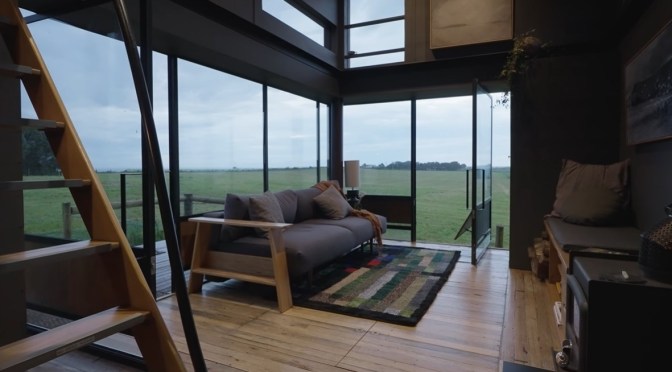
The Local Project – The Cutting by Small and Ample is a DIY pre-fab tiny home that encompasses sustainable living. Designed to shatter the idea that small homes cannot be generous, Aaron Shields, Director at Ample, and aspiring architect Nick Lane collaborate on The Cutting, a DIY pre-fab tiny home.
Video timeline: 00:00 – Introduction to the DIY Tiny Home 00:36 – The Brief – Small but Generous 00:54 – Situated on a Patch of Farmland with Views of The Cutting 01:11 – A Tour of the Tiny Home 02:30 – The Challenges in Designing a Small and Transportable Home 03:14 – A Reclaimed and Recycled Material Palette 03:35 – Textural Materiality 03:52 – The Aussie Shed
Promoting a better future with the idea that less is more, the designers have provoked others to think outside the box when crafting residential projects. Looking over The Cutting, an area where the sea cuts into the sand dunes, the home provides plentiful living within its 30 square meters. The house tour of the small home begins at arrival, with basalt pavers that lead up towards the DIY pre-fab tiny home. A set of steps – made from cow trough supports, reclaimed hardwood and perforated mesh salvaged from an old farm shed on the property – brings the occupants to the front door that pivots into the passive house.
Once inside, the kitchen, dining and living spaces are infused with warm timbers and bamstone cobbles, which together pare back the interior and tie the cabin into the surrounding landscape. At the south-western end of the DIY pre-fab tiny home, a double-glazed and steel window section with operable awnings allows for cross flow ventilation throughout the small home. Up on the mezzanine level, a study nook has been inserted into the floor and blurs the connection between upstairs and downstairs.
To cooperate with Victorian road rules, Aaron and Nick needed to design to specific dimensions in order to make the DIY pre-fab tiny home transportable. After collapsing the roof by 1500 millimetres, the small home can then be moved to its new location and settled on the land. With a hope to change the perception surrounding how homes can contribute to sustainability agendas, the designers use reclaimed materials. By doing so, every piece of furniture within the DIY pre-fab tiny home is built from reclaimed wood.
The floor is recycled iron bark, while many of the other timber elements have been sourced from other structures. Futhermore, the designers have championed the idea of the Australian shed with the use of timber and metal on the exterior, reflecting the history of the landscape. Overall, Aaron and Nick have created a modest home with an unexpected perceived spatial generosity that celebrates the value of materials.
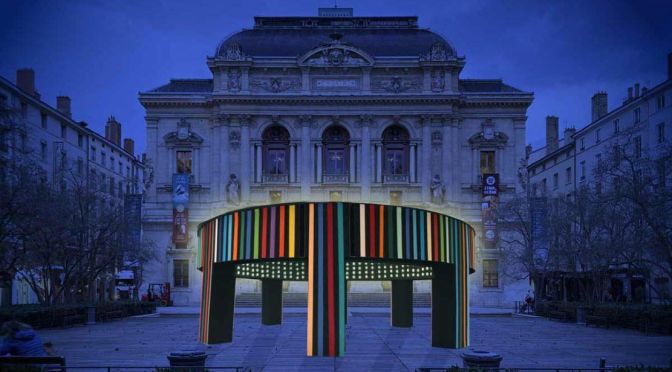
FRANCE 24 English – The annual Festival of Lights – a spectacular display of illuminations projected on historical monuments and public buildings across town – kicked off in Lyon in France this Thursday. But with Europe in the grip of an energy crisis, this year’s extravaganza has also been designed to use as little electricity as possible while still putting on a memorable show.
Travel and Adventure Studios (December 2022) – The wild jangling of bells, shaggy pelts, curved horns and terrifying masks: When Krampus and Perchten run down the street, growling, half dancing, half stamping, every single spectator is left just a little unsettled.
Krampus- and Perchten parades truly are an unforgettable experience, as much a part of Salzburg’s Christmas season as the famous Christkindlmarkt and the almost meditative Advent Singing. From the end of November until the beginning of December, you can also experience this unique folk custom in the City of Salzburg itself.
While no one would claim Perchten parades are peaceful, they will definitely leave you with lasting memories. An ancient tradition you can only experience in this part of the Alpine world.
The documentary film Slovenia Green presents Slovenia’s green story and, through the stories of locals, destination representatives, and tourism providers, tell viewers that Slovenia is a safe destination with a sustainable offer and unspoiled nature.
The film follows a cyclist on a Slovenia Green Gourmet Route, a cycling route created in 2021 in cooperation between the Slovenian Tourist Board and the Slovenia Green Consortium and the destinations it passes through. This route takes the cyclist among sustainable food providers in Slovenia from Ljubljana to Posočje, Goriška Brda, Vipava Valley, and Karst, and back through the capital to Sevnica, Podčetrtek, Ptuj, and Maribor. It takes place exclusively between destinations with the Slovenia Green Destination label – a label that recognizes destinations that pay particular attention to responsible tourism development and sufficiently meet the criteria of the international Green Destinations standard.
Film Director: Andro Kajzer, Matej Lavka & Miha F Kalan Production Company: Zveza Karata Film Client: Slovenian Tourist Board
Two million year-old DNA found in frozen soil has been sequenced, revealing a surprising picture of an ancient landscape. Extinct creatures including, unexpectedly, elephant-like mastadons turn out to be among the beasts roaming Greenland. Researcher Eske Willerslev explains how DNA found in the environment can be used to reconstruct the past as so-called ‘eDNA’ becomes a vital tool for palaeontologists.















 Boomers Daily