

According to Rakuten Intelligence, the cost of a ride from a ride-sharing app like Uber or Lyft increased 92% between January of 2018 and July of 2021. Many riders have also noticed increased wait times for rides, and a recent driver shortage is likely to blame. In early July 2021, Uber and Lyft drivers were about 40% below capacity. The companies have taken notice of this driver shortage, and are investing millions worth of bonuses and base rates to convince drivers to return. But will it be enough to get drivers back on the roads?
Category Archives: Technology

Views: Goat Herding With Drones & Smartphones In Inner Mongolia (Video)
Troubled by his missing goat, Hu-Chun, a herder living in the steppes of Inner Mongolia, embarks on a journey to bring Ghalatar back into the fold. With a smartphone in hand and a motorcycle as his faithful steed, Hu-Chun traverses the mountain and desert plains herding around 500 goats. As a college-educated man who has returned from the city to continue his family’s agricultural way of life, Hu-Chun is part of a new generation of Mongolian herders embracing technology and a traditional lifestyle. He has also installed a 360-degree camera on top of a hill to monitor the precipitous terrain surrounding his home… continue reading on https://o6g7.app.link/kCWWETUZ1ib

Analysis: How Moderna & Pfizer-BioNTech Created Vaccines In Record Time
The decision to pivot an entire business to focus on the coronavirus is an obvious one in hindsight, at least for Moderna, BioNTech and Pfizer, which succeeded beyond anyone’s expectations — and will reap billions of dollars in sales of their vaccines this year alone.
It wasn’t such a clear decision in the early months of 2020, though that’s when Moderna’s chief executive, Stephane Bancel, and BioNTech’s chief, Ugur Sahin, starting turning their ships, they told CNBC in interviews for this documentary about the vaccine race, produced by CNBC senior health and science reporter Meg Tirrell and senior digital producer Sam Rega.
“The night that China locked down Wuhan, I’m like: ‘When was the last time I know a city has been locked down because of an infectious disease?’” Bancel recalled. “And what goes through my mind is: what do the Chinese know that we don’t know?“ Bancel said he awoke sweating at 4 a.m., realizing, “Jeez, there’s going to be a pandemic like 1918.” For Sahin, it was reading a paper in the Lancet in late January describing the outbreak in China.
“I did a number of calculations, fast calculations, and realized it had already spread,” Sahin said. “And it was clear that it was already too late to stop the disease.” But he was convinced BioNTech, then focused mainly on personalized cancer therapies, may be able to do something. His company reached out to Pfizer, he said, proposing to work on a vaccine for the novel coronavirus using the same technology, messenger RNA, on which they’d already partnered to try to tackle the flu.
“We had the first contact a few days after starting the project,” Sahin said. “At that time, Pfizer was not yet interested.” Albert Bourla, Pfizer’s CEO, confirmed Sahin’s account, saying in the earliest months of 2020, he was focused on maintaining the company’s operations in China. But by late February, he said, he’d determined Pfizer needed to work on a treatment and a vaccine.
“What is the best approach?” Bourla said he asked his team. Kathrin Jansen, head of Pfizer’s vaccine research and development, said they assessed all existing technologies, including protein-based vaccines and vaccines using viral vectors. “They all have too few pros and too many cons,” she said.
But messenger RNA was a risk; it had never been used before as an approved vaccine or drug. “I wrestled a little bit with the decision,” Bourla said. But after another meeting with the team, “they convinced me.” That’s when Sahin called a second time. The outbreak, by that point, was already in New York, he said. Reaching Jansen, he described the work that BioNTech already had underway, and asked if Pfizer would like to work together. “And I said: absolutely,” Jansen remembered. “Let’s talk about this.”
At Moderna, it was never a question that messenger RNA would be the way forward; that was the technology around which the company was founded in 2010. But that didn’t mean questions didn’t exist. “Even going into March, there were voices that said vaccines were false hope,” recalled Dr. Stephen Hoge, Moderna’s president.
“It did feel for a period of time that we needed to defend even the idea of trying.” “When we were thinking about how do we get into Phase 1, what does it look like to prepare for a pandemic, the eyes of the world felt as though they were looking at Moderna as this biotech … ‘what are they trying to do?’” said Hamilton Bennett, Moderna’s senior director of vaccine access and partnerships.
“It was only when we transitioned in that March notification from the WHO that this was a global pandemic, it’s an emergency, that I think people started to realize that what we’re doing isn’t playing in a sandbox trying to demonstrate our technology,” Bennett said. “We’re developing a vaccine that’s going to stop the pandemic.” The companies succeeded, in what became one of the greatest medical races in history. Here, they recall how it happened.
Analysis: Is Hydrogen The Fuel Of The Future?
It’s been hailed as fuel of the future. Hydrogen is clean, flexible and energy efficient. But in practice there are huge hurdles to overcome before widespread adoption can be achieved.
Video timeline: 00:00 How hydrogen fuel is generated. 02:04 How hydrogen fuel could be used. 02:46 Why hydrogen fuel hasn’t taken off in the past. 03:40 Is hydrogen fuel safe? 04:31 Hydrogen’s advantage over batteries. 05:00 How sustainable is hydrogen fuel? 06:13 Why the hype about hydrogen may be different this time.

Views: The ‘MSG Sphere’ In Las Vegas Will Reshape The Entertainment Industry
The world-first spherical structure, containing the world’s largest and highest resolution LED screen that will not only transform the Las Vegas skyline, but quite literally reshape the live entertainment industry.
Since the days of Dean Martin and the Rat Pack in the 1960’s Las Vegas has been renowned for live entertainment and between showcase fights and residencies from Lady Gaga, Celine Dion, Britney Spears and Magic Mike the city is constantly raising the bar with what it has to offer.
Its latest offering, developed by Madison Square Garden Entertainment and located just off the strip behind the Venetian, is unlike anything anywhere else on Earth.
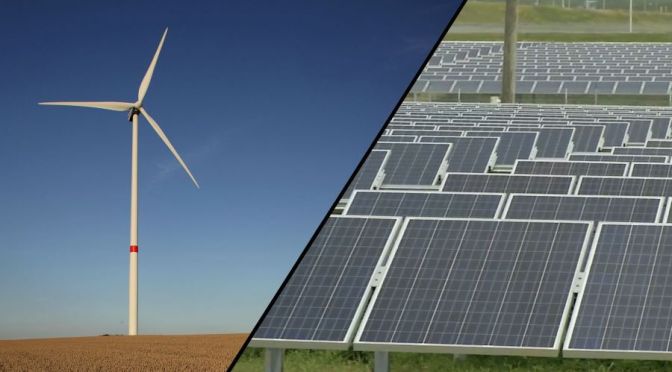
Renewable Energy: The Political Backlash (WSJ)
Political battles at the most local levels are slowing the pace of decarbonization Property owners in the windy and sunny parts of the U.S. are pushing back against large-scale renewable energy development, opposition that researchers say could slow the transition to a cleaner economy. Photo: Aaron Yoder/WSJ

Concept Camper Vans: Renault Electric ‘2022 Hippie Caviar Hotel’ (Video)

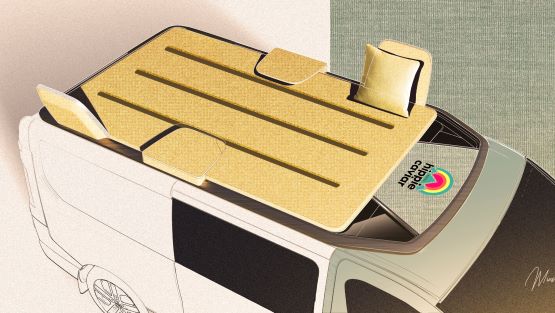

Traffic SpaceNomad: THE “READY-TO-GO” CAMPER. With its four or five seats and its compact size, the SpaceNomad can be used as a normal passenger car for everyday use.
▪ Renault resented at the CARAVAN SALON in Düsseldorf, All-new Trafic SpaceNomad will be added to the Renault catalogue at the beginning of 2022. After Switzerland, it will be marketed in five other European countries
▪ Converted by French campervan manufacturer Pilote, All-new Trafic SpaceNomad is available in two lengths with four or five seats. Its pop-up roof creates space for two large beds as well as a shower and kitchenette so travellers can set off on their journeys without having to worry about accommodations
▪ Renault will share its hippie-chic vision of the campervan with its Hippie Caviar Hotel show car, alongside the iconic Estafette campervan ▪ All-new SpaceClass Escapade and Master Campervan will complete the Renault offer at the Düsseldorf Motor Show
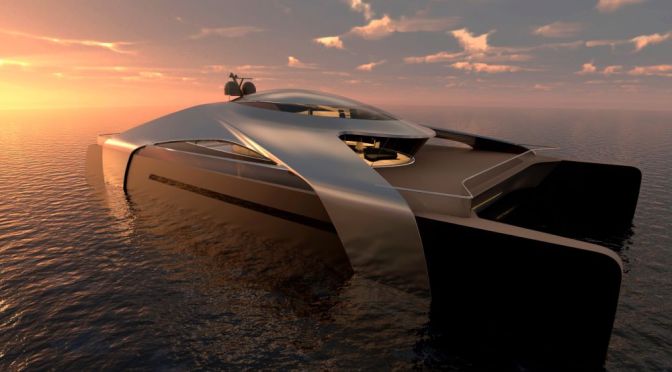
Design: Migma Hydrogen-Powered Catamaran By RUMA In Madrid, Spain

Migma is the greek word for mixture, an evocation to the life of the sea through structural bionic elements where the rationality of the technique is mixed with the fluidity of nature, represented by this noiseless Hydrogen-powered 180 feet electric Catamaran as a living entity that furrows the seas with zero emissions.





Migma catamaran is based on a minimalist and high-end aesthetic, creating a new way to understand spaces within a catamaran, where the core structure is located in the middle and all elements grow from it.
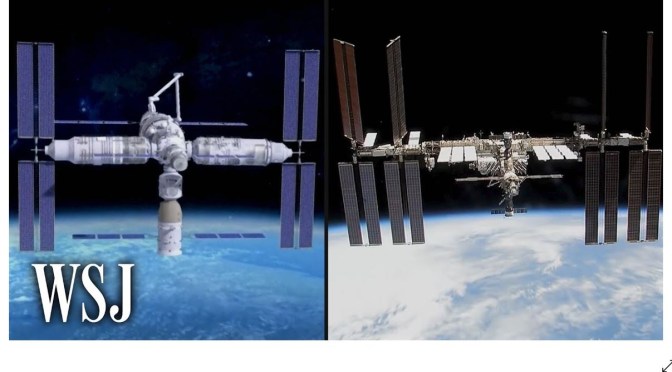
Tech Views: China’s New Modular Space Station
China says its spacecraft has more advanced technology. While the future of the nearly 23-year-old International Space Station remains uncertain after 2024, China says its newly equipped Tiangong station will be up and running by next year. WSJ unpacks the design and technology of both space stations. Photo: CCTV; NASA
 Boomers Daily