As pump prices for gasoline spin higher, a motorist could easily conclude that gas stations are making a killing—but our exclusive analysis finds that isn't the case. In this issue: pic.twitter.com/DwyqrQoC8C
Your July/August 2022 issue of BRITAIN is here, and there's much excitement in the air as time is up on the five-year restoration of Big Ben…get your copy here: https://t.co/f2L16XheEO
Big Ben, the world’s most famous clock has been under wraps for four years, its iconic bell silenced. This year, restored to its former glory, Big Ben once again shows its face.
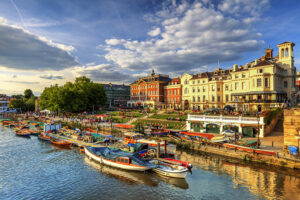
Between Richmond and Hampton Court is a storied stretch of the River Thames, whose banks are lined with grand houses, royal parks and Henry VIII’s favourite palace.
The promise and perils of a breakthrough in machine intelligence
Jun 9th 2022ShareGive
Picture a computer that could finish your sentences, using a better turn of phrase; or use a snatch of melody to compose music that sounds as if you wrote it (though you never would have); or solve a problem by creating hundreds of lines of computer code—leaving you to focus on something even harder. In a sense, that computer is merely the descendant of the power looms and steam engines that hastened the Industrial Revolution. But it also belongs to a new class of machine, because it grasps the symbols in language, music and programming and uses them in ways that seem creative. A bit like a human.
The “foundation models” that can do these things represent a breakthrough in artificial intelligence, or ai. They, too, promise a revolution, but this one will affect the high-status brainwork that the Industrial Revolution never touched. There are no guarantees about what lies ahead—after all, ai has stumbled in the past. But it is time to look at the promise and perils of the next big thing in machine intelligence.
The Casarabe people lived in southwest Amazonia around AD 500–1400, but understanding of this culture has been limited because the archaeological remains are covered in dense forest. In this week’s issue, Heiko Prümers and his colleagues reveal the discovery of new Casarabe settlements in the Bolivian Amazon. The researchers used lidar to scan the forest, revealing 2 large settlements (each covering more than 100 hectares) and 24 smaller sites, 15 of which had previously been known to exist.
The cover image shows Cotoca, one of the two large settlements, in which earthen mounds (one more than 20 metres high) and long causeways can clearly be seen. The team suggests that these results are the first evidence of agrarian-based, low-density urbanism in western Amazonia. They conclude that the region was not as sparsely populated in pre-Hispanic times as was previously thought.
Times Literary Supplement (TLS), June 10, 2022 – This week’s @TheTLS, featuring @ianground on Wittgenstein’s notebooks; @CaroDuttlinger on Kafka’s drawings; @wander2wonder on Budapest; Emily Barton on Mieko Kawakami; @sophieolive on fabric; @TobyLichtig on Jarvis Cocker – and more.
This year, events are taking place across the country to celebrate the 1,900th anniversary of the construction of Hadrian’s Wall (the eagle-eyed among you may have spotted that this most-famous Roman landmark has also featured, in some capacity, in every issue of CA since January).
This month our cover story considers whether the Romans too may have commemorated the Wall’s construction – and we also have an opinion piece asking how sure we can be about its date.
From monumental stonework to modern quarrying, we next head to Bedfordshire to learn about archaeological investigations at Black Cat Quarry, carried out before extraction works began on the site. There, excavations have revealed an impressive multi-period landscape, including Neolithic and Bronze Age settlements, a significant Roman farmstead, and what may be the remains of a Viking ‘fort’ referred to in the Anglo-Saxon Chronicle.
News, Views and Reviews For The Intellectually Curious














 Boomers Daily