

From a British Medical Journal (BMJ) online release:
 Although he had no pet birds, on closer questioning he had recently acquired a duvet and pillows containing feathers. His symptoms, chest radiograph and lung function tests improved after removal of all feather bedding, and he was also started on oral corticosteroid therapy. Our case reinforces the importance of taking a meticulous exposure history and asking about domestic bedding in patients with unexplained breathlessness. Prompt recognition and cessation of antigen exposure may prevent the development of irreversible lung fibrosis.
A 43-year-old non-smoker was referred with a 3-month history of malaise, fatigue and breathlessness. Blood avian precipitins were strongly positive. Lung function testing confirmed a restrictive pattern with impaired gas transfer. A ‘ground glass’ mosaic pattern was seen on CT imaging, suggestive of hypersensitivity pneumonitis.
Feather duvet lung (FDL), is an immunologically mediated form of hypersensitivity pneumonitis (HP), also sometimes called extrinsic allergic alveolitis. FDL is caused by inhalation of organic dust from duck or goose feathers found in duvets and pillows. Antigen inhalation triggers an immunological cascade, resulting in lung parenchymal inflammation. Repeated exposure may result in irreversible lung fibrosis.
To read more: https://casereports.bmj.com/content/12/11/e231237



 It started with a phone call. In a week, a scammer would take Nina Belis’s life savings. WSJ’s Sarah Krouse explains why robocalls persist: Because sometimes they work.
 Syndicated columnist Mark Shields and New York Times columnist David Brooks join Judy Woodruff to discuss the week in politics, including the biggest revelations and most compelling characters from impeachment hearings, whether they will change voters’ minds about impeachment, how 2020 Democrats performed in their fifth debate and President Trump’s moves on military justice.


 A third of the nurses who took the survey are baby boomers and 20% of survey takers said they planned to retire in the next five years. More than a quarter, 27%, said they were unlikely to be working at their current job in a year.


 You may have seen the aftermath of a landslide, driving along a twisty mountain road—a scattering of rocks and scree impinging on the pavement. And up until now, that’s pretty much how scientists have tracked landslides—roadside observations and spotty satellite images. Now, researchers are hoping to track landslides systematically by instrumenting an entire
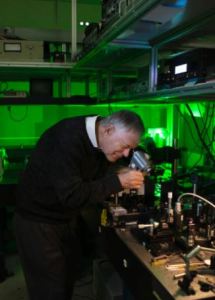 Byer also helped develop the quietest, most stable laser in the world, called the diode-pumped YAG laser. YAG lasers are today found in everything from communications satellites to green handheld laser pointers, which Byer co-developed with two of his graduate students and cites as one of his favorite inventions (he had joined Stanford in 1969). YAG lasers also form the main beams of the gravitational wave-detecting instrument, LIGO, which in 2015 achieved the most precise measurement ever made by humans when its antenna detected the tenuous spacetime fluctuations generated by two colliding black holes 1.3 billion light-years away.
 One summer morning in 1964, Byer drove the hour from Berkeley down to Mountain View for a job interview at a California company called Spectra Physics. He walked in to find an empty lobby but could hear clapping and cheering in the back of the building. After politely waiting for several minutes, he followed the commotion to a darkened room filled with men whose jubilant faces were illuminated by a rod of red-orange light that seemed to float above an instrument-strewn table
 A SELECTION of three essential articles read aloud from the latest issue of The Economist. This week, Hong Kong is not the only part of China’s periphery to resent
  Boomers Daily