
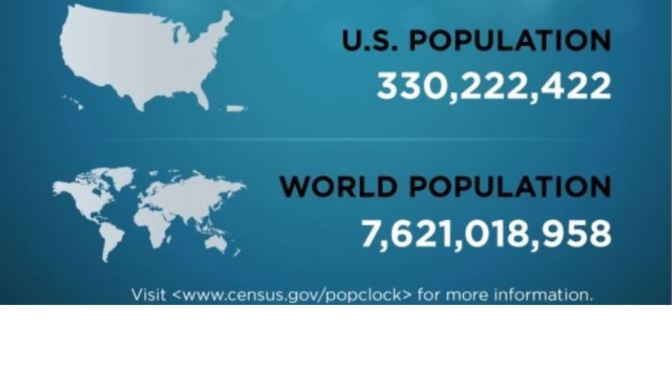
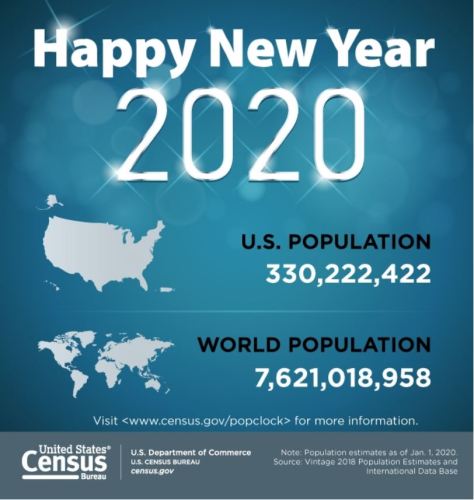
DEC. 30, 2019 — As the nation prepares to ring in the new year, the U.S. Census Bureau projects the U.S. population will be 330,222,422 on Jan. 1, 2020. This represents an increase of 1,991,085, or 0.61%, from New Year’s Day 2019. Since Census Day (April 1) 2010, the population has grown by 21,476,884 or 6.96%.
In January 2020, the United States is expected to experience one birth every eight seconds and one death every 11 seconds. Meanwhile, net international migration is expected to add one person to the U.S. population every 34 seconds. The combination of births, deaths and net international migration will increase the U.S. population by one person every 19 seconds.
The projected world population on Jan. 1, 2020, is 7,621,018,958, an increase of 77,684,873, or 1.03%, from New Year’s Day 2019. During January 2020, 4.3 births and 1.9 deaths are expected worldwide every second.
The Census Bureau’s U.S. and World Population Clock simulates real-time growth of the United States and world populations at <www.census.gov/popclock>.




 and Paris and collected work by artists such as Pablo Picasso, Joan Miró, and Georges Braque.


 With 11 protein options for its burgers (including salmon, lamb, falafel and dry-aged beef), two patty sizes and a host of toppings, Burgerim—which increased its unit count by nearly 250% in 2018 to become the country’s fastest-growing emerging chain—is upping the complexity of the traditional burger concept.


 Boomers Daily