

Against the World: Anti-Globalism and Mass Politics Between the World War

by Tara Zahra
In a timely and thought-provoking book, Zahra delves into the tumultuous years between World War I and World War II to argue that it was resistance to globalism and globalization that ended up weakening Europe’s then-fragile democracies, eventually contributing to the continent’s slide into dictatorship. READ THE REVIEW
Judgment at Tokyo: World War II on Trial and the Making of Modern Asia

by Gary Bass
Bass’s magnificent book, an account of the post–World War II Tokyo war-crimes trial, encourages a deeper understanding of the Asian experience of war and occupation. His work also sheds light on an enduring debate about liberalism and international politics, showing how the trial played formative roles both in postwar Asian politics and in the making of the postwar global human rights regime. READ THE REVIEW
The Crisis of Democratic Capitalism

by Martin Wolf
In a sophisticated and expansive account, Wolf, a veteran economics commentator, suggests that the root cause of today’s political and economic malaise lies in the breakdown of the relationship between capitalism and liberal democracy—and the failure of institutions to counter poverty and marginalization. READ THE REVIEW
Human Rights for Pragmatists: Social Power in Modern Times
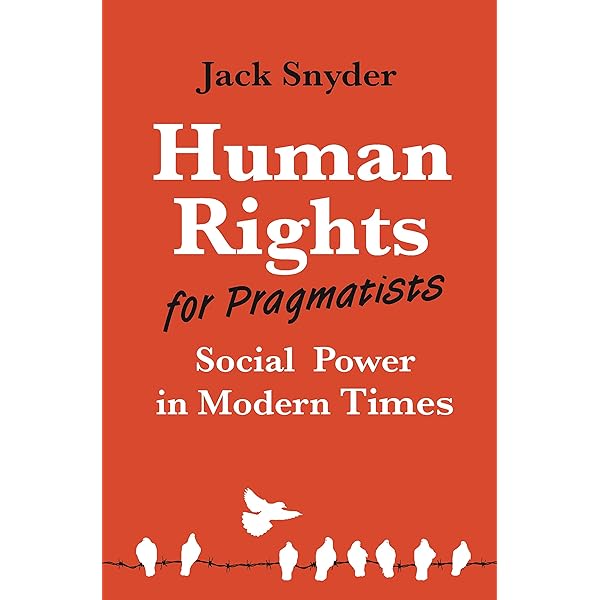
by Jack Snyder
In this masterful work, Snyder offers a bold explanation for why, how, and when societies make progress in expanding political rights and freedoms, arguing that breakthroughs occur when human rights serve the interests of a country’s dominant political coalition .READ THE REVIEW
Geopolitics and Democracy: The Western Liberal Order From Foundation to Fracture

by Peter Trubowitz and Brian Burgoon
Trubowitz and Burgoon argue in this groundbreaking study that the current backlash against the Western-led liberal international order can be traced to the 1990s, when the United States and European governments encouraged globalization at the expense of social and economic protections at home. READ THE REVIEW
The Project-State and Its Rivals: A New History of the Twentieth and Twenty-first Centuries

by Charles S. Maier
Moving beyond the standard account of the twentieth century as an epic struggle between democracy and autocracy, Maier examines how a wide range of actors tried to harness industrial modernity in the pursuit of power and material interests, weaving an alternative narrative about the explosive interplay of economic privilege and political grievance. READ THE REVIEW







 The Economist
 The Economist (September 11, 2023) – As the counter-offensive continues, Ukrainian forces are running out of time to make substantial gains. Diplomatic attempts to isolate Russia have failed and progress on the front lines is slowing. From the capital Kyiv,
 CNBC International
 Boomers Daily