
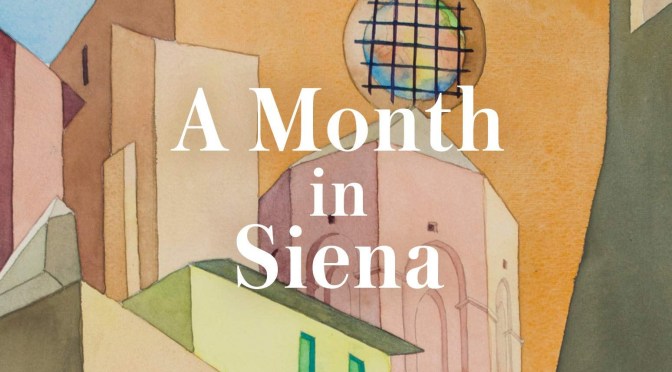
From a Penguin Random House release:
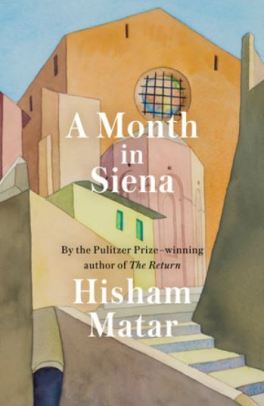 Including beautiful full-color reproductions of the artworks, A Month in Siena is about what occurred between Matar, those paintings, and the city. That month would be an extraordinary period in the writer’s life: an exploration of how art can console and disturb in equal measure, as well as an intimate encounter with a city and its inhabitants. This is a gorgeous meditation on how centuries-old art can illuminate our own inner landscape—current relationships, long-lasting love, grief, intimacy, and solitude—and shed further light on the present world around us.
From the Pulitzer Prize–winning author of The Return comes a profoundly moving contemplation of the relationship between art and life.
Listen to an excerpt below:
After finishing his powerful memoir The Return, Hisham Matar, seeking solace and pleasure, traveled to Siena, Italy. Always finding comfort and clarity in great art, Matar immersed himself in eight significant works from the Sienese School of painting, which flourished from the thirteenth to the fifteenth centuries. Artists he had admired throughout his life, including Duccio and Ambrogio Lorenzetti, evoke earlier engagements he’d had with works by Caravaggio and Poussin, and the personal experiences that surrounded those moments.
To read more: https://www.penguinrandomhouse.com/books/609913/a-month-in-siena-by-hisham-matar/

 In this gorgeously illustrated collection of airline route maps, Mark Ovenden and Maxwell Roberts look to the skies and transport readers to another time. Hundreds of images span a century of passenger flight, from the rudimentary trajectory of routes to the most intricately detailed birds-eye views of the land to be flown over. Advertisements for the first scheduled commercial passenger flights featured only a few destinations, with stunning views of the countryside and graphics of biplanes. As aviation took off, speed and mileage were trumpeted on bold posters featuring busy routes. Major airlines produced highly stylized illustrations of their global presence, establishing now-classic brands. With trendy and forward-looking designs, cartographers celebrated the coming together of different cultures and made the earth look ever smaller.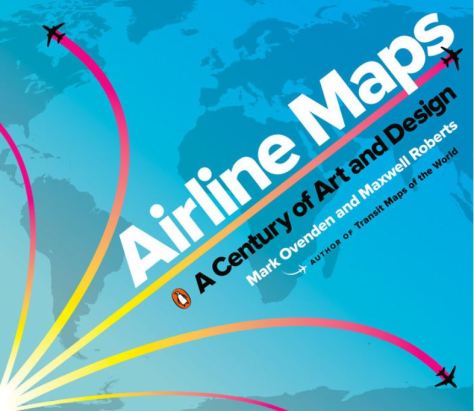

 “I suppose I started off with a fairly literal view of the world,” he says. “But, quite early on, it became clear to me that there was much more going on than simply the picture I was seeing; that the natural world had an agenda of its own; that it was going to live out life, regardless of how we viewed it and how we used it; and, indeed, regardless of the fancy metaphors that we used.”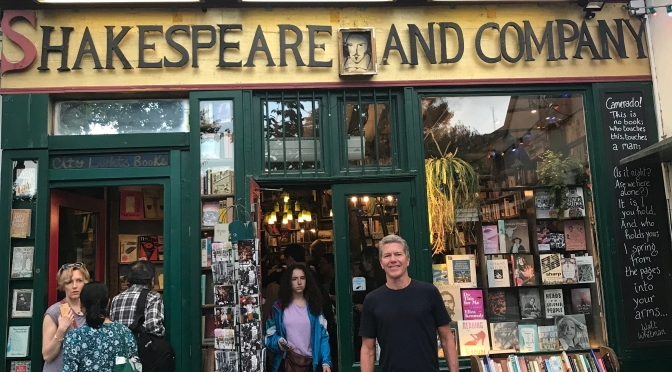
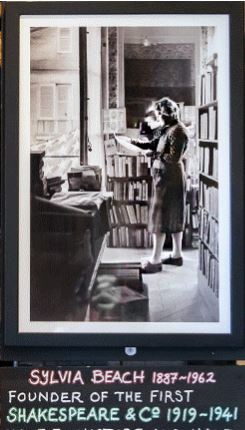 One hundred years ago this month, you opened the shutters of a small bookshop on rue Dupuytren. Its name was Shakespeare and Company. I often wonder if, on that first morning, you could ever have imagined how important your story would be.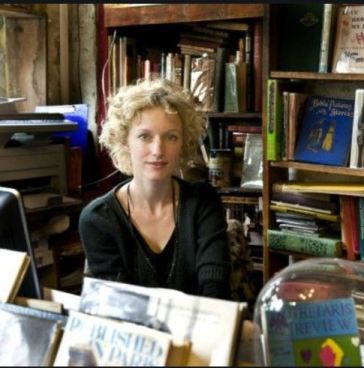


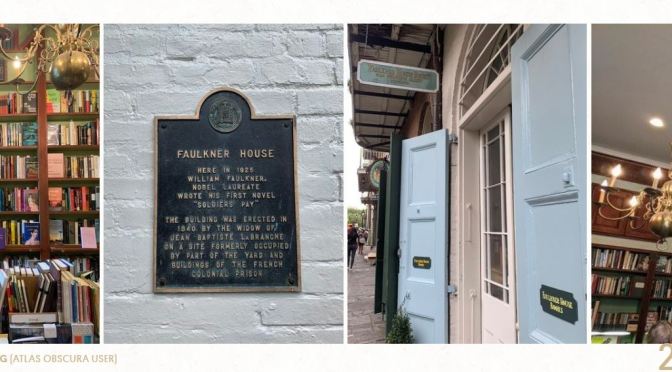
 Inside, the small store has a good selection of literary fiction ranging from classics to current publications. There is also a great selection of books about New Orleans and local culture. There is, of course, a dedicated area, almost shrine-like, for Faulkner’s works, and the shop owner will let you take a look at those more expensive books, “if you want to get in trouble with your wallet.”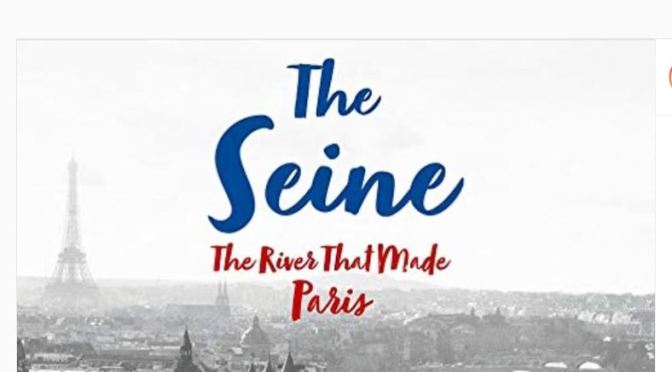
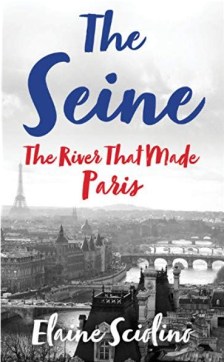 Sciolino’s keen eye and vivid prose bring the river to life as she discovers its origins on a remote plateau of Burgundy, where a pagan goddess healed pilgrims at an ancient temple. She follows the Seine to Le Havre, where it meets the sea. Braiding memoir, travelogue, and history through the Seine’s winding route, Sciolino offers a love letter to Paris and the river at its heart and invites readers to explore its magic.
 In “Unto This Last and Other Essays on Art and Political Economy” (1860), which gives the exhibition its title, Ruskin “sees” interconnected social injustices. He attacks economic inequality. Later, he sets out to establish a utopian community in working-class Sheffield, England. In one gallery we see his influence on “progressive thinkers worldwide.” Gandhi said that reading “Unto This Last” in 1904 transformed his life and ideas.
 ‘If you can paint one leaf,” John Ruskin once declared, “you can paint the world.” And in “Unto This Last: Two Hundred Years of John Ruskin”—the hypnotically potent (though flawed) exhibition at the Yale Center for British Art marking the bicentennial of his birth—we see how wonderfully he kept trying.
 The acclaimed biographer Edmund Morris
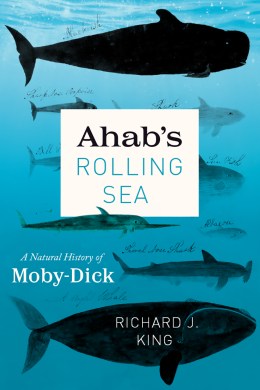 A revelation for Moby-Dick devotees and neophytes alike, Ahab’s Rolling Sea is a chronological journey through the natural history of Melville’s novel. From white whales to whale intelligence, giant squids, barnacles, albatross, and sharks, Richard J. King examines what Melville knew from his own experiences and the sources available to a reader in the mid-1800s, exploring how and why Melville might have twisted what was known to serve his fiction. King then climbs to the crow’s nest, setting Melville in the context of the American perception of the ocean in 1851—at the very start of the Industrial Revolution and just before the publication of On the Origin of Species.
  Boomers Daily