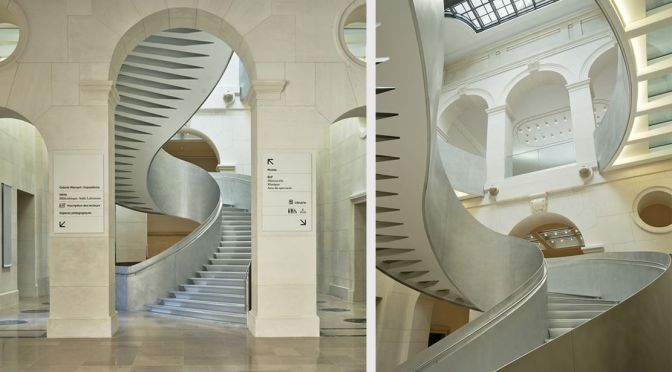
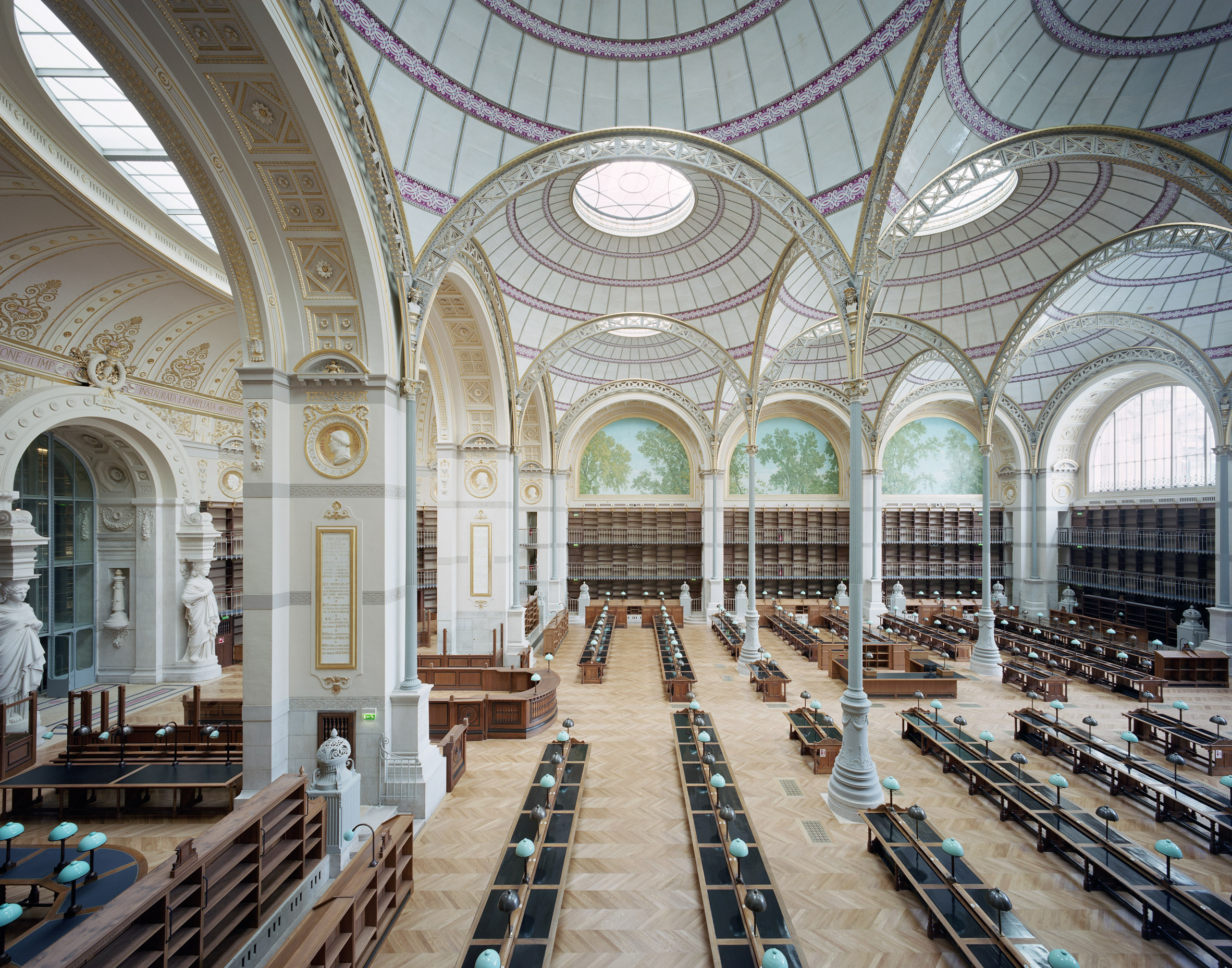

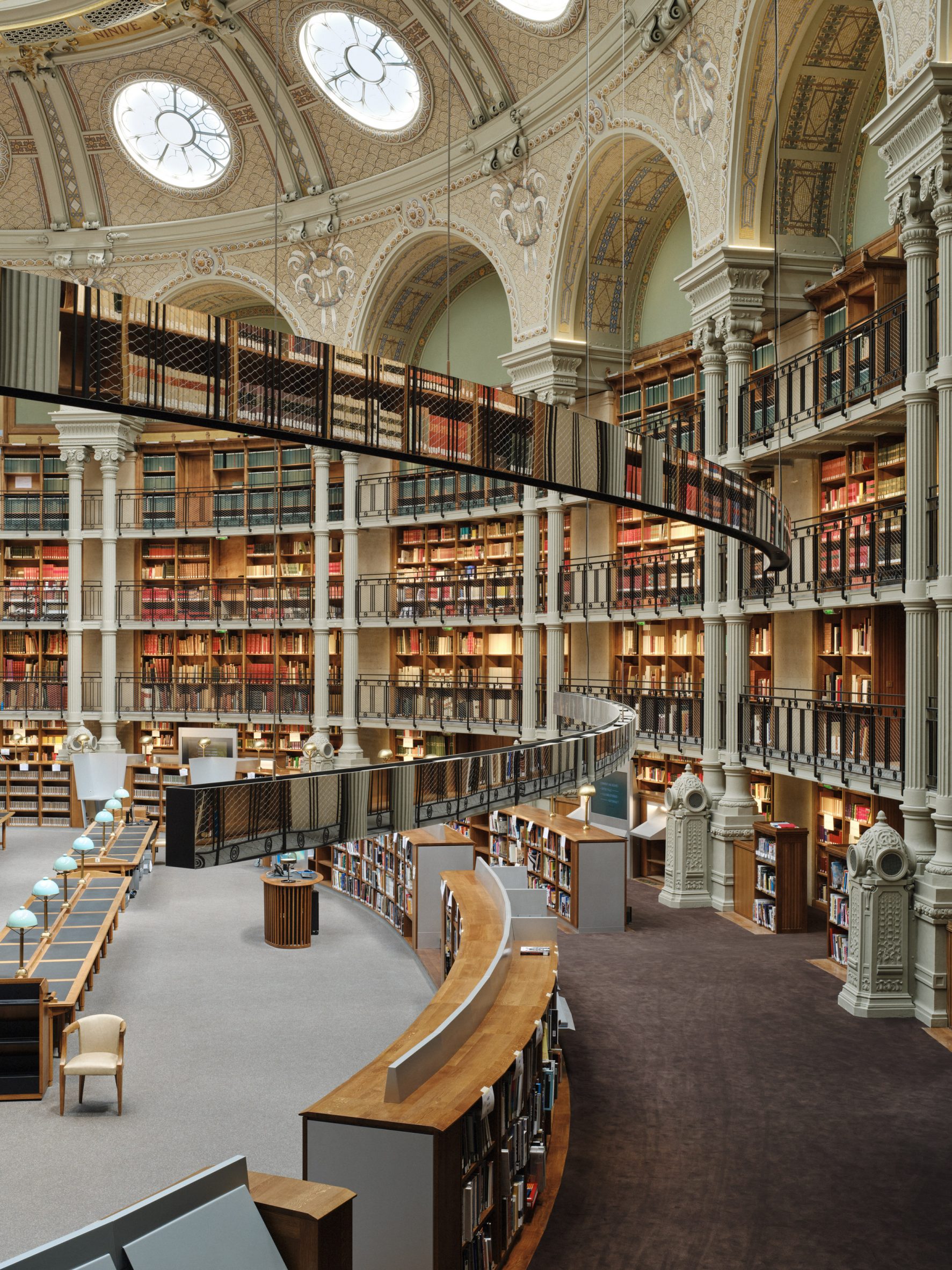
Completed in the late 19th century by architect Henri Labrouste, the library is considered a masterpiece of the Beaux Arts style, with vast, skylit reading rooms framed by slender steel columns and highly decorative arches.

Completed in the late 19th century by architect Henri Labrouste, the library is considered a masterpiece of the Beaux Arts style, with vast, skylit reading rooms framed by slender steel columns and highly decorative arches.
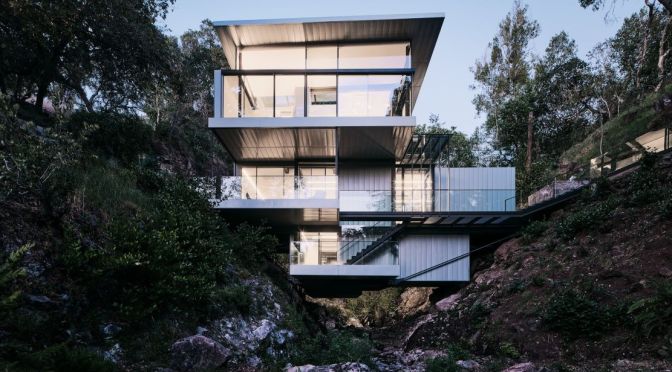
Suspended between two beautiful California hills, this remodel spans a creek and boasts a waterfall in the back yard.

To build such a house anew is no longer allowed in California, but following strict guidelines, we reconceived an existing structure, transforming the relationships between home, water and land. A steel frame inserted beneath the original floors anchors the home to the rocky hillsides, thus allowing us to remove supporting columns from within the creek bed.

A human-made object in nature may exist in harmony or disparity. Our goal was to deepen this home’s connection to the environment, creating a place where our clients can live immersed within an exceptional landscape. Taking care to protect and restore the land, we suspended the renovated house between two wooded hills, where it overlooks a rushing waterfall and spans the creek below.

A third floor addition strikes a more slender profile facing east, to engage the breadth of the site. The experience is one of being in nature and also humbled by it.

The goal with this unique site was to enhance the relationship of the structure to the nearby bodies of water and the rock face. Rather than bearing down and disturbing the creek below, the new structural system has been anchored to the bedrock within the flanks of the hill, suspending the home

From the history behind the towering art deco 30 Rockefeller Plaza to the iconic ice skating rink and smaller details you may not be aware of, come along as Adam explores and explains everything there is to know about Rockefeller Plaza.

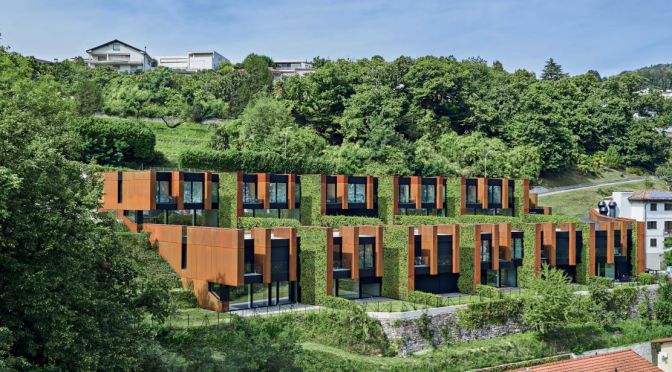
The architectural intervention is daring and aims at a harmonious connection with the surrounding space and landscape, without spoiling it; throughout plays of tension with shapes and insertion into the vegetation. In order to reach this goal, curved weathering steel blades are positioned so that, in perspective, they go beyond the woods in the south and direct the units and the view towards the lake. The radius of curvature is measured so that the sagitta of the chord of the circle doesn’t exceed 1 mm per linear metre, making thus the interiors furnishable and going back to a human scale, just like the dualism produced by Richard Serra’s sculptures.

Because of the steepness, we created two different blocks in order to further guarantee the view of the lake to the properties, divided by a system of main and secondary blades to create an internal and subordinate subdivision of the units. The insertion of the vegetation was inspired by New York’s High Line which scratches the pavement just like the blades do. This logic was transposed into our project both horizontally and vertically, thus the blades represent at the same time both a boundary and a bridge.


Video timeline: 00:00 – Introduction to the Extraordinary Garden Home 00:11 – The Architect’s Favourite Aspects 00:40 – A Queensland Location 01:08 – The Well-Travelled Clients and their Desire for Sub-Tropical Modern Architecture 01:26 – A Strong Form and Sense of Materiality 01:48 – A Walkthrough of the Home and its Materials 02:29 – The Spine of the Home 03:00 – The Owners 03:20 – A Response to Natural Light 03:39 – Accommodating for Entertaining 03:56 – Implementing Passive Design Principles 04:50 – Seeing the Clients Grow into the Home
Desiring a family home that was equal parts building and garden, the clients needed a home that could provide privacy and areas for entertaining. Handling the combination of public and private spaces with ease, the architect has also challenged the traditional entrance sequence of the home. From its exterior, Cove House strikes a formidable presence, yet with its singular floating plane roof and plant life,
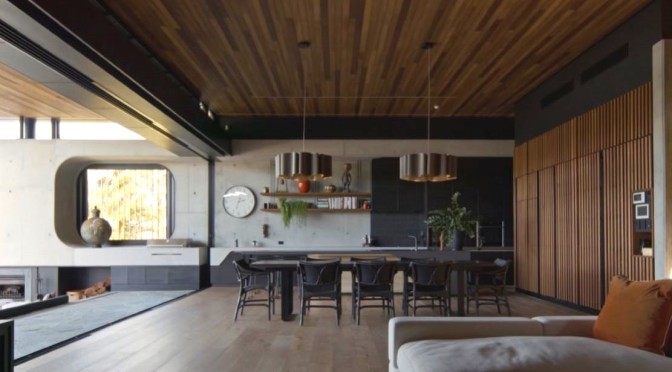
Cove House establishes itself as a modern architecture garden home. To create a modern architecture garden home, the architect has offset the concrete and dark tones of the exterior with warm timber battens to soften the entrance. Starting the house tour, the green landscape spine runs down the centre of the home, separating the public entry and the private living spaces. Additionally, the green spine guides guests towards the rear of the home, where the living and entertainment spaces are situated.
Contributing to the interior design of the Cove House, concrete and timber are combined to establish a flowing effect from outside in, honouring the client’s appreciation of climate-responsive materials and architecture. Answering the client’s love of boating and water, Cove House embraces open plan living and joins with the natural reserve, Coomera Island, which sits opposite the home. By opening the rear glass doors, the owners can increase the entertaining size onto the back deck and the passion pit – a curved lounging area that embraces outside living.
Providing the clients with a space to grow into, the modern architecture garden home also offers privacy from its neighbours on either side. Following critical passive design principles for the modern architecture garden home, the large roof-span provides wide-set eaves that protect from rain, provide deep shade during summer and curate cool breezes through the home. Additionally, the natural stone floor and concrete were employed as a thermal mass element to help regulate the home’s temperature all year round. As the house ages, Justin Humphrey Architects has specifically chosen the material palette to influence an alternative approach to address the natural climate setting.

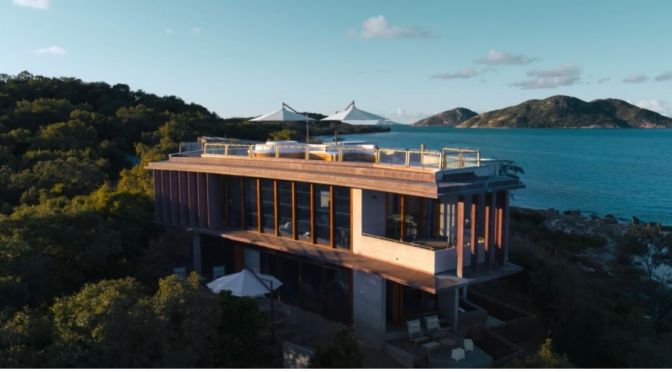
Lizard Island is an island on the Great Barrier Reef in Queensland, 1,624-kilometre northwest of Brisbane and part of the Lizard Island Group that also includes Palfrey Island. It is part of the Lizard Island National Park. Lizard Island is within the locality of Lizard in the Cook Shire.
Video timeline: 00:00 – Introduction to the Most Brilliant Architectural Home 00:26 – Playing with Light and Shadow 00:44 – Creating a Family Home 01:47 – Filtering Through the Concrete Shroud 02:00 – Views From Each Living Space 02:24 – The Original Brief 02:59 – A Quick but Complex Build 04:14 – Emulating A Sanctuary with Other Worldly Vibes 04:30 – The Skin of the Building 04:46 – A Balancing Act with The Materials 05:05 – Returning to the Project 05:26 – Proud Moments
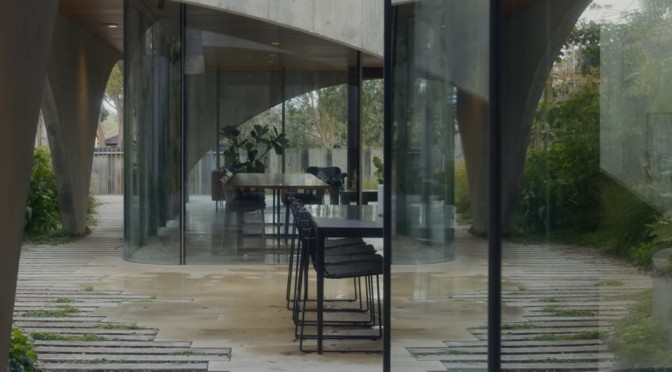
Over an 18-month building process, Flux Construction and Edition Office have created a house unlike other modern architectural homes. First seen from the outside, Hawthorn House appears as a monolithic structure yet, on the inside, the family home becomes a private sanctuary for its owners. Similar to other modern architectural homes, Hawthorn House suffered from lack of privacy in its suburban location.
To respond to this need, Edition Office has pushed the skin of the building out from the glass line, which allows for both privacy and the softening of light. Upstairs has been provided more privacy through light volumes, a structural choice between the buildings form and glass line that open up to the sky. Furthermore, the light volumes also provide advantageous views and the experience of seeing the seasons as they change.
Employing unique interior design choices that allow for ease of living, the architect and interior designer have configured downstairs as one singular platform. Offering different experiences, each living area has a differing focus. From the front pavilion, the homing in on the northern light and established lemon gum tree offers the owners a space to connect with their surrounds. Experienced in the more intimate rear pavilion, an inward focus of the home brings a soft and warming essence to the interior. Celebrating the structural form of modern architectural homes, Edition Office and Flux Construction operated with a concise approach when completing the house.
Through the connection of materials, the home is a celebration of concrete, timber and glass, which is observed immediately from the exterior shell. Equally as important as the home, the evolving landscape offers a place of cognitive restoration. With a mixed use of exotic species and natives, the green life helps to provide a comforting space that will continue to grow in place. Over the modern architectural home’s form, Edition Office has provided its clients with complete privacy through a humble material palette and lush landscaping.
Video timeline: 00:00 – Introduction to the Garden Home 00:26 – The Inner-City Location 01:14 – An Overview of the Home 01:49 – A Walkthrough of the Home 02:28 – The Key Brief of Garden Connection 02:50 – Original Timber Cottages 03:18 – Separation of Old and New 03:53 – The Kitchen 04:11 – A Seamless Integration of Fisher & Paykel 04:44 – The Fisher & Paykel Fit 05:16 – Key Materials 05:59 – A Connection of Texture and Detail 06:22 – The Connection Between Owner and Architect 06:59 – Proud Moments
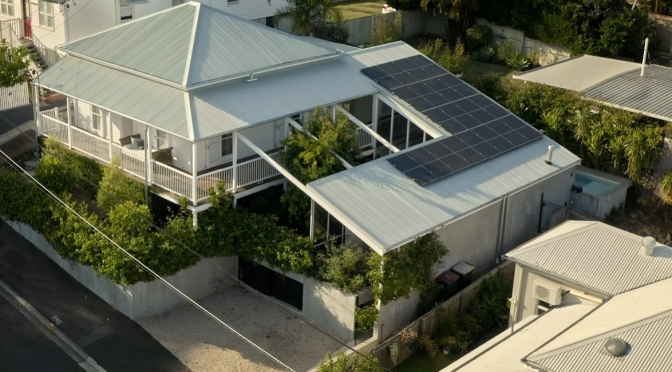
Working closely with Jacqueline, the architect avoided building underneath the home to keep the streetscape intact. Instead, John Ellway used the vacant land to the side of the original cottage to provide a much-needed extension that leans into the cascading landscape of the site. Found by the client, the cottage home was in a dilapidated state, though internally and structurally the house was in good condition with a much-needed update to accommodate the contemporary needs of the family.
After bringing John Ellway on board, Jacqueline expressed an aspiration to instil a feeling like that of living in a garden. Beginning the house tour from the parking area, the entry to the home opens to the kitchen, dining and living spaces. Immediately connecting to the gardens through large glass doors and windows, the house opens up onto a grass patch for the family to enjoy. Providing the space to embrace living in a garden, the grass patch also offers a private outdoor reprieve. Connecting the new extensions with the older parts of the cottage, a breezeway also adds another layer of connection to the garden.
The private rooms sit in the old section of the cottage, with the entertainment spaces confined to the new extensions. The home’s extended veranda instils the experience of living in a garden as occupants step into the new volume. Incorporating seamless connections throughout the architecture, John Ellway has made additional interior design choices in the kitchen, adding nooks and crannies to conceal appliances and ensuring the interior architecture is kept sleek and simple.
In the kitchen, Fisher & Paykel’s integrated appliances seamlessly blend into the joinery, providing a cohesive effect. Aside from aligning with budget and aesthetic desires, John Ellway used Fisher & Paykel to coincide with the broader context of the kitchen. Focused on using key materials to further assist with the idea of living in a garden, the client and architect chose plywood, brass countertops and polished concrete to foster a warm and natural connection. Together, John Ellway and Jacqueline work to combine finishes and textures to create an uplifted and refreshing home.

Video timeline: 00:00 – Introduction to the Wooden Cabin House 00:37 – The Meaning and History Behind Waikopua 01:17 – The Original Weatherboard Bach 01:48 – A Walkthrough of the Cabin House 02:15 – Establishing Relationships Between Architect and Builder 02:37 – A Reflection of the Beach 03:35 – A Special Customised Feature 03:54 – The Method Behind the Design 04:26 – Controlling the Light 04:51 – A Durable and Evolving Material Palette 05:35 – Dash’s Collaboration Method
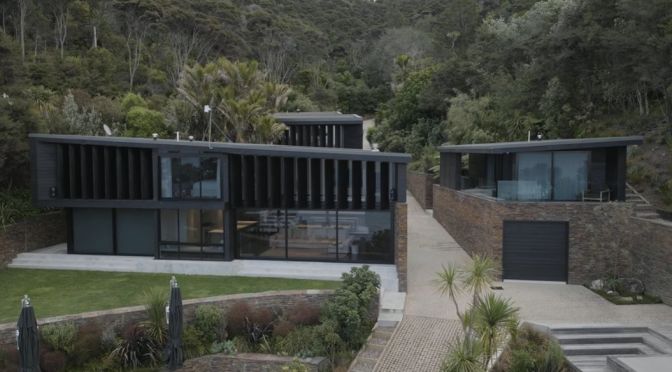
With architecture and interior design from Daniel Marshall Architects (DMA) and construction by Dash Build, Waikopua reinstalls a resilience through its built form and establishes a connection to the surrounding land. Originally a colonial farming site, DMA and Dash Build relay a connection to the site’s history by positioning the cabin house to embrace the green life that surrounds it.
Forming the design moving forward, the foliage and island landscape provide the basis for the modern and sculptural extensions of the home. Referencing the home’s previous iteration, the architect and builder have employed the same aluminium louvers and double-height space of the original home. With the consistency of interior design choices and detailing of weatherboards, a refined touch seamlessly transpires through each room and building.
Inspired by the idea of a campsite, the Waiheke Island cabin house takes the forms of separate accommodation units. The main pavilion houses the kitchen, living and dining rooms downstairs, whilst upstairs provides a shared bunk room and bedrooms that are detailed with honeyed timber accents to further relay the connection to the surrounds. Located just behind the main pavilions, the guest house is a separate living area, allowing for a sense of a privacy within the campsite-inspired layout. Nestled between the main pavilions, a weatherboard and concrete deck allows for an informal gathering space where guests can relax and enjoy the island life.
From entrance, the driveway becomes the focal point, used as both a guide for guests and allowing for unencumbered sightlines down to the ocean. To embrace natural light, DMA and Dash Build employed elements upon the exterior of the home to harness the changing sunlight. Able to be admired from sea, large louvered fins have been fixed at a set angle to stop the harsher light of day from coming in and provide the owners a space of reprieve.
Moreover, the materials used upon the exterior have been selected for durability against the intense environment of salt spray and the changing weather. From the black weatherboards that blend with the fauna to the tiles that reference the surrounding rockface, Waikopua by DMA and Dash Build evolves and further embeds itself into the landscape over time.


Charles Jencks and Maggie Keswick | Anupama Kundoo | Margarete Schütte-Lihotzky | João Batista Vilanova Artigas | Laurie Simmons | Kochi Architects Studio | Ekar Architects | Atelier Tho.A | Chat Architects | Fernanda Canales Arquitectura | Brillhart Architecture
Very few people have the resources to realise the house of their dreams, yet the results can be extraordinary. From the London home of Charles Jencks and Maggie Keswick, which is a manifestation of their postmodern fantasies, to the local materials and construction techniques of Anupama Kundoo’s Wall House in Auroville, this issue revisits houses designed by architects for themselves, and sometimes their families. Also celebrated are the winning projects of the 2022 AR House Awards, featuring innovative and intriguing dwellings from Mexico, Japan, Thailand, Vietnam and the Bahamas.



 Boomers Daily