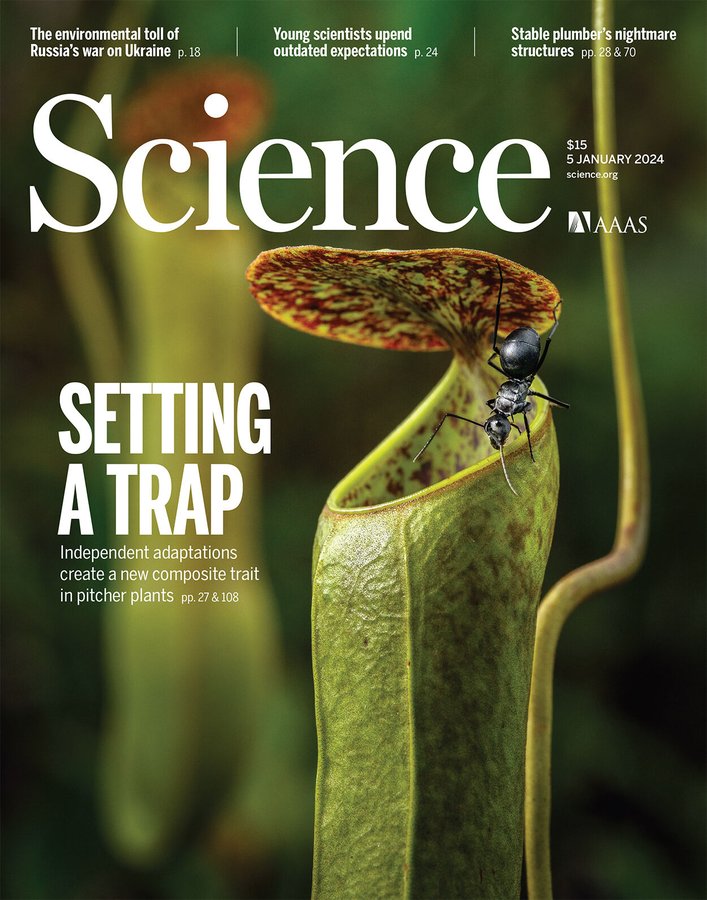
Science Magazine – December 21, 2023: The new issue featuresa carnivorous Nepenthes gracilis pitcher plant luring an ant into a precarious position under the roof-like trap lid.
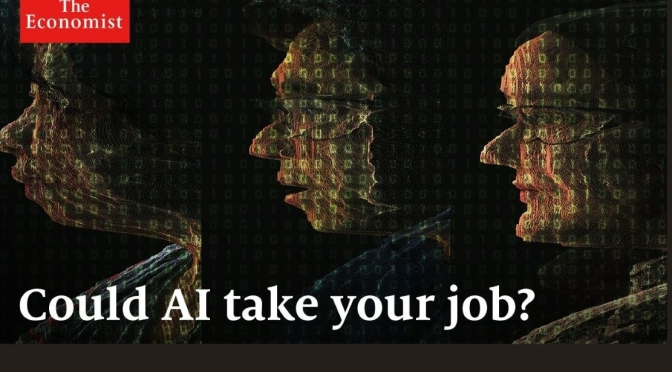
The Economist (January 4, 2024) – A new wave of artificial intelligence is starting to transform the way the entertainment industry operates. Who will be the winners and losers?
Video timeline: 01:07 AI is changing the music business 04:09 How big data revolutionised entertainment industries 05:20 Can AI predict a film’s success? 09:26 How generative AI is creating new opportunities 12:36 What are the risks of generative AI?
Louisiana Channel (January 4, 2024) – When writing, Joyce Carol Oates writes about people, often about a family, because “the family unit to me is like the nexus of all emotion, and people derive their meaning from the position in families,” she says.
Video timeline:0:00 On preferred subjects for writing 3:20 On Karen Blixen /Isak Dinesen 4:24 On families 6:54 On the mother figure 9:00 On the novel ‘Babysitter’ 17:27 On the novel ‘Night. Sleep. Death. And the Stars’ 22:48 How traveling resembles writing 28:47 On Donald Trump
“What is so exciting about the novel is that it mimics life and that you end up doing something you never thought you would do,” says Joyce Carol Oates, one of America’s greatest living novelists, when looking back on a life of writing.
It might be a violent event or something politically relevant, or it could be a racist experience that sets off a novel. In her storytelling, Oates finds it interesting to focus on girls at the beginning of puberty: “There’s a kind of wonderful neutrality of childhood that gets conditioned out when girls get to be 12 – 14 years old. And then, from that point on, when they’re so shaped by what we call the male gaze and the expectations of others that they grow into being someone who is this female image.”
But today, the family is very different and there are all kinds of families: “There are families of same-sex couples who got married and they may adopt a child or they may have a child of their own, but then there may be families that are like communes where people are living, sharing a house, but they are a family and they may have dogs and cats who know who they are. […] The so-called nuclear family – which is just a father, mother, and children – still exists, of course, but it’s not the only example of any longer, which is wonderful. It all begins with the emancipation of women”, Joyce Carol Oates concludes.
Oates feels attracted to writing because writing is storytelling and “what’s interesting about storytelling is that you have to have revelations. That you start off with a situation, and a little bit of a mystery evolves, and then you have to follow the tendrils and the roots of that mystery, like an investigator. And then there has to be a revelation.” This means that Oates focuses a lot in her writing on the pacing and the suspense and the movement, like “how long is a paragraph, how short is the dialogue, and how much dialogue is there in proportion to the exposition, and the craftsman side of writing is actually where many people write.“
The Economist Magazine (January 4, 2024): The latest issue features‘The man supposed to stop Donald Trump is an unpopular 81-year-old; Israel-Hizbullah – Can war be avoided?; The stakes in Taiwan’s election; An interview with Volodymyr Zelensky; The surge in AI nationalism…
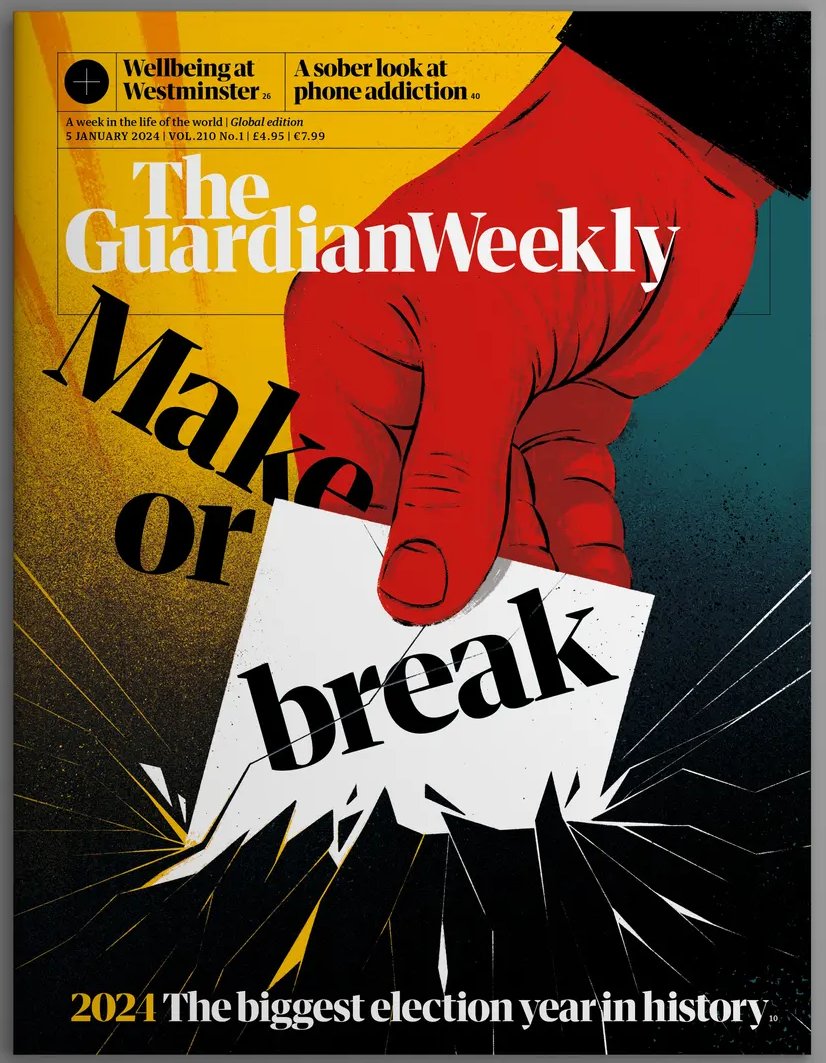
About 2 billion people have the opportunity to cast their ballots in polls that span the globe from the United States to Taiwan, and India to Mexico in 2024. The outcomes, as our analysts and correspondents explain in our big story, have implications for us all.
Washington bureau chief David Smith looks at the likely rerun of 2020’s Biden v Trump contest in November and explores what has changed and what has not in the US as the old adversaries square up. It is an almost foregone conclusion that Narendra Modi will be back for a third term as Indian prime minster, reports Hannah Ellis-Petersen from Delhi where analysts fear his victory will further imperil the country’s Muslim minority. And while Vladimir Putin will certainly continue as president in Russia, Pjotr Sauer explains why the man about to become fifth-time president might allow other candidates onto the ballot list. From Taiwan’s poll on 13 January to the 27-state European elections in June, how citizens vote will influence the geopolitical landscape for us all, while the conduct of campaigns will reveal how vulnerable democracies now are to misinformation and cyber interference from malign actors.
The Globalist Podcast (January 4, 2024) – The latest on Iran following the cancellation of president Ebrahim Raisi’s trip to Turkey and discuss the US decision to reopen border crossings with Mexico.
Plus: the release of the explosive Epstein papers and business news with economist Vicky Pryce.
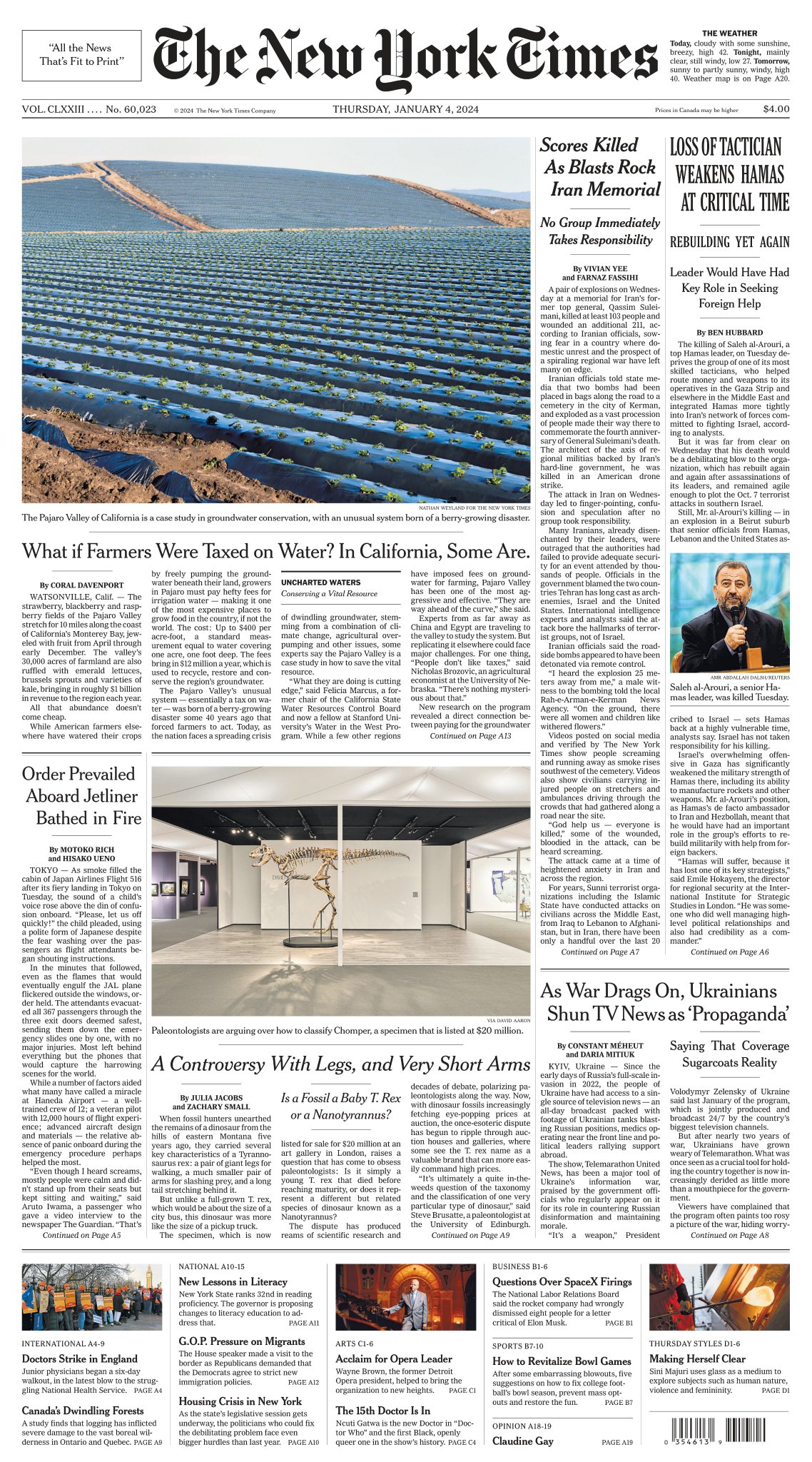
The killing of Saleh al-Arouri, a key Hamas strategist, in Lebanon sets the organization back at a vulnerable time. The group has rebuilt after the assassination of other leaders, though.
With aquifers nationwide in dangerous decline, one part of California has tried essentially taxing groundwater. New research shows it’s working.
‘It’s State Propaganda’: Ukrainians Shun TV News as War Drags on
A government-approved news program intended to counter Russian disinformation and boost morale is coming under criticism for painting a rosy picture of the war.
News, Views and Reviews For The Intellectually Curious














 Boomers Daily