Tag Archives: Tours

Tours: Fisherman’s House, Parramatta River, Sydney

Sitting on the edge of Parramatta River, Fisherman’s House is a unique underground home with a sense of the unexpected. Without revealing all at once, the waterfront house is a unique underground home by Studio Prineas that instils moments of awe within every level.

Video Timeline: 00:00 – Introduction to the Underground Home 00:30 – The Waterfront Location of the Home 00:45 – The Original Timber Cottage 01:04 – A Minimalistic View On Arrival 01:35 – A Longstanding Friendship Between Architect and Client 02:05 – Working with an Open Design Brief for the Home 02:33 – The Original Steel Cladding 02:46 – Restoring and Reusing Original Materials from the House 03:28 – Careful Contrast of the New Wing to The Cottage 04:08 – Taking Pride in Preservation and Creation 04:30 – The Swimming Pool

Fisherman’s House is one of the last remaining timber cottages in the area that sits nine metres below the road, hidden from the public eye and offering a serene escape from the city. The client – an engineer and family friend of the architects – delivered an open design brief and sense of freedom for Studio Prineas to organically explore what the unique underground home could become.

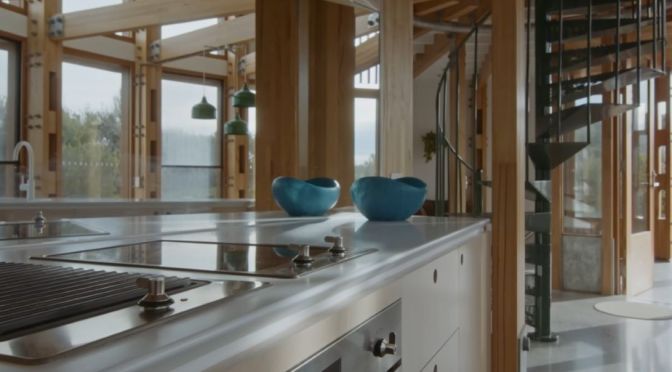
The main desire for the client was to have the living spaces facing the water; while there was no desire to keep the original cottage, this was something that Studio Prineas knew they needed to maintain. Throughout the restoration process, removing previous cladding revealed the original weather boards underneath; inside the home, the original timber flooring and lining boards were saved to bring back the lightness of the architecture. With waterfront views from the kitchen, living and dining spaces and entertainment deck, the interior design of the original cottage defers from the new wing.

Additionally, the glazed link is a vertical connection from the original cottage to the private living spaces above. From the lightness of the timber cottage below, the upper levels speak to the rockface behind whilst offering a more grounded appearance with darker timbers. Employing concrete ceilings with rough sawn Oregon formworks that brought a timber look and imprint on the concrete, Studio Prineas established a differentiating space that still feels connected through minute details.

Conserving the history of the cottage whilst creating a contemporary unique underground home for the clients, Studio Prineas were able to embody many design ideas that they have been establishing over many years. As one of the more memorable aspects, the pool acts as one of the last additions of the unique underground home. Unexpected and holding much of the original cottage’s history, the pool offers an enchanting place to sit and watch as the sun sets over the home.
Travel Guides: Summer & Winter In Lake Tahoe (4K)

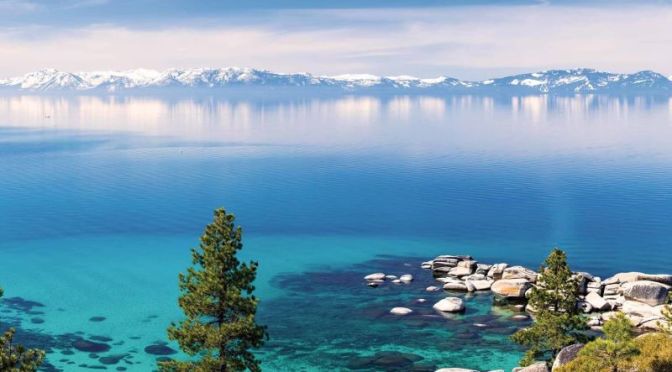
Lake Tahoe is a large freshwater lake in the Sierra Nevada Mountains, straddling the border of California and Nevada. It’s known for its beaches and ski resorts.

Video timeline: South Lake Tahoe(4:45), Emerald Bay(16:25), Meeks Bay(18:15), Homewood(19:10), Tahoe City(19:43), Truckee(20:29), Tahoe Vista(21:48), Kings Beach(22:12), Crystal Bay, NV(23:22), Incline Village(24:01), Sand Harbor(26:23)

On the southwest shore, Emerald Bay State Park contains the 1929 Nordic-style mansion Vikingsholm. Along the lake’s northeast side, Lake Tahoe Nevada State Park includes Sand Harbor Beach and Spooner Lake, a gateway to the long-distance Tahoe Rim Trail.

Tours: St. Andrews Beach House, Victoria, Australia

St Andrews Beach House is a holiday cabin by Austin Maynard Architects informed by a passion for sustainability. The circular cabin captures sunlight and breezes while allowing nature to regrow healthily around it. The flat roof captures water for the gardens and bathrooms. Sustainable materials include timber, double glazed windows and a concrete slab contributing thermal mass to the cabin.

Video timeline: 00:00 – Introduction to St Andrews Beach House 00:37 – The Beachside Location 01:04 – The Vision Behind The House 01:24 – Taking Inspiration From New Zealand Bach’s 01:57 – A Bach Type Layout 02:16 – Sustainably Small But Mighty 02:55 – A Carbon Storage Home 03:08 – Conditional Timber Selections 03:45 – The Importance of Sunlight 04:15 – The Positives of A Circular Home 04:38 – A Demountable Home 05:16 – Proud Moments In Designing and Creating The Home

Additionally, a heat pump system heats the water and the slab, keeping the house warm during the winter. Locally sourced eucalypt timber ensures the cabin can stand against time and the coastal elements. It also contributes to the cabin’s sustainability, capturing of carbon instead of producing it. The material is used inside as well, continuing both the warm, raw aesthetic and the sustainability benefits throughout.

Designed as one structural module repeated 26 times around, the efficiency of the cabin’s construction was optimised. It is also made to be demountable, so that clients are able to either dismantle or salvage the materials for another build in future, if needed. With the importance of sunlight stressed in the brief, large louvre doors were installed to allow light to flood through, and on days when the weather is blossoming, the doors can be opened to connect the deck with the living and dining areas of the cabin.

Due to its circular structure, the beach side cabin can capture or exclude the breeze whenever there is a need, and, as the spiral staircase in the centre leads up the private bedroom spaces, circulation of air and sun can continue around the entire cabin. With a playful and sustainable rationale, St Andrews Beach House is a home away from home that gives back to the surrounding land.

Walks: The Iguazú Falls In Northern Argentina (4K)

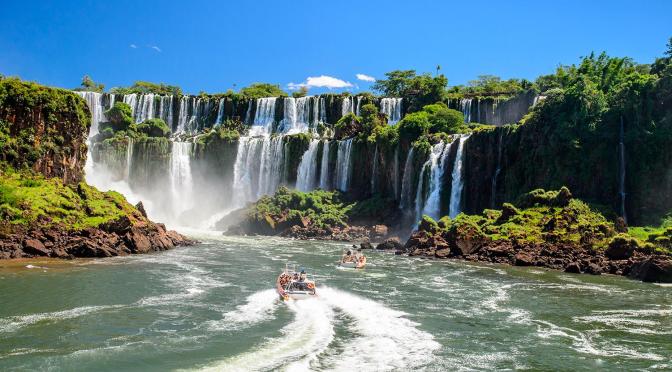
This is a walk in Iguazu Falls, in the province of Misiones in Northern Argentina. This video was recorded in the Devil’s throat.

The Iguazu National Park consists of two national parks, one in Foz de Iguazu (Brazil) and the other one in Puerto Iguazu (Argentina). The curious thing is that although one only sees the falls as the main attraction, the park has a size of 252,982 hectares (67,720 on the Argentine side and 185,262 on the Brazilian side).

These falls in Argentina and Brazil managed to attract so much attention that almost at the same time they were declared National Parks (1934 in Argentina and 1939 in Brazil). And after some years and millions of visitors fascinated by the landscape and the sound of this natural attraction, UNESCO declared them as World Heritage Site in 1984, and reaffirmed as Exceptional Universal Value (their cultural and nature it’s so important that it’s conservation should be of worldwide interest) in 2013.

Exhibits: ‘Edvard Munch – A Poem of Life, Love and Death’ (Musée d’Orsay)

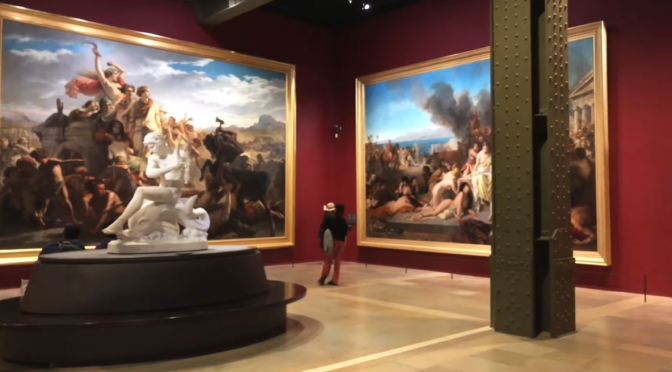
In collaboration with the Munch Museum in Oslo, the Musée d’Orsay is devoting an exhibition to the famous Norwegian painter Edvard Munch (1863-1944), whose work, in all its breadth – sixty years of creation – and complexity, remains partly unknown.

Munch’s work occupies a pivotal place in artistic modernity. It has its roots in the 19th century and would find its place firmly in the next one. Moreover, his entire work is permeated by a singular vision of the world, giving it a powerful symbolist dimension that is not limited to the few masterpieces he created in the 1890s. Moving beyond fin-de-siècle symbolism, Munch transcended this movement beyond its peak to make it the backbone of his work, giving it its great coherence.

Filmed on October 2, 2022.

Tours: Cliffhanger House In Toowoomba, Australia

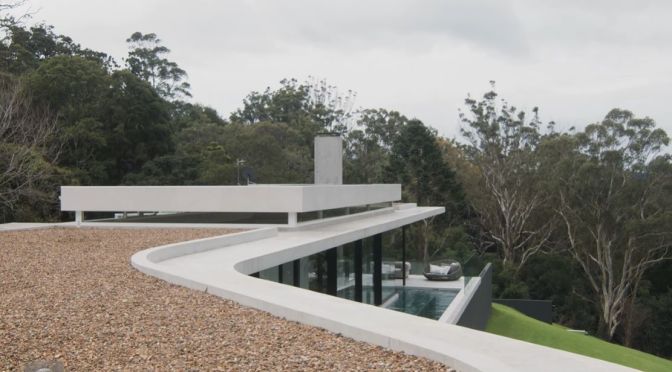
Evoking grandiosity through carefully considered sharp points and rounded edges, the concrete super house by Joe Adsett Architects offers unrivalled views of Toowoomba’s sweeping landscape. Creating a piece of architecture that was befitting of the location and striking natural landscape,

Video timeline: 00:00 – A Welcome to Cliffhanger House 00:36 – The Location of the Super House 00:46 – Building On The Edge of A Landslide Zone 01:36 – Arriving At The Site 02:00 – The Vitrocsa Glazing Suite 02:40 – A Seamless Flow From Kitchen to Outdoors 03:00 – An Extension of The Main Living Area 03:14 – The Material Palette 03:52 – Emulating The Architecture Through Furniture 04:17 – Designing Weather Flexible Houses 04:41 – The Challenging Aspect of The Cantilever

Vitrocsa collaborated with Joe Adsett Architects to produce the concrete super house that fully embraced its location. Balancing at the very top of the site, the concrete super house offers views from East of Brisbane toward Picnic Point and Table Top Mountain. Whilst the home’s location is situated over a ridge, Joe Adsett Architects endeavoured to create more space by cantilevering away from the slope.

By projecting part of the concrete super house out from the built space, the ability to create a more functional living space with privacy from surrounding neighbours arose. Arriving at the concrete super house, the gaze is immediately ensnared by the curving concrete wall that cantilevers away from the base of the home. With the garage underneath the house offering one way of entrance, it is the curved pathway leading to the deliberately oversized glass pivot door that is the striking entrance of the home.

Working with Vitrocsa to create the glazing for the home, the frame of the windows was done with a slender aluminium product comprised of reinforced stainless steel. Made in Australia and designed to Swiss specifications, the framing offers unbroken views of the surrounding landscape whilst also bringing a seamless indoor-outdoor flow into the home. With restrained materials used across the exterior architecture, the interior design choices also reflect the primary theme of the concrete super house.

Softened with veneered timber products and large porcelain tiles, curves and sharp points are repeated through the joinery elements. Furthermore, the furnishings also introduce soft textures and colours that bring a humanising element to the concrete super house.

Architecture: Wallaroo Residence Tour, Canberra

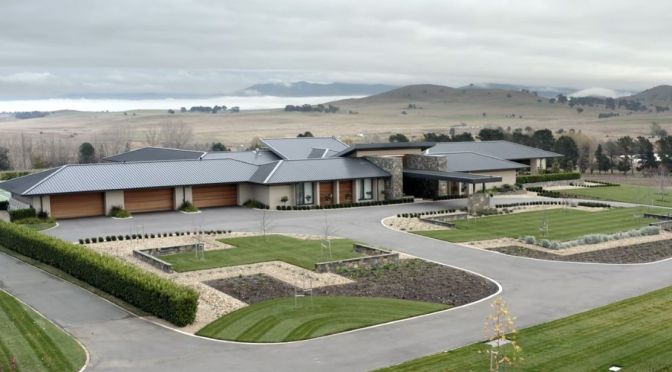
In touch with a vast rural landscape, Wallaroo Residence rises from atop one of Canberra’s many slopes. Crafted by DNA Architects, the modern farmhouse gently weaves natural elements into its modern expression, emerging as a place of retreat.

Video timeline: 00:00 – Introduction to theModern Farmhouse 00:35 – Hitting The Brief 01:10 – A Walkthrough of the House 01:47 – The Key Architectural Features 02:23 – Navigating The Weather Elements 02:44 – Separation Between The Family and The Entertaining Areas 02:55 – The Contemporary Kitchen 03:41 – A Focus On Sustainability 04:24 – The Modern Farmhouse Aesthetic 04:52 – The Architects Favourite Part of The Home

Settled on the edge of Canberra, Wallaroo Residence follows a design brief readily assigned to DNA Architects. The luxury home presents as a modern farmhouse, a concept first proposed by its traditional pitched roof and then explored within an interior of considered materials maturely applied. Aggrandising the entrance of the modern farmhouse, a floating porte-cochère leads on to an impressive set of glass doors. Internally, a timber-clad kitchen sits to the east of the arrival space, beyond which lies the family living room.

From there, the residence separates into the laundry room and master suite which offers unobstructed southern views. Along the back wall of the kitchen, Fisher & Paykel DishDrawers are effortlessly integrated into both the wall itself and the adorning joinery. On the kitchen island, a Full Surface Fisher & Paykel Induction Hob satisfies the desire for sustainable living and enables multiple pans to be warmed at once.

In the laundry room, large capacity Fisher & Paykel Washer Dryers inject a sense of efficiency into the modern farmhouse. Embracing its unique perspective, Wallaroo Residence testifies to the ongoing appeal of a city escape. With inhered functionality and a contemporary aesthetic, the modern farmhouse represents a distinguished interpretation of rural luxury.

2022 Museum Tours: Musée d’Orsay In Paris, France

Musée d’Orsay, (French: “Orsay Museum”) national museum of fine and applied arts in Paris that features work mainly from France between 1848 and 1914. Its collection includes painting, sculpture, photography, and decorative arts and boasts such iconic works as Gustave Courbet’s The Artist’s Studio (1854–55), Édouard Manet’s Le Déjeuner sur l’herbe (1863; Luncheon on the Grass), and Pierre-Auguste Renoir’s Dance at Le Moulin de la Galette (1876; Bal du moulin de la Galette).

The Musée d’Orsay is housed in the former Gare d’Orsay, a railway station and hotel that was designed by Victor Laloux and located on the Left Bank of the Seine River opposite the Tuileries Gardens. At the time of its completion in 1900, the building featured an ornate Beaux Arts façade, while its interior boasted metal construction, passenger elevators, and electric rails.

Because of changes in railway technology, however, the station soon became outdated and was largely vacant by the 1970s. Talks to transform the builing into an art museum began early in the decade and were finalized in 1977 through the initiative of Pres. Valéry Giscard d’Estaing. With government funds, the building was restored and remodeled in the early 1980s by ACT architecture group.

The interior was designed by Gaetana Aulenti, who created a complex layout of galleries that occupied three main levels surrounding the atrium beneath the building’s iconic iron-and-glass barrel vault. On the ground floor, formerly the building’s train platforms, extensive stone structures broke up the cavernous space and created a central nave for the sculpture collection and gallery spaces for painting and decorative arts.

Views: Tour Of Top Secret ‘CIA Museum’ In Virginia

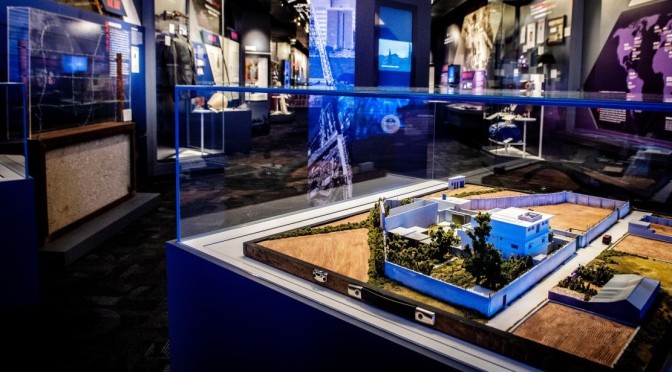
The CIA museum is perhaps the most unusual – and exclusive – in the world. Located inside the US intelligence agency’s headquarters in Langley, Virginia, the museum has just been renovated to mark the agency’s 75th anniversary. Official visitors can see the gun found with Osama bin Laden when he was killed, next to Saddam Hussein’s leather jacket. Its doors are firmly shut to the public, but a small group of journalists, including the BBC, were given exclusive access inside.