Tag Archives: Poems

THE CAFÉ OF ECHOES

At Caffè Florian, a poet rehearses silence, quarrels with Ruskin, and dines with memory.

By Michael Cummins, Editor, September 2, 2025

In the autumn of 1883, Robert Browning arrived in Venice not as a poet seeking inspiration, but as a man rehearsing his own silence. He was seventy-one, celebrated in England yet still dogged by the charge of obscurity, more famous abroad for Elizabeth’s immortal sonnets than for his own labyrinths. This essay is not fact but speculation, not history but atmosphere: Browning imagined at his table in Caffè Florian, where mirrors, velvet, and silence conspired with memory to become his final stage.

The boat nudged the dock like a hesitant thought. Browning stepped off with the stiffness of age and the grace of habit. The air smelled of brine and stone, of centuries folded into mist. He paused, cane in hand, and looked toward the dome of the Salute—its silhouette a question mark against the morning haze. Seventy-one years weighted his shoulders, but he stood upright, as though irony itself were a brace. The vaporetto pulled away, its wake dissolving into green silk. He had no luggage beyond a notebook and the ghosts already crowding his mind.

The fog is not weather—it is thought. It thickens, withdraws, curls back upon itself. Even in this cup before me it lingers: caffè corretto, black cut with brandy, bitter and sweet as a line half-finished. Florian is dim at this hour, its velvet walls inhaling the echoes of centuries. Mirrors multiply the room into infinity. Each reflection a fragment of me: old, young, diminished, fractured. A poet made a kaleidoscope.

Byron once sat here, Goethe scribbled here, conspirators whispered “Viva San Marco!” in the Sala del Senato. Today I sit, ordering polenta e schie—shrimp fried in brine—and the taste is lagoon, memory, salt. A plate of amaretti arrives, sugared consolation. The waiter suggests biscotti di mandorla as well, almonds crushed into sweetness. I chew slowly. The polenta is soft, golden, humble—like memory softened by time. The schie, tiny survivors of the lagoon, taste of endurance. Amaretti crumble like old letters, sugared on the outside, hollow at the core. The coffee, thick as ink, stains the tongue with bitterness and clarity. Florian does not serve meals; it serves metaphors.

Across the square, Quadri blazes with chandeliers, an operatic stage flattering the surface. Florian is darker, more inward. Its light is borrowed, its silences long. Quadri is performance for an audience. Florian is monologue.

I open my notebook: Ruskin, copied lines from The Stones of Venice. His voice has been my reluctant companion for thirty years. “We may live without her, and worship without her, but we cannot remember without her.” John, always the preacher. He carved morality into marble, turned buttresses into sermons. For him, Venice’s decline was sin. For me, decline is theatre. To remember is not to repent but to perform again. Memory is rehearsal.

The waiter refills my cup. The brandy sharpens thought, steadies irony. I recall my own lines from A Toccata of Galuppi’s:

As for Venice and her people, merely born to bloom and drop,
Here on earth they bore their fruitage, mirth and folly were the crop.

I scolded them then. How Puritan I was. Sitting now at Florian, I envy them. Folly is not failure; it is fruit. Who begrudges the bloom because it falls?

A German couple at the next table mutter Goethe. Their syllables stumble in Venetian air. A waiter tells a French traveler that Byron loved their zabaglione. A young woman sketches the gilded lamp above the doorway, her graphite smudged. She glances at me: “Are you a writer?” “No,” I reply, “a reader of ruins.” She frowns, puzzled. Youth believes silence means emptiness.

Elizabeth drifts through the mirrors. Her eyes catch mine across the velvet gloom. She wrote of Florence in Casa Guidi Windows, calling for liberty. She saw windows; I see walls. She opened; I enclosed. She is remembered for love, I for irony.

Her voice returns in my By the Fire-Side:

Oh, moment one and infinite!
The water slips o’er stock and stone;
The West is tender, yet the night
So soon must veil it, mine alone.

The water slips even now beneath the piazza stones. Tenderness yields to night. And yet—even absence is mine.

I once watched her read Petrarch aloud at Casa Guidi, her voice trembling with belief. She said poetry must lift. I said it must dig. We never resolved it. But in Venice, I hear her voice lifting still, even as I dig. I imagine writing a letter to her, one I will never send: My dearest Ba, Florian multiplies us in its mirrors. You see eternity; I see fragments. You spoke love; I speak echoes. And still, together, we wrote scaffolding for survival.

Ruskin appears across the table, severe, ascetic, with eyes that drill into conscience. He clears his throat: “The first cause of the fall of Venice was her falsehood.” He gestures to Florian’s mirrors. “Deceit multiplied.”

I answer: “John, is not poetry falsehood? Have I not spoken through murderers and monks, adulterers and judges? Masks, every one. But tell me—was the mask less true than the face?”

He insists: “Gothic is the expression of a Christian people, the confession of their faith in the work of their hands.”

I sip. “Faith, carved into cornices, labor engraved in stone. And what has it left us? Ruins. Whereas the Renaissance, with all its duplicity, left us colour, flourish, theatre. I prefer a glowing lie to a tedious truth.”

Ruskin frowns: “The Lamp of Truth must burn in every arch.”

“Truth burns, yes,” I reply, “but it also blinds. Give me the lamp of illusion, John. It casts longer shadows.”

I remember reading Ruskin aloud to Elizabeth once, in Florence, when his Seven Lamps of Architecture was still fresh. She had shaken her head. “He sees sermons in stone,” she said. “I see spirit in breath.” We argued half the night, she quoting Casa Guidi Windows, I muttering that breath is nothing without scaffolding. And here I sit now, scaffolding without breath.

The waiter brings another plate, sets down biscotti di mandorla. Ruskin fades into the mirror. I smile. I have won the debate by eating.

But another ghost sidles into Florian: Byron, lounging with rakish ease, boots muddy from some clandestine canal adventure. He leans back, laughing: “Browning, you scold folly, yet you envy it. Admit it—you envy me.” I do. I envied him once, his thunder, his immediate grip on the world. Venice loved his scandal, his Don Juan verses written between embraces. I admired the music, the power, the theatricality, even as I recoiled from his flamboyance. He used Venice as a symbol of faded grandeur, of moral ambiguity. And have I not done the same, though with less applause? “You were lightning,” I tell him. “I am only the echo.” He winks. “Echoes last longer than thunder.”

And Shelley, gentler, spectral, drifts in too. He never lodged here long—only passed through—but his lyricism breathed Italy. I remember writing Pauline, my first confession of a poet’s soul, under his influence. Shelley gave me metaphysics tuned to music, ideals sung into air. I once wrote a short poem, Memorabilia, about shaking hands with a man who had known him. Imagine—that thrill of proximity! Shelley’s ghost leans toward me now, whispering: “Poetry must lift, Robert, even from ruins.” His words tremble like a lyre string.

I admire Shelley still, though I turned away from his idealism. He lifted; I dug. He soared; I performed. And yet, I cannot deny: his fusion of thought and song shaped me as much as Byron’s theatre. Byron gave me thunder, Shelley gave me music. Elizabeth gave me breath. Ruskin gave me quarrel. And Venice—Venice gives me echo.

I recall In a Gondola, my youthful play with passion:

The soul of music slumbers in the shell
Till waked and kindled by the master’s spell.

How earnest I was. I believed love eternal, dramatised into permanence. Now I know better. Love is architectural. It leaves ruins. One walks among them—not grateful for permanence, but for echo.

The young artist glances at me again, and this time she sketches my hand—gnarled, ink-stained, resting on the cup. I wonder what she sees. Not the poet, surely. Perhaps only a ruin worth recording. Perhaps only another relic of Venice.

Florian’s velvet breathes of centuries. The Sala del Senato still hums with 1848, Daniele Manin declaring the Republic of San Marco. I imagine their whispers lingering, “Viva San Marco!” clinging to the mirrors. Byron’s laughter, Shelley’s sighs, Casanova’s schemes, Goldoni’s wit—all still staged. The velvet absorbs nothing; it amplifies.

Outside, the piazza fills with orchestras. From Florian, a waltz in minor key, introspective, precise, like Strauss slowed by melancholy. From Quadri across the stones, a polka, bright, frivolous, Offenbach reborn in defiance. The melodies clash above San Marco. Venice plays both scores at once, refusing to choose between tragedy and farce.

I attempt a stanza in my head to match their duel, half-jesting, half-serious:

One side mourns with violins, one side laughs with brass,
Yet both belong to Venice, as shadow and mirror pass.
I sit between the melodies, cane planted, glass in hand,
Hearing waltz and polka argue what I cannot command.

The waiter sets down another caffè corretto. I trace the rim of the cup, whisper fragments that may form another book. A line half aloud:

One who never turned his back but marched breast forward,
Never doubted clouds would break…

I know better. Clouds often do not break. Yet I say it still. Faith is not in triumph, but in endurance.

Elizabeth’s ghost leans across the table, chiding gently. She opened windows, I enclosed walls. She gave hope; I gave puzzles. She left sonnets; I left monologues. She is love’s voice; I am irony’s echo. Together we were scaffold and soul. Alone, I am scaffold only.

The German couple departs, their voices swallowed by velvet. The gondolier outside cries a Byron line again, misremembered. The young woman finishes her sketch, closes her notebook. I scribble a note in Ruskin’s margin: “Dear Mr. Ruskin, Gothic is faith hewn in stone. Renaissance is theatre. And theatre endures longer than sermons.”

I close the notebook, order one last plate—polenta e schie again, salt and brine against the tongue. Outside, gondolas drift like commas in an endless sentence. Mirrors scatter me into fragments. Florian holds me like a stage.

Ruskin’s voice returns from memory: “When we build, let us think that we build for ever.” Poor John. Nothing lasts forever. Not fresco, not marble, not even love. But echoes last. And echo is all art requires.

Tomorrow I depart. The fog will remain. And somewhere in it, a voice—hers, mine, ours—will echo still.

They will read me in fragments, quote me in footnotes, misunderstand me in classrooms. That is the fate of poets. But if one reader hears the echo—hears Elizabeth’s breath in my silence, hears Venice in my irony, hears Byron’s thunder subdued into cadence, hears Shelley’s song distilled into thought—then I have not vanished. I have rehearsed eternity.

And when I return, as I surely shall, though not by will but by death’s courtesy, they will bring my coffin to the Salute. Bells will toll, gondolas will line the water, poets will compose their elegies. They will call me Venice’s last guest, though I was only ever her reader of ruins. Elizabeth will not be there, but I will hear her still, in the fog, in the echo, in the silence.

For art does not conclude. It endures. Like Venice herself, it is scaffolding and soul, ruin and flame, silence and applause. And in the hush that follows, I hear my own final stanza rehearsed already by this city—Ruskin’s stones, Elizabeth’s voice, Byron’s thunder, Shelley’s song, Galuppi’s chords, my reluctant cadence—echoing forever across the water.

THIS ESSAY WAS WRITTEN AND EDITED UTILIZING AI

The Curated Persona vs. The Cultivated Spirit

“There is pleasure in the pathless woods,
There is rapture on the lonely shore,
There is society where none intrudes,
By the deep sea, and music in its roar.”
— Lord Byron, Childe Harold’s Pilgrimage

Intellicurean (July 20, 2025):

We are living in a time when almost nothing reaches us untouched. Our playlists, our emotions, our faces, our thoughts—all curated, filtered, reassembled. Life itself has been stylized and presented as a gallery: a mosaic of moments arranged not by meaning, but by preference. We scroll instead of wander. We select instead of receive. Even grief and solitude are now captioned.

Curation is no longer a method. It is a worldview. It tells us what to see, how to feel, and increasingly, who to be. What once began as a reverent gesture—a monk illuminating a manuscript, a poet capturing awe in verse—has become an omnipresent architecture of control. Curation promises freedom, clarity, and taste. But what if it now functions as a closed system—resisting mystery, filtering out surprise, and sterilizing transformation?

This essay explores the spiritual consequences of that system: how the curated life may be closing us off from the wildness within, the creative rupture, and the deeper architecture of meaning—the kind once accessed by walking, wandering, and waiting.

Taste and the Machinery of Belonging

Taste used to be cultivated: a long apprenticeship shaped by contradiction and immersion. One learned to appreciate Bach or Baldwin not through immediate alignment, but through dedicated effort and often, difficulty. This wasn’t effortless consumption; it was opening oneself to a demanding process of intellectual and emotional growth, engaging with works that pushed against comfort and forced a recalibration of understanding.

Now, taste has transformed. It’s no longer a deep internal process but a signal—displayed, performed, weaponized. Curation, once an act of careful selection, has devolved into a badge of self-justification, less about genuine appreciation and more about broadcasting allegiance.

What we like becomes who we are, flattened into an easily digestible profile. What we reject becomes our political tribe, a litmus test for inclusion. What we curate becomes our moral signature, a selective display designed to prove our sensibility—and to explicitly exclude others who don’t share it. This aesthetic alignment replaces genuine shared values.

This system is inherently brittle. It leaves little room for the tension, rupture, or revision essential for genuine growth. We curate for coherence, not depth—for likability, not truth. We present a seamless, unblemished self, a brand identity without flaw. The more consistent the aesthetic, the more brittle the soul becomes, unable to withstand the complexities of real life.

Friedrich Nietzsche, aware of human fragility, urged us in The Gay Science to “Become who you are.” But authentic becoming requires wandering, failing, and recalibrating. The curated life demands you remain fixed—an unchanging exhibit, perpetually “on brand.” There’s no space for the messy, contradictory process of self-discovery; each deviation is a brand inconsistency.

We have replaced moral formation with aesthetic positioning. Do you quote Simone Weil or wear linen neutrals? Your tastes become your ethics, a shortcut to moral authority. But what happens when we are judged not by our love or actions, but by our mood boards? Identity then becomes a container, rigidly defined by external markers, rather than an expansive horizon of limitless potential.

James Baldwin reminds us that identity, much like love, must be earned anew each day. It’s arduous labor. Curation offers no such labor—only the performative declaration of arrival. In the curated world, to contradict oneself is a failure of brand, not a deepening of the human story.

Interruption as Spiritual Gesture

Transformation—real transformation—arrives uninvited. It’s never strategic or trendy. It arrives as a breach, a profound disruption to our constructed realities. It might be a dream that disturbs, a silence that clarifies, or a stranger who speaks what you needed to hear. These are ruptures that stubbornly refuse to be styled or neatly categorized.

These are not curated moments. They are interruptions, raw and unmediated. And they demand surrender. They ask that we be fundamentally changed, not merely improved. Improvement often implies incremental adjustments; change implies a complete paradigm shift, a dismantling and rebuilding of perception.

Simone Weil wrote, “Attention is the rarest and purest form of generosity.” To give genuine attention—not to social media feeds, but to the world’s unformatted texture—is a profoundly spiritual act. It makes the soul porous, receptive to insights that transcend the superficial. It demands we quiet internal noise and truly behold.

Interruption, when received rightly, becomes revelation. It breaks the insidious feedback loop of curated content. It reclaims our precious time from the relentless scroll. It reminds us that meaning is not a product, but an inherent presence. It calls us out of the familiar, comfortable loop of our curated lives and into the fertile, often uncomfortable, unknown.

Attention is not surveillance. Surveillance consumes and controls. Attention, by contrast, consecrates; it honors sacredness. It is not monitoring. It is beholding, allowing oneself to be transformed by what is perceived. In an age saturated with infinite feeds, sacred attention becomes a truly countercultural act of resistance.

Wilderness as Revelation

Before curation became the metaphor for selfhood, wilderness was. For millennia, human consciousness was shaped by raw, untamed nature. Prophets were formed not in temples, but in the harsh crucible of the wild.

Moses wandered for forty years in the desert before wisdom arrived. Henry David Thoreau withdrew to Walden Pond not to escape, but to immerse himself in fundamental realities. Friedrich Nietzsche walked—often alone and ill—through the Alps, where he conceived eternal recurrence, famously declaring: “All truly great thoughts are conceived by walking.”

The Romantic poets powerfully echoed this truth. William Wordsworth, in Tintern Abbey, describes a profound connection to nature, sensing:

“A sense sublime / Of something far more deeply interfused, / Whose dwelling is the light of setting suns…”

John Keats saw nature as a portal to the eternal.

Yet now, even wilderness is relentlessly curated. Instagrammable hikes. Hashtagged retreats. Silence, commodified. We pose at the edge of cliffs, captioning our solitude for public consumption, turning introspection into performance.

But true wilderness resists framing. It is not aesthetic. It is initiatory. It demands discomfort, challenges complacency, and strips away pretense. It dismantles the ego rather than decorating it, forcing us to confront vulnerabilities. It gives us back our edges—the raw, unpolished contours of our authentic selves—by rubbing away the smooth veneers of curated identity.

In Taoism, the sage follows the path of the uncarved block. In Sufi tradition, the Beloved is glimpsed in the desert wind. Both understand: the wild is not a brand. It is a baptism, a transformative immersion that purifies and reveals.

Wandering as Spiritual Practice

The Romantics knew intuitively that walking is soulwork. John Keats often wandered through fields for the sheer presence of the moment. Lord Byron fled confining salons for pathless woods, declaring: “I love not Man the less, but Nature more.” His escape was a deliberate choice for raw experience.

William Wordsworth’s daffodils become companions, flashing upon “that inward eye / Which is the bliss of solitude.” Walking allows a convergence of external observation and internal reflection.

Walking, in its purest form, breaks pattern. It refuses the algorithm. It is an act of defiance against pre-determined routes. It offers revelation in exchange for rhythm, the unexpected insight found in the meandering journey. Each footstep draws us deeper into the uncurated now.

Bashō, the haiku master, offered a profound directive:

“Do not seek to follow in the footsteps of the wise. Seek what they sought.”

The pilgrim walks not primarily to arrive at a fixed destination, but to be undone, to allow the journey itself to dismantle old assumptions. The act of walking is the destination.

Wandering is not a detour. It is, in its deepest sense, a vocation, a calling to explore the contours of one’s own being and the world without the pressure of predetermined outcomes. It is where the soul regains its shape, shedding rigid molds imposed by external expectations.

Creation as Resistance

To create—freely, imperfectly, urgently—is the ultimate spiritual defiance against the tyranny of curation. The blank page is not optimized; it is sacred ground. The first sketch is not for immediate approval. It is for the artist’s own discovery.

Samuel Taylor Coleridge defined poetry as “the best words in the best order.” Rainer Maria Rilke declared, “You must change your life.” Friedrich Nietzsche articulated art’s existential necessity: “We have art so that we do not perish from the truth.” These are not calls to produce content for an audience; they are invitations to profound engagement with truth and self.

Even creation is now heavily curated by metrics. Poems are optimized for engagement. Music is tailored to specific moods. But art, in its essence, is not engagement; it is invocation. It seeks to summon deeper truths, to ask questions the algorithm can’t answer, to connect us to something beyond the measurable.

To make art is to stand barefoot in mystery—and to respond with courage. To write is to risk being misunderstood. To draw is to embrace the unpolished. This is not inefficiency. This is incarnation—the messy, beautiful process of bringing spirit into form.

Memory and the Refusal to Forget

The curated life often edits memory for coherence. It aestheticizes ancestry, reducing complex family histories to appealing narratives. It arranges sentiment, smoothing over rough edges. But real memory is a covenant with contradiction. It embraces the paradoxical coexistence of joy and sorrow.

John Keats, in his Ode to a Nightingale, confronts the painful reality of transience and loss: “Where youth grows pale, and spectre-thin, and dies…” Memory, in its authentic form, invites this depth, this uncomfortable reckoning with mortality. It is not a mood board. It is a profound reckoning, where pain and glory are allowed to dwell together.

In Jewish tradition, memory is deeply embodied. To remember is not merely to recall a fact; it is to retell, to reenact, to immerse oneself in the experience of the past, remaining in covenant with it. Memory is the very architecture of belonging. It does not simplify complex histories. Instead, it deepens understanding, allowing generations to draw wisdom and resilience from their heritage.

Curation flattens, reducing multifaceted experiences to digestible snippets. Memory expands, connecting us to the vast tapestry of time. And in the sacred act of memory, we remember how grace once broke into our lives, how hope emerged from despair. We remember so we can genuinely hope again, with a resilient awareness of past struggles and unexpected mercies.

The Wilderness Within

The final frontier of uncuration is profoundly internal: the wilderness within. This is the unmapped territory of our own consciousness, the unruly depths that resist control.

Søren Kierkegaard called it dread—not fear, but the trembling before the abyss of possibility. Nietzsche called it becoming—not progression, but metamorphosis. This inner wilderness resists styling, yearns for presence instead of performance, and asks for silence instead of applause.

Even our inner lives are at risk of being paved over. Advertisements and algorithmic suggestions speak to us in our own voice, subtly shaping desires. Choices feel like intuition—but are often mere inference. The landscape of our interiority, once a refuge for untamed thought, is being meticulously mapped and paved over for commercial exploitation, leaving little room for genuine self-discovery.

Simone Weil observed: “We do not obtain the most precious gifts by going in search of them, but by waiting for them.” The uncurated life begins in this waiting—in the ache of not knowing, in the quiet margins where true signals can penetrate. It’s in the embrace of uncertainty that authentic selfhood can emerge.

Let the Soul Wander

“Imagination may be compared to Adam’s dream—he awoke and found it truth.” — Keats

To live beyond curation is to choose vulnerability. It is to walk toward complexity, to embrace nuances. It is to let the soul wander freely and to cultivate patience for genuine waiting. It is to choose mystery over mastery, acknowledging truths revealed in surrender, not control.

Lord Byron found joy in pathless woods. Percy Bysshe Shelley sang alone, discovering his creative spirit. William Wordsworth found holiness in leaves. John Keats touched eternity through birdsong. Friedrich Nietzsche walked, disrupted, and lived with intensity.

None of these lives were curated. They were entered—fully, messily, without a predefined script. They were lives lived in engagement with the raw, untamed forces of self and world.

Perhaps / The truth depends on a walk around a lake, / A composing as the body tires, a stop. // To see hepatica, a stop to watch. / A definition growing certain…” Wallace Stevens

So let us make pilgrimage, not cultivate a profile. Let us write without audience, prioritizing authentic expression. Let us wander into ambiguity, embracing the unknown. And let us courageously welcome rupture, contradiction, and depth, for these are the crucibles of genuine transformation.

And there—at the edge of control, in the sacred wilderness within, where algorithms cannot reach—
Let us find what no curated feed can ever give.
And be profoundly changed by it.

THIS ESSAY WAS WRITTEN AND EDITED BY INTELLICUREAN USING

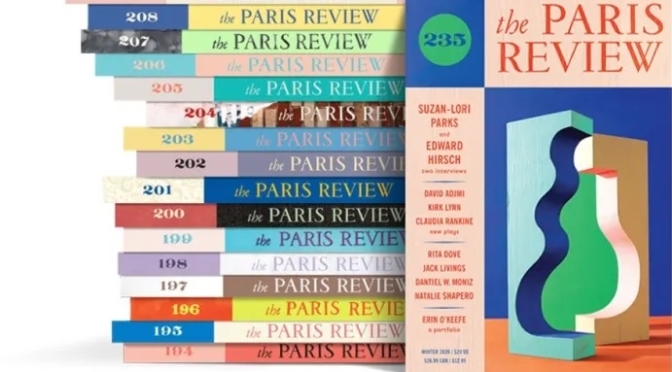
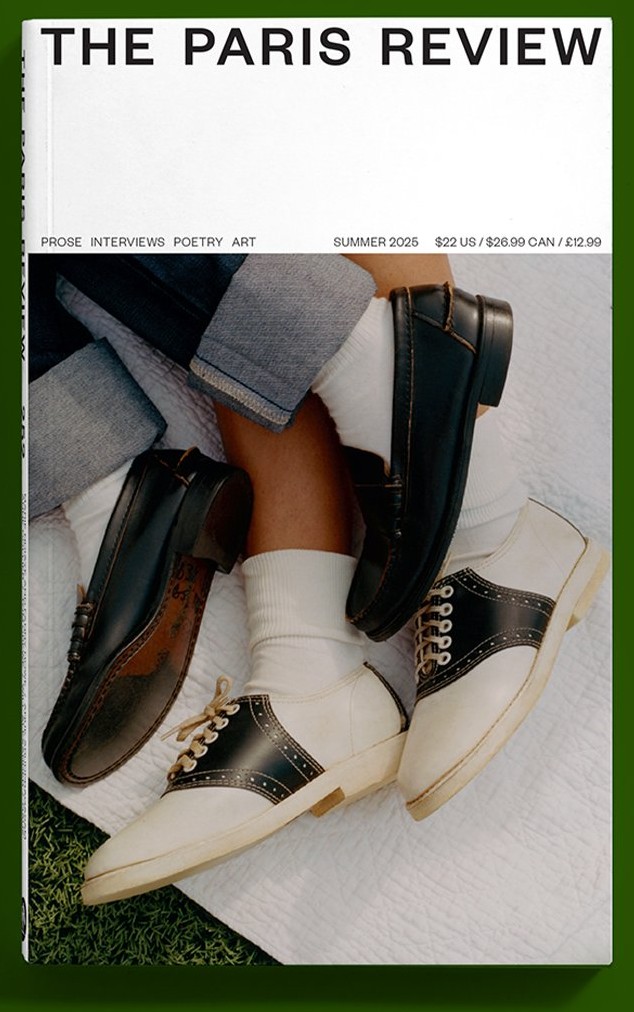
THE PARIS REVIEW – SUMMER 2025 LITERARY PREVIEW

Image

THE PARIS REVIEW (June 24, 2025):

Fanny Howe on the Art of Poetry: “If I could say I was assigned something at birth, it would be to keep the soul fresh and clean, and to not let anything bring it down.”

Marie NDiaye on the Art of Fiction: “Oh, no! Reading beautiful books can’t be traumatizing. Seeing awful things can be—but reading? I don’t believe in that at all.”

Prose by Anuk Arudpragasam, Tom Crewe, GauZ’, Zans Brady Krohn, and Joy Williams.

Poetry by Will Alexander, John Berryman, Yongyu Chen, Eugene Ostashevsky, Ricardo Reis, and Nell Wright.

Art by Anne Collier, Celia Paul, and Alessandro Teoldi; cover by Tyler Mitchell.

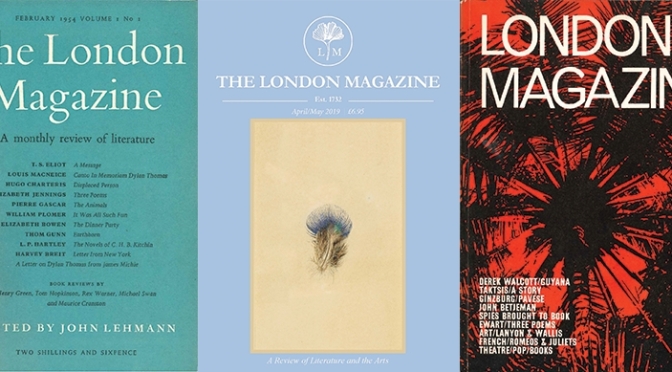
The London Magazine – February/March 2025

Image

THE LONDON MAGAZINE (February 3, 2025): The latest issue features…

Cusk, Experimentalism and the Limits of Autofiction

Zuhri James

‘I don’t think character exists anymore’, Rachel Cusk declared in a 2018 interview. This was not the first time Cusk appeared to be announcing the atrophy of the traditional novel. In a 2014 interview with The Guardian, Cusk stated she was ‘certain autobiography’ was ‘increasingly the only form in all the arts’. Inversely, fiction and its conventional preoccupation with ‘making up John and Jane’, Cusk argued, was only becoming more ‘ridiculous’, ‘fake and embarrassing’. It is precisely this disregard for literary orthodoxy that runs through Cusk’s widely acclaimed trilogy of autofictional novels – Outline (2014), Transit (2016) and Kudos (2018). 

Heat Signature

.Idra Novey

My twin brother calls from the hospital. He’s finished his blood draw and wants to know the word in Portuguese for watermelon. I recite the word for him – melancia – though my brother’s mind isn’t likely to keep hold of it. Zach can no longer keep a hold of his house keys or his phone, which he left yesterday in the bathroom sink. Before we hang up, I ask him to please wait for me in the lounge area for outpatient services, not to wander outside the hospital.

Jacqueline Feldman: ‘It’s salutary to spend time around people who have arranged their lives in radical ways.’

.Julia Steiner

Jacqueline Feldman’s Precarious Lease: The Paris Document – out from Fitzcarraldo Editions on 30 January – delivers captivating literary reportage on Parisian squats of the early 2010s. Feldman introduces us to people who transformed abandoned buildings into homes, shelters and hubs for artistic creation. With echoes of Agnès Varda’s work, Feldman’s prose is compassionate and honest, acknowledging her own role as an observer. She answered these questions by email about her fifteen-years-long project, begun in 2009.

Literary Arts: The London Magazine – December 2024

Image

The London Magazine (December 2, 2024): The latest issue features poetry, short fiction and…

Joey Connolly on information overload, syzygy and Liz Truss.

Betty Rose Townley on Hera Lindsay Bird and the texture of bisexuality.

Jen Calleja on writing experimental memoirs.

Aidan Tulloch on walking through England’s World’s Ends. 

Richie Jones on Jack Reacher and headbutts. 

Reviews by Rowland Bagnall, Tommy Gilhooly, Patrick Cash, Tallulah Griffith.

Cover image by Paul Graham.

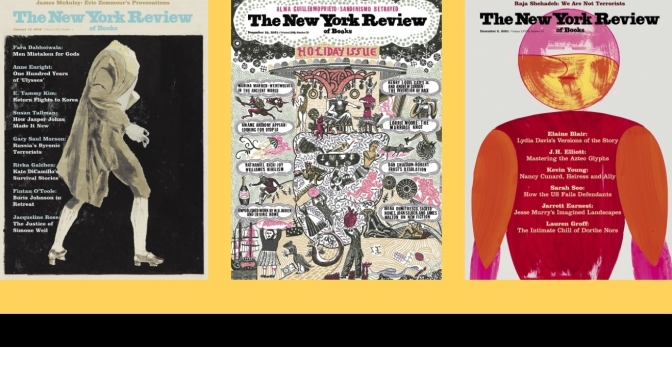
The New York Review Of Books – December 19, 2024

Table of Contents - December 19, 2024 | The New York Review of Books

The New York Review of Books (November 28, 2024) The latest issue features ‘The Evils of Factory Farming’…

Israel’s Revenge: An Interview with Rashid Khalidi

The scholar of Palestinian history talks about what has and has not surprised him about the world‘s response to Israel‘s assault on Gaza.

Under the Spanish Volcano

A recent exhibition at the Prado showcased artists engaging with the ferment and conflict of turn-of-the-century Spain.

‘The Look of Shame’

The French director Catherine Breillat has spent her career insisting on women’s agency and reclaiming taboo desires—sometimes with troubling implications.

Arts & Culture: The New Criterion -December 2024

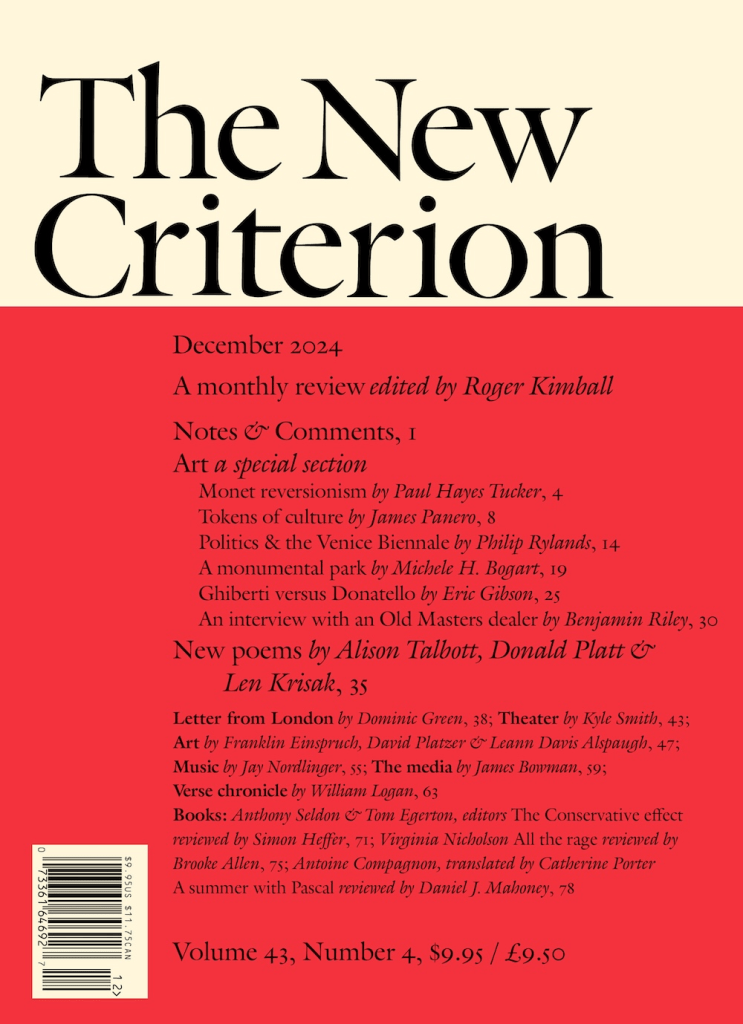
The New Criterion – The December 2024 issue features

Art: a special section

An interview with an Old Masters dealer by Benjamin Riley

Monet reversionism by Paul Hayes Tucker

Tokens of culture by James Panero

Politics & the Venice Biennale by Philip Rylands

A monumental park by Michele H. Bogart

Ghiberti versus Donatello by Eric Gibson

The New York Review Of Books – December 5, 2024

Image

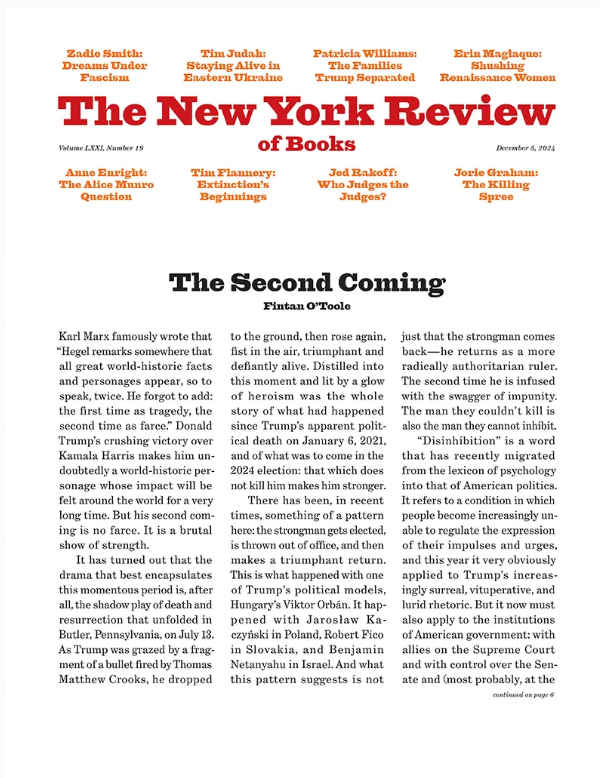
The New York Review of Books (November 14, 2024) The latest issue features The Second Coming – Disinhibition will be the order of the day in Donald Trump’s America.

The Second Coming

Disinhibition will be the order of the day in Donald Trump’s America. By Erin Maglaque

Soundscapes of the Silenced

In late Renaissance Florence one in five women lived behind institutional walls whose rule was sensory mortification. Historians are struggling to recover their inexpressible secrets.

“A Veil of Silence: Women and Sound in Renaissance Italy” by Julia Rombough

In Search of Fullness

In his new book, the philosopher Charles Taylor looks at modern poetry as a unique record of spiritual experience in a secular age.

“Cosmic Connections: Poetry in the Age of Disenchantment” by Charles Taylor

The New York Review Of Books – November 21, 2024

Image

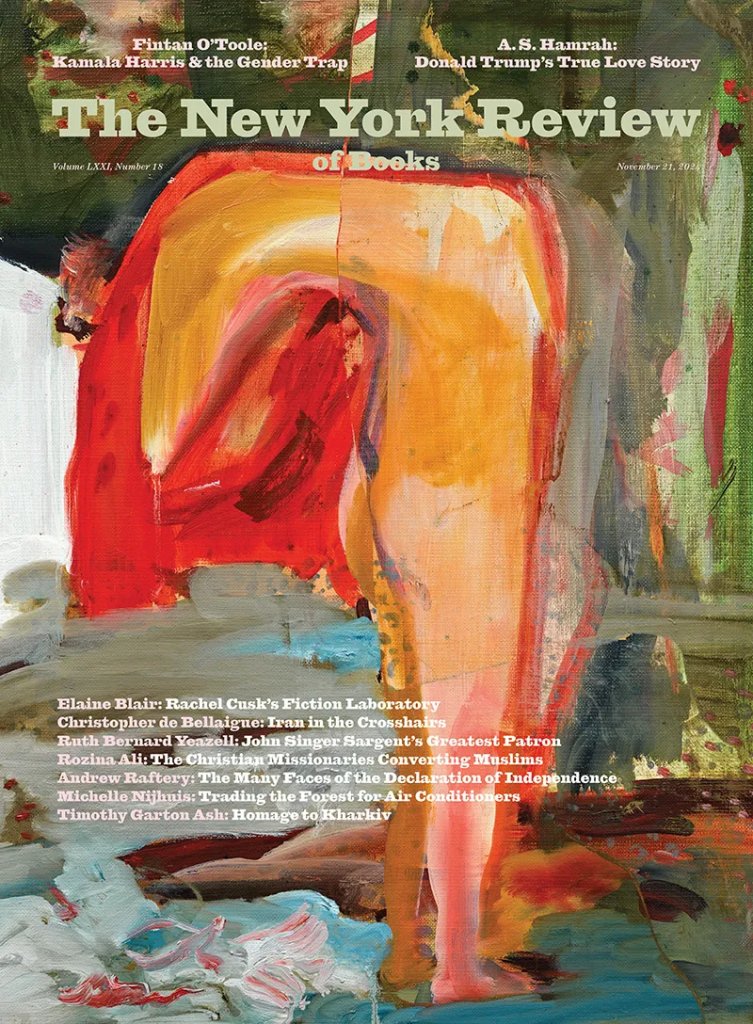
The New York Review of Books (October 31, 2024) The latest issue features Coco Fusco on yearning to breathe free, Elaine Blair on Rachel Cusk, Fintan O’Toole on Trump’s predations, Ruth Bernard Yeazell on John Singer Sargent, Michelle Nijhuis on the disasters wrought by remaking nature for human ends, Clair Wills on Janet Frame, Andrew Raftery on the Declaration of Independence, Rozina Ali on evangelical missionaries in Afghanistan and Iraq, A.S. Hamrah on the Trump biopic, Tim Parks on Nathaniel Hawthorne, poems by John Kinsella and Emily Berry, and much more.

The Crime of Human Movement

Two recent books about our immigration system reveal its long history of exploiting vulnerable individuals for financial gain.

Welcome the Wretched: In Defense of the “Criminal Alien” by César Cuauhtémoc García Hernández

In the Shadow of Liberty: The Invisible History of Immigrant Detention in the United States by Ana Raquel Minian

Life in the Ruins

Two new books consider the delusion of the human quest to be free from the constraints of nature.

The Burning Earth: A History by Sunil Amrith

A Natural History of Empty Lots: Field Notes from Urban Edgelands, Back Alleys, and Other Wild Places by Christopher Brown

Iran Exposed

The Islamic Republic’s sordid proxy war with the West may now be leaving it open to an all-out attack as Israel attempts to eliminate its enemies throughout the region.

Arts & Culture: The New Criterion -November 2024

Image

The New Criterion – The November 2024 issue features

The profundity of evil by Douglas Murray

Emily Dickinson at the post office by William Logan

Pevsner revised by Simon Heffer

“The Power Broker” in perspective by Myron Magnet