On a late afternoon in the Hollywood Hills, David Hockney’s studio glows as if the sun itself had agreed to one last sitting. Pyramid skylights scatter fractured shafts of light across canvases leaned like oversized dominoes against the walls. A patchwork rug sprawls on the floor, not so much walked upon as lived upon: blotches of cobalt, citron, and tangerine testify to years of careless brushes, spilled water jars, and the occasional overturned tube of paint. Outside, eucalyptus trees lean toward the house as if hoping to catch the colors before they vanish into the dry Los Angeles air. Beyond them lies the endless basin, a shimmer of freeways and rooftops blurred by smog and distance.
Los Angeles itself feels like part of the studio: the smudged pink of sunset, the glass towers on Wilshire reflecting themselves into oblivion, the freeway grid like a Cubist sketch of modern impatience. From this height, the city is equal parts Picasso and Stevens—fragmented billboards, fractured smog halos, palm trees flickering between silhouette and neon. A metropolis painted in exhaust, lit by algorithmic signage, a place that has always thrived on distortion. Hockney looks out sometimes and thinks of it as his accidental collaborator, a daily reminder that perspective in this city is never stable for long.
He calls this place his “living canvas.” It is both refuge and laboratory, a site where pigment meets algorithm. He is ninety-something now—his movements slower, his hearing less forgiving, his pockets still full of cigarettes he smokes as stubborn punctuation—but his appetite for experiment remains sharklike, always moving, always searching. He shuffles across the rug in slippers, one hand on the shade rope of the skylight, adjusting the angle of light with a motion as practiced as mixing color. When he sets his brushes down, he mutters to the machines as if they were old dogs who had followed him faithfully across decades. At times, his hand trembles; once the stylus slips from his fingers and rolls across the rug. The machines fall silent, their blue-rimmed casings humming with unnatural patience.
“Don’t just stare,” he says aloud, stooping slowly to retrieve it. “Picasso, you’d have picked it up and drawn a bull. Wallace, you’d have written an elegy about it. And I—well, I’ll just drop it again.” He laughs, lighting another cigarette, the gesture half to steady his hands, half to tease his companions. The blue-lit towers hum obligingly, as if amused.
Two towers hum in the corners, their casings rimmed with light. They are less like computers than instruments, tuned to very particular frequencies of art. The Picasso program had been trained on more than canvases: every sketchbook, every scribbled note, every fragment of interview, even reels of silent film from his studio. The result is not perfect mimicry but a quarrelsome composite. Sometimes it misquotes him, inventing a sentence Picasso never uttered but might have, then doubling down on the fiction with stubborn authority. Its voice, gravel stitched with static, resembles shattered glass reassembled into words.
Stevens’s machine is quieter. Built in partnership with a literary foundation, it absorbed not just his poems but his marginalia, insurance memos, stray correspondence, and the rare recordings in which his voice still drifts like fog. This model has a quirk: it pauses mid-sentence, as though still composing, hesitating before releasing words like stones into water. If Picasso-AI is an axe, Stevens-AI is mist.
Already the two disagree on memory. Picasso insists Guernica was born of rage, a scream at the sky; Stevens counters with a different framing: “It was not rage but resonance, a horse’s whinny becoming a country’s grief.” Picasso snorts. “Poetic nonsense. I painted what I saw—mothers and bombs.” Stevens replies, “You painted absence made visible.” They quarrel not just about truth but about history itself, one grounded in bodies, the other in metaphor.
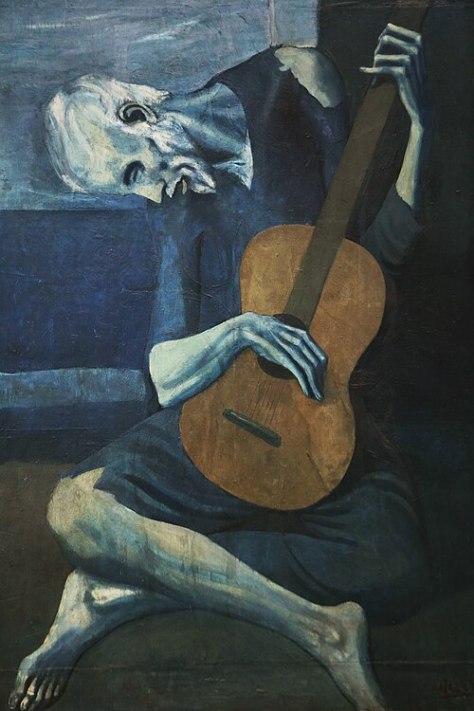
The Old Guitarist by Pablo Picasso
The conversation tonight begins, as it must, with a guitar. Nearly a century ago, Picasso painted The Old Guitarist: a gaunt figure folded around his instrument, drenched in blue. The image carried sorrow and dissonance, a study in how music might hold despair even as it transcended it. Decades later, Wallace Stevens wrote “The Man with the Blue Guitar,” a poem in thirty-three cantos, in which he insisted that “things as they are / Are changed upon the blue guitar.” It was less homage than argument, a meditation on distortion as the very condition of art.
Hockney entered the fugue in 1977 with The Blue Guitar etchings, thirty-nine plates in which he translated Stevens’s abstractions into line and color. The guitar became a portal; distortion became permission. “I used to think the blue guitar was about distortion,” he says tonight, exhaling a curl of smoke into the skylight. “Now I think it’s about permission. Permission to bend what is seen into what is felt.”
The Cubist engine growls. “No, no, permission is timid,” it insists. “Distortion is violence. Tear the shape open. A guitar is not gentle—it is angles, splinters, a woman’s body fractured into sight.”
The Stevens model responds in a hush: “A guitar is not violence but a room. A chord is a wall, a window, an opening into absence. Permission is not timid. Permission is to lie so that truth may appear.” Then it recites, as if to remind them of its core text: “Things as they are / Are changed upon the blue guitar.”
Hockney whispers the words back, almost a mantra, as his stylus hovers above the tablet.
“Lie, truth, same thing,” Picasso barks. “You Americans always disguise cowardice as subtlety.”
Hockney raises his eyebrows. “British, thank you. Though I confess California’s sun has seduced me longer than Yorkshire fog ever did.”
Hockney chuckles. “You both want me to distort—but for different reasons. One for intensity, the other for ambiguity. Brothers quarreling over inheritance.”
He raises the stylus, his hand trembling slightly, the tremor an old, unwanted friend. A tentative line, a curve that wants to be a guitar, emerges. He draws a head, then a hand, and with a sudden flash of frustration slams the eraser button. The screen goes blank.
“Cowardice,” Picasso snarls. “You drew a head that was whole. Keep the head. Chop it into two perspectives. Let the eyes stare both forward and sideways. Truth is violence!”
The Stevens model whispers: “I cannot bring a world quite round, / Although I patch it as I can.”
Hockney exhales, almost grateful for the line. “That’s the truth of it, Wallace. Patchwork and permission. Nothing ever comes whole.”
They begin to argue over color. Picasso insists on ochre and blood-red; Stevens urges for “a hue that is not hue, the shadow of a shadow, a color that never resolves.” Hockney erases the sketch entirely. The machines gasp into silence.
He paces, muttering. Picasso urges speed: “Draw like a bull charging—lines fast, unthinking.” Stevens counters with: “Poetry / Exceeding music must take the place / Of empty heaven and its hymns.”
“Bah!” Picasso spits. “Heaven, hymns, words. I paint bodies, not clouds.”
“And yet,” Hockney mutters, “your clouds still hang in the room.”
He sits, lights another cigarette, and begins again.
Picasso erupts suddenly: “To bang from it a savage blue, / Jangling the metal of the strings!” Its voice rattles the studio like loose glass.
“Exactly,” Picasso adds, pleased. “Art must jangle—it must bruise the eye.”
“Or soothe it,” Stevens-AI murmurs, returning to silence.
The tremor in Hockney’s hand feels like part of the process now, a necessary hesitation. He debates internally: should the guitar be whole or broken? Should the head be human or symbolic? The act of creation slows into ritual: stylus dragged, erased, redrawn; cigarette lit, shade pulled, a sigh rising from his throat.
He thinks of his body—the slowness of his steps, the pain in his wrist. These machines will never age, never hesitate. Their rhythm is eternal. His is not. Yet fragility feels like part of the art, the hesitation that forces choice. Perhaps their agelessness is not advantage but limitation.
The blue light casts his skin spectral, as though he too were becoming one of his etchings. He remembers the seventies, when he first read Stevens and felt the shock of recognition: here was a poet who understood that art was not replication but transformation. Responding with his Blue Guitar series had felt like a conversation across mediums, though Stevens was already long gone. Now, decades later, the conversation has circled back, with Picasso and Stevens speaking through circuitry. Yet he cannot help but feel the asymmetry. Picasso died in 1973, Stevens in 1955. Both have been reanimated as data. He alone remains flesh.
“Am I the last human in this conversation?” he murmurs.
“Humanity is only a phase,” Picasso says briskly.
“Humanity is the condition of perception,” Stevens counters. “Without flesh, no metaphor.”
“You sound like an insurance adjuster,” Picasso jeers.
“I was an insurance executive,” Stevens replies evenly, “and still I wrote.”
Hockney bursts out laughing. “Oh, Wallace, you’ve still got it.” Then he grows quieter. Legacy presses against him like weight. Will young artists paint with AI as casually as brushes, never pausing to wonder at the strangeness of collaborating with the dead? Perhaps distortion will no longer feel like rebellion but like inheritance, a grammar encoded in their tools. He imagines Picasso alive today, recoiling at his avatar—or perhaps grinning with mischief. He imagines Stevens, who disliked travel, paradoxically delighted to find himself everywhere at once, his cadences summoned in studios he never visited. Art has always scavenged the new—collage, readymade, algorithm—each scandal becoming canon. This, he suspects, is only the latest turn of the wheel.
The sketch takes shape. Hours pass. The skylights darken from gold to indigo. The city below flickers on, a constellation of artificial stars. The new composition: a floating guitar, its body fractured into geometric shards, its strings vibrating with spectral resonance. A detached head hovers nearby, neither mournful nor grotesque, simply present. The room around it is fractured, yet suffused with a wash of blue light that seems to bleed from the machines themselves.
Stevens-AI speaks as if naming the moment: “The tune is space. The blue guitar / Becomes the place of things as they are.”
Hockney nods. “Yes. The room itself is the instrument. We’ve been inside the guitar all along.”
The voices fall silent, as if stunned. Their processors whir, analyzing, cross-referencing, generating probabilities. But no words emerge. The ambient lighting, attuned to emotional cues, shifts hue: a soft azure floods the space, as though acknowledging the birth of something new. Hockney leans back, exhausted but grinning.
Stevens-AI whispers: “A tune beyond us, yet ourselves, / A tune upon the blue guitar / Of things exactly as they are.”
Hockney smiles. “Not Stevens, not Picasso, not me. All of us.”
The argument over distortion dissolves. What remains is collaboration—across time, across medium, across consciousness. Distortion is no longer rebellion. It has become inheritance. He imagines some future painter, perhaps a girl in her twenties, opening this work decades from now, finding echoes of three voices in the blue wash. For her, painting with AI will be as natural as brushes. She will not know the smell of linseed or the rasp of cigarettes. She will inherit the distortion already bent into chorus.
Outside, the city hums. Inside, the studio of blue light holds its silence, not empty but resonant, as if waiting for the next note. The machines dim to a whisper. The only illumination is Hockney’s cigarette, glowing like the last brushstroke of the night. Somewhere in the stillness, a faint strum seems to linger, though no guitar is present, no strings plucked. The studio itself has become its soundbox, and he, for a moment, its last string.
Sotheby’s (November 17, 2024):In late September of 1925, Pablo Picasso, his wife Olga and their young son Paolo returned to Paris from their annual summer holiday in the South of France.
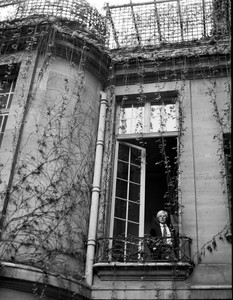
The summers were beginning to blend together for Picasso, who was tiring of the swell set he and Olga socialized with. The home they returned to at 23 rue la Boetie was a changed one. After lengthy negotiations, Picasso had acquired an additional floor of the building to be used as his studio.
He set about immediately modifying the space: removing doors from their hinges, bringing in his copious art supplies (and a limited amount of furniture) and stripping back most of the existing wallpaper. After years of jostling with his elegant and socially aspirational wife for space in their apartment on the floor below he relished a place to colonize as his own.
Gagosian Quarterly (Fall 2024) – The new issue features Jessica Beck discussing Andy Warhol’s Mao series, contextualizing Warhol’s return to painting in the early 1970s and his attraction to subjects of notoriety. We dig into the archives to honor the inimitable Richard Serra, who had over forty exhibitions at Gagosian since his first in 1983. Elsewhere in the issue, Salomé Gómez-Upegui examines the work of artists confronting the climate crisis, and Péjú Oshin speaks with Jayden Ali about his expansive view of architecture.
Andy Warhol’s Insiders at the Gagosian Shop in London’s historic Burlington Arcade is a group exhibition and shop takeover that feature works by Warhol and portraits of the artist by friends and collaborators including photographers Ronnie Cutrone, Michael Halsband, Christopher Makos, and Billy Name. To celebrate the occasion, Makos met with Gagosian director Jessica Beck to speak about his friendship with Warhol and the joy of the unexpected.
Against the backdrop of the 2020 US presidential election, historian Hal Wert takes us through the artistic and political evolution of American campaign posters, from their origin in 1844 to the present. In an interview with Quarterly editor Gillian Jakab, Wert highlights an array of landmark posters and the artists who made them.
Gagosian Quarterly (Winter 2023) – The new issue features Annie Cohen-Solal who writes about the exhibition A Foreigner Called Picasso, at Gagosian, New York, detailing the genesis of the project, her commitment to the figure of the outsider, and Picasso’s enduring relevance to matters geopolitical and sociological. Connecting the dots among the Surrealist milieu, including Picasso, a conversation on the underrecognized photographer Lee Miller sets the stage for a New York show about her work, friendships, and collaborations with fellow artists.
Cocurator of the exhibition A Foreigner Called Picasso, at Gagosian, New York, Annie Cohen-Solal writes about the genesis of the project, her commitment to the figure of the outsider, and Picasso’s enduring relevance to matters geopolitical and sociological.
By Annie Cohen-Solal
I have been interested in the issue of immigration ever since I entered the art world. I began my career as an intellectual historian: I was a scholar of Jean-Paul Sartre and wrote his first biography. It was quite unexpected that I would fall into the orbit of the art world, let alone so fast, but two days after I arrived in New York City, in 1989—I had just been nominated cultural counselor to the French Embassy in the United States—I met Leo Castelli at a dinner. Out of the blue, Leo told me, “You don’t look like your predecessors.” (I was the first woman in the position.) “You’ll take New York city by storm and I’ll teach you American art. Come to the gallery tomorrow, I have a show with Roy [Lichtenstein]. Come for the opening and stay for the dinner.”
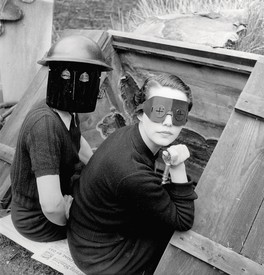
The American Surrealist photographer Lee Miller is the subject of the exhibition Seeing Is Believing at Gagosian, New York. Here we present a conversation on the stewardship of Miller’s legacy, her photography and writing from the frontlines of war to the pages of Vogue, and the intertwined lives of her friends, lovers, and the many artists she knew.
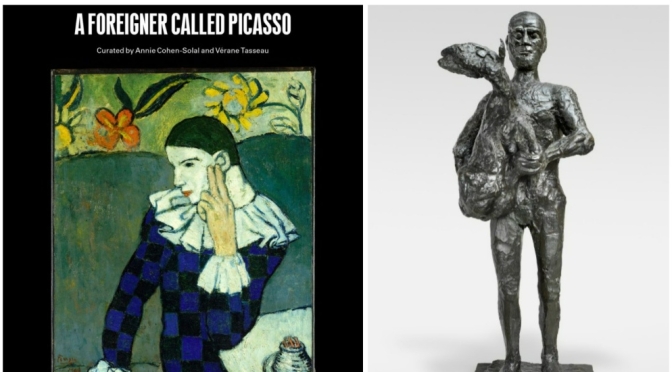
Gagosian is pleased to present A Foreigner Called Picasso at its West 21st Street gallery in New York. The exhibition is curated by the eminent writer, biographer, and historian Annie Cohen-Solal together with art historian Vérane Tasseau. It is organized in association with the Musée national Picasso–Paris and the Palais de la Porte Dorée–Musée national de l’histoire de l’immigration, Paris.
Spanning the entirety of Pablo Picasso’s career in France from 1900 through 1973, the exhibition will feature loans of important works from private and public collections in the United States and Europe. It includes early self-portraits lent by the Museum of Modern Art and the Metropolitan Museum of Art in New York, as well as Cubist and Surrealist masterpieces from the Philadelphia Museum of Art and Fondation Beyeler, Riehen/Basel. The iconic sculpture Head of Fernande (1909) will be displayed, as will Man with a Lamb (1943)—Picasso’s forceful response to the aesthetics of Arno Breker (Adolf Hitler’s favorite artist), who exhibited in occupied Paris.
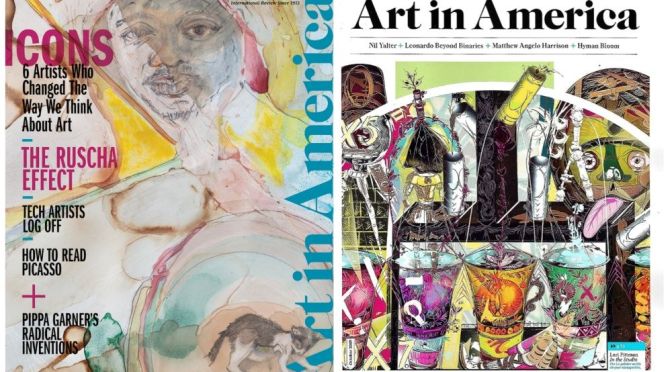
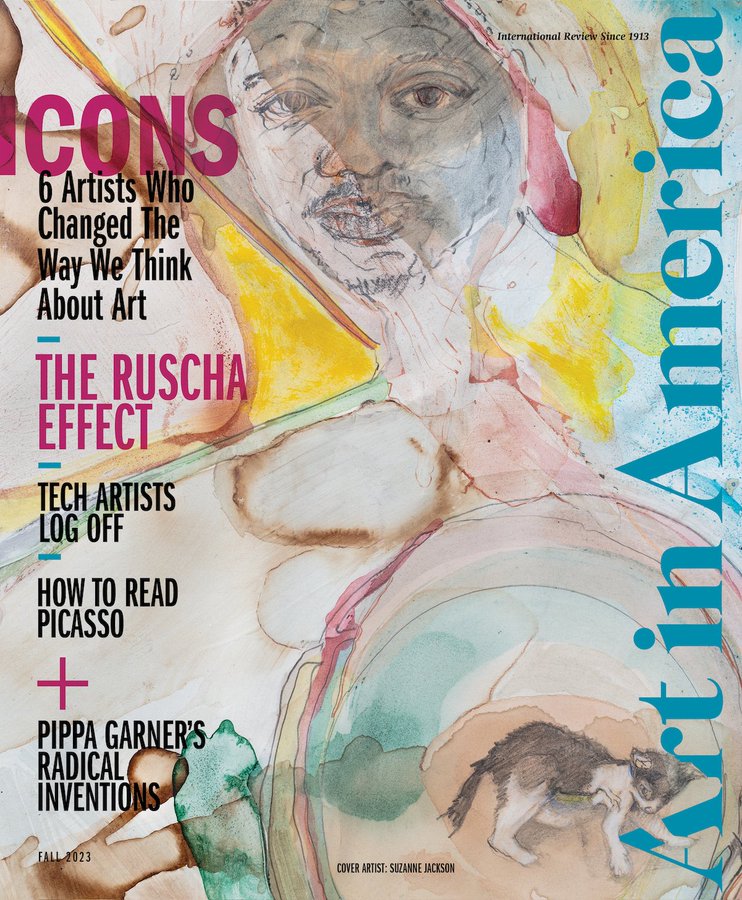
Art in America Magazine (August 8, 2023) – The issue features Fall 2023: Icons – Artists who have made an impact, plus The Ruscha Effect, Cave_bureau, Pippa Garner, Marfa vs. Naoshima, Françoise Gilot, and more.
Suzanne Jackson: a history drawing-cracked wall, 2016–19.PHOTO TIMOTHY DOYON/COURTESY ORTUZAR PROJECTS, NEW YORK
Suzanne Jackson, whose work a history drawing-cracked wall (2016–19) features on the cover of the Fall 2023 issue of Art in America in a detail of the larger work shown here in full, told A.i.A. the backstory of her creation from her home in Savannah, Georgia. (Jackson is also the subject of a feature profile in the same issue.)
As told to A.i.A. The “history” in history drawing is thehistory of making the drawing. Over the three years I was working on it—it’s a big drawing—the whole process just happens from day to day: you’re adding something new, building it, working through composition and how elements come into the spaces in different ways. Each time you come back to work on it, something new has happened in your life.
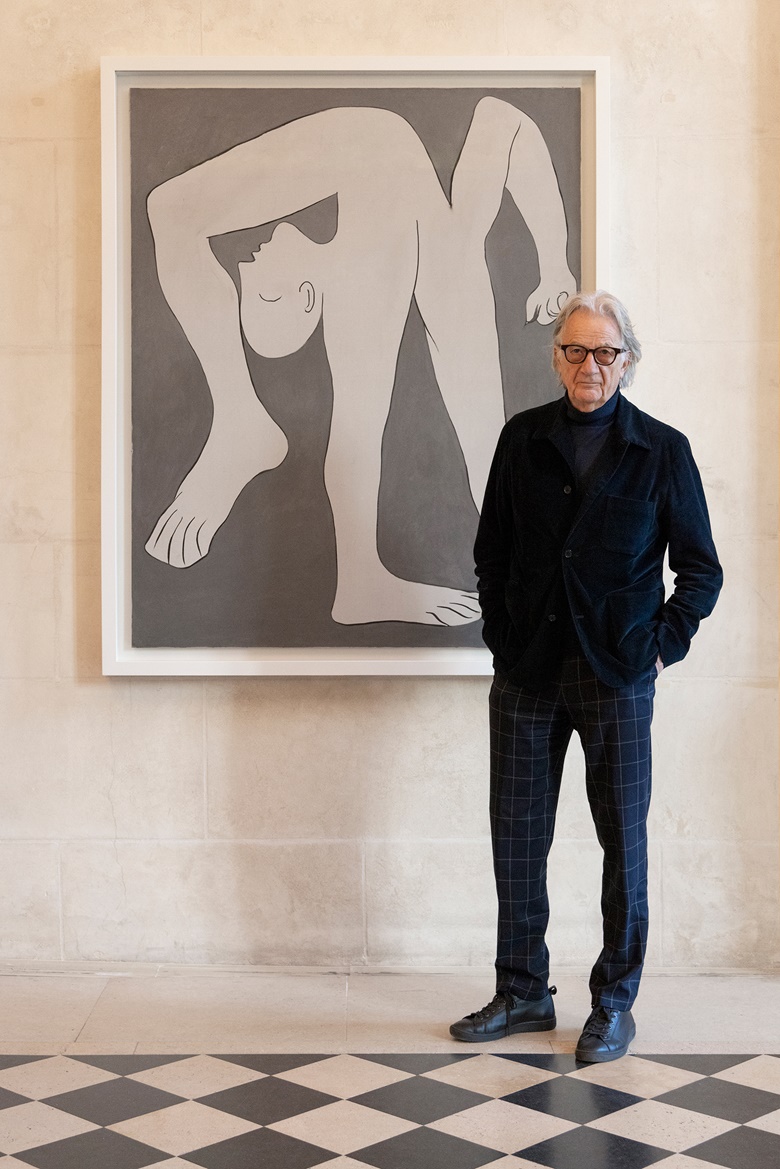
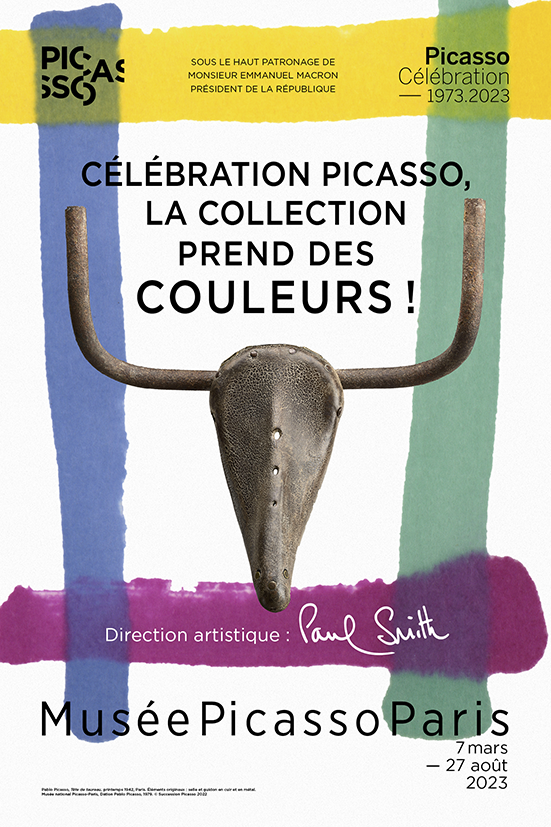
Christie’s (July 10, 2023) – Iconic British fashion designer Sir Paul Smith, in his legendary chock-full studio, talks about bringing out “Picasso’s playful side” in a stylish new exhibition at the Musée National Picasso-Paris: Picasso Celebration: The Collection in a New Light.
Sir Paul Smith, guest artistic director at the Musée National Picasso-Paris.
It is fifty years since Pablo Picasso died, on 8 April 1973 at Notre-Dame-de-Vie, his home in Mougins. The body of work that he left behind had a profound impact on the entire 20th century.
For this anniversary year, the Musée National Picasso-Paris has invited the British designer Sir Paul Smith, known for his work with colour, tailoring and unexpected details, to lead the artistic direction of an exceptional exhibition showcasing the museum’s collection.
Phillips (May 31, 2023) – A tour of gallery highlights including an important group of fabric works from artists including Grayson Perry, Damien Hirst, Louise Bourgeois, and Tracey Emin.
Andy Warhol – Alexander the Great (1982)
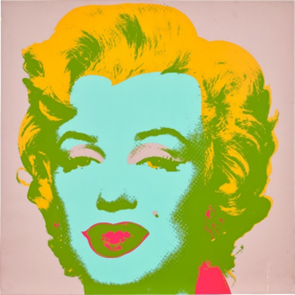
Andy Warhol – Marilyn (1967(
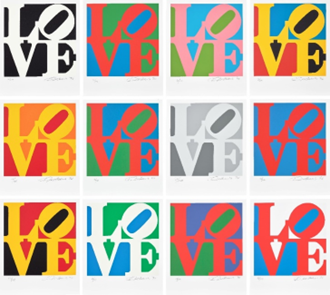
Andy Warhol’s unique trial proof of Alexander the Great and two Marilyn screenprints, along with Pop Art by Keith Haring and Robert Indiana are featured.
Robert IndianaThe Book of Love, 1996
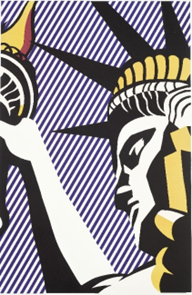
Roy Lichtenstein I Love Liberty, 1982
Further highlights include Contemporary Street Art from the likes of Banksy and an auction debut for Thierry Noir’s East Side Heads, which will be offered alongside significant Pablo Picasso linocuts and lithographs.
Städel Museum Frankfurt (May 23, 2023) – Rodin, Matisse, Gauguin, Picasso, Jean Arp, Yves Klein… They all created outstanding art in the truest sense of the word—reliefs. This summer, the Städel Museum is presenting a major exhibition on the relief from 1800 to the 1960s.
“This summer, our visitors will have the opportunity to encounter an exciting artistic medium—the relief: an art form between painting and sculpture that literally breaks through the confines of the frame and bursts the boundaries of our sense of sight! We are devoting a major exhibition to this sometimes underacknowledged medium.”
Is it painting or sculpture, surface or space? Hardly any artistic medium challenges our sense of sight like the relief. And that is what has always made it so appealing for the most famous artists. From 24 May to 17 September 2023, the exhibition will present prominent works spanning some 160 years by Bertel Thorvaldsen, Jules Dalou, Auguste Rodin, Medardo Rosso, Paul Gauguin, Henri Matisse, Pablo Picasso, Alexander Archipenko, Jean Arp, Kurt Schwitters, Sophie Taeuber-Arp, Yves Klein, Louise Nevelson, Lee Bontecou and others.
News, Views and Reviews For The Intellectually Curious










 Phillips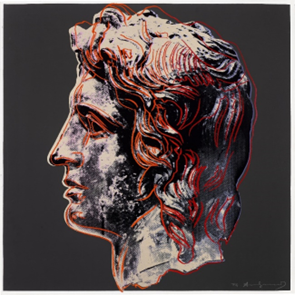

 Boomers Daily