
A selection of three essential articles read aloud from the latest issue of The Economist. This week, the new era of macroeconomics; (9:25) the EU after striking a huge deal; (17:00) and the challenges for Mexico as its youth departs.
Tag Archives: News

Sunday Morning Podcast: News From Switzerland, London And Tokyo
 Monocle’s Markus Hippi is joined by a line-up of guests from Switzerland, London and Tokyo for the weekend’s liveliest discussion.

Global News Podcast: States File More Lawsuits, Spain’s New Lockdown
 NPR News Now discusses continued criticism of federal agents in states, Spain’s new lockdown measures and other international news.
World News Podcast: Unemployment In America Rises, China Tensions And South Korean Recession
 The Economist reports on the rise of American unemployment, tensions with China and South Korea falls into recession.
Morning News Podcast: Race For Covid-19 Vaccine, Swing States & Fall TV
 The U.K. and China made big news with promising results in vaccine development for the coronavirus — the US, Russia and at least five other countries are also working on possible vaccines.
But for a vaccine to work effectively, these countries should be working together. Instead, they’re clashing. Countries like the US and Canada have even accused Russia of stealing our vaccine research. Plus:
- Pennsylvania, Wisconsin, North Carolina and Georgia are all swing states at the center of the 2020 voting crisis.
- And, how the virus will wreak havoc on your fall TV lineup.
Guests: Axios’ Dave Lawler, Stef Kight, and Sara Fischer

Morning News Podcast: Reopening Schools And Joe Biden’s Foreign Policy
 Some of the country’s largest school districts have already made the decision to go online-only for this coming school year. Many are talking about hybrid models that combine distance and in-person learning, but whether they’re online or in the classroom, teachers will bear the brunt of making their classes work.
- Plus, why Joe Biden’s campaign is dreading foreign policy.
- And a little joy for your Friday, a pandemic parody
Guests: Axios’ Kim Hart and Hans Nichols, Austin school teacher Rachel Seney, and National Education Association president Lily Eskelsen García.
Morning News Podcasts: Public Health Experts, 2020 Campaign & Hacks
This week, the Trump administration ordered hospitals to bypass the Centers for Disease Control and Prevention send all coronavirus-related data straight to the Department of Health and Human Services. This is just the latest step in President Trump’s war on public health experts.
- Plus, a shakeup on Trump’s 2020 campaign team.
- And, a major Twitter hack Wednesday afternoon left some of the most powerful people on the platform vulnerable to a cryptocurrency scam.
Guests: Axios’ Sam Baker, Mike Allen, and Ina Fried.
Morning News: Testing Buildings For Covid-19, Small Firms & Visas
Buildings are getting tested for coronavirus, too. Research teams in Oregon are conducting real-time coronavirus tests on ventilation systems in buildings that could be essential for returning to the office or school.
- Plus, small businesses are facing an existential threat.
- And, in a rare move, the Trump administration rescinds a recent guideline that would have sent hundreds of thousands of international students packing.
Guests: Axios’ Joann Muller, Dion Rabouin, and Mike Allen.
Morning News Podcast: Global Covid-19 Cases Surpass 13 Million, China
The Economist Morning Briefing, July 14th, 2020: Coronavirus cases surpass 13m and China and America trade insults.
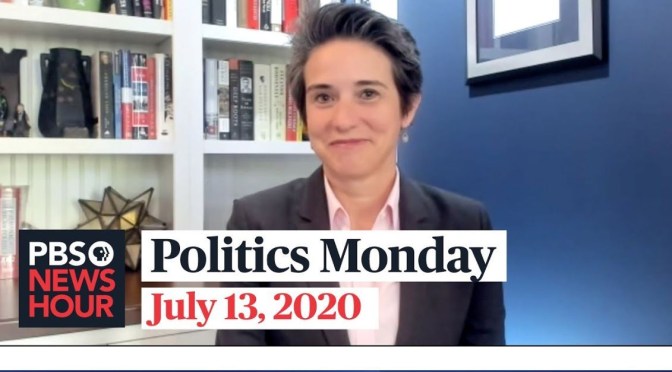
Politics Monday: Tamara Keith And Amy Walter On Latest In Washington (PBS)
NPR’s Tamara Keith and Amy Walter of the Cook Political Report join Amna Nawaz to discuss the latest political news, including President Trump’s commutation of Roger Stone’s prison sentence and the Lincoln Project’s TV ad response, Trump’s attacks on U.S. health experts during the pandemic and what poll numbers in states struggling with COVID-19 could mean for Trump and Republican senators.
 Boomers Daily