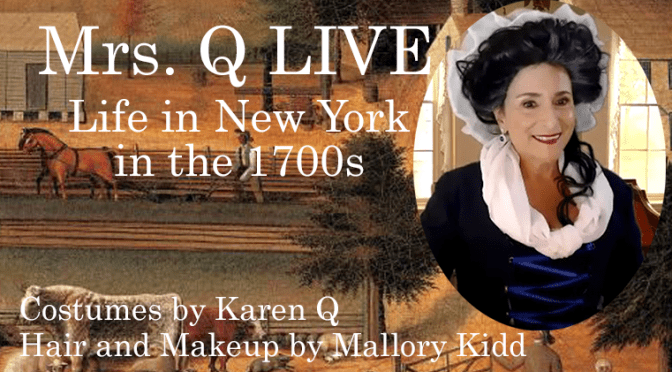
New York City LIVE: Downtown Manhattan in the American Revolution with Karen Q’s Patriot Tours.
Karen Q is a Revolutionary War and Founding Era historian. She is the author of Theodosia Burr: Teen Witness to the Founding of a New Nation, 21st Century Imprints, Lerner Books. She also appears in area Revolutionary War reenactments as “Mrs. Q”. Karen is a regular cast member of the Travel Channel’s *Mysteries at the Museum* and has appeared on more than twenty episodes. You can see a full list of episodes here.
Central Park is an urban park in New York City located between the Upper West and Upper East Sides of Manhattan. It is the fifth-largest park in the city by area, covering 843 acres.
Central Park was the first landscaped public park in the United States. Advocates of creating the park–primarily wealthy merchants and landowners–admired the public grounds of London and Paris and urged that New York needed a comparable facility to establish its international reputation. A public park, they argued, would offer their own families an attractive setting for carriage rides and provide working-class New Yorkers with a healthy alternative to the saloon. After three years of debate over the park site and cost, in 1853 the state legislature authorized the City of New York to use the power of eminent domain to acquire more than 700 acres of land in the center of Manhattan.
An irregular terrain of swamps and bluffs, punctuated by rocky outcroppings, made the land between Fifth and Eighth avenues and 59th and 106th streets undesirable for private development. Creating the park, however, required displacing roughly 1,600 poor residents, including Irish pig farmers and German gardeners, who lived in shanties on the site. At Eighth Avenue and 82nd Street, Seneca Village had been one of the city’s most stable African-American settlements, with three churches and a school. The extension of the boundaries to 110th Streetin 1863 brought the park to its current 843 acres.
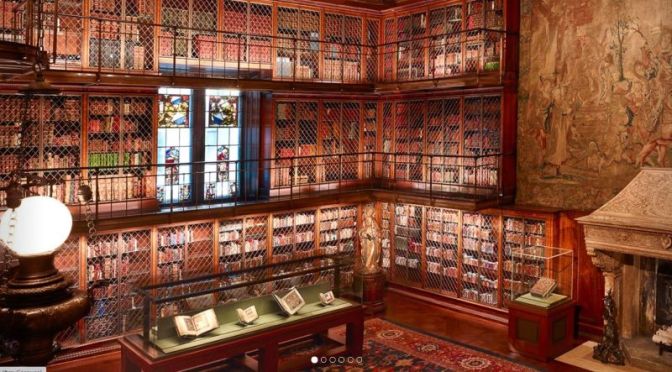
The Morgan Library & Museum, formerly the Pierpont Morgan Library, is a museum and research library in the Murray Hill neighborhood of Manhattan, New York City. It is situated at 225 Madison Avenue, between 36th Street to the south and 37th Street to the north.
A complex of buildings in the heart of New York City, The Morgan Library & Museum began as the private library of financier Pierpont Morgan (1837–1913), one of the preeminent collectors and cultural benefactors in the United States. As early as 1890 Morgan had begun to assemble a collection of illuminated, literary, and historical manuscripts, early printed books, and old master drawings and prints.
Mr. Morgan’s library, as it was known in his lifetime, was built between 1902 and 1906 adjacent to his New York residence at Madison Avenue and 36th Street. Designed by Charles McKim of the architectural firm McKim, Mead & White, the library was intended as something more than a repository of rare materials. Majestic in appearance yet intimate in scale, the structure was to reflect the nature and stature of its holdings. The result was an Italian Renaissance-style palazzo with three magnificent rooms epitomizing America’s Age of Elegance. Completed three years before McKim’s death, it is considered by many to be his masterpiece. In 1924, eleven years after Pierpont Morgan’s death, his son, J. P. Morgan, Jr. (1867–1943), known as Jack, realized that the library had become too important to remain in private hands. In what constituted one of the most momentous cultural gifts in U.S. history, he fulfilled his father’s dream of making the library and its treasures available to scholars and the public alike by transforming it into a public institution.
Over the years—through purchases and generous gifts—The Morgan Library & Museum has continued to acquire rare materials as well as important music manuscripts, early children’s books, Americana, and materials from the twentieth century. Without losing its decidedly domestic feeling, the Morgan also has expanded its physical space considerably.
In 1928, the Annex building was erected on the corner of Madison Avenue and 36th Street, replacing Pierpont Morgan’s residence. The Annex connected to the original McKim library by means of a gallery. In 1988, Jack Morgan’s former residence—a mid-nineteenth century brownstone on Madison Avenue and 37th Street—also was added to the complex. The 1991 garden court was constructed as a means to unite the various elements of the Morgan campus.
The largest expansion in the Morgan’s history, adding 75,000 square feet to the campus, was completed in 2006. Designed by Pritzker Prize–winning architect Renzo Piano, the project increases exhibition space by more than fifty percent and adds important visitor amenities, including a new performance hall, a welcoming entrance on Madison Avenue, a new café and a new restaurant, a shop, a new reading room, and collections storage. Piano’s design integrates the Morgan’s three historical buildings with three new modestly scaled steel-and-glass pavilions. A soaring central court connects the buildings and serves as a gathering place for visitors in the spirit of an Italian piazza.
New York City has completed the world’s thinnest skyscraper, the 111 West 57th Street, which will soar above Central Park on Billionaire’s Row alongside the Central Park tower and other iconic supertall skyscrapers. 111 West 57th Street, also known as the Steinway Tower, is a supertall residential project by developers JDS Development Group and Property Markets Group in West Midtown in Manhattan, New York City. Located at 111 West 57th Street near Sixth Avenue, the development will be a combination of the original landmarked Steinway Building designed in 1925 by Warren & Wetmore, and a new tower addition on the adjacent site. Parkside Construction Builders is the general contractor. The world’s thinnest skyscraper will sway up to 5 feet during storms. The tower topped out in 2019 and is expected to open in early 2021. Steinway tower is one of the tallest buildings in the United States, as well as the thinnest skyscraper in the world with a width-to-height ratio of about 1:23.
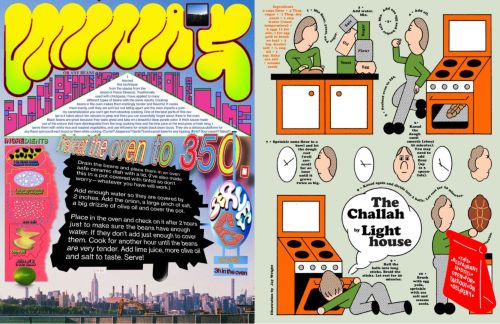
We were a website, and now we’re a cookbook. We’re a project by illustrators and designers to help raise money for New York restaurants and their employees. We’re 38 recipes from 38 restaurants for you to cook at home. And we’re a $20 donation for every book sold to New York City restaurants, through ROAR’s employee relief fund.
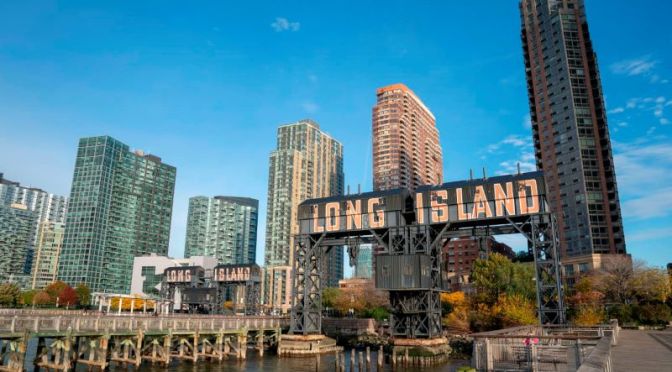
A redeveloped industrial area along the East River in Queens, Long Island City is known for its gleaming high-rises with sweeping views of Manhattan. Innovative art galleries and performance spaces, as well as pockets of trendy bars and restaurants, appeal to local artists and young professionals. MoMA PS1 showcases cutting-edge art and hosts seasonal dance parties. Locals enjoy the quiet riverfront park.
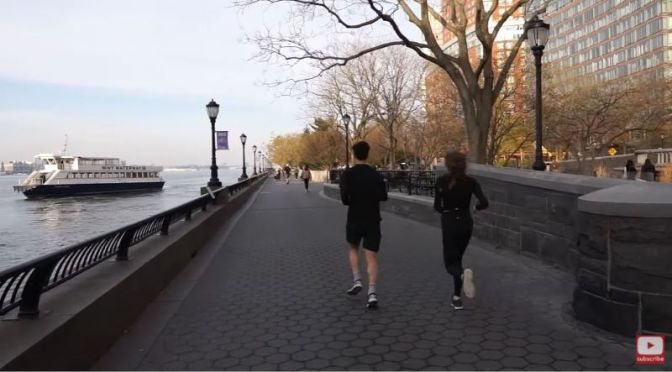
Set along the Hudson River, Battery Park City is a mainly residential neighborhood of upscale high-rise apartment buildings. During the workweek, its casual eateries and bars draw professionals from the nearby Financial District. On weekends, the area slows down, though locals and visitors are drawn to the multitower Brookfield Place shopping center and the bike friendly paths of the riverfront park.
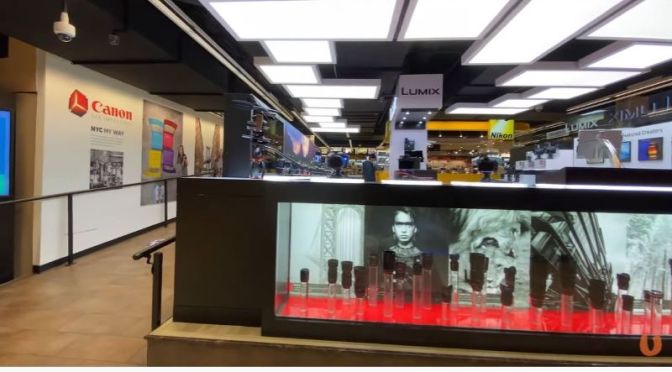
B&H Photo Video (also known as B&H Photo and B&H and B&H Foto & Electronics Corporation) is an American photo and video equipment retailer founded in 1973, based in Manhattan, New York City.[1] B&H conducts business through online e-commerce consumer sales, business to business sales, and its one retail location. Customers engage with B&H via its websites, retail store, phone sales and customer service, email, and chat channels.
B&H stands for Blimie & Herman, the founders of the store. B&H was named the leading online consumer electronics retailer by Consumers Reports for 2018. Newsweek named B&H as one of America’s Top Companies for Customer Service for 2019, with top position in the consumer electronics category based on over 130,000 customer evaluations. In 2018, Forbes named B&H as one of America’s Best Mid-Size Employers. Also in 2018, B&H’s consumer website was recognized as the Best for User Experience of any e-commerce company by the Baymard Institute.
News, Views and Reviews For The Intellectually Curious









 Boomers Daily