Tag Archives: Middle East

THE COURAGE TO QUESTION: HOW AN EMPIRE WAS BUILT

By Michael Cummins, Editor, August 16, 2025

The memory of the Islamic Golden Age evokes powerful images: Baghdad’s legendary House of Wisdom, a beacon of scholarship for the world’s greatest minds; the astronomical observatories of Samarkand, mapping the heavens with unprecedented precision; the grand libraries of Córdoba, containing more books than all of Europe combined. For roughly five centuries, from the 8th to the 13th, the Islamic world was the undisputed global epicenter of science, philosophy, and culture. Its innovations gifted humanity algebra and algorithms, advanced surgical techniques, and the classical Greek philosophy that would later fuel the European Renaissance.

This flourishing was no accident. It was the direct result of a powerful, synergistic formula: the fusion of a voracious, institutionalized curiosity with strategic state patronage and a climate of relative tolerance. Yet, its eventual decline offers an equally crucial lesson—that such a vibrant ecosystem is fragile. Its vitality is contingent on maintaining an open spirit of inquiry, the closing of which precedes stagnation and decay. The story of the Islamic Golden Age, told through its twin centers of Baghdad and Córdoba, is therefore both an inspiring blueprint for civilizational greatness and a timeless cautionary tale of how easily it can be lost.

The Engine: A Genius for Synthesis

The foundation of the Golden Age was its genius for synthesis. It was an institutionalized curiosity that understood new knowledge is forged by actively seeking out, challenging, and combining the wisdom of others. As the scholar Dimitri Gutas argues in his seminal work, Greek Thought, Arabic Culture, this was not a random burst of energy but a deliberate, state-sponsored project driven by the “social and political imperatives of a new empire.” The Abbasid Caliphs, having established their capital in Baghdad in 762, sat at the crossroads of the Persian, Byzantine, and Indian worlds. Rather than view the intellectual traditions of these conquered or rival lands as a threat, they saw them as an invaluable resource for building a universalist imperial ideology.

This conviction gave rise to the Translation Movement, a massive, state-funded effort to translate the great works of science, medicine, and philosophy into Arabic. The nerve center of this project was Baghdad’s House of Wisdom (Bayt al-Hikmah). Far more than a library, it was a dynamic academy, a translation bureau, and a research institute where scholars from across the known world collaborated.

Their goal was never mere preservation. As the historian George Saliba demonstrates, they were active innovators who critically engaged with, corrected, and vastly expanded upon ancient texts. Ptolemy’s astronomical model in the Almagest was not just translated; it was rigorously tested in new observatories, its mathematical errors identified, and its cosmological assumptions challenged by thinkers like Ibn al-Haytham (Alhazen), whose work on optics overturned centuries of classical theory.

He did not simply import knowledge; he synthesized it into something new.

This process created a powerful intellectual alchemy. In mathematics, Muhammad ibn Musa al-Khwarizmi, a Persian scholar at the House of Wisdom, encountered the revolutionary numeral system from India, which included the concept of zero. He fused this with the geometric principles of the Greeks to create a new discipline he outlined in his landmark book, The Compendious Book on Calculation by Completion and Balancing. From the title’s key term, al-jabr (‘completion’ or ‘restoring’), the world received algebra—a tool for abstract problem-solving that would transform the world.

This same engine of synthesis, fueled by a competitive spirit, was humming thousands of miles away in Al-Andalus. In its capital, Córdoba, the physician Al-Zahrawi (Abulcasis), often called the father of modern surgery, compiled the Al-Tasrif, a thirty-volume medical encyclopedia. It was a monumental synthesis of classical medical knowledge with his own pioneering innovations, introducing the use of catgut for internal stitches and designing dozens of new surgical instruments that would define European medical practice for centuries. In philosophy, the Córdoban thinker Ibn Rushd (Averroes) produced radical commentaries on Aristotle that were so influential he became known simply as “The Commentator” in medieval Europe. He sought to demonstrate that reason and revelation were not in conflict but were two paths to the same truth, a bold intellectual project that would profoundly reshape Western scholasticism.

The Fuel: Strategic Investment in Knowledge

This intellectual engine was deliberately and lavishly fueled by rulers who saw investment in knowledge as a cornerstone of state power, prestige, and practical advantage. The immense wealth of the Abbasid Caliphate, derived from its control of global trade routes, made this grand-scale patronage possible. This power was materialized in Baghdad itself, Caliph al-Mansur’s perfectly circular “City of Peace,” an architectural marvel with the caliph’s palace and the grand mosque at its absolute center, symbolizing his position as the axis of the world. Later Abbasid palaces were sprawling complexes of exquisite gardens, cool marble halls, and courtyards filled with intricate fountains and exotic animals—dazzling stages for courtly life where poets, musicians, and scholars vied for the caliph’s favor.

It was within these opulent settings that legendary patrons like Harun al-Rashid and his son, al-Ma’mun, held court. Al-Ma’mun, a rationalist thinker himself, is said to have been inspired by a dream in which he conversed with Aristotle. He poured vast resources into the House of Wisdom, funding expeditions to Byzantium to acquire rare manuscripts and reportedly paying translators their weight in gold.

This model of state-sponsored knowledge was pursued with competitive fervor in Al-Andalus. In Córdoba, the Umayyad Caliph Abd al-Rahman III sought to build a capital that would eclipse all rivals. A few miles outside the city, he constructed a fabled palace-city, Madinat al-Zahra (“the shining city”). It was a breathtaking statement of power, built in terraces on a mountainside with thousands of imported marble columns. Its audience chambers were adorned with ivory and ebony, and at the center of the most magnificent hall lay a basin filled with shimmering quicksilver, which, when agitated, would flood the room with dazzling reflections of light.

This was a “war of culture” in which libraries were arsenals and palaces were declarations of supremacy. It was in this environment that Al-Hakam II, Abd al-Rahman’s son, amassed his legendary library of over 400,000 volumes, a beacon of knowledge designed to outshine Baghdad itself. This rivalry between distant capitals created a powerful ecosystem for genius, establishing a lasting infrastructure for discovery that attracted the best minds from every corner of the globe.

The Superpower: Pragmatic and Inclusive Tolerance

The era’s intellectual and financial investments were supercharged by a climate of relative tolerance. This was not a modern, egalitarian pluralism, but a practical and strategic inclusion that prevented intellectual monocultures and proved to be a civilizational superpower. As María Rosa Menocal writes in The Ornament of the World, this was a culture capable of a “first-rate pluralism,” where contradictions were not just tolerated but were often the source of creative energy.

The work of the Golden Age was a multi-faith and multi-ethnic endeavor. In Baghdad, the chief translator at the House of Wisdom and the most important medical scholar of his time, Hunayn ibn Ishaq, was a Nestorian Christian. A master of four languages—Syriac, Arabic, Greek, and Persian—he established a rigorous methodology, collecting multiple manuscript versions of a text to ensure the most accurate translation. For generations, Christian physicians from the Bakhtishu’ family served as personal doctors to the Abbasid caliphs.

This principle was just as potent in the West. In Córdoba, the court of Abd al-Rahman III thrived on the talents of figures like Hasdai ibn Shaprut, a Jewish physician and scholar who rose to become the caliph’s most trusted diplomat and vizier. He not only managed foreign policy but also used his position to patronize Hebrew poets and grammarians, fostering a golden age of Jewish culture that flourished in the heart of Islamic Spain. This was made possible by the dhimmi (protected peoples) system, which, while hierarchical, guaranteed non-Muslims the right to practice their faith and participate in intellectual life. In the realms of science and philosophy, merit and skill were often the ultimate currency. This diversity was the Golden Age’s secret weapon.

The Cautionary Tale: The Closing of the Mind

The Golden Age did not end simply with the hoofbeats of Mongol horses in 1258. Its decline was a prolonged grinding down of the audacious spirit of open inquiry. The Mongol sack of Baghdad was a devastating blow, but it struck a body already weakened by an internal intellectual malaise.

This cultural shift is often symbolized by the brilliant 11th-century theologian, Abu Hamid al-Ghazali. His influential critique of Hellenistic philosophy, The Incoherence of the Philosophers, was not an attack on reason itself—he was a master of it, who championed Aristotelian logic as a necessary tool for theology. Rather, it was a powerful argument against what he saw as the metaphysical overreach of philosophers on matters that he believed could only be known through divine revelation. His work, however, was a symptom of a decisive cultural turn. The intellectual energy of the elite, and the patronage that supported it, began to be re-channeled—away from speculative, open-ended philosophy (falsafa) and towards the preservation and systematization of established religious doctrine.

The central questions shifted from “What can we discover?” to “How do we defend what we know?”

This was compounded by political fragmentation. As the central authority of the Abbasid Caliphate waned, insecure local rulers, like the Seljuk Turks, increasingly sought legitimacy by patronizing conservative religious scholars. Funding flowed toward madrasas focused on theology and law rather than independent scientific academies. When a culture begins to fear certain questions, it loses its ability to generate new answers. The great North African historian Ibn Khaldun, writing in the 14th century from the ruins of this intellectual world, diagnosed the decline with stunning clarity in his Muqaddimah. He observed that when civilizations become too comfortable and focused on preserving past glories, they lose the “group solidarity” and intellectual dynamism that made them great. This growing intellectual rigidity created a civilizational brittleness, leaving it vulnerable to catastrophic external shocks.

Conclusion: A Timeless Blueprint

The legacy of the Islamic Golden Age is a double-edged one. Its rise in both the East and West provides a clear blueprint for greatness, built on relentless curiosity, wise patronage, and pragmatic inclusion. This formula demonstrates that progress is a product of openness and investment. Its decline, however, is a stark warning. The erosion of that most crucial pillar—the open, questioning mind—preceded the civilization’s fall.

The essential lesson of this epic is that culture precedes power. The wealth, military strength, and political influence of the caliphates were not the cause of the Golden Age; they were the result of a culture confident enough to be curious, strong enough to tolerate dissent, and wise enough to invest in knowledge. The engine of its greatness was not the treasury, but the House of Wisdom and the Library of Córdoba. Consequently, its decline was not merely a political or military failure, but the late-stage symptom of an intellectual culture that had begun to value orthodoxy over inquiry. When the questions stopped, the innovations stopped, and the foundations of power crumbled from within.

This narrative is not a historical artifact. It is a timeless blueprint, revealing that the most critical infrastructure any society can build is not made of stone or steel, but of the institutions and values that protect and promote the open pursuit of knowledge. In our modern world, the House of Wisdom finds its echo in publicly funded research universities, in international scientific collaborations, and in the legal frameworks that protect free speech and intellectual inquiry. The patronage of al-Ma’mun is mirrored in the grants that fund basic research—the kind of open-ended exploration that may not have an immediate commercial application but is the seedbed of future revolutions. The tolerance of Córdoba is the argument for diversity in our labs, our boardrooms, and our governments, recognizing that a multiplicity of perspectives is not a liability to be managed, but a strategic asset that fuels innovation.

The open secret of the Golden Age is therefore not a secret at all, but a choice. It is the choice to believe that greatness is born from the courage to question, to synthesize, and to explore. It is the choice to see knowledge not as a finite territory to be defended, but as an infinite ocean to be discovered. The moment a society decides it already has all the answers—the moment it values certainty over curiosity—is the moment its decline becomes inevitable.

THIS ESSAY WAS WRITTEN AND EDITED UTILIZING AI

The Economist Magazine – December 14, 2024 Preview

All weekly editions | The Economist

The Economist Magazine (December 12, 2024): The latest issue features ‘What Now?’…

How the new Syria might succeed or fail

The end of the house of Assad. Much will go wrong. But for now, celebrate a tyrant’s fall

What Spain can teach the rest of Europe

Our number-crunching suggests it was the best-performing rich economy in 2024

America’s searing market rally brings new risks

Financial innovation is just as much to blame as the technological sort

Multilateral institutions are turning away from the poorest countries

Even bail-outs are getting expensive

Politics: The Guardian Weekly-December 13, 2024

Image

The Guardian Weekly (December 11, 2024): The new issue features The fall of Syria’s brutal dictatorship. Plus The best books of 2024.

Not even the most optimistic of rebels could have predicted the rapid collapse, last weekend, of the Assad dynasty that ruled Syria with an iron fist for more than 50 years. Yet while there was relief and joy both inside Syria and among the nation’s vast displaced diaspora, it was also accompanied by apprehension over what might come next.

1

Spotlight | Russia and Ukraine wait warily for Trump transition
The idea of the US president-election as a saviour for Ukraine, as unlikely as it may seem, holds an appeal for an exhausted nation without a clear path to victory. Shaun Walker and Pjotr Sauer report

2

Environment | The jailed anti-whaler defiant in face of extradition threat
Capt Paul Watson talks to Daniel Boffey about his arrest on behalf of the Japanese government, his ‘interesting’ Greenland prison, and separation from his children

3

Feature | The growing threat of firearms that can be made at home
One far-right cell wanted to use 3D-printed guns to cause ‘maximum confusion and fear’ on the streets of Finland. Could the police intercept them in time? By Samira Shackle

4

Opinion | Farage is lying in wait. Britain can’t afford for Starmer to fail
It is not enough for the Labour leader’s ‘milestones’ to be achieved. Voters must feel the improvement in their daily lives, says Guardian columnist Jonathan Freedland

5

Culture | The best books of 2024
From a radical retelling of Huckleberry Finn to Al Pacino’s autobiography, our critics round up their favourite reads of the year

The Economist Magazine – December 7, 2024 Preview

The Economist Magazine (December 5, 2024): The latest issue features ‘America’s Gambling Frenzy’….

America’s gambling boom should be celebrated, not feared

The gambling frenzy is mostly about people being free to enjoy themselves

France steps into deep trouble

It has no government and no budget, and is politically gridlocked

Yoon Suk Yeol of South Korea should resign, or be impeached

His coup attempt was foiled. But grave tests still remain for the country

Joe Biden abused a medieval power to pardon his son

The president’s reversal is understandable, hum

Politics: The Guardian Weekly – Nov. 29, 2024

The Guardian Weekly (November 28, 2024): The new issue features last week’s escalation of Nato ballistic missile activity, in which UK and US-made missiles were launched into Russia for the first time, brought a predictably cold response from Vladimir Putin – who loosened Moscow’s nuclear doctrines and promised more attacks with a new, experimental ballistic missile.

1

Spotlight | Does lame duck Biden have time to Trump-proof democracy?
The outgoing US president may only have weeks left in the White House, but activists say he can secure civil liberties, accelerate spending on climate and healthcare, and spare death row prisoners. David Smith reports

2

Science | My weird, emotional week with an AI pet
Casio says Moflin can develop its own personality and build a rapport with its owner – and it doesn’t need food, exercise or a litter tray. But is it essentially comforting or alienating? Justin McCurry finds out

3

Feature | Are we right to strive to save the world’s tiniest babies?
Doctors are pushing the limits of science and human biology to save more extremely premature babies than ever before. But when so few survive, are we putting them through needless suffering? By Sophie McBain

4

Opinion | A social media ban is in everyone’s interests – not just kids under 16
Van Badham on why she resents being excluded from protection against monetised fear, anger and toxicity

5

Culture | A road trip like no other: an epic drive on the Autobahn
Fifty years after electronic pioneers Kraftwerk released a 23-minute song about a road – and changed pop music for ever – Tim Jonze hits the highways of Düsseldorf and Hamburg in search of its futuristic brilliance

Cover: Claremont Review Of Books – Fall 2024

Claremont Review of Books (Fall 2024): The new issue features ‘Making America Great. Again.’…

America’s Red Shift

Now who’s on the wrong side of history? by Charles R. Kesler

Donald Trump and the Republican Party had a triumphant Election Day, gaining ground in all parts of the country and among almost all voting sectors. He won all seven of the ballyhooed swing states, by comfortable margins except in the blue-wall states of Wisconsin (where his margin of victory was 0.9%), Michigan (1.4%), and Pennsylvania (1.8%). Still, he won all three blue-wall states twice—in 2024 as in 2016—something no Republican had managed since Ronald Reagan. Trump regains office alongside a Republican-controlled Senate and House of Representatives, too, the trifecta of what political scientists call “undivided government,” not enjoyed by Republicans since the first two years of his own first term.

To Overthrow the World: The Rise and Fall and Rise of Communism

To Overthrow the World: The Rise and Fall and Rise of Communism

The Political and Strategic History of the World, Volume I: From Antiquity to the Caesars, 14 A.D.

The Political and Strategic History of the World, Volume I: From Antiquity to the Caesars, 14 A.D.

Light of the Mind, Light of the World: Illuminating Science Through Faith

Light of the Mind, Light of the World: Illuminating Science Through Faith

Farnsworth’s Classical English Argument

Farnsworth's Classical English Argument

The Economist Magazine – November 23, 2024 Preview

All weekly editions | The Economist

The Economist Magazine (November 21, 2024): The latest issue features ‘Disrupter-In-Chief’….

The opportunities—and dangers—for Trump’s disrupter-in-chief

Elon Musk is given the ultimate target: America’s Government

Germany cannot afford to wait to relax its debt brake

It should move before the election

From Nixon to China, to Trump to Tehran

Iran is weak. For America’s next president that creates an opportunity

Too many master’s courses are expensive and flaky

Governments should help postgraduates get a better deal

Politics: The Guardian Weekly – Nov. 22, 2024

Image

The Guardian Weekly (November 21, 2024): The new issue features ‘The crisis in the Church of England’…

Existentialist crises might more commonly be associated with some who seek out religion, rather than with those religions themselves, but that’s where the Church of England has found itself in recent days.

The resignation of Justin Welby, the archbishop of Canterbury, followed a damning report into the church’s shameful failures over the serial child abuser John Smyth, which detailed even more disturbing details of cover-ups by some senior clergy.

1

Spotlight | Trump’s shock-and-awe team
A flurry of controversial and extremist picks for Trump’s administration has provoked criticism and made heads spin. David Smith reports from Washington

2

Science | The inverse link between cancer and dementia
Scientists have long been aware of a curious connection between these common and feared diseases. At last, a clearer picture is emerging, writes Theres Lüthi

3

Feature | Kernels of hope
During the siege of Leningrad, botanists in charge of an irreplaceable seed collection, the first of its kind, had to protect it from fire, rodents – and hunger. By Simon Parkin

4

Opinion | Seven lessons from a long-serving economics editor
From Thatcher to Trump and Brexit, the Guardian’s outgoing economics editor, Larry Elliott, reflects on his 28 years in the role.

5

Culture | Faking history
Film and TV have a slippery relationship with the truth when it comes to historical epics. Simon Usborne meets the experts whose advice goes unheeded

Analysis: The World Ahead In 2025 – The Economist

Image

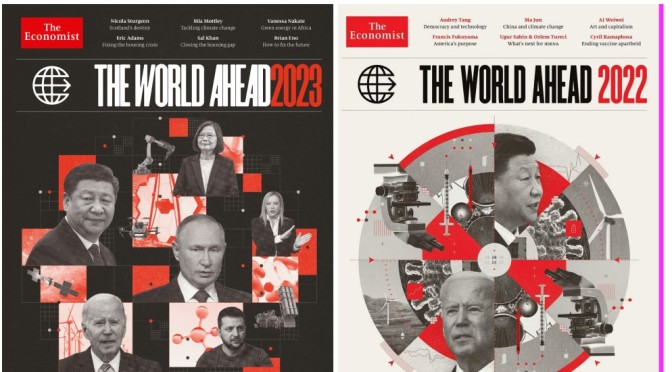
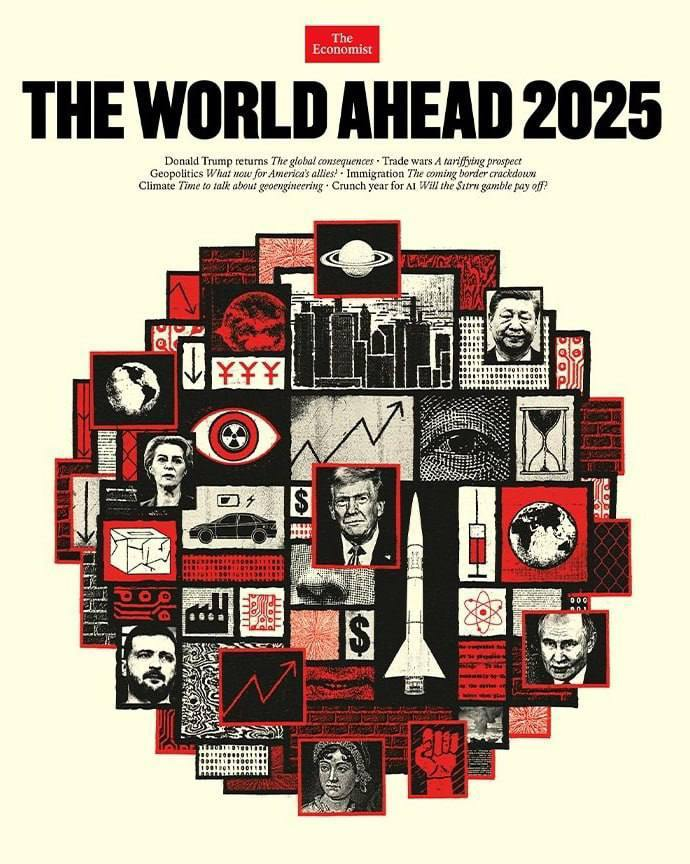
The Economist The World Ahead 2025 (November 20, 2024) : In 2025, as seen on the cover, the main event is Trump’s return to the White House and the global consequences of his policies, such as a new wave of trade wars with China. There is also an expected rise in technologies such as artificial intelligence and autonomous vehicles.

Tom Standage’s ten trends to watch in 2025

A letter from the editor of The World Ahead

The three forces that will shape 2025

Watch the interplay between Donald Trump, technology and radical uncertainty

The cover mentions climate issues and hints at a new phase in the fight for social equality, especially among women. Last year, the cover predicted geopolitical instability, an economic crisis, climate disasters, and the g

Politics: The Guardian Weekly – Nov. 15, 2024

Image

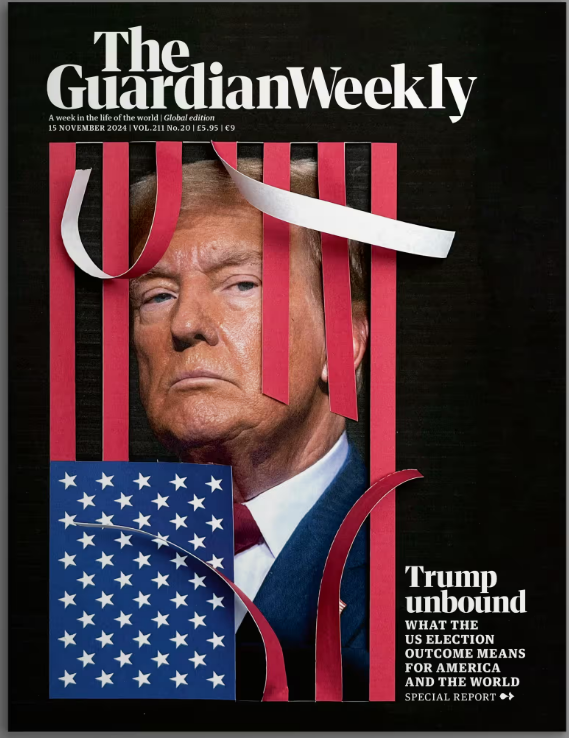
The Guardian Weekly (November 14, 2024): The new issue features ‘Trump Unbound’ – What the US Election outcome means for America and the World…

In a special edition of the Guardian Weekly, our Washington bureau chief David Smith and diplomatic editor Patrick Wintour reflect on how Trump 2.0 is likely to play out for the US and for the rest of the world.

We look at the role played by the president-elect’s key supporter, Elon Musk, and ask what the world’s richest man can now expect back in return. We also trace the rise of the vice-president elect JD Vance, who is now just a heartbeat away from the presidency.

And senior US political reporter Joan E Greve considers the Democrats – bereft, broken and facing an internal civil war after a campaign that ended in disaster.

1
Spotlight | Odour of oil and return of Trump hang heavy over Cop29
As the annual UN climate summit got under way in Azerbaijan this week, Fiona Harvey sizes up the hopes for progressThe video player is currently playing an ad. You can skip the ad in 5 sec with a mouse or keyboard

2
Science | Unravelling the paradoxes of plankton
Scientists are sequencing the DNA of microscopic marine life – to help us learn more about ourselves, reports Brianna Randall

3
Feature | When adult children cut the cord
Grownups who cut of f contact with their family are often trying to break away after a traumatic childhood. But sometimes the estrangement can be totally unexpected for parents. By Gaby Hinsliff

4
Opinion | Trump unleashed will be even worse than last time’s dress reherarsal
From a public health crisis to the end of Nato, the threats are clear, writes Jonathan Freedland

5
Culture | Sportswriters and arts critics swap jobs
How does the English National Opera compare to the Premier League … or the NFL to a West End musical? Our sports and culture experts found out